






Kostel svatého Prokopa (Butovice) Church
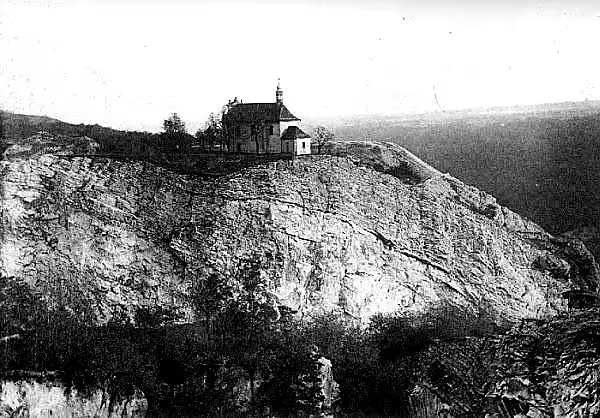
Objekt se nedochoval — na místě dnes nestojí. Následující text popisuje jeho historii, ne současnou návštěvu.
The Church of Saint Prokop in Butovice, Prague, stands as a poignant reminder of early 18th-century Baroque architecture that once graced the limestone cliffs of this historic region. Built between 1711 and 1712 under architect Pavel Ignác Bayer and funded by Adam František ze Schwarzenberg, it was consecrated on July 4, 1712. Despite its destruction in the mid-20th century due to quarrying activities, the church remains a significant historical monument reflecting Prague's rich cultural heritage.
Emerging during Bohemia's flourishing Baroque period within the Habsburg Monarchy, this era saw substantial architectural developments across Europe, with Prague becoming a center for Baroque art and architecture. Construction began in the late 17th century, continuing into the early 18th century when it symbolized religious devotion and artistic achievement.
Architecturally, the Church of Saint Prokop featured a single-nave, vaulted design typical of the Baroque style. A section was added to the nave in 1723, with further modifications made in 1893. The church had two smaller bells on its tower and an organ loft without pedals, accessible via spiral stairs from both sides. It housed four altars, including a main altar dedicated to Saint Prokop adorned with polychrome linden wood carvings. This altar also displayed a copy of a miraculous image of Saint Prokop from Sázava Monastery, highlighting its religious significance.
Notable figures like Adam František ze Schwarzenberg played crucial roles in the church's establishment and maintenance. During World War II, German forces constructed an underground facility within quarried spaces around it. After the war, the Czechoslovak army used the site for military purposes until its demolition in 1966 due to structural instability.
Key events include its initial construction and consecration in the early 18th century, followed by expansions and modifications over the years. Quarrying activities began in 1887 with limestone extraction from the Svatoprokopská Cave, leading to explosions in 1890 that damaged parts of the church and surrounding structures.
Today, the site where the Church of Saint Prokop once stood is no longer accessible as a historical monument due to its demolition. However, it remains an important part of Prague's history, offering insights into Baroque period architectural and cultural developments in Bohemia. Visitors interested in this heritage can learn about the church through local historical records and guided tours that recount its story.
The Church of Saint Prokop serves as a testament to the artistic and religious fervor of its time, inviting reflection on the impermanence of architectural marvels and the enduring legacy they leave behind. Its history encourages visitors to appreciate the cultural narratives embedded in Prague's landscape, even when physical remnants are no longer present.
Then and now
Drag the slider to compare how the landmark may have looked when it was built with the view today.
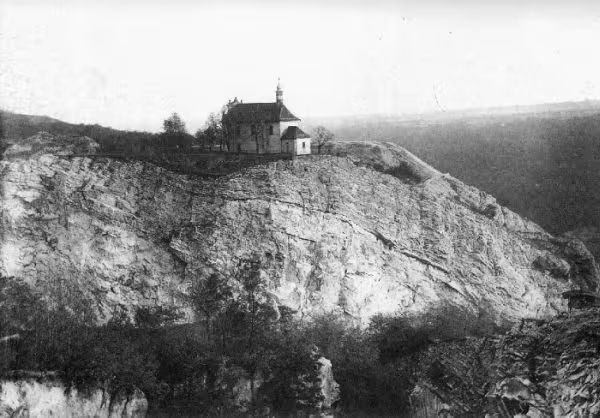
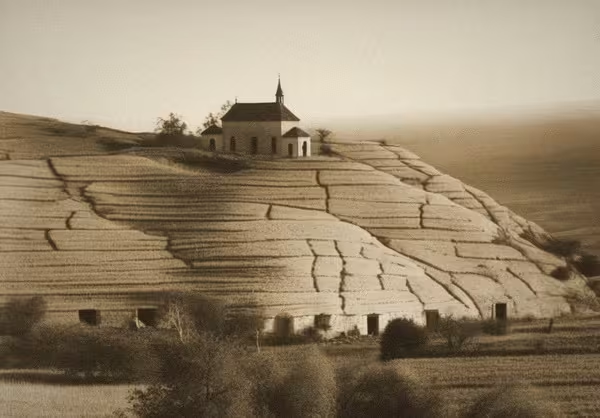
The historical appearance on the left is an AI-generated visualisation and serves as inspiration only.
Historical milestones
- 1711
- Construction of the Church of Saint Prokop began.
- 1712
- The church was consecrated on July 4th.
- 1723
- A section of the nave was added to the church.
- 1890
- Explosions caused by quarrying activities led to the destruction of parts of the church and surrounding cave structures.
Architectural development
The Church of Saint Prokop was initially constructed between 1711 and 1712 with a single-nave, vaulted design. A section of the nave was added in 1723, and further modifications were made until 1893. The church featured Baroque elements such as two smaller bells on its tower and an organ loft without pedals. It housed four altars, including a main altar dedicated to Saint Prokop, adorned with polychrome linden wood carvings.
Historical events
The foundation stone of the Church of Saint Prokop was laid in the late 17th century and construction continued until July 4, 1712, when it was consecrated.
In 1723, a section of the nave was added to the church.
During World War II, German forces constructed an underground facility within the quarried spaces around the church.
After the war, the Czechoslovak army took over and used the site for military purposes until its demolition in 1966 due to structural instability.
Points of interest
- The Church of Saint Prokop was built between 1711 and 1712 under architect Pavel Ignác Bayer and funded by Adam František ze Schwarzenberg. - It was consecrated on July 4, 1712, reflecting early 18th-century Baroque architecture in Prague. - Despite its destruction due to quarrying activities in the mid-20th century, it remains a significant historical monument of Prague's cultural heritage. - The church featured a single-nave, vaulted design typical of the Baroque style and had two smaller bells on its tower with an organ loft accessible via spiral stairs. - During World War II, German forces constructed an underground facility within quarried spaces around the church.
Guide
This guide is narrated by a synthetic voice generated by artificial intelligence.
Show guide text
This text was created by artificial intelligence and has not been editorially reviewed. It may contain inaccuracies.
The Church of Saint Prokop stood on the summit of limestone cliffs in Prokopské údolí. Today you won't find it anymore, because it was demolished in 1966.
The foundations of the church were laid back in the second half of the seventeenth century. In 1711, the feast of Saint Prokop was renewed and the saint was declared the patron of the Czech lands. Construction then continued under the direction of the Baroque architect Pavel Ignác Bayer, who worked from earlier plans. The funds were provided by Prince Adam František ze Schwarzenberka. The church was consecrated on July fourth, 1712. In 1723, a part of the nave was added to it, and in 1730 the sacristy. It was last repaired in 1893.
It was a single-nave Baroque structure, vaulted, spacious and airy. In a small bell tower on the roof ridge hung two smaller bells. Above the main entrance was a spacious gallery with small organ pipes without pedals, and winding stairs on both sides of the door led up to it. The square sanctuary had beveled corners.
The church had four altars. The main altar, dedicated to Saint Prokop, was carved from colored linden wood and decorated with lace made from acanthus leaves. Below on the sides knelt two angels, and around the central image wound four smaller cherubs. At the top of the altar, the sculptor Jan Jakub Char z Postoloprt placed a sculptural group of the Holy Trinity. The altar also bore the combined coat of arms of the Schwarzenbergs and Lobkowiczes, because it was paid for by the married couple Schwarzenbergs. In the middle hung a copy of the miraculous image of Saint Prokop from Sázavský klášter. It was painted in 1712 by the Prague painter Jan Jiří Schummer. He also created the images for the side altars of Saint Eustace and Saint John of Nepomuk. The third side altar was dedicated to Saint James, and his image was considered a work of art. On the walls of the nave hung four large paintings by the painter Jan Jiří Heintsche, among them a painting of Saint Francis Borgia. They most likely came to the church from the dissolved Jesuit monastery.
The end of the church began with limestone quarrying. In 1887, the rock mass was removed in the area of Svatoprokopská jeskyně. In 1890, an explosion of the rock followed, destroying the remains of the cave along with the hermitage. The church thus found itself at the edge of the quarry. During the Second World War, the Germans built an underground structure in the excavated quarry. After the war, it was taken over by the Czechoslovak army, and the church found itself inside a guarded military zone. Because of compromised structural stability and the threat of collapse, it was eventually demolished.
Businesses nearby
Do you run a restaurant, accommodation, shop, museum, rental, wellness or other visitor service near this monument? Show yourself directly to the people heading to it — this is how they will see you in the app and on the web:
Events nearby

Zdroj akcí: otevřená data měst a obcí ČR (Národní katalog otevřených dat) a kalendář akcí Národního památkového ústavu.
Nearby
The Church of Saint Prokop was located in the limestone cliffs of Butovice, near Prague. The area is known for its natural beauty and historical significance, including the Svatoprokopská Cave.
Visualizations and artistic views


The visualisations are generated by artificial intelligence and serve as inspiration.
Photos from the area
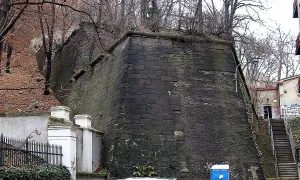
Real photos taken near the monument


Zdroj a licence jsou uvedeny u každého snímku.
Atmosphere of the place
This atmospheric visualisation of the place and period was generated by artificial intelligence. It is not real footage of the location.
Tips from visitors
No tips yet. Be the first!
Log in and add your tip.
Sources and literature
Photos: CZ: Autorem této fotografie je neznámá osoba. EN: Author of this photo is unknown person. / Public domain — Wikimedia Commons. The author and licence also appear when you hover over the image.
Faktickým podkladem tohoto textu byl článek na Wikipedii, jehož autory jsou přispěvatelé Wikipedie. Článek je dostupný pod licencí CC BY-SA 4.0.
Location on the map
Příběhy a pověsti
Legendy, pověsti a příběhy spjaté s touto památkou
Fotografie návštěvníků
Zatím žádné fotografie. Buďte první, kdo přidá fotografii z návštěvy!
Log in a přidejte svou fotografii nebo hodnoťte.
Za ověřenou návštěvu v aplikaci získáte víc bodů — poznáme podle GPS, že jste na místě.
Reviews and comments