



Kostel svatého Prokopa (Štěnovice) Church
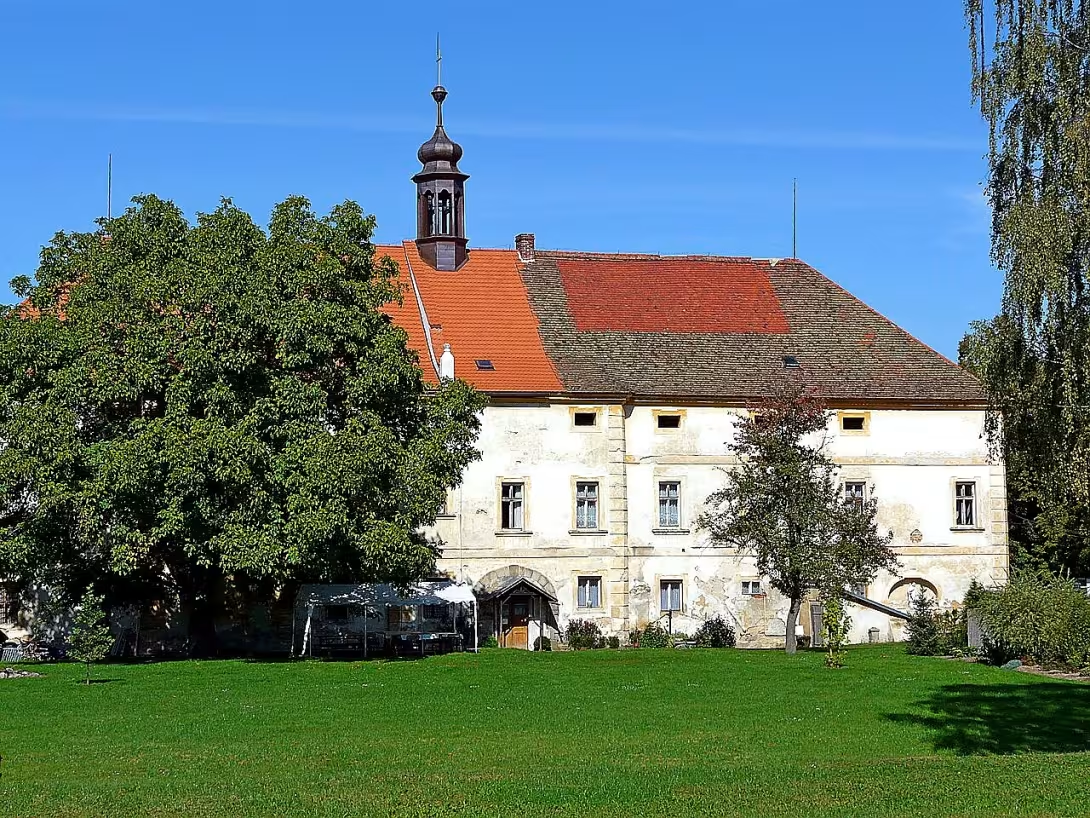
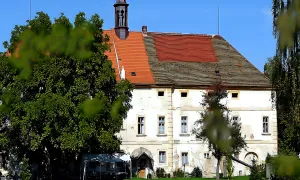
The Church of St. Prokop is an example of a pragmatic baroque that has emerged from the particular needs of the community. Instead of being built as a separate building, the builders built the temple into an early Baroque granary between 1747 and 1753. Today, the church occupies the western part of the building, while its eastern part serves as a living space.
The foundation of the temple was the initiative of the owner of the Puppet Manor Marie Theresa von Pötting, born Michnova from Vacín. Local Czech peasants had a considerable distance to the parish church in Litice, where they went to German mass. In order to facilitate access to religious ceremonies and respect their Czech identity, Mrs. von Pötting decided to establish her own church on her estate. It was an expression of both practical management and a certain inclination towards the needs of the domestic population.
After the construction was completed in 1753, the building became the centre of spiritual life in the immediate vicinity. By the time of the reforms of Joseph II, which fundamentally reorganized the church structures in the Habsburg monarchy, the whole house was used as a monastery. In this way, Štěnovice has become an important place in the region for several decades.
In his newer history, his role gradually simplified. Today it serves as a filial church of the Roman Catholic parish of Pilsen-Bory, which means that its administration ensures a larger parish in Pilsen. Although it is no longer the centre of the monastery community, it continues to serve the believers and represents a valuable proof of the way in which local spiritual and social needs were addressed in the 18th century.
The construction remains a testament to the creativity of the then era - a solution to reasonably transform an economic building into a functional temple, indicating its ability to adapt to constraints and conditions. For a visitor, the church has an interesting value as an example of a modest but efficient baroque who have lived in the normal life of the rural community.
Then and now
Drag the slider to compare how the landmark may have looked when it was built with the view today.
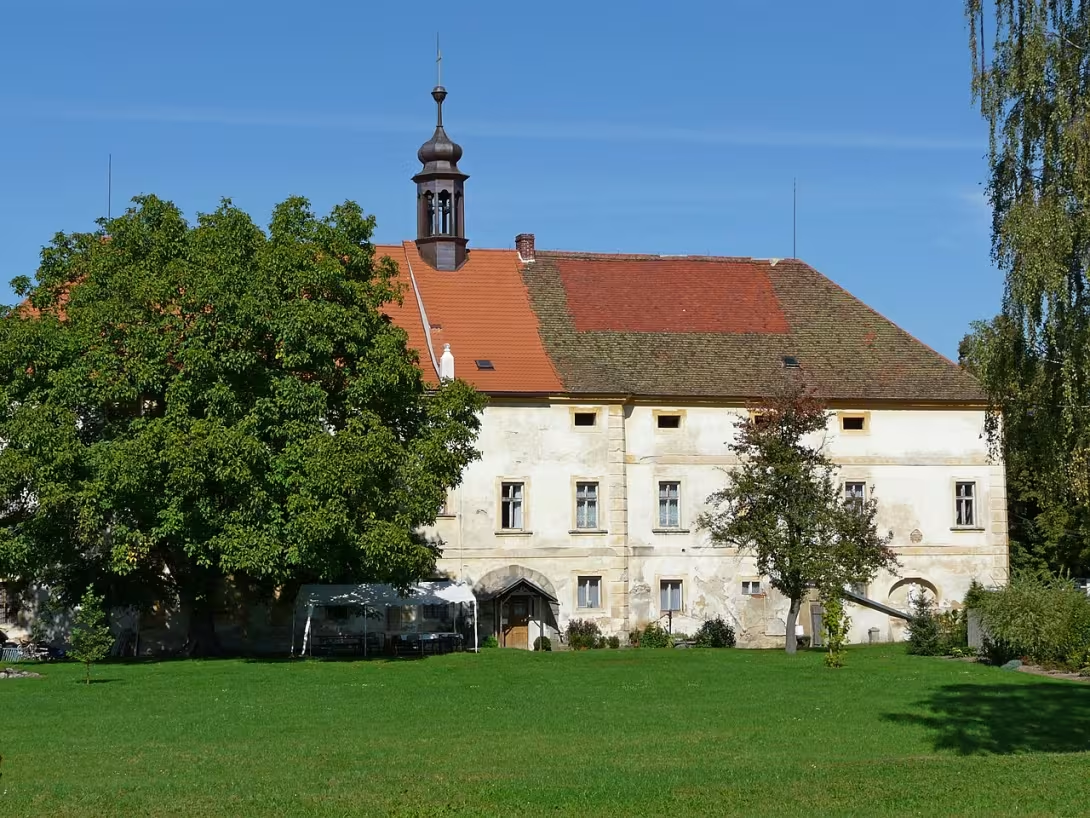

The historical appearance on the left is an AI-generated visualisation and serves as inspiration only.
Historical milestones
- 1747
- The beginning of the reconstruction of the early Baroque granary to the church of St. Prokop, initiated by Marie Terezia von Pötting.
- 1753
- The completion of the reconstruction and consecration of the church, which became the center of spiritual life in the surroundings.
- Around 1750- 1780
- The church served as a monastery until the reforms of Josef II reorganized the church structure.
- 18th century (more precisely 1747-1753)
- The church was created as an example of a pragmatic baroque built into an economic building for the needs of the Czech rural community.
- After 1784
- The loss of the monastery function after the Josephine reforms, the church remained as a local spiritual center.
- 20th century (today)
- The church is a filial church of the Pilsen-Bory parish, maintaining a historical function for local believers.
Architectural development
The church was created by rebuilding the western part of the early Baroque granary in 1747-1753. The original granary was adapted for religious purposes while preserving part of the residential area in the eastern part of the house. The construction is simple but typical for Baroque adaptation - combines practical and religious functions. Materials and detailed architectural elements are not detailed in the documentation, but the overall impression corresponds to early Baroque style with later modifications.
Historical events
1747-1753: The creation of the church as an installation into a granary for Czech peasants; 1753: Church and parish house serve as a monastery; 18th century: Cancellation of the monasteries by Joseph II and change of function of the building; 20th century: Church becomes a filial church of the parish Pilsen -Bory
Owners
Marie Terezie von Pötting (roz. Michnová z Vacínova) - founder of the church; then the estate belonged to different nobility families, the exact practice of ownership after 1753 are not included in the supporting documents
Points of interest
- The church of St. Prokop was created as part of an early Baroque granary, when it was built into its western part between 1747 and 1753.
- The eastern part of the original granary still serves as a living space.
- The initiator of the construction was the owner of the Puppet Manor Marie Theresa von Pötting, which made it easier for local Czech peasants to access the mass in their native language.
- Until the time of the reforms of Joseph II, the whole house served as a monastery, making Štěnovice the centre of the monastery life in the surroundings for a while.
Guide
This guide is narrated by a synthetic voice generated by artificial intelligence.
Show guide text
This text was created by artificial intelligence and has not been editorially reviewed. It may contain inaccuracies.
The Church of Saint Prokop in Štěnovice is a baroque building with an unusual origin. It did not develop as a standalone building, but was built into an early baroque granary between 1747 and 1753. To this day it occupies the western part of the rectory, while the eastern part serves as a residence.
The church was founded by the owner of the Štěnovice estate, Marie Terezie von Pötting, née Michnová of Vacínov. It was intended for Czech farmers who had a long way to go to the parish church in Litice, where moreover masses were celebrated in German.
From 1753 until the reforms of Joseph the Second, the entire building was a monastery. Today the church is a subsidiary church of the Roman Catholic parish of Plzeň-Bory.
Frequently asked questions
Can the monument be visited?
Religious buildings are usually open mainly during services; at other times a visit is normally arranged with the parish or the operator. We have not verified specific times.
Where is the monument?
Location: Štěnovice, Plzeňský kraj. The map on this page shows the exact spot.
Why is the monument protected?
It is listed in the Central List of Cultural Monuments of the Czech Republic as a cultural monument. It is protected as part of a larger listed ensemble.
For kids
Imagine going back to the past in the Middle Ages. Instead of cars and computers, you'll find goats and horses, instead of colors and gothic architecture. And it was at that time that the church of St. Prokop stood in Puppet Island.
It was like entering another realm. The church stood high above the surroundings and its stone wall was like a solid chateau that protected people from danger. Imagine how people from nearby villages came here to pray and promise God they'd be good.
Businesses nearby
Do you run a restaurant, accommodation, shop, museum, rental, wellness or other visitor service near this monument? Show yourself directly to the people heading to it — this is how they will see you in the app and on the web:
Events nearby


Zdroj akcí: otevřená data měst a obcí ČR (Národní katalog otevřených dat) a kalendář akcí Národního památkového ústavu.
Nearby
Within a radius of 5 km is the parish church of St. James in Litice (German-speaking parish), which was originally intended for the German population, while the church of St. Prokop in Puppies was intended for Czech peasants. The surrounding area is typical for southwest Pilsen with field formations and forest stands.
Accommodation nearby
Trips and activities nearby
Guided tours, tickets and activities nearby from GetYourGuide
Affiliate link: if you buy from the partner, we may receive a commission. The price for you does not change.
Search tours and activities →Themed route
Thematic cruise route: History and cultural diversity of south-western Pilsen
1. Church of St. Prokop in Puppies * Type: Baroque parish church * This church is a unique monument of Czech cultural heritage in the region, built for Czech peasants. Its interior with rich decoration and historical elements reveals the environment of rural inhabitants in the past.
2. St. Jacob's Parish Church in Litice * Type: Gothic-Baroque church * A church originally designed for the German population is located just 3 km from Pupovice. Its architecture and language history reflect the diversity of the region and its cultural division. Interesting is the comparison of both churches as a symbol of common but different heritage.
3. Walk through the surrounding field departments and forests * Type: Natural walk * The surroundings of Puppies and Litic offer picturesque landscapes typical of the south-western Pilsen region. Forest trails and field paths allow you to know the natural beauty of the region and relax from historical monuments.
Seasonal recommendations
Spring The church of St. Prokop in Puppies is awakened to life in spring in a completely different light than in other seasons. The sun, which rises below the horizon in March and April, paints the stone walls of the church in warm, golden shades, while the surrounding meadows and orchards bloom in white and pink flowers of apple trees and cherry trees. The air is fresh but still cold, and the atmosphere is calm, almost meditative - ideal for walking around where nature wakes up after winter. It is also specific that at this time the church is often visited by local families during Easter services, which adds an impression of holidays and renewal to the environment. It is practically advisable to visit the memory early in the morning or in the morning when the church is still at rest and the light is the most beautiful. Clothes should be layered - warm but light, because the weather can change quickly. It is also recommended to monitor the forecast in April, as rainy days can be frequent and roads to the church can become muddy.
Summer In summer, the church of St. Prokop will turn into a vivid picture of medieval architecture lit by the sun, which in the morning creates sharp shadows on stone reliefs and turrets. The surrounding landscape is green and rich, but in the main summer season (July and August) the traffic is higher, especially for tourists travelling in Pilsen. The atmosphere is warm and warm, but there is a pleasant shade in the church, which every visitor will appreciate in hot days. It is also specific that in summer months the church is often visited at evening services, when light turns into golden and orange tones. Practically, it is best to come early in the morning or late in the afternoon to avoid crowds gathering around the church in the morning. Clothes should be light, but covering the shoulders and knees, especially when entering the church. It is also advisable to bring water and sunglasses in the summer months, as the sun in this area is intense.
Autumn Autumn brings a magical atmosphere to Puppies, where the church of St. Prokop excels in the surrounding area with red and yellow leaves. The sun, which is lower in September and October, creates long shadows and the church appears to be more mysterious, surrounded by forests and fields that prepare for winter. The air is clean and cold, and there is peace in the church, which is ideal for meditation or a tour of details that are lost in bright light in other seasons. It is also specific that in the autumn months the church is often visited during worship in advent time when pre-Christmas mood flows into the environment. Practically best to visit the memory in the morning, when the light is the most beautiful and the crowds are less. Clothes should be warm but not too heavy because the weather can change quickly and rainy days are common at this time. It is also recommended to monitor the forecast in October, as the winds can be strong and the roads to the church can become slippery.
Winter In winter, the church of St. Prokop will turn into a white and quiet scenery, where the snow cover highlights its medieval details and the towers are lost in the fog. The sun, which rises very low in December and January, creates a fine silver light that gives the church a mysterious atmosphere. The surrounding landscape is quiet and almost fairytale, and in advent time, a pre-Christmas mood flows into the environment, which is also felt inside the church. It is also specific that in the winter months the church is often visited at Christmas services, when heat and joy of the upcoming holidays flow into the environment. Practically best to visit the memory in the morning, when the light is the most beautiful and the crowds are less. Clothes should be warm and laminated, because temperatures can fall below freezing and the winds can be strong. In winter it is also important to watch the opening times of the church, which can be shortened at this time. If you decide to visit the memory in winter, remember to bring warm drinks to help you enjoy the peaceful atmosphere of this wonderful place.
Visualizations and artistic views


The visualisations are generated by artificial intelligence and serve as inspiration.
Photos from the area
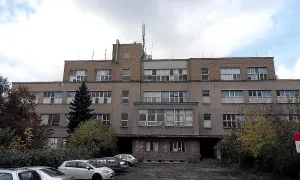
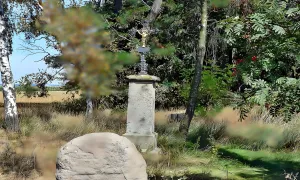
Real photos taken near the monument

Zdroj a licence jsou uvedeny u každého snímku.
Atmosphere of the place
This atmospheric visualisation of the place and period was generated by artificial intelligence. It is not real footage of the location.
Tips from visitors
No tips yet. Be the first!
Log in and add your tip.
Sources and literature
Photos: Josef Špiller / CC BY-SA 3.0 — Wikimedia Commons. The author and licence also appear when you hover over the image.
Faktickým podkladem tohoto textu byl článek na Wikipedii, jehož autory jsou přispěvatelé Wikipedie. Článek je dostupný pod licencí CC BY-SA 4.0.
Location on the map


Příběhy a pověsti
Legendy, pověsti a příběhy spjaté s touto památkou
Fotografie návštěvníků
Zatím žádné fotografie. Buďte první, kdo přidá fotografii z návštěvy!
Log in a přidejte svou fotografii nebo hodnoťte.
Za ověřenou návštěvu v aplikaci získáte víc bodů — poznáme podle GPS, že jste na místě.
Reviews and comments