



Štěnovice Chateau
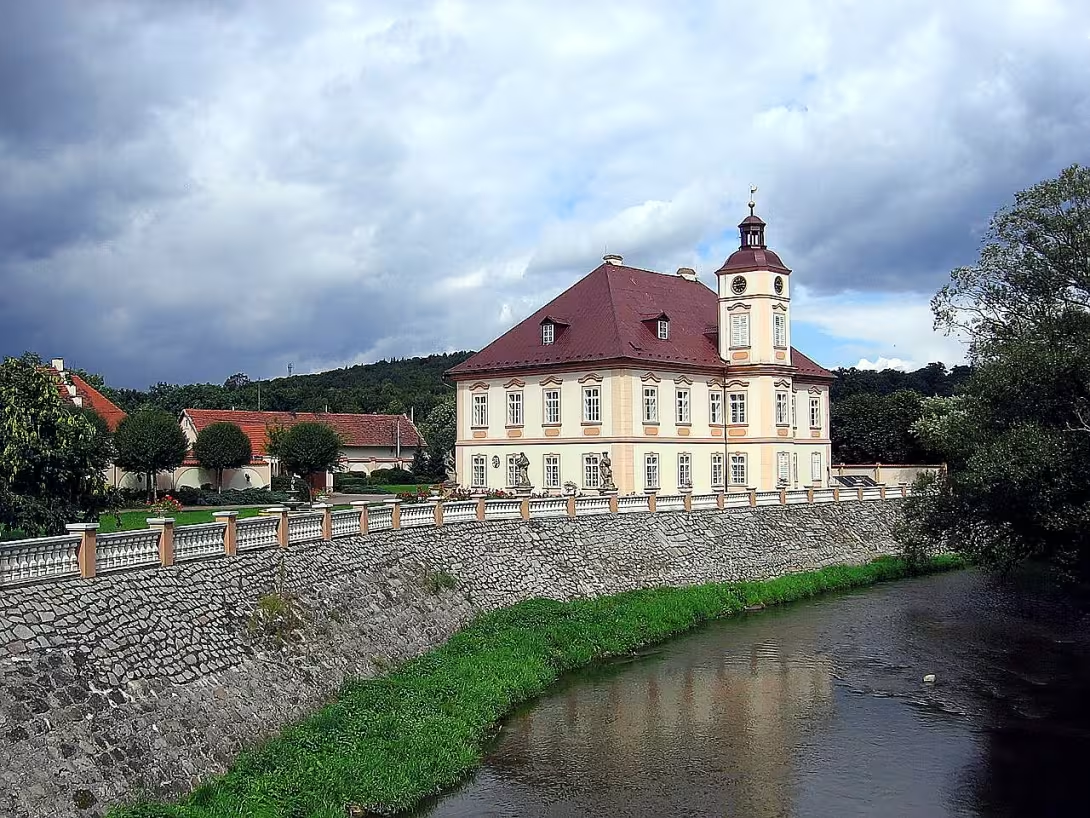
Štěnovice is an interesting part of the building heritage of northwest Bohemia. This Baroque chateau is located in the heart of a small village of the same name in the district of Plzeň-jih, on the left bank of the River Hull. The construction created in the first quarter of the eighteenth century speaks of the rich life of the land nobles and of the changes of owners who have been operating here for almost three centuries.
The oldest mention of the mansion in Puppies is the old fortress from the fourteenth century, which stood on the island over the confluence of the Hull and the Losini creek, in the place of the early medieval chateau. Sometime during the first half of the sixteenth century, it was replaced by a Renaissance fortress whose exact location we don't know today.
Today's chateau in Baroque style was built around 1723. Although traditionally attributed to the founder of Anna Dorota of Schirnding, the pestilence of the chateau bears the name of Marie Rozina of Schirnding, the birth of Vinkler of Heimfeld, who inherited the village probably after Anna Dorota. The construction was designed by Jakub Auguston mladší. Maria Rozna's estate remained until about 1738 when she became the owner of Countess Theresa Pötting. After it was owned by Count Charles Michna of Vacín since 1788, later Matyah Lesky and his son Karel. During the nineteenth century he changed owners several times - his owners were Vojtěch Mladota from Solopisk, Ferdinand from Weissenbach and the free master Antonín Starck. Since 1915, the Jaroslav brothers and Karel VyKoukal have operated here. In 1948 the chateau became the seat of the local national committee, to which it served until 1991, when Jaroslav VyKoukal took over.
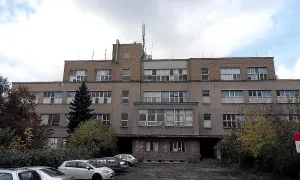
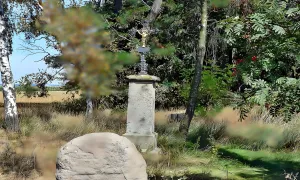
The Puppy Chateau is a rectangular one-storey building with rounded corners and seven to four window axes. On the longer side by the river, the prism tower decorated with clock is turned off. The ground floor with the vaulted vaults contains in the hall cancelled chapel frescopainting from F. J. Luxe. Three Baroque statues of saints - Saint Florian, Saint Joseph and Saint Ivo - can be seen in the park near the left wall. Their pedestals carry an alliance coat of arms of the Schirndinger and Winkler families with the 1723 year, which confirms the time of the chateau.
Today Štěnovice remains privately owned and protected as a cultural monument of the Czech Republic. Their building and property history makes them an interesting example of the continuity of land ownership and changing in pieces of bauers in Pilsen.
Then and now
Drag the slider to compare how the landmark may have looked when it was built with the view today.
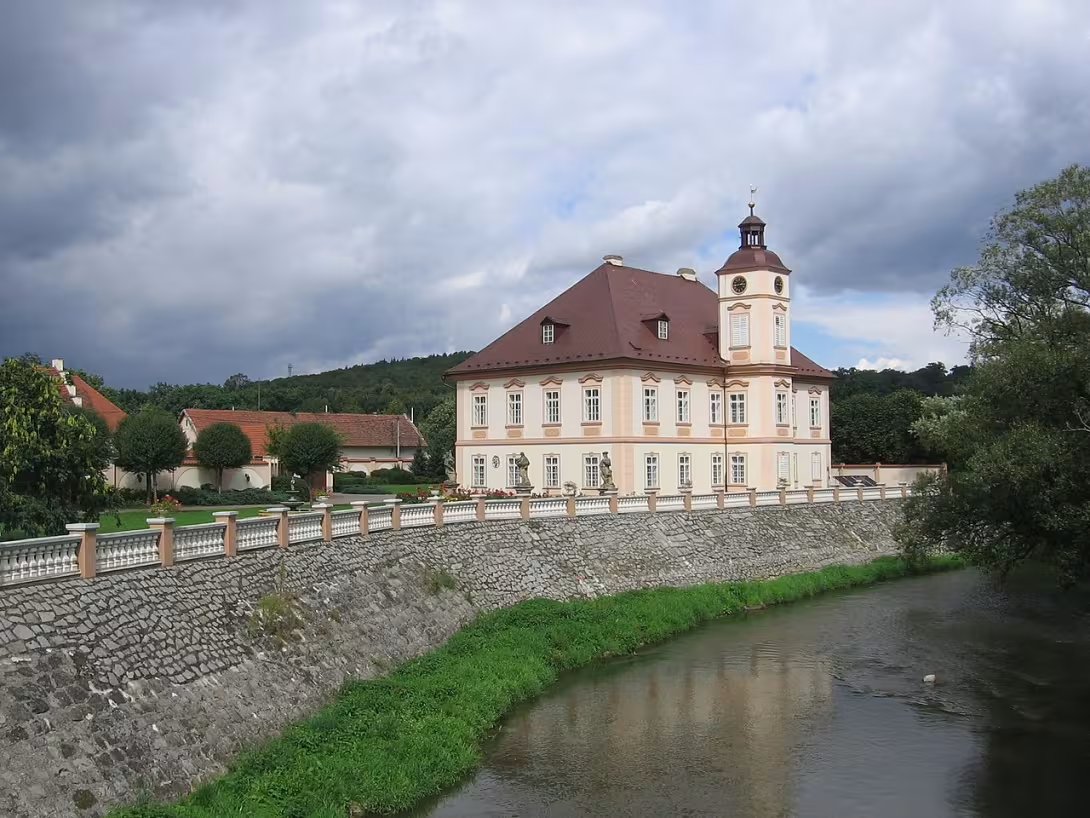

The historical appearance on the left is an AI-generated visualisation and serves as inspiration only.
Historical milestones
- 1723
- The foundation of the Baroque chateau by Maria Rozina from Schirnding.
- 1834
- Sell the estate to Vojtěv Mladota of Solopisk.
- 1948
- The chateau becomes the seat of the local national committee.
- 1991
- Hand the chateau over to the son of the last owner, Jaroslav Vykal.
Architectural development
Originally there was a fourteenth fortress and later a Renaissance fort. The current Baroque chateau is a one-storey building with rounded corners and a prism tower. The interior contains rolled vaults and fresco in the former chapel.
Historical events
1723 - the foundation of the Baroque chateau by Maria Rozina from Schirnding; 1948 - the chateau becomes the seat of the local national committee; 1991 - the transfer of the chateau to Jaroslav Vypokal.
Owners
Marie Rozina ze Schirndingu (until 1738), Terezia Pötting (after 1738), Karel Michna from Vacinova (1788), Matyah Lesky (until 1809), Karel Leski, Vojtěk Mladota from Solopisk (from 1834), Ferdinand from Weissenbach (from 1840), Antonia Weissenbach (until 1851), Antonín Starck (from 1851), Ludvík Fritsch, Šebestian Klitka (from 1899), Antonín Veltrubský from Veltrub (1913), Josef Vykokal (1915), Karel Vykokokal (from 1946), village (from 1948-1991), Jaroslav Vykokokal (from 1991).
Points of interest
- Today's Baroque chateau was built around 1723 and was designed by Jakub Auguston mladší. - There was a 14-century fort at the chateau and a Renaissance fort later. - On the ground floor there is a broken chapel with frescopainting from F. J. Luxe. - In the park near the left wall there are three Baroque statues of saints, which were created between 1723 and 1725. - The chateau is a rectangular one-story building with a prism tower decorated with clocks.
Guide
This guide is narrated by a synthetic voice generated by artificial intelligence.
Show guide text
This text was created by artificial intelligence and has not been editorially reviewed. It may contain inaccuracies.
Štěnovický Castle stands on the left bank of the Úhlava River in the village of the same name in the Plzeň region. It is a Baroque structure dating from around 1723. Today it is in private ownership and is protected as a cultural monument.
A noble residence had existed here much earlier. From the fourteenth century, an old fortified house stood on a promontory above the confluence of the Úhlava and Losinský streams, built on the site of an early medieval fortified settlement. In the first half of the sixteenth century, it was replaced by a Renaissance fortified house. It likely stood where a manor farm was located, though its exact position is unknown.
Who founded the castle is not entirely clear. Traditionally, Anna Dorota of Schirndingen is considered the founder. However, an inscription on the entrance portal names Marie Rozina of Schirndingen, born Winklerin of Heimfeld, who apparently inherited the village from Anna Dorota. Based on the style of the portal, the building was designed by Jakub Auguston the Younger.
The owners then changed frequently. After Marie Rozina, from around 1738, the estate belonged to Countess Terezie Pöttinger, born Michna. In 1788, Count Karel Michna of Vacínov is mentioned. The estate then included Čižice and Štěnovický Borek. Matyáš Leština and his son Karel followed. From 1834, the estate was owned by Vojtěch Mladota of Solopiska, and from 1840 by Ferdinand of Weissenbach. After his death, his widow Antonie held it. In 1851, Antonín Starck purchased the estate, and after him it was inherited by Doctor of Law Ludvík Fritsch.
From 1899 it belonged to Šebestián Klička, then to Antonín Veltrubský of Veltrub, and from 1915 to Josef Vykoukal. His sons Jaroslav and Karel managed the estate until 1945. From 1946, Karel was the sole owner. In 1948, the castle became the seat of the local national committee, and the local administration was headquartered there until 1991. Then the municipality transferred it to Jaroslav Vykoukal, the son of the last owner.
The castle is a rectangular single-storey building with rounded corners, with seven and four window axes. On the longer side facing the river is a prismatic tower with a clock. The ground floor is vaulted with barrel vaults with lunettes. In the entrance hall of the defunct chapel, a fresco by the painter Lux has been preserved.
In the park near the castle stand three Baroque statues of saints: Saint Florian, Saint Joseph, and Saint Ivo. They date from 1723 to 1725. On their pedestals is the combined coat of arms of the Schirndingen and Winkler of Heimfeld families and the date 1723.
Tips for visitors
The best time to visit the chateau Štěnovice is in summer, especially in May to September, when the gardens are in full bloom and temperature are pleasant. The Baroque architecture seems to be in its best form these months, making the visit particularly charming.
For those travelling by public transport, we recommend checking the current connections with a search engine and route planner.
What to take with you: We recommend you bring a sunscreen, sun protection, water and shoes suitable for walking on the lawn. If you are planning to photograph the lock, you should bring a high-quality camera or a mobile phone with a good camera.
Photos: The best places for photography are especially gardens and patios of the chateau, where there is an excellent view of Baroque architecture. The best light rises around noon and evening, when the sun illuminates buildings in the most beautiful way.
What to visit in the area: Near the chateau there is the river Úšula, which offers an opportunity for relaxing walks and picnics. The Confluence of the Head and the Losin creek is also an interesting place for a short trip to the surroundings.
Tips for families with children: The Štěnovice Chateau offers space for cute moments and for small visitors. Children can look forward to a walk in the gardens and play in the natural environment around the Urge River.
Frequently asked questions
Can the monument be visited?
Some buildings of this kind are open for guided tours, others serve another purpose or are privately owned. We have not verified whether and when this monument is open – please ask the operator.
What are the opening hours and admission?
We have not verified the opening hours or admission. Current information is published by the operator.
Where is the monument?
Location: Plzeňská 1, Štěnovice, Plzeňský kraj. The map on this page shows the exact spot.
Why is the monument protected?
It is listed in the Central List of Cultural Monuments of the Czech Republic as a cultural monument (register no. 41953/4-3583).
For kids
Imagine going back 303 years until there were no cars or phones or computers in the world. Instead, the land was full of horses, strollers and people walking.
Štěnovice is a chateau that stood around 1723. It was built by Mrs. Maria Rozin of Schirnding, who was rich and beautiful. The chateau was her sanctuary where she could meet with friends and family members.
Businesses nearby
Do you run a restaurant, accommodation, shop, museum, rental, wellness or other visitor service near this monument? Show yourself directly to the people heading to it — this is how they will see you in the app and on the web:
Events nearby



Zdroj akcí: otevřená data měst a obcí ČR (Národní katalog otevřených dat) a kalendář akcí Národního památkového ústavu.
Nearby
The River Head, the Confluence of the Head and the Losin creek.
Accommodation nearby
Trips and activities nearby
Guided tours, tickets and activities nearby from GetYourGuide
Affiliate link: if you buy from the partner, we may receive a commission. The price for you does not change.
Search tours and activities →Themed route
1. Štěnovice (chateau), monument: The main destination of the trip, where one can admire the architecture of this mansion. 2. River Head, natural element: Walk along the shore offers peace and beautiful landscape views. 3. Confluence of the Hole and the Losin stream, natural phenomenon: A place where two watercourses are combined, ideal for a short rest in nature.
Seasonal recommendations
In spring, the Štěnovice Chateau wakes up with the surrounding landscape. The light is fine in this period and the colors of the fresh green give the monument a fresh look. It's the perfect time for quiet walks around. We recommend wearing layered clothes because morning temperatures can still be cold, even if the sun is already warm. Since the traffic is lower than in the high season, you can avoid interference and enjoy a quiet atmosphere.
Summer months bring the most life to the area and full of sun. The chateau is surrounded by dense vegetation, which provides a pleasant shade. Due to the increased number of visitors in the main summer season, it is best to arrive at the beginning of the operating time to ensure better space for the tour. Don't forget light summer clothes, headgear and enough fluids to keep the heat from bothering you too much.
Autumn season offers the most beautiful visual experience thanks to the golden and red shades of leaves that surround the historical wall. Morning fog creates a mysterious and nostalgic atmosphere that is perfect for photography. For comfortable movement in the surroundings it is necessary to choose high-quality waterproof shoes and warmer layers of clothing. The best time to visit is in the morning when the light is still sufficient and the air is not yet so cold.
In winter the Štěnovice Chateau is very quiet and lonely. Short days and low sun create a specific, frosty atmosphere that is very impressive along the historic walls. It is important to carefully verify the current opening times, which are usually shorter in this period. It is necessary for visitors to wear very warm clothes, including gloves and hats to enjoy a tour without unpleasant cold.
Visualizations and artistic views


The visualisations are generated by artificial intelligence and serve as inspiration.
Photos from the area
Real photos taken near the monument

Zdroj a licence jsou uvedeny u každého snímku.
Atmosphere of the place
This atmospheric visualisation of the place and period was generated by artificial intelligence. It is not real footage of the location.
Tips from visitors
No tips yet. Be the first!
Log in and add your tip.
Sources and literature
Photos: Jik jik / Public domain — Wikimedia Commons. The author and licence also appear when you hover over the image.
Faktickým podkladem tohoto textu byl článek na Wikipedii, jehož autory jsou přispěvatelé Wikipedie. Článek je dostupný pod licencí CC BY-SA 4.0.
Location on the map


Příběhy a pověsti
Legendy, pověsti a příběhy spjaté s touto památkou
Fotografie návštěvníků
Zatím žádné fotografie. Buďte první, kdo přidá fotografii z návštěvy!
Log in a přidejte svou fotografii nebo hodnoťte.
Za ověřenou návštěvu v aplikaci získáte víc bodů — poznáme podle GPS, že jste na místě.
Reviews and comments