



Kostel svatého Štěpána (Kvilda) Church
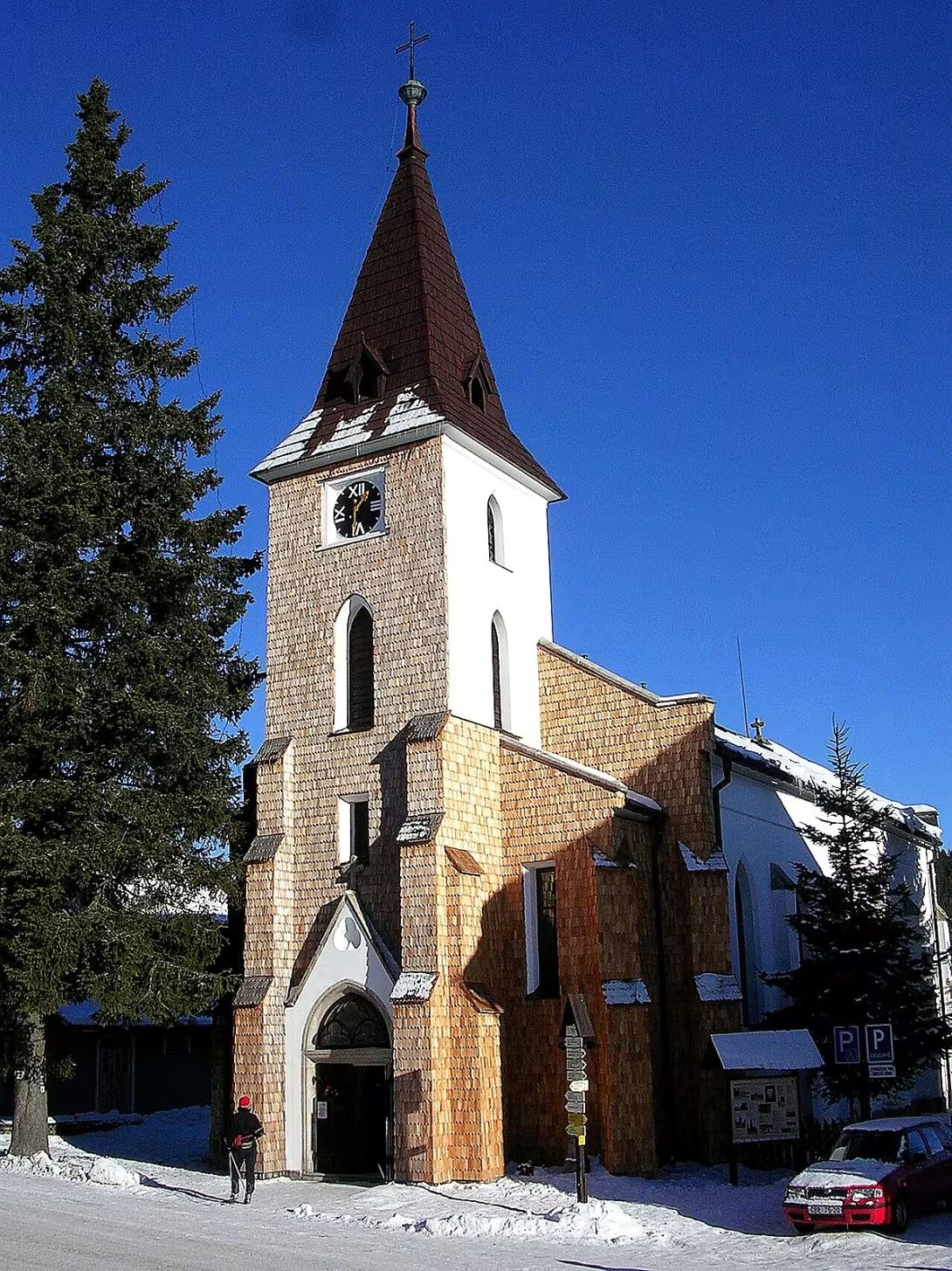
The church of St. Stephen is located in the centre of the village Kvilda and is particularly marked by its location - it is the most situated church in the Czech Republic. Currently it serves as a filial church of the parish of Vimperk, after the abolition of the original Quilde parish.
The original building at this place was a wooden one-ship building from 1765, dedicated to St. Stephen. The church was built by Arnošt Vilém Malovec, owner of the chateau, which bears the cost of the building. Part of it was a tower with a characteristic onion-shaped beating. In 1889, however, this church destroyed a fire that seized the whole village and significantly affected its future.
Due to the importance of the place for the local community, the construction of a new temple was soon launched. In 1892 he started building a stone church Jan Štěrbík, with the resources provided by kníže František Thun von Hohenstein. The building lasted until 1893 and the church was ceremonially consecrated in 1894. Bishop ThDr. Martin Říha attended the ceremony, which granted the temple its canonical status.
Ongeveer of the century later the temple was thoroughly renovated. Between 1994 and 1999, work was carried out to restore the building, bell and organ. The financial support was provided by both current residents and emigrants - mostly former German-speaking citizens of Kvilda, indicating a lasting relationship between the community and the place.
Around the church is a cemetery already founded at the wooden building. Unfortunately, in 1978, the army destroyed it unsparingly - the tombstones were damaged and taken away. In the spring of 2004, some tombstones were symbolically returned to this place. In 2008, a monument commemorating history was created.
To the right of the entrance to the church you can see so-called death boards - wooden structures on which in the past, especially in winter, deceased persons were placed until the weather allowed them to be buried.
The majestic spruce in front of the church was also interesting. Until 2013, it served as the highest living Christmas tree in the Czech Republic with a height of 26,5 metres. The tree eventually succumbed to the bark, dried and was topped at the end of July 2019. From the rest of it was carved by artist Jiří Nekola a sculpture called "Šumava," carved from about a three-metre piece of the remaining tribe. The statue was festively revealed on the first August of 2020 and symbolizes the Bohemian Mountains - depicts a young woman walking without care.
Then and now
Drag the slider to compare how the landmark may have looked when it was built with the view today.
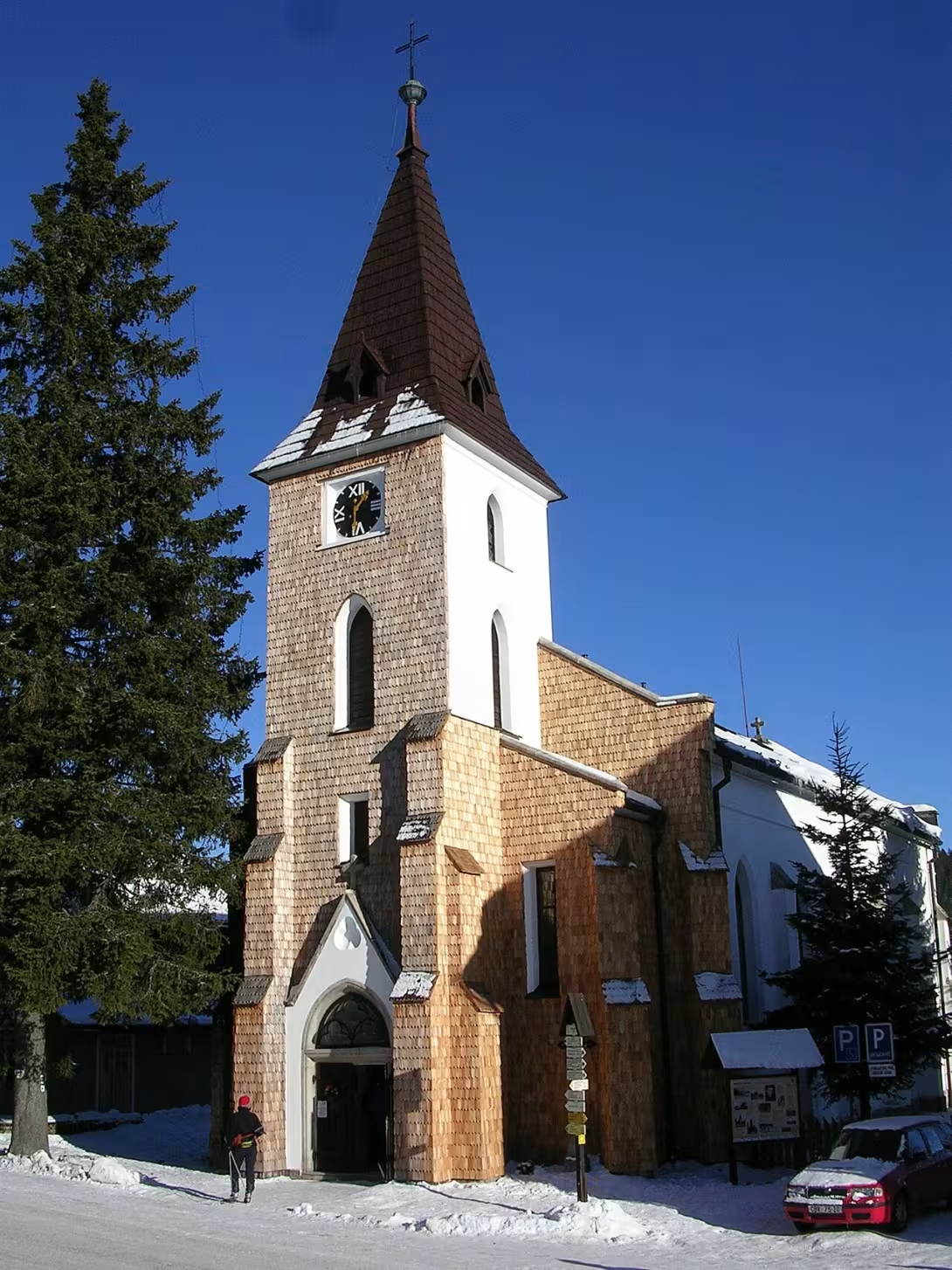

The historical appearance on the left is an AI-generated visualisation and serves as inspiration only.
Historical milestones
- 1765
- The foundation of the original wooden church of St. Stephen at the expense of Arnost Wilhelm Malovka.
- 1889
- The destruction of the original wooden church by fire, which destroyed the entire village of Kvilda.
- 1892
- The construction of a stone church in the place of the destroyed predecessor.
- 1894
- The consecration of the new church by Bishop Martin Ríhou.
- 1994-1999
- Renovation of the church including bell, organ and facade with financial support of the inhabitants.
Architectural development
The church was built as a pseudo-gothic new building in place of a wooden predecessor. The basic structure is made of stone, the western facade is covered with shingles. The tower with the needle roof dominates the facade. In 1994- 1999 there was extensive renovation of the interior and exterior, including repair of technical equipment. Materials and style correspond to the historical architecture of the late 19th century.
Historical events
1765 - The position of the original wooden church of St. Stephen at the expense of Arnold Wilhelm Malovka.
1889 - The destruction of the original church by fire, which affected the municipality of Kvilda.
1892-1893 - Construction of a stone church financed by Prince Franz Thun von Hohenstein.
1994- 1999 - Renovation of the church including the bell and organ with financial support of former and current residents.
Owners
After the abolition of the parish in Kvilda (after 1945) the church went to the administration of the parish Vimperk; Today is owned by the church administration (Czech Brotherhood Church evangelical or Roman Catholic Church, the exact legal form is not mentioned in the supporting documents).
Points of interest
- St. Stephen's Church is the highest laid church in the Czech Republic.
- The original wooden church from 1765 was built by Arnošt Vilém Malovec, owner of the Wall Manor.
- In 1889, the whole village and church were destroyed by a fire that fundamentally affected the other fate of the local community.
- The new stone church was built in 1892-1893 and consecrated in 1894 by Bishop Martin Říhou.
- In 2004, some tombstones from the cemetery, destroyed in 1978, were symbolically returned to their original place.
Guide
This guide is narrated by a synthetic voice generated by artificial intelligence.
Show guide text
This text was created by artificial intelligence and has not been editorially reviewed. It may contain inaccuracies.
The Church of Saint Stephen stands in the center of Kvildu at an altitude of 1065 meters. It is the highest-situated church in the Czech Republic. It was formerly the parish church of the Kvildu parish. After the parish was dissolved, it became a branch church of the Vimperk parish.
Originally, a wooden single-nave church from 1765 stood on this site, also dedicated to Saint Stephen. Ernst Wilhelm Malovec, the owner of the Zdíkov estate, built it at his own expense. The church had a pyramidal tower with an onion-shaped dome. It was destroyed by a fire that swept through the town in 1889.
In 1892, Jan Štěrbík began constructing a stone church on the same spot. Prince František Thun von Hohenstein provided the funds for the construction. The building work continued until 1893, and in 1894, Bishop Martin Říha consecrated the church. Between 1994 and 1999, the church underwent renovation, including repairs to the bell and the organ. Both former German residents and current inhabitants of Kvildu contributed to it.
The cemetery by the church came into existence already with the original wooden building. Until the end of the war, it was mainly German-speaking residents of Kvildu who were buried there. Behind the cemetery stood a mortuary. In 1978, the army ruthlessly demolished the cemetery. The gravestones were damaged and removed, and metal and cast iron crosses ended up in scrap metal collections. In spring 2004, the gravestones were symbolically returned. In 2008, a place of remembrance with a memorial was created there. Residents of Kvildu have been striving for several years to restore the cemetery.
By the wooden fence to the right of the church entrance are death boards. Especially during the winter months, the deceased were placed on them and waited there until the weather permitted burial.
In front of the church grew a spruce that was the tallest living Christmas tree in the Czech Republic until 2013. It measured twenty-six and a half meters. In 2013, this record went to a spruce in Mladkov. The Kvildu spruce was later attacked by bark beetles and the tree dried out. At the end of July 2019, it was felled. About three meters of the tree remained. From it in July 2020, artist Jiří Nekola carved a sculpture called Šumava. They ceremoniously unveiled it on August first, 2020. The sculpture symbolizes the Šumava mountains and depicts a young woman walking carefree through nature.
Tips for visitors
The best time to visit St. Stephen's church is in the summer months, especially in July and August, when the weather is more stable and nature in the surroundings is blooming. These months are also the most sunny days, which allows beautiful photos. In winter the visit is interesting for snow scenery, but it is necessary to count on a more limited availability and possible transport problems to the top.
It is recommended to arrive by car because public transport to such height is not regular. In winter it is necessary to consider the possibility that some roads may be closed.
When visiting the church take on comfortable clothes and shoes because the terrain around is often uneven and rocky. In winter it is necessary to dress up in warm clothes and take with you suitable winter shoes. Then bring plenty of water and perhaps even refreshments, because there are not many shopping options in the area. Also remember to protect against the sun if you visit the church in the summer months.
For photography is the best time early in the morning or vice versa in late afternoon when light is softer and not so intense. The best places for photography are around the church, especially from the terrace in front of it, where there is a view of the surrounding peaks. In winter there are interesting pictures of the church surrounded by snow. Always make sure that your photography does not interfere with the calm of visitors.
Another interesting feature is Šumava peaks, such as Tin or Blaten Hill, which are about 30 minutes away by car. These peaks offer breathtaking views and opportunities for tourist trips.
For families with children, a visit to St. Stephen's church is very interesting. Children can see the historical church and learn something about its history. You can play around and explore nature. It is also recommended to visit the peaks of Šumava where children can run and discover new places.
Frequently asked questions
Can the monument be visited?
Religious buildings are usually open mainly during services; at other times a visit is normally arranged with the parish or the operator. We have not verified specific times.
Where is the monument?
Location: Kvilda, Jihočeský kraj. The map on this page shows the exact spot.
Why is the monument protected?
It is listed in the Central List of Cultural Monuments of the Czech Republic as a cultural monument (register no. 26717/3-3616).
For kids
Imagine going back 136 years to a time when the earth was full of secrets and miracles. Now imagine that you are in a small village Kvilda, where St. Stephen's Church, the highest laid church in the Czech Republic!
At the time when the church had not yet worked, there were people who lived here for a living in agriculture and livestock farming. The village was full of life, music and dancing. People gathered in the markets and in the village pubs, where they gathered around the fire and talked about their adventures today and before.
Businesses nearby
Do you run a restaurant, accommodation, shop, museum, rental, wellness or other visitor service near this monument? Show yourself directly to the people heading to it — this is how they will see you in the app and on the web:
Nearby
- Protected area at an altitude of 1000-1300 meters with rich flora and fauna, located about 1 km from the church.
- The highest peaks of Šumava are 5-10 km from Kvilda and offer views of the surrounding landscape.
- The town is about 15 km from Kvilda, which is the centre of the region and offers other historical monuments such as Vimperk Chateau or St. James Church.
Accommodation nearby
Themed route
Thematic trip route from Kvilda
1.Kostel svatého Štěpána (Kvilda) * Type: * Historical landmark * Why is it worth a visit: * This Baroque church, built in the first half of the 18th century, is not only the spiritual centre of the village Kvilda, but also architectural pearls with rich history and artistic elements.
2. Natural Reservations Kvilda * Type: * Protected area * Why is it worth visiting: * This reservation, located just miles from the church, is home to unique flora and fauna. It is an ideal place for nature lovers who want to record rare species of plants and animals in their natural environment.
3. Šumava vertices (Tin, Blaten Hill) * Type: * Climbing and hiking trails * Why is it worth a visit: * These highest peaks of Šumava offer excellent views of the surrounding landscape. They are an ideal place for tourists and climbers looking for new challenges and want to enjoy beautiful experiences in the air.
4. Walk around St. Stephen's Church * Type: * Local walk * Why is it worth a visit: * Walking around the church offers an opportunity to enjoy the peace and beauty of the surrounding environment. It is an ideal way to immerse yourself in the atmosphere of the village and discover its picturesque corners.
This route offers a combination of cultural and natural experiences in one of the most beautiful sections of Šumava.
Seasonal recommendations
Spring In May and June, the Church of St. Stephen's in Kvilda dressed in a green dress, when the surrounding forests and meadows flourish and the sun's rays flow through the windows into cold interiors. The specific light here highlights the details of gothic frescoes and stone reliefs, while the outdoor area offers a peaceful atmosphere with bird singing and shushing springs. It is convenient to visit early in the morning, when the church avoids summer crowds, and to wear light but laminated clothing - spring in southern Bohemia can be variable. The best time is between 9:00 and 11:00, when light falls favourably on the western facade and shadows highlight architectural details.
Summer In July and August, Kvilda will turn into a living place where St. Stephen's Church stands in the middle of the green, but its interior remains a cool haven before summer heat. There is a contrast between the sun's outdoor space and the lodestine under the roof vaults, where pleasant temperature is maintained. It is recommended to visit the church in the morning, when the air is fresh and the crowds are still thin, and avoid the noon hours, when people and heat accumulate inside. Light, breathable clothes and comfortable shoes are suitable, as the surrounding roads lead on uneven terrain. In the main summer season it is also advisable to check the opening times in advance, as some parts of the church can be closed on hot days.
Autumn In September and October, the Church of St. Stephen dresses in golden and red shades, when the forests around him grow in intensity and sunlight turns into warm, soft shades. There is a quiet atmosphere where the tourist crowds are shrinking and the church offers an intimate tour without rush. It is advisable to visit it in the morning when the air is cooling and the light falls favourably on the stained glass that starts to change colors. Clothes should be warmer than in summer, but still light, as autumn weather can be variable. In November, in the time of St. Catherine's, the church becomes a place of quiet concentration, when the outdoor space turns into a veil of fog and shadows extend.
Winter In December and January, the Church of St. Stephen becomes a place of peace and quiet, when snow cover and frozen trees create a fabulous atmosphere. There is a silver light that reflects off the snow and penetrates through the stained glass, creating mysterious, blue shades in the interior. Suitable is warm but comfortable clothes, as outdoor paths can be slippery and temperatures often fall below freezing. In advent time, the church becomes a place of meditation, when its interior becomes a cozy refuge from winter cold.
Visualizations and artistic views


The visualisations are generated by artificial intelligence and serve as inspiration.
Photos from the area
Real photos taken near the monument


Zdroj a licence jsou uvedeny u každého snímku.
Atmosphere of the place
This atmospheric visualisation of the place and period was generated by artificial intelligence. It is not real footage of the location.
Tips from visitors
No tips yet. Be the first!
Log in and add your tip.
Sources and literature
Photos: cs:ŠJů / CC BY-SA 3.0 — Wikimedia Commons. The author and licence also appear when you hover over the image.
Faktickým podkladem tohoto textu byl článek na Wikipedii, jehož autory jsou přispěvatelé Wikipedie. Článek je dostupný pod licencí CC BY-SA 4.0.
Location on the map



Příběhy a pověsti
Legendy, pověsti a příběhy spjaté s touto památkou
Fotografie návštěvníků
Zatím žádné fotografie. Buďte první, kdo přidá fotografii z návštěvy!
Log in a přidejte svou fotografii nebo hodnoťte.
Za ověřenou návštěvu v aplikaci získáte víc bodů — poznáme podle GPS, že jste na místě.
Reviews and comments