



kostel svatého Václava (Dolní Jirčany) Church
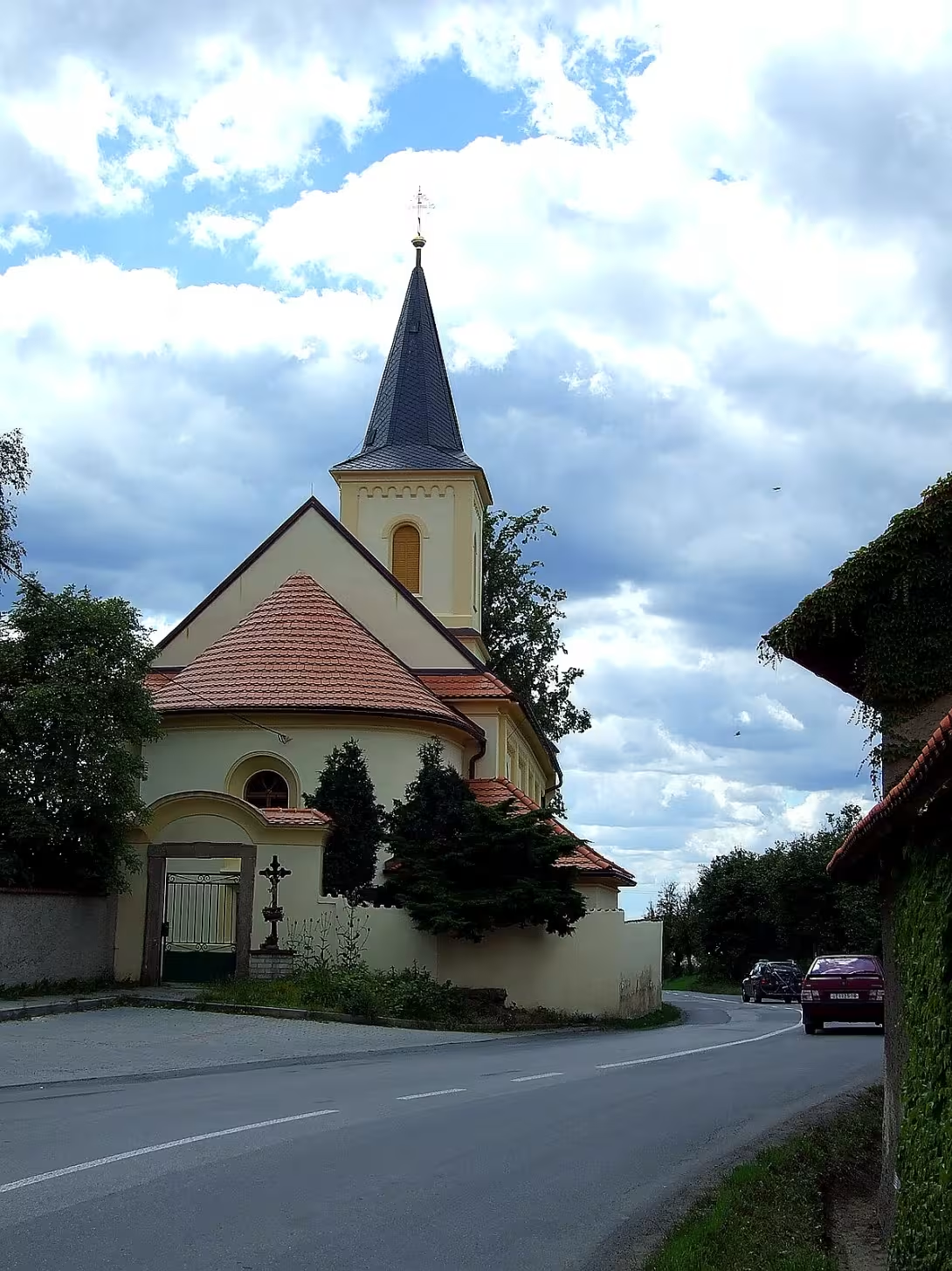
The church of St. Wenceslas in Lower Jircan is a Roman Catholic parish church with early Gothic architecture, located on the upper part of the village. This building, which is a natural urban dominant area, is protected as a cultural monument of the Czech Republic since 1965. The church has a single-boat orientation with a half-circle end of apsid and sacristy attached to the north side of the presbytery.
The oldest part of the church, including presbytery and sacristy, dates back to the 13th century. In 1330-1350, apsida was encircled by a rib arch, which contributed to its architectural character.
In 1877 there was a major reconstruction under the direction of architect B. Münzbergera. The original ship was demolished and replaced by a new, larger building with pseudo-Romanesque appearance, which reflects the historical trends of the time.
The exterior of the church is plastered and united by a historic facade. Apsida has a base-shaped shape with dimensions of 5.3 metres wide and 5.09 metres long. The facade of the ship is rhythmised by pilasters that vertically break the wall into the field. The three-story tower is horizontally divided by the ledge and its upper floor has broken windows with a middle column.
The interior of the church is flat-ceiling with a fabion, divided into a boat and elevated presbytery separated by a winning arch. The presbytery has a cross rib arch with profiled ribs growing from the needles. Here are the Baroque statues of St. John Nepomuk and Virgin Mary Karlovsky, as well as the pontifical chair with acantic carving.
The interior is complex, mostly from the Baroque and Rococo times. The main altar is rococo frame from the middle of the 18th century with the painting of St. Wenceslas probably the work of Ignatius Raab. Other important elements are the Baroque baptisms from 1714 and the tombstones of the Sebusin family from 1601-1605.
Until 1877, the church had no stone tower. Instead, the wooden bell tower of the prism-type with a chisel roof stood, which was demolished during the reconstruction and replaced by a new tower.
Today, the church of St. Wenceslas in Lower Jircan is an important cultural monument where history and the present meet. Its architectural character and wealth of interior make it an important attraction for tourists and locals, offering an opportunity to become familiar with its history and architectural changes.
Historical milestones
- 13th century
- The oldest part of the church, presbytery and sacristy.
- 1330-1350
- Enlarged apsida with a rib arch.
- 1714
- The acquisition of the Baroque Baptist.
- around 1750
- The origin of the Rococo main altar.
- 1877
- Rebuilding the ship and replacing the wooden bell tower with a stone tower.
- 1965
- Protection of the building as a cultural monument of the Czech Republic.
Architectural development
The oldest part of the church, presbytery and sacristy, comes from the early Gothic period of the 13th century. In the second quarter of the 14th century, the apsida was sealed with a rib arch. In 1877 there was a major reconstruction during which the original ship was demolished and replaced with a new one, which led to the unification of the expression of the church with history.
Historical events
- 1330-1350
- Apsida was newly sealed with a rib arch.
- 1877
- Basic reconstruction of the whole building under the direction of architect B. Münzbergera.
Points of interest
- The Church of St. Wenceslas is protected as a cultural monument of the Czech Republic since 1965. - The oldest part of the church dates back to the 13th century, the apsida was encapsulated by a rib arch in 1330-1350. - In 1877 there was a reconstruction under the guidance of architect B. Münzbergera, the original ship was demolished and replaced with a new one with pseudo-Romanesque appearance. - Until 1877, the church had no stone tower; instead there was a wooden bell of the prism type, which was demolished during the reconstruction and replaced by a new tower. - The main altar is a rococo frame from the middle of the 18th century with the painting of St. Wenceslas probably by Ignatius Raab.
Guide
Show guide text
This text was created by artificial intelligence and has not been editorially reviewed. It may contain inaccuracies.
Welcome to the Lower Jircan. You have just stopped before one of the most important and oldest points in this area. The church of St. Wenceslas stands before your eyes. Before we take a deeper look at his history, pay attention to what you're seeing right now. Feel how this building dominates the whole neighborhood. It is placed on a significant surface, which means that from this place it acts as a natural center and the main point of the whole village landscape. It's the first thing you see when you approach this village, and it's a place that gives the whole place its character and face. Look at her silhouette and feel the calm, sacral atmosphere that has been around this place since the centuries.
In order to fully understand the importance of this construction, we must go back deep into the past together. This church is not just a prayer building, it's a living chronicle that goes back to the 13th century. It is during this period that the very oldest parts were created, which form the very basis and core of the entire building. If you went in now, you would see the space of the presbytery and sacristy that came from this early period. Imagine the times when the first stones were laid here and when this Roman Catholic parish building was the center of the life of the local community. The Church of St. Wenceslas is therefore not only a modern object, but an inheritance which bears traces of the medieval world.
Now try to focus on the architecture itself and what you can perceive when looking at its structure. The church is built in an early Gothic style. This style is characterized by a certain purity and strength that you can feel in its overall form. The church has one-sided orientation, which means that its inner space consists of one main, continuous whole. If you look at its endings, you'll see an apside that's half-circular. This part is very important because it is here that significant architectural progress has taken place. In the years between thirty-thirty and thirty-fifty, this apside was provided with a so-called rib arch. This detail, which was a technical one at the time, provides space not only for strength, but also for beauty, which can be perceived in the rhythm of the stone lines. On the north side of the presbytery is then connected another space, sacristy, which serves for the needs of the spiritual servant.
Now pay attention to how this Gothic base has changed over the centuries and how new layers of history have been inserted into it. The church is not immutable, but it has constantly evolved along with the people who used it. In the year one thousand seven hundred and fourteen here was taken the Baroque Baptist, who brought the style of her time into the space. A little later, around the year a thousand seven hundred and fifty, the main altar was created in rococo style. These two styles, the baroque and the rococo, brought a different feeling to the church, a different richness and a different way of expressing the faith that floats over the original gothic foundation. It is a fascinating dialogue between different times that you can perceive in this space.
Another major breakthrough in the history of this building occurred much later, in the nineteenth century. In the year one thousand eight hundred seventy-seven there was a massive reconstruction that fundamentally changed the appearance of the church as you know it today. The whole process was run by an architect named B. Münzberger. During this period, the original part of the church was demolished and replaced by a new construction. This change was not only about the inner space, but also about what the church looks like from the outside. There was an important change at the tower. The original wooden bell tower was replaced by a solid stone tower. This move meant that the church gained its endurance today and the elevated appearance that you now see before you. This stone tower has become a symbol of stability and a new age for the whole village.
Although history has not given us the names of the particular people who laid these stones in the 13th century, or those who have confessed their faith in the church for centuries, you still feel their presence here. Every modification, every new vault or altar is evidence of human effort and effort to make this place as beautiful as possible. Even if we don't know the names of the builders back then, their work speaks for themselves.
The interesting thing that might interest you is how much this building is appreciated even in modern times. The church of St. Wenceslas is not only an old house, it is a protected cultural monument of the Czech Republic. This protection was granted in the year one thousand nine hundred sixty-five. This means that this building is considered the great treasure of our country and its historical value is recognised at the highest level. It is proof that despite all the changes, reconstructions and new styles brought to the church by different generations, its core and its importance remain unchanged.
Now that you know the basic story of this place, I suggest you move on and explore every part of this space. Feel every wall, every line and every change in architecture you've just heard. Let the atmosphere of a place that has survived for hundreds of years and that still stands here for all of us. I hope that this brief view of the history of St. Wenceslas Church has brought you new insight and that you will enjoy the rest of your journey around this beautiful village. I wish you a pleasant continuation of the tour.
Tips for visitors
The best time to visit the church of St. Wenceslas in Lower Jircan is autumn or spring, when nature is especially lovely in the surroundings and the sky is less likely to cover the sunlight. This church boasts the beauty of early Gothic, which is ideal for those who like historical architecture.
We recommend checking the current connection with an online search engine.
What to take with you: Don't forget the sun glasses for better photos and comfort when viewing architecture. In the winter months, it is advisable to carry warm clothes, as the visit on a strong top can be cold.
Photography: The best light for photography is usually morning or evening. The top of the church offers views of the surrounding landscape, which are particularly photogenic in sunny weather. Photography inside the church can be restricted to protect the monument.
What to visit nearby: There are other historical and natural attractions nearby that can be explored during the visit. We recommend exploring the surrounding forests or taking a short walk along local roads, which is an ideal way to enjoy peace and nature.
Frequently asked questions
Can the monument be visited?
Religious buildings are usually open mainly during services; at other times a visit is normally arranged with the parish or the operator. We have not verified specific times.
Where is the monument?
Location: Středočeský kraj. The map on this page shows the exact spot.
Why is the monument protected?
It is listed in the Central List of Cultural Monuments of the Czech Republic as a cultural monument (register no. 1000132128).
Businesses nearby
Do you run a restaurant, accommodation, shop, museum, rental, wellness or other visitor service near this monument? Show yourself directly to the people heading to it — this is how they will see you in the app and on the web:
Events nearby
Zdroj akcí: otevřená data měst a obcí ČR (Národní katalog otevřených dat) a kalendář akcí Národního památkového ústavu.
Nearby
🏰 Historic sites (370)
- Památník obětem 1. sv. války 3.7 km
- památník na paměť shromáždění husitského lidu 4.4 km
- Kalvárie 4.8 km 5. května
- Pomník k 100. výročí založení Československé republiky 4.9 km
- Pomník české státnosti 5.0 km
- Padlým a zemřelým vojínům 5.4 km
- Padlým hrdinům za vlast 5.5 km
- zámek Dobřejovice 5.7 km
- památník obětem I. a II. světové války 6.0 km
- Výstava čínského umění 6.0 km +420724252496 web
- zámek Nebřenice 6.2 km
- Regionální muzeum v Jílovém u Prahy 6.3 km
- Regionální muzeum 6.3 km
- Fighter Pilot Captain Carl Raymond Alfred 6.7 km
- zámek Štiřín 6.7 km web
- Pomníček Jiřího Fürsta 6.8 km
- Pomník padlým 6.8 km
- František Matoušek 6.8 km
- Zámek Olešovice 6.9 km Ringhofferova 436
- Muzeum Štola Halíře 7.2 km +420241950791 web
🍽️ Restaurants and dining (1512)
- Jirčanská hospůdka Na návsi 0.1 km
- Na kopečku 0.1 km
- Kabina 0.5 km Sportovců 209 web
- Rubín 1.2 km
- U Císaříků 1.4 km
- Voňavá zahrada 1.8 km
- Hattrick 1.9 km
- Petry svět 1.9 km
- U Kohouta 2.0 km +420 241 932 629 web
- V Uličce 2.1 km
- Relax klub 2.2 km web
- Davi Restaurace 2.2 km +420 773 726 789 web
- Tutti pizza 2.2 km +420 736 144 999
- U Klokana 2.2 km Budějovická 20 web
- Bamboo fast food 2.2 km +420 773 026 789
- U Mirouna 2.4 km
- Presto pizza 2.4 km web
- Restaurace u slepych 2.7 km
- Na Kocandě 3.0 km Pražská 134 +420 602 136 172 web
- Bowling steakbar 3.1 km Budějovická 899 +420 315 810 301 web
🏨 Accommodation (169)
- Aurooms 2.6 km Na Drahách 224 web
- Oase 3.2 km web
- Mandava 4.3 km
- Chateau Clara Futura 4.7 km
- Motel U Krbu 5.1 km Vídeňská 360 +420 244 913 432 web
- Sporthotel Vestec 5.1 km Sportovní 456
- Penzion Inema 5.4 km
- Penzion Magdalena 5.7 km +420 602 232 224 web
- Park Hotel Popovičky 5.9 km
- Park Hotel Popovičky 5.9 km
- Štiřínská stodola 6.5 km +420 323 607 784 web
- Floret (recepce) 6.5 km Květnové náměstí 96 +420 296 528 400 web
- Paloma 6.6 km Květnové náměstí 53
- Hotel Zámek Štiřín 6.7 km web
- Park Hotel Průhonice 6.8 km Uhříněveská 12 +420 267 750 405 web
- Prager 7.2 km
- Club Hotel Praha 7.2 km
- Lifestyle Hotel 7.2 km V lužích 999/1
- Hotel U Věže 7.4 km
- Aquapalace Hotel Prague 7.5 km Obchodní 137 web
🚲 Rentals and sport (221)
- Lyže Yesenice 2.6 km
- Svět plavání 2.7 km
- climbing wall 3.1 km
- Sportovní areál Jesenice 3.1 km
- Sportoviště obce Vestec 4.0 km U Hřiště 575
- opt play 4.4 km
- Tělocvična 4.4 km
- Zeus bike 5.0 km
- FK Dobřejovice 5.9 km
- JK Harfa 5.9 km
- Bazén 6.0 km
- TK Wilson centrum 6.2 km
- Bikeclinic 6.2 km K Vrtilce 317/64
- Floret 6.5 km web
- Sportovní areál Šeberov 6.9 km web
- Cho VN SaPa 6.9 km
- HOP Aréna 7.2 km
- Sportisimo 7.2 km
- Tenisové kurty 7.4 km
- Fotbalové hřiště 7.5 km
🥾 Hiking and nature (209)
- Vápenka 1.8 km
- Kamínek 3.8 km
- Mandava 4.4 km
- Křížka 4.4 km
- Voyage Prague Kids 4.5 km Do Višňovky 76 +420776073178 web
- Obecní park Želivec 5.6 km
- Botič 5.6 km
- Vyhlídková vež Gloriet 5.9 km
- Skalsko 6.0 km
- Drnka 6.2 km
- Castle view 6.3 km
- Žlábek 6.3 km
- Panoramic view of the lake, Pruhonice 6.4 km
- Boží skála 6.5 km
- Boží skála 6.6 km
- Ringhofferova studánka 6.6 km
- Dinka Quelle 6.6 km
- Ringhofferova studna krytá 6.6 km
- Kněžská studna 6.6 km
- Pod Točnou 6.8 km
Accommodation nearby
Trips and activities nearby
Guided tours, tickets and activities nearby from GetYourGuide
Affiliate link: if you buy from the partner, we may receive a commission. The price for you does not change.
Search tours and activities →Themed route
Thematic cruise route: St. Wenceslas Church (Lower Jirčany)
1. Church of St. Wenceslas (Lower Jirčany) - Type: Religious monument - Why is it worth a visit: This church is an important historical building which represents Baroque architecture. It is a place of peace and respect with rich history and beautiful interior.
2. Memory of the fallen - Type: Memorial - Why is it worth a visit: This monument is dedicated to war victims and commemorates historical events that affected the region. It's a place to think about the consequences of war.
3. Local Park - Type: Green area - Why is it worth a visit: The park offers an opportunity to relax and walk in a quiet green garden. It is ideal for relaxing after a church tour.
4. Municipal House - Type: Historical building - Why is it worth visiting: This building is an example of the local architecture and history of the village. It can be interesting for those interested in regional cultural heritage.
5. The Chapel of St. Gilji - Type: Chapel - Why is it worth visiting: This chapel is a small but important religious place with beautiful architecture. It's a place for quiet prayers and reflection.
This route offers a combination of historical, religious and natural attractions in the region of Dolní Jirčany.
Seasonal recommendations
Spring: In the spring period, the church of St. Wenceslas in Lower Jirčany is transformed into a special place to visit when flowering gardens and trees begin to open a leaf blanket. Sun rays illuminate the architecture of the church in fine light, which gives visitors a feeling of a new beginning and renewal. It is advisable to visit the memorial at the end of March or spring for mild temperatures, but it is good to have light clothes ready for a cooler morning and evening. Despite the possible increase in traffic at this time, there is generally a moderate flow of people, which allows a peaceful tour.
Summer: Summer brings long sunny days and warm nights that create ideal conditions for exploring the church of St. Wenceslas. The sun illuminates architectural details in full gloss, which increases their beauty and attracts more visitors. The best time to visit is an early afternoon or early morning, when the landmass is not yet burdened with a monument. The important thing is to wear light clothes and protective sunglasses to safely examine all parts of the church.
Autumn: In autumn, the surrounding area of St. Wenceslas church is transformed into a colourful palette of golden and red leaves, which adds a romantic tone to the visit. The sunny days are still pleasant, but the evening cold appears quickly. The best time to visit is in the early afternoon or early morning, when the temperature is reasonably mild and fewer people choose the tour. It is advisable to wear several layers of clothing to adapt quickly to the temperature change.
Winter: The winter visit to St. Wenceslas Church offers a unique view of the monument, when its architecture is lit by cool rays of sun or evening lighting. Winter May to December brings frosty temperatures, so it is important to visit a monument with warm clothes and protective metal for your feet. The opening of the church may be shortened during winter days, so it is advisable to plan a day tour. Despite the cold conditions, the traffic usually decreases and it allows a quieter walk around the sights.
Visualizations and artistic views


The visualisations are generated by artificial intelligence and serve as inspiration.
Photos from the area
Real photos taken near the monument


Zdroj a licence jsou uvedeny u každého snímku.
Tips from visitors
No tips yet. Be the first!
Log in and add your tip.
Sources and literature
Photos: I would appreciate being notified if you use my work outside Wikimedia. More of my work can be found in my personal gall / CC BY-SA 3.0 — Wikimedia Commons. The author and licence also appear when you hover over the image.
Faktickým podkladem tohoto textu byl článek na Wikipedii, jehož autory jsou přispěvatelé Wikipedie. Článek je dostupný pod licencí CC BY-SA 4.0.
Location on the map
More monuments – Středočeský kraj
Show all in the region




Příběhy a pověsti
Legendy, pověsti a příběhy spjaté s touto památkou
Fotografie návštěvníků
Zatím žádné fotografie. Buďte první, kdo přidá fotografii z návštěvy!
Log in a přidejte svou fotografii nebo hodnoťte.
Za ověřenou návštěvu v aplikaci získáte víc bodů — poznáme podle GPS, že jste na místě.
Reviews and comments