






Kostel svatého Víta (Rudolfov) Church
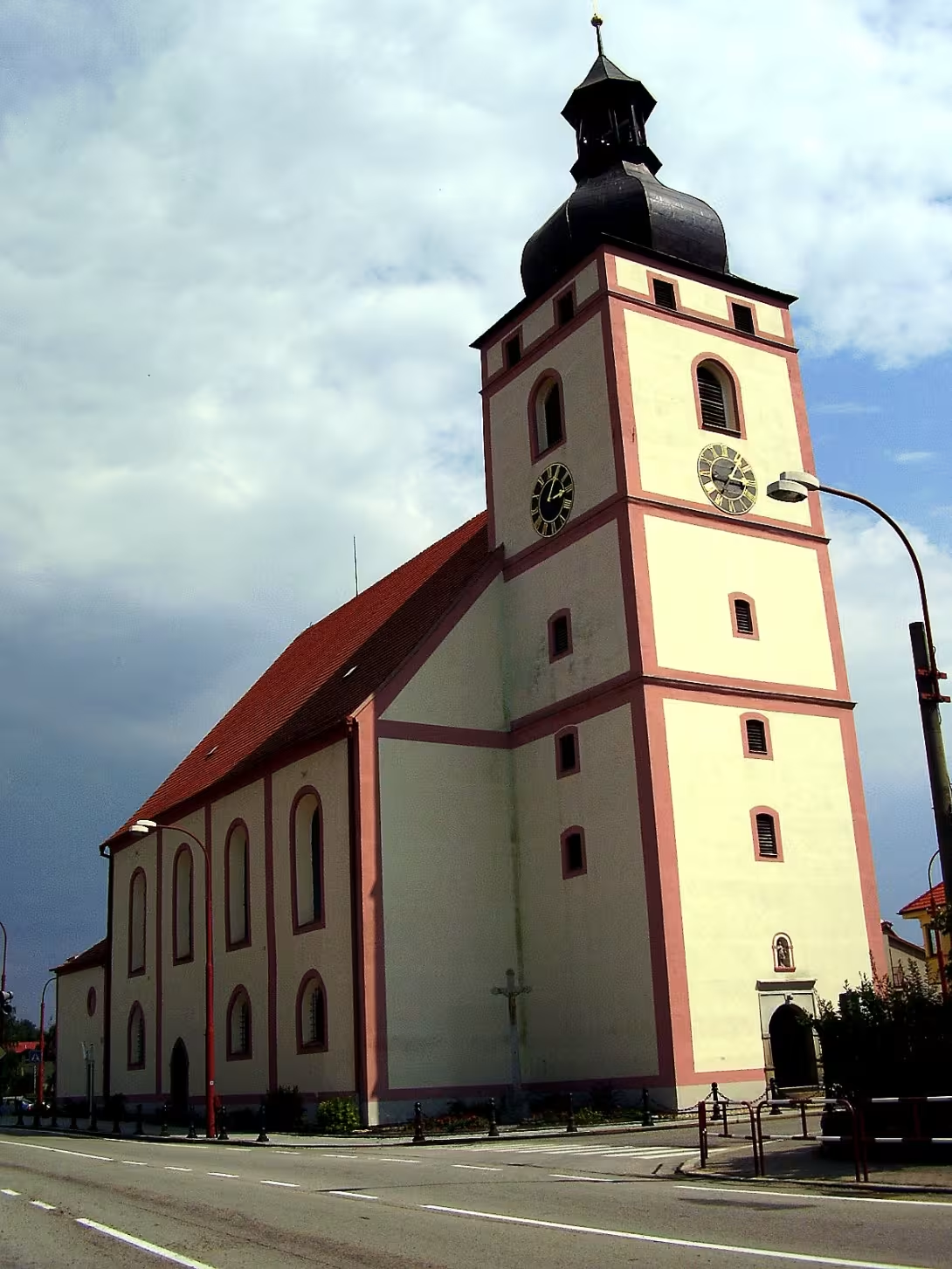
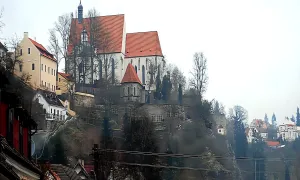
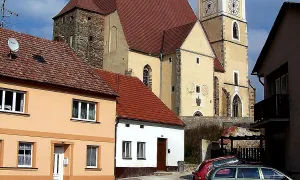
The Church of Saint Vitus in Rudolfov is a remarkable Renaissance hall church deeply rooted in the history of local mining communities. Situated at Rudolfov’s heart in Jihočeský kraj, this architectural gem serves as both a cultural monument and a dominant feature of the town and its surroundings. Its unique design and historical transformations reflect significant religious shifts during Bohemia's Reformation period.
The church's origins are linked to silver mining expansion around Rudolfov, attracting miners from regions like the German Ore Mountains. In 1536, a utraquist chapel was permitted due to this influx, marking the start of religious infrastructure development in the town. By 1583, construction began on an Evangelical (Lutheran) church, completed by 1586. Rudolfov became a focal point for Protestant communities during this period. However, from 1636 onwards, the church transitioned to Catholicism.
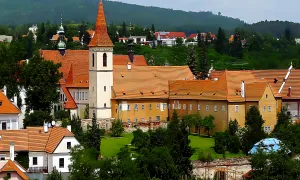
Architecturally, the Church of Saint Vitus is distinguished as a Renaissance hall church with three naves, an unusual structure in South Bohemia. It is oriented east to west, featuring a triple-apse presbytery at the eastern end and a pyramidal tower housing three bells at the western end. After a fire in 1679, significant renovations occurred in the late 18th century. In 1765, the church was vaulted, replacing its original truss roof, with exterior repairs following in 1766.
The interior is equally noteworthy. The main altar, dedicated to Saint Vitus, features baroque design from around 1700 and underwent extensive restoration in the 19th century. It showcases a unique depiction of the Virgin Mary with Saint James, rare in Bohemia. Additionally, it houses a copy of the Rudolfov Madonna, originally donated by Capuchin monks of České Budějovice in 1698. The original carving is now part of the Alšova Jihočeská Galerie collection.
The church also features a late baroque pulpit and a restored side altar with Archangel Michael in its southern chapel. A historical baptismal font, with a cover dating back to 1689, adds to the rich tapestry of artifacts within. The walls are adorned with early baroque paintings depicting Christ’s Passion, forming a Stations of the Cross.
The bell tower houses three bells: Saint Vitus, Saint Francis de Sales, and Saint Barbara. Historical records indicate that before World War I, there were five bells, requisitioned in 1917 for wartime purposes. After the war, only one remained until additional ones were acquired in 2013.
Today, the Church of Saint Vitus remains a significant cultural and historical site, open to visitors who wish to explore its rich history and architectural beauty. Its unique blend of religious heritage and artistic elements makes it a must-visit destination for anyone interested in South Bohemia's cultural tapestry. The church stands as a testament to the region’s past while continuing to inspire with its enduring legacy.
Then and now
Drag the slider to compare how the landmark may have looked when it was built with the view today.
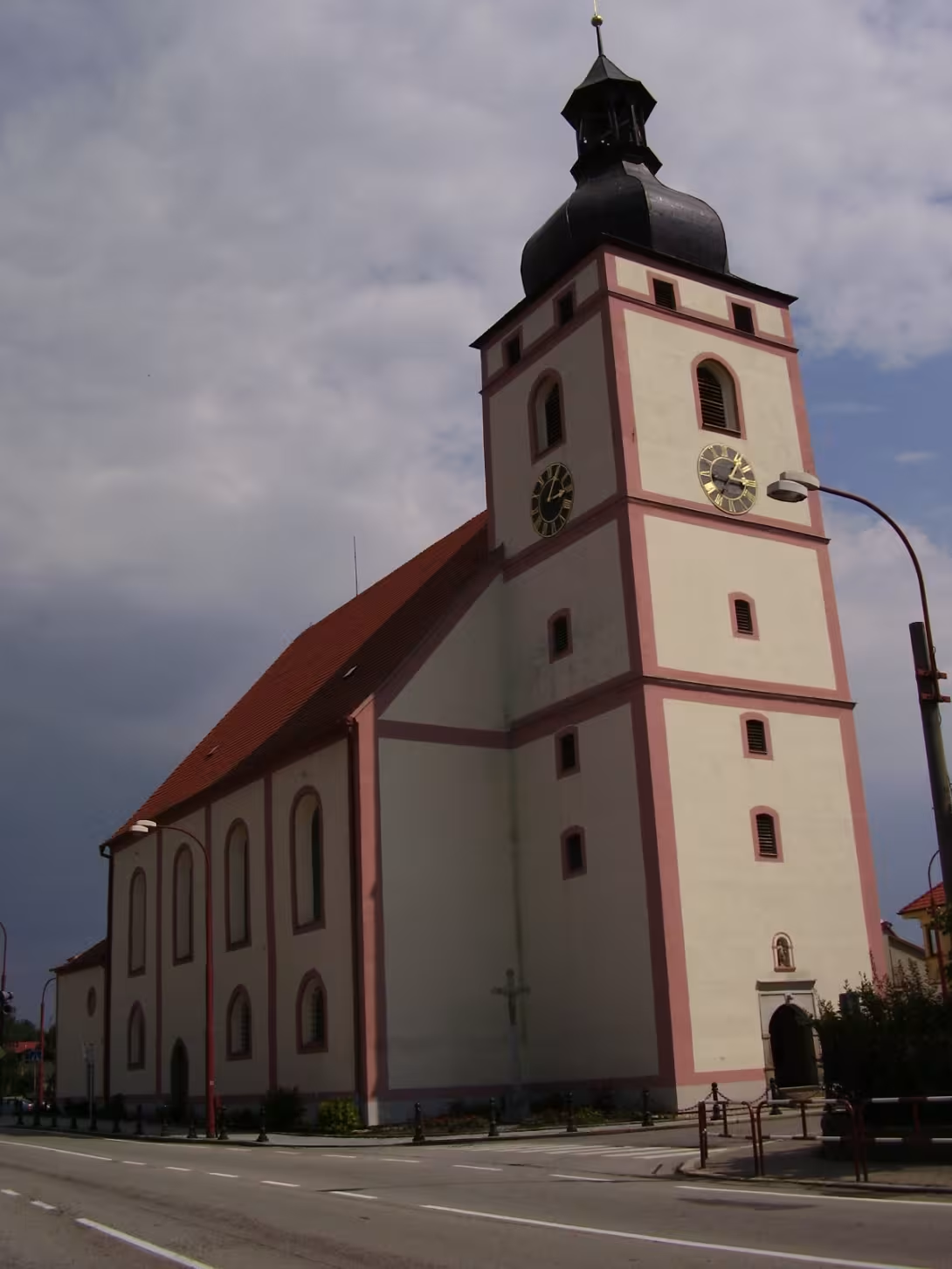

The historical appearance on the left is an AI-generated visualisation and serves as inspiration only.
Historical milestones
- 1583
- Construction of the Evangelical (Lutheran) church began.
- 1636
- The church became Catholic.
- 1679
- The church was destroyed by fire.
- 1765
- The church was vaulted.
- 1766
- Exterior repairs were completed.
Architectural development
The Church of Saint Vitus was initially built as an Evangelical (Lutheran) church and later became Catholic. It underwent significant changes after a fire in 1679, including being vaulted in 1765 and exterior repairs in 1766.
Historical events
In 1536, the construction of a utraquist chapel was permitted due to the expansion of silver mining in the area.
The church was completed as an Evangelical (Lutheran) church in 1586 and became Catholic from 1636 onwards.
A fire destroyed the church in 1679, leading to further renovations in the late 18th century.
Points of interest
- The Church of Saint Vitus's architectural design as a Renaissance hall church with three naves is quite rare in South Bohemia, showcasing an unusual structural choice for the region.
- Originally built to serve Protestant communities during the Reformation, the church transitioned to Catholicism in 1636, reflecting significant religious shifts and conflicts within the area.
- The main altar features a unique depiction of the Virgin Mary with Saint James, which is notably rare in Bohemia, highlighting distinct artistic influences at the time of its creation around 1700.
- Before World War I, the church's bell tower housed five bells. However, three were requisitioned for wartime purposes in 1917, leaving only one until new bells were acquired in 2013 to restore its historical sound.
- The original carving of the Rudolfov Madonna, a significant artifact within the church, is now part of the Alšova Jihočeská Galerie collection, with only a copy remaining at the site.
Guide
This guide is narrated by a synthetic voice generated by artificial intelligence.
Show guide text
This text was created by artificial intelligence and has not been editorially reviewed. It may contain inaccuracies.
The Church of Saint Vitus is a Roman Catholic parish church in the center of Rudolfov, near the road from České Budějovice to Lišov. It is a cultural monument and the dominant landmark of the town and the surrounding area.
Its origins are connected with silver mining. Miners came to the region at that time, mainly from the German part of the Ore Mountains, and needed a place for worship. In 1536, the construction of a Utraquist chapel was permitted. In 1583, construction of a Lutheran church began and was completed in 1586. It has been Catholic since 1636. In 1679 it burned down. In 1765, a vault replaced the original wooden ceiling, and a year later the exterior was also repaired.
It is a Renaissance three-aisled hall church with galleries. This arrangement of aisles is unique in South Bohemia. To the east it has a presbytery with a triangular end, and to the west a prismatic tower.
The main altar is Baroque, from around 1700. A statue of Saint Vitus stands at its top, but the main painting depicts Saint John of Nepomuk. To the right of the painting stands Saint Joachim with a small girl, who represents the Virgin Mary. Such a depiction is not found elsewhere in Bohemia. On the left is Saint Joseph with the Christ Child. Higher up stand smaller statues of Saint Christopher and Saint John the Baptist in fur with a lamb.
By the side altar is a faithful copy of a woodcut of the Virgin Mary of Rudolfov, measuring 141 centimeters high. The original was given to the people of Rudolfov in 1698 by Capuchins from České Budějovice. Since 1953 it has been part of the collection at the South Bohemian Gallery. It is a rare work, as it belongs to a small group of Gothic woodcuts in Bohemia that were created as early as the thirteenth century.
On the walls hang fourteen early Baroque paintings of the Stations of the Cross. The pulpit is late Baroque. A new baptismal font made of granite from Chválkovice was consecrated in 2014, but its cover is from 1689. In the southern chapel stands a restored altar with the Archangel Michael. Set into the flooring is a tombstone of the knight Daniel Matyáš ze Sudetu with a German inscription.
Before the First World War, five bells hung in the tower. In 1917 they were confiscated for war purposes. In 1925 they were replaced, but in 1942 they were confiscated again. After the Second World War, only the bell of Saint Vitus was obtained, which then remained in the tower alone for 71 years. In the 1980s, a collection for new bells began. In June 2013, two bells from the Tomášková-Dytrychová foundry were added to the tower. They were blessed by auxiliary bishop Pavel Posád. Saint Francis of Sales was cast in 2008 and weighs 456 kilograms. It bears the inscription: By myself I can do nothing. With God I can do all things. Saint Barbara was cast in 2011.
Frequently asked questions
Can the monument be visited?
Religious buildings are usually open mainly during services; at other times a visit is normally arranged with the parish or the operator. We have not verified specific times.
Where is the monument?
Location: Rudolfov, Jihočeský kraj. The map on this page shows the exact spot.
Why is the monument protected?
It is listed in the Central List of Cultural Monuments of the Czech Republic as a cultural monument (register no. 15438/3-398).
Businesses nearby
Do you run a restaurant, accommodation, shop, museum, rental, wellness or other visitor service near this monument? Show yourself directly to the people heading to it — this is how they will see you in the app and on the web:
Events nearby
Zdroj akcí: otevřená data měst a obcí ČR (Národní katalog otevřených dat) a kalendář akcí Národního památkového ústavu.
Accommodation nearby
Trips and activities nearby
Guided tours, tickets and activities nearby from GetYourGuide
Affiliate link: if you buy from the partner, we may receive a commission. The price for you does not change.
Search tours and activities →Themed route
Tematická výletní trasa kolem Kostela svatého Víta v Rudolfově
1. Kostel svatého Víta (Rudolfov)
Typ: Historická památka, kostel
Proč stojí za návštěvu: Tento barokní kostel je nejvyšší a nejslavnější architektonickou památkou v Rudolfově. Je známý svým impozantním vysokým špičatým střechovým návrhem, který se pyšní jednou z nejvyšších v České republice. Kostel je také domovem bohatých interiérů a historických artefaktů, což jej činí fascinujícím pro milovníky dějin a architektury.
2. Kaple svaté Anny
Typ: Kaple
Proč stojí za návštěvu: Tato kaple je umístěna v blízkosti kostela svatého Víta a nabízí klidný útočiště pro ty, kteří hledají místo na meditaci nebo krátkou modlitbu. Její jednoduchá architektura kontrastuje s barokním nádherou kostela a poskytuje pohled do minulosti duchovního života v obci.
3. Náměstí Míru
Typ: Náměstí, veřejný prostor
Proč stojí za návštěvu: Centrálním místem Rudolfova je toto historické náměstí, které slouží jako srdce komunity. Je to místo pro setkávání a relaxaci, kde lze si užít klidné chvilky na zahradách nebo se podívat na místní akce a události. Náměstí je ideálním začátkem či koncem vašeho výletu, nabízejícím pohledy na další historické budovy obce.
4. Kostelní zahrada
Typ: Zahrada, přírodní prostor
Proč stojí za návštěvu: Kostelní zahrada je místo plné klidu a krásy, kde můžete procházet mezi květinami a stromy. Je to ideální místo pro ty, kteří hledají příležitosti ke klidnému pohledání nebo fotografování v přírodním prostředí. Zahrada poskytuje únik od městského života a nabízí možnost užít si krásy období roku.
Tato trasa nabízí kombinaci historických, duchovních a přírodních zážitků v okolí Kostela svatého Víta, což činí Rudolfov ideálním místem pro celodenní návštěvu.
Seasonal recommendations
Spring: Visiting the Church of St. Vitus (Rudolfov) during spring offers a unique blend of natural beauty and historical charm. The surrounding landscape bursts into life with vibrant wildflowers, creating a picturesque setting that enhances the church's architectural splendor. As daylight extends, the soft morning light beautifully illuminates the intricate stonework, providing an ideal time for photography. Visitors should be prepared for occasional showers, so carrying a lightweight raincoat or umbrella is advisable. While crowds are generally moderate, arriving early in the day can ensure a more tranquil experience.
Summer: The summer months bring out the best of Rudolfov's Church of St. Vitus with its lush greenery and warm sunlight casting dramatic shadows across the church's facade. This season often sees an influx of tourists, especially during peak holiday periods, so planning your visit for early morning or late afternoon can help avoid larger crowds. Lightweight clothing is recommended to stay comfortable in the heat, along with sun protection such as hats and sunscreen. The longer daylight hours provide ample time to explore both the church's interior and its scenic surroundings.
Autumn: Autumn transforms Rudolfov into a tapestry of warm colors, offering a serene backdrop for visiting St. Vitus Church. The cooler temperatures make it an ideal time for leisurely exploration without the summer crowds. The soft, golden light of late afternoon enhances the historical details of the church, making it perfect for photography enthusiasts. Visitors should dress in layers to accommodate fluctuating temperatures throughout the day and consider bringing a warm jacket as evenings can be brisk.
Winter: Winter visits to St. Vitus Church are marked by a quiet, almost mystical atmosphere under a blanket of snow, which adds a magical element to its Gothic architecture. The shorter days mean that early morning visits allow for the best lighting conditions before dusk sets in. Due to the potential for inclement weather, visitors should dress warmly and be prepared for possible closures or reduced hours during severe winter storms. Despite fewer tourists, the church's interior offers warmth and shelter, providing a cozy respite from the cold outside.
Visualizations and artistic views


The visualisations are generated by artificial intelligence and serve as inspiration.
Photos from the area
Real photos taken near the monument


Zdroj a licence jsou uvedeny u každého snímku.
Tips from visitors
No tips yet. Be the first!
Log in and add your tip.
Sources and literature
Photos: Isolda11 / CC BY-SA 3.0 — Wikimedia Commons. The author and licence also appear when you hover over the image.
Faktickým podkladem tohoto textu byl článek na Wikipedii, jehož autory jsou přispěvatelé Wikipedie. Článek je dostupný pod licencí CC BY-SA 4.0.
Location on the map
Příběhy a pověsti
Legendy, pověsti a příběhy spjaté s touto památkou
Fotografie návštěvníků
Zatím žádné fotografie. Buďte první, kdo přidá fotografii z návštěvy!
Log in a přidejte svou fotografii nebo hodnoťte.
Za ověřenou návštěvu v aplikaci získáte víc bodů — poznáme podle GPS, že jste na místě.
Reviews and comments