






Kostel svatého Víta (Týn nad Vltavou) Church
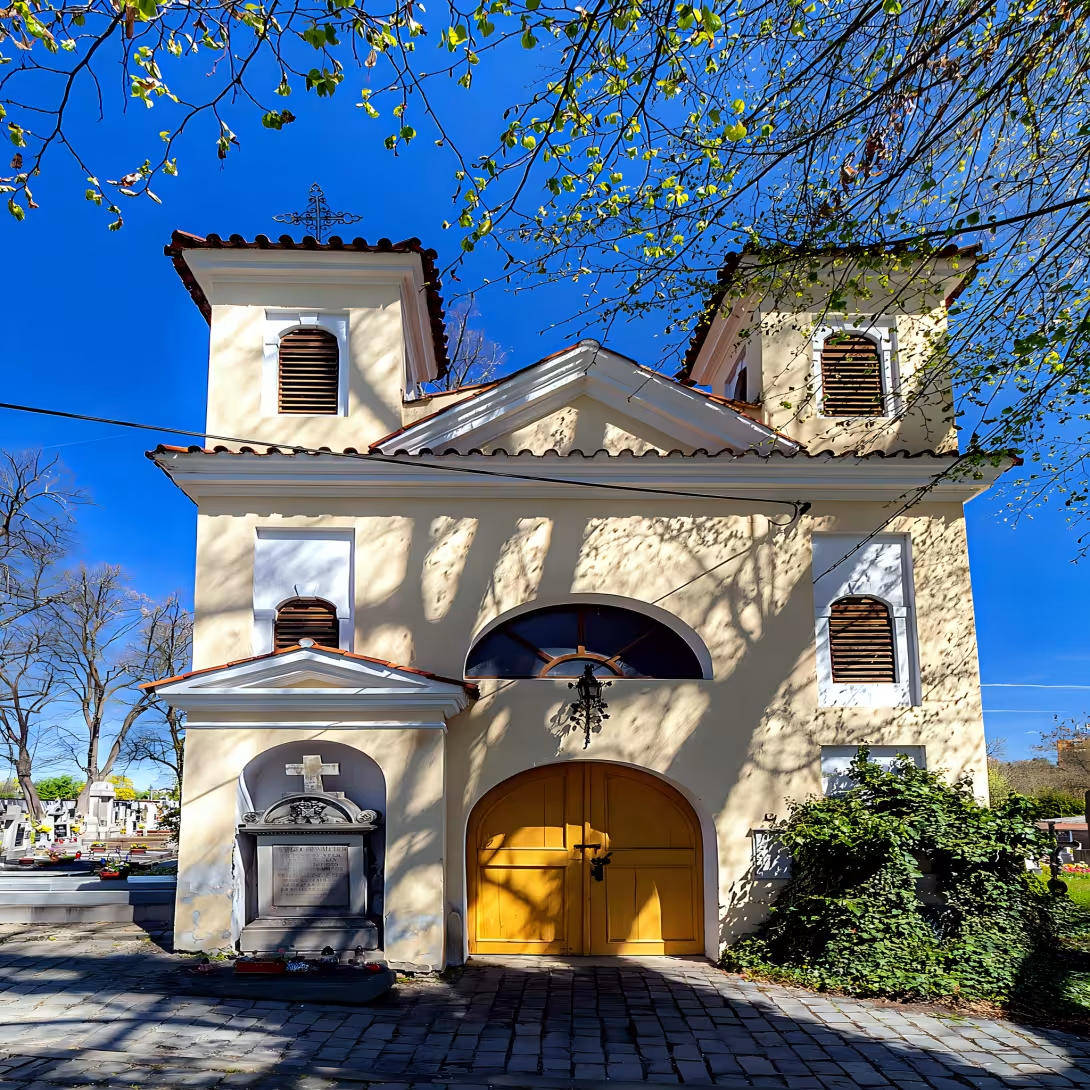
St. Vitus Church in Týn nad Vltavou is an early Baroque cemetery church located in the village Týn nad Vltavou in the district České Budějovice. It is protected as a cultural monument of the Czech Republic and belongs to the monument zone of the city. Its construction was a reaction to the plague epidemic in 1680-1681, which required a new cemetery space for the inhabitants of Týn nad Vltavou.
The creation of the church is closely linked to the historical context of the plague. Originally, the victims were buried at St. James's church, but due to the growing number of deceased, this space became crowded. As a result, a new cemetery outside the city was built in 1681- 1682 and the church of St. Vitus related to it. According to historical sources, it is possible that the Italian architect Antonio de Alfieri, who was at the time in Týn nad Vltavou and whose name is associated with other construction projects in the region, was the builder. The financing of the construction was provided from the collections of the public, the estate of local citizen Kubesh and the contribution of Prague Archbishop Jan Fridrich.
Architecturally, the church is characteristic of the early Baroque style. It is a walled structure made of quarry stone, built on a ground plan of a rectangle with three apsides and a bell tower on the south front. The church's ship is encircled by a dome with a centre in the lantern, which adds a moving spatial depth of the interior. The exterior is decorated with tympanone between square bells and tent roof above the front. The interior has a square floor plan with covered corners, niche and apsid arched on three sides. The hall allows access to the main ship, which is divided by the orbital ledge.
The church has been repaired several times. In 1820, the original bell was rolled over by the Czech-Budějovice bell maker Jan Perner. Other repairs took place in 1863 and 1876, which helped keep the construction in good condition.
The cemetery of St. Vitus was founded during the plague epidemic in 1680-1681. After the abolition of the cemetery at St. James's church in 1771, it became the only place for burial in Týn nad Vltava. The cemetery is housed by a walled cemetery wall of quarry stone and has an old morgue in the southwest part, which served for funerals of members of the Kolodya branch of the Wrocław of Mirovic. There is also an Art Nouveau tomb of the Wesselse family and a modern operating building.
The Church of St. Vitus is not only an important cultural monument, but also a place to bury important persons associated with Tyn nad Vltava. Among them is the composer Karel Komzák older and historian of the town Josef Sakař. Although the church is not directly associated with major historical events, its creation and architecture reflect important aspects of regional history.
Today the church of St. Vitus in Týn nad Vltavou is accessible to visitors who want to discover its architectural beauty and learn more about the history of the city. It is a place offering peace and opportunity to reflect on the past of the region. The visit to St. Vitus Church is therefore a journey to Baroque architecture and deeper layers of local history and culture.
Then and now
Drag the slider to compare how the landmark may have looked when it was built with the view today.
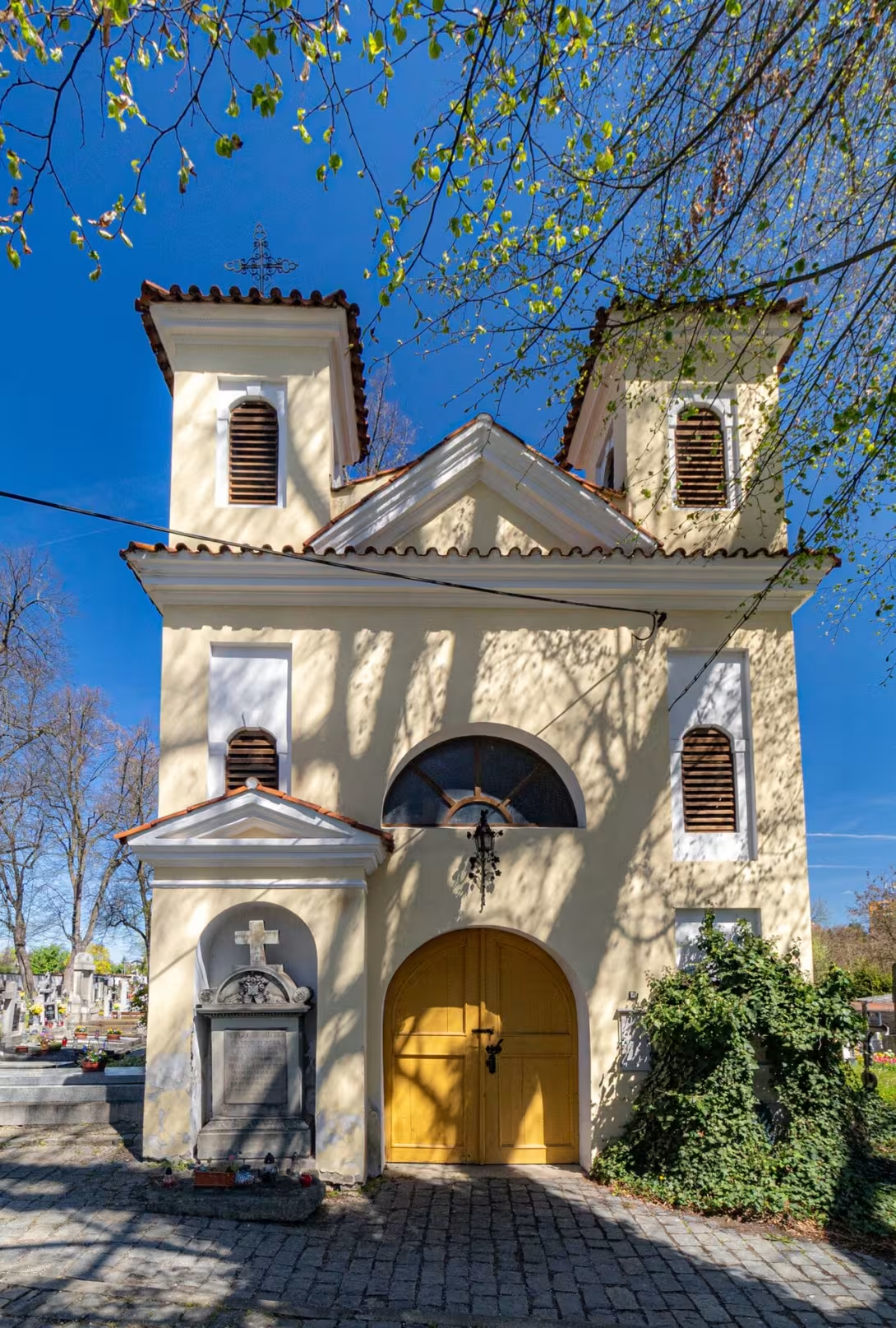

The historical appearance on the left is an AI-generated visualisation and serves as inspiration only.
Historical milestones
- 1680-1681
- The plague epidemic led to the creation of a new cemetery and the status of St. Vitus' church.
- 1820
- The outpouring of the original church bell by Jan Perner.
Architectural development
The church of St. Vitus is a walled building with a quarry stone, surrounded by a dome and a condom. The facade has an entrance with a segmental clasp and a semi-circular clasp. The interior is square with an orbital ledge, the crypt under the cemetery margin served for funerals of prominent persons.
Historical events
- 1680-1681
- A plague epidemic in Týn nad Vltava.
- 1820
- Jan Perner spilled the original church bell.
- 1863 and 1876
- The church was repaired.
Points of interest
- The Church of St. Vitus was built to respond to the plague epidemic in 1680-1681.
- According to historical sources, Italian architect Antonio de Alfieri could have been the builder of the church.
- The financing of the building was provided by collections of public, estate after Kubesh and the contribution of Prague Archbishop Jan Friedrich.
- The church is characteristic of the early Baroque style with walled construction made of quarry stone and three apsides.
- There's an old morgue in the cemetery that used to bury members of the Kolodya branch of the Wrocław of Mirovic.
Guide
This guide is narrated by a synthetic voice generated by artificial intelligence.
Show guide text
This text was created by artificial intelligence and has not been editorially reviewed. It may contain inaccuracies.
Welcome to the historical church of St. Vitus in Týn nad Vltava. You are facing a unique early Baroque building, which was built in response to the plague epidemic that hit this village in 1680-1681. The church is located in the southern part of the cemetery, which is part of the protected cultural monument of the Czech Republic.
Let's move on to the historical context. This building was founded as a central burial site so that people could say their final farewell to relatives and friends who died of the plague. And this is where you are today. Welcome to St. Vitus Church.
Now pay attention to the architecture. The church is a rectangular shape with three apsides and a bell tower on the front. Look at the facade and see how its simplicity and purity do not match the dramatic historical context surrounding it. This is characteristic of early Baroque architecture, which tried to combine elements of the classic with new, more expressive elements.
According to historical sources, Italian architect Antonio de Alfieri could have built the church. However, his name is only likely because no further information on his participation in the construction is known.
St. Vitus Church is also associated with a local citizen named Kubesh. His estate helped finance the construction, along with the contributions of Prague Archbishop Jan Friedrich. So when you're here, you're also in a place where history and the human story meet.
The interesting thing is that the church of St. Vitus was built to respond to a plague epidemic in 1680-1681. And right here, in this place, you can feel the atmosphere of that time.
Today you are already at the end of our tour, but we hope you have learned something new about the history and importance of this church. If you are interested, you can continue to walk around the cemetery and explore other details and attractions offered by this place. Whether you were brought here by interest in history or just a coincidence, we hope you enjoyed it. I'll say goodbye to you at St. Vitus' church in Týn nad Vltava.
Tips for visitors
The best time to visit the church of St. Vitus in Týn nad Vltavou is autumn or spring, when the weather is pleasant and sunny. These months offer ideal conditions for walking around the cemetery and exploring the confident architecture of the church, which looks most beautiful in the sun's light.
We recommend the use of public transport by transport, because Týn nad Vltavou has good networks of connections with nearby cities. Current information about routes and times can be found in online search engines or on websites of public transport providers.
When visiting the church of St. Vitus it is advisable to bring a warm suit, especially in colder months. It is also important to have a camera or mobile phone to capture the beauty of the church and the surrounding cemetery. Visitors who want to take advantage of interactive offers are advised to check the availability of audioguides on the official website.
Photography of St. Vitus' church is the most advantageous morning or evening when the sun's rays illuminate his facade in a fascinating way. The best places for photography are mainly from the cemetery towards the north or from the surrounding street where it is possible to capture a general view of the church.
The historical centre of Týna nad Vltavou with its picturesque streets and an ancient bridge can be visited in the vicinity of the monument. For families with children it is appropriate to visit the surrounding forests where they can encounter natural miracles and explore nature nearby.
Frequently asked questions
Can the monument be visited?
Religious buildings are usually open mainly during services; at other times a visit is normally arranged with the parish or the operator. We have not verified specific times.
Where is the monument?
Location: Týn nad Vltavou, Jihočeský kraj. The map on this page shows the exact spot.
Why is the monument protected?
It is listed in the Central List of Cultural Monuments of the Czech Republic as a cultural monument (register no. 25518/3-509).
For kids
Imagine going back to the past, when Týn nad Vltavou was a small town surrounded by forests and the Vltava River. The church of St. Vitus was the cemetery church where the inhabitants of the village were missing.
How did it look here? There were only wooden houses and small settlements. People lived from agriculture and fishing. The river Vltava was the blood of their lives. Local people used to fish, swim and farm.
Businesses nearby
Do you run a restaurant, accommodation, shop, museum, rental, wellness or other visitor service near this monument? Show yourself directly to the people heading to it — this is how they will see you in the app and on the web:
Nearby
ITEX Show interactive overview of the surroundings - restaurants, accommodation, rentals and other places within a 15 km radius.
Data: OpenStreetMap contributors, 15 km radius.
‡ Historical monuments
- Baroque sculpture Great Depot (3.6 km)
- _ (4.8 km)
- Master Jan Hus (5.5 km)
- Municipal Museum (8.4 km)
- Museum of Tourism (8.7 km)
- Memorial of fallen private (10.5 km)
- sv Jan Nepomucký (10.5 km)
- sv Jan Nepomucký (10.7 km)
Restaurant and catering
- Pizzeria Kontakt (0.5 km - Veselská 747)
- Hossovka Kacovská turret (0.5 km - Žizkova 562)
- Art Caffe Bar (0.5 km - waterfront 5th May 199)
- Neznašovské farmhouse (3.3 km - 15)
- Guesthouse Pod Skalou (8.2 km)
- Dining room on Rose (8.7 km)
- camera (8.8 km)
- Hostice u Hrdliččky (9.1 km)
Accommodation
- Castle guesthouse (0.1 km)
- Plzenka (0.2 km)
- Pezion under churches (0.3 km)
- Autokemp (4.2 km)
- Guesthouse U Pštrosa (6.9 km)
- U Pichllou (8.4 km)
- Pštross vila (8.6 km - Valtrova 33)
- Hotel Pansk (8.6 km)
› Rental and sports
- Cyclosport
- Sport hala (0.3 km)
- Kanoist Spark Club KKJ Týn nad Vltavou (0.5 km - Salt 422)
- Na Palubu (0.6 km)
- Mech Wall (6.8 km)
- JOLA (8.9 km)
- Swimming pool Beshynie (9.0 km)
- Purkarec (10.9 km)
© Tourism and nature
- Jew gutter (mouth) (6.6 km)
- Jewish Mound (under Nuzice) (6.7 km)
- Kopanins (for cross) (7.4 km)
- Outlook Vojty Náprstka (8.9 km)
- Study at St. Anny (9.2 km)
- Radetice (10.5 km)
- U Hutí (11.2 km)
- Nepomuk (11.5 km)
Accommodation nearby
Trips and activities nearby
Guided tours, tickets and activities nearby from GetYourGuide
Affiliate link: if you buy from the partner, we may receive a commission. The price for you does not change.
Search tours and activities →Themed route
Route: Týn nad Vltavou - Church of St. Vitus - Old Týn - Švihov - New Ténec - Týn nad Vltavou
1. Church of St. Vitus - Gothic church from 1352 with remarkable interior and tower, which is a dominant city. The church is famous for its unique architecture and rich history.
2. Old Týn - the historical core of the city of Týna nad Vltavou, which offers nice architectural attractions and the atmosphere of the medieval city.
3. Švihov - the local part of Týna nad Vltavou, where there are several historical houses and objects that are part of the city's core.
4. New Týnec - the local part of Týna nad Vltavou, where there are several historical houses and objects that are part of the city's core.
Seasonal recommendations
Spring: In the spring season, the church of St. Vitus is surrounded by flowering trees and flowers, creating a pleasant atmosphere. Practical advice: the weather in spring season is often unstable, it is advisable to bring an umbrella and siege clothes. The best time to visit the church is in the early morning hours when it is still quiet and there are not so many visitors.
Summer: In summer, St. Vitus' church is full of tourists, which is why it is good to arrive early to avoid crowds. Practical advice: In summer it is ideal to visit the church in the early morning hours or later in the evening when there are fewer people. Don't forget to bring your sunglasses and umbrella because sunlight can be strong.
Autumn: In the autumn season, the church of St. Vitus is surrounded by beautiful colours of falling leaves, creating a pleasant atmosphere. Practical advice: the weather in autumn season can be cold, it is advisable to bring warm clothes. The best time to visit the church is in the early morning hours when it is still quiet and there are not so many visitors.
Winter: In winter, the church of St. Vitus is surrounded by snow and silence, creating a calm atmosphere. Practical advice: In the winter season the church is open for a shorter period of time, so it is good to know in advance about opening times. It is advisable to bring warm clothes and boots with goody, because the march to the church can be dangerous to the snowy surface.
Visualizations and artistic views


The visualisations are generated by artificial intelligence and serve as inspiration.
Photos from the area
Real photos taken near the monument


Zdroj a licence jsou uvedeny u každého snímku.
Atmosphere of the place
This atmospheric visualisation of the place and period was generated by artificial intelligence. It is not real footage of the location.
Tips from visitors
No tips yet. Be the first!
Log in and add your tip.
Sources and literature
Photos: MartinVeselka / CC BY-SA 4.0, rozlišení zvýšeno umělou inteligencí — Wikimedia Commons. The author and licence also appear when you hover over the image.
Faktickým podkladem tohoto textu byl článek na Wikipedii, jehož autory jsou přispěvatelé Wikipedie. Článek je dostupný pod licencí CC BY-SA 4.0.
Location on the map
More monuments – Týn nad Vltavou
Show all in the municipality
Příběhy a pověsti
Legendy, pověsti a příběhy spjaté s touto památkou

Fotografie návštěvníků
Zatím žádné fotografie. Buďte první, kdo přidá fotografii z návštěvy!
Log in a přidejte svou fotografii nebo hodnoťte.
Za ověřenou návštěvu v aplikaci získáte víc bodů — poznáme podle GPS, že jste na místě.
Reviews and comments