



Kostel svatého Vojtěcha Menšího Church

Objekt se nedochoval — na místě dnes nestojí. Následující text popisuje jeho historii, ne současnou návštěvu.
The Church of Saint Vojtěch Menší was once a notable historical church in Prague's Podskalí area, at the corner of what are now Plavecká and Vyšehradská streets. It existed before 1230 and served as a parish church by 1351. The site is steeped in legend, particularly involving Durynk, who was punished by Prince Neklan for killing a child entrusted to him. To counteract the malevolent spirit believed to haunt this location, the church was built and dedicated to Saint Vojtěch. Its original appearance may be depicted in Hartmann Schedel's 'Liber Chronicarum' from 1493.
The Church of Saint Vojtěch Menší emerged during a period when Bohemia experienced significant religious and political changes. As Christianity spread across Central Europe, the church became an integral part of this transformation. Its early history coincides with these developments, reflecting the region's evolving spiritual landscape. The Hussite Wars in 1420 brought both destruction and restoration to the church.
Architecturally, while specific details about the Church of Saint Vojtěch Menší are not well-documented, it is known that the building underwent significant changes over its history. Initially constructed before 1230, it faced damage from a fire during the Hussite Wars in 1420 but was subsequently restored. The church's architectural style and specific phases remain largely unrecorded.
Throughout its existence, the Church of Saint Vojtěch Menší experienced various administrative shifts. By 1351, it was recognized as a parish church. During the tumultuous period of the Hussite Wars in 1420, the church suffered damage but was restored to serve both Catholic and Utraquist rites. In later years, specifically by 1790, the church ceased to exist under its original form.
The church is also associated with intriguing legends that add a layer of mystique to its history. One such tale recounts a mysterious priest celebrating midnight mass at Christmas in an empty church, believed to be Saint Vojtěch himself. This legend speaks to the enduring spiritual significance attributed to the site by local communities.
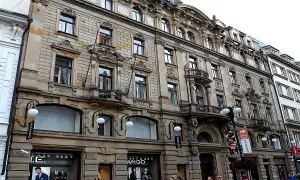
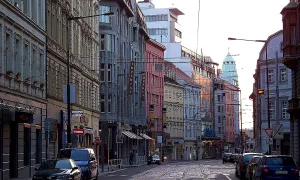
Today, the original Church of Saint Vojtěch Menší no longer stands; its location is marked by a building with the address čp. 1355 and the restaurant "U tří bojovníků." While visitors cannot explore the church itself, the site remains an important historical point in Prague's rich tapestry of stories and legends. Its legacy continues to captivate those interested in the city's medieval past and its spiritual heritage.
The Church of Saint Vojtěch Menší offers a glimpse into Prague's layered history, where legend intertwines with documented events. While the physical structure may no longer exist, its story endures as a testament to the region's cultural and religious evolution. Visitors are invited to explore this historical site and reflect on its significance within the broader narrative of Prague's past.
Historical milestones
- 1351
- The church is documented as a parish church.
- 1420
- The church was damaged by fire during the Hussite Wars but later restored.
Architectural development
The Church of Saint Vojtěch Menší underwent significant changes over its history. Initially built before 1230, it was restored after being damaged in a fire during the Hussite Wars in 1420. The church's architectural style and specific phases are not well-documented.
Historical events
In 1420, during the Hussite Wars, the church was damaged by fire but later restored and served under both Catholic and Utraquist rites.
By 1790, the church had ceased to exist.
Points of interest
- The legend of Durynk and Prince Neklan adds a mystical layer to the Church of Saint Vojtěch Menší's history, highlighting local folklore about supernatural retribution and redemption. - A mysterious tale tells of a priest celebrating midnight mass at Christmas in an empty church, believed by some to be Saint Vojtěch himself, symbolizing the site's enduring spiritual significance. - The church served both Catholic and Utraquist rites after its restoration post-Hussite Wars, reflecting Bohemia’s religious diversity during turbulent times. - Despite its historical importance, specific architectural details of the Church of Saint Vojtěch Menší remain largely undocumented, leaving much to speculation about its original design. - Today, the site is marked by a modern building at čp. 1355 and the restaurant "U tří bojovníků," preserving the memory of this medieval church within Prague's urban landscape.
Guide
This guide is narrated by a synthetic voice generated by artificial intelligence.
Show guide text
This text was created by artificial intelligence and has not been editorially reviewed. It may contain inaccuracies.
You will no longer see the Church of Saint Vojtech the Lesser today. It stood in Prague's Podskalí, at the corner of what are now Plavecká and Vyšehradská streets. This place was called v Koutku. Today, there stands house number 1355 with a restaurant called U tří bojovníků.
The church existed already before 1230 and is mentioned as a parish church in 1351. Its origins are accompanied by a legend. A man named Durynk allegedly hanged himself on an alder tree here after being struck by the wrath of Prince Neklan. Durynk had killed a child whom the prince had entrusted to his care. From that time on, an evil spirit appeared at this place in the form of a black bird, or Ohnivec. To stop its haunting, they decided to build a church here dedicated to Saint Vojtech. When a new church with the same patron saint was later built in Jirchářích, the Podskalí church began to be called the Church of Saint Vojtech the Lesser. Its original appearance is probably captured in the oldest veduta of Prague. It comes from the Latin illustrated chronicle of Hartman Schedel, published in 1493.
In 1420, during the Hussite troubles, the church was damaged by fire. However, it was soon rebuilt and masses were celebrated there under both kinds. When the church fell back into Catholic hands, Prague lacked priests. The Podskalí residents therefore had difficulty finding a parish priest for a long time. They pleaded with the Archbishop of Prague, the abbot of Emmaus, and the Vyšehrad chapter, but to no avail. Masses were celebrated there only occasionally.
Another legend is connected to this time. Once at Christmas, the bell of this church joined in with the bells of Emmaus. The inhabitants came running and saw the church lit up. An unknown priest in a bishop's mitre was there with his assistant, preparing to celebrate midnight mass. The people in the crowded church were happy that they could celebrate Christmas as it should be celebrated, and in their own church. After the blessing, the priest and his assistant went to the sacristy. The sexton, who had never seen them before, went to look after them, but the sacristy was empty. One old woman then told how, when she left the church first, she saw a bright light in the sky and two figures ascending upwards. Everyone believed that it was Saint Vojtech himself who had celebrated the mass, taking pity on the abandoned sanctuary and its parishioners.
According to written sources, the church remained under the spiritual administration of the Church of Saint Vojtech the Greater on Prague's New Town until 1784. In 1790 it ceased to exist.
Businesses nearby
Do you run a restaurant, accommodation, shop, museum, rental, wellness or other visitor service near this monument? Show yourself directly to the people heading to it — this is how they will see you in the app and on the web:
Tips from visitors
No tips yet. Be the first!
Log in and add your tip.
Sources and literature
Faktickým podkladem tohoto textu byl článek na Wikipedii, jehož autory jsou přispěvatelé Wikipedie. Článek je dostupný pod licencí CC BY-SA 4.0.
More monuments – Nové Město
Show all in the municipality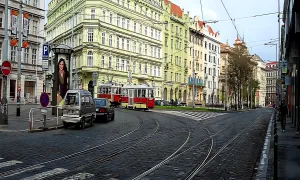


Příběhy a pověsti
Legendy, pověsti a příběhy spjaté s touto památkou
Fotografie návštěvníků
Zatím žádné fotografie. Buďte první, kdo přidá fotografii z návštěvy!
Log in a přidejte svou fotografii nebo hodnoťte.
Za ověřenou návštěvu v aplikaci získáte víc bodů — poznáme podle GPS, že jste na místě.
Reviews and comments