



kostel Zvěstování Panny Marie v Mariánském Týnci Church
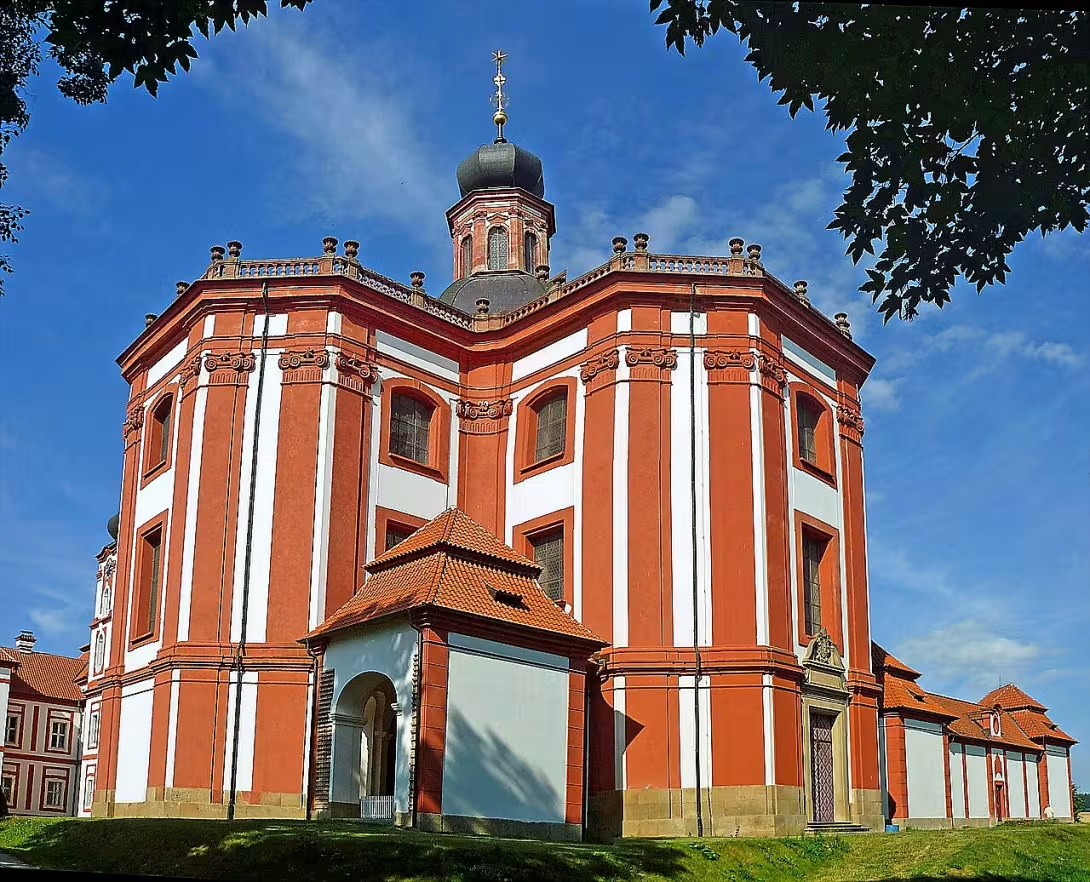
The Church of the Annunciation of the Virgin Mary in Mariánské Týnec near Kralovic is part of the former Proboststvo of the Pláské těciách monastery. He was born out of religion and became one of the important Baroque buildings of the Czech countryside.
The history of the place goes much deeper than the construction itself. The first mention of the local chapel of St. Peter and Paul comes from the papal bulge of Pope Innocence IV from the year 1250, when it was taken care of by the monastery of plastics. In the first decade of the 16th century, the monastery placed a wooden sculpture of the Annunciation of the Virgin Mary and the Archangel Gabriel. The believer attributed them miraculous effects, and the place gradually became the destination of the pilgrims. In 1518, the temple was robbed, severely damaged during the 30-year war. Abbot Jakub Vrchota of Rosenwert, however, restored and expanded it in the years around 1640 and again from 1648 to 1651. In 1699, a proboscy was established on the site.
At the beginning of the 18th century, the Abbot Eugen Tyttl realized that the original buildings were no longer enough for the rising tide of pilgrims. He decided to build a whole new site. The project was invited by architect Jan Blažej Santini-Aichel. The cornerstone of the new church was laid with great fame on 2nd July 1711. However, the actual construction began only in 1720 under the leadership of Pilsen townsman Matìj Kondel. Construction and decoration works lasted over 30 years; The church was consecrated in 1762. The precious Baroque sculpture found a place on the main altar in 1777.
The belonging to the Metternich family and the subsequent political changes were a fatal evil for the construction. In 1785 Emperor Joseph II cancelled the monastery. A year later, the sculpture was taken to the church of St. Peter and Paul in Kralovice. The abandoned area began to fall gradually in poverty. Metternichs only used it economically and set up a granary in the church.
It was only in 1920 that a disastrous collapse of the dome and part of the vaults threatened, that rescue enthusiasts called. Among them were architect Hanuš Zápal and historian Ladislav Lábek. They set up the Union to save Mariánska Týnica, and with great efforts they prevented total destruction. Since 1952, the regional museum has been based here. Between 1953 and 1956 the reconstruction was covered with new roofs above the side shoulders. Today, this baroque ensemble stands as proof of the long relationship between the Czech countryside and the vortex and as a monument to the craft effort of the past centuries.
Then and now
Drag the slider to compare how the landmark may have looked when it was built with the view today.
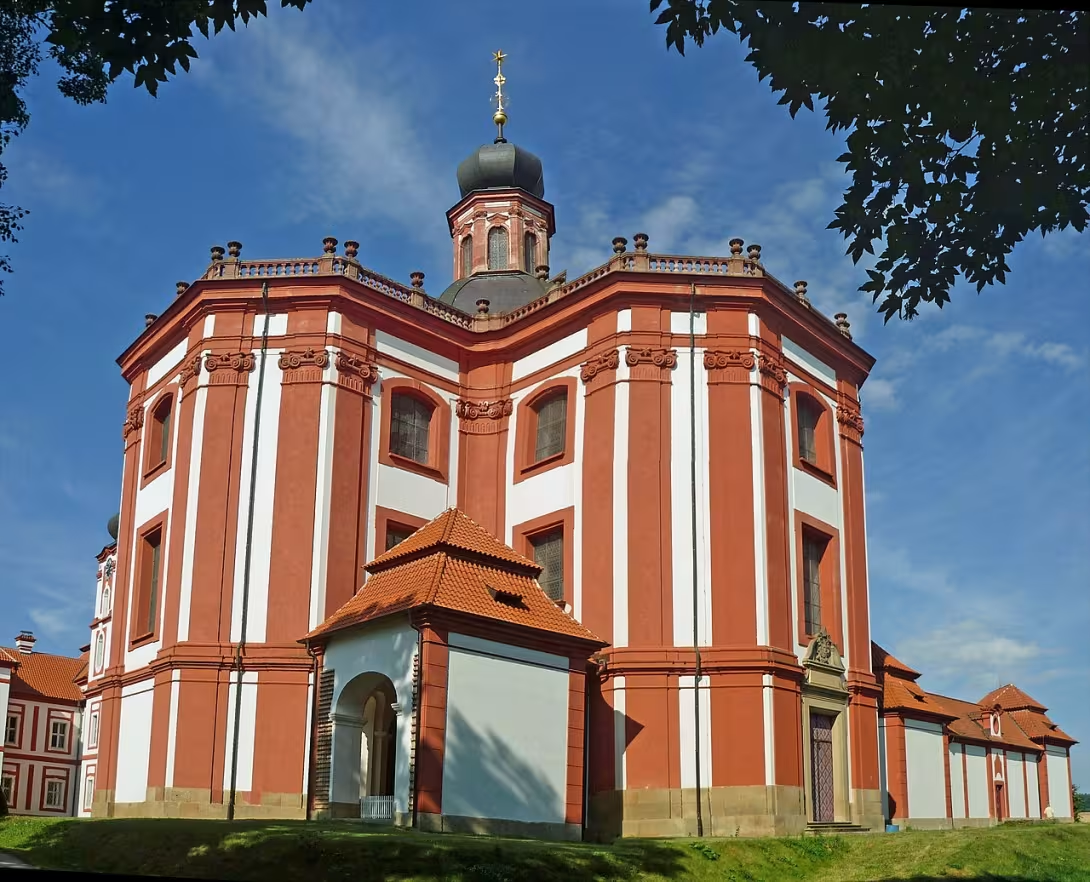

The historical appearance on the left is an AI-generated visualisation and serves as inspiration only.
Historical milestones
- 1250
- The first written mention of the chapel of St. Peter and Paul in Týnka in the bull of Pope Innocence IV.
- 1518
- Robbery of the church and the beginning of the pilgrimage cult around the miraculous sculpture of the Annunciation of the Virgin Mary.
- 1711
- The laying of the foundation stone of the new church and the premises.
- 1785
- Cancellation of the monastery in the Plasi and the demise of the pilgrimage place.
- 1920
- The collapse of the church dome and the launch of rescue work.
- 2018
- Declaration of the church and grounds for the national cultural monument.
Architectural development
The church was built as a Baroque three-boat building with a dome and rich decoration. The original Gothic church from the 16th century was rebuilt and expanded between 1640 and 1651, but the final Baroque form was obtained only in the 18th century. The main altar was supplemented by the miraculous sculpture of the Annunciation of the Virgin Mary in 1777. There was a partial collapse in the 19th century, which required provisional measures. In the 20th century there was stabilization and the area was used as a museum.
Historical events
- 1250
- The first written mention of the chapel of St.
Owners
1250-1785 – Cistercian monastery in Plas (Patronage Law); 1785-1920 – Religious fund, then the Metternich family; since 1952 – Regional Museum (area).
Points of interest
- The Church of the Annunciation of the Virgin Mary was created at the site of the elder chapel of St. Peter and Paul, which is the first mention in the papal bull from 1250.
- The wooden sculpture of the Annunciation of the Virgin Mary and the archangel Gabriel was located in a place around 1500 and served as a pilgrimage site with its miraculous effects.
- The church was damaged during the Thirty Years' War and Abbot Jakub Vrchota restored it and extended it in the years around 1640 and again in 1648-1651.
- The construction of the present church began only in 1720 after the decision of Abbot Eugene Tyttle, who had the original buildings demolished due to the increasing number of pilgrims.
- In 1785 the monastery was abolished by Emperor Joseph II, the church was abandoned and its premises served as a granary.
Guide
This guide is narrated by a synthetic voice generated by artificial intelligence.
Show guide text
This text was created by artificial intelligence and has not been editorially reviewed. It may contain inaccuracies.
The Church of the Annunciation of the Virgin Mary in Mariánský Týnec near Kralovice dates from the eighteenth century. It stands in the area of the former provost's residence of Mariánská Týnice, which belonged to the Cistercian monastery in Plasy. The church together with the entire area is a cultural monument and in 2018 it was declared a national cultural monument.
The origins of this place go back to the year 1250. At that time, in a bull by Pope Innocent the Fourth, there first appears the chapel of Saint Peter and Paul in the small settlement of Týnec. The Plasy monastery held the patronage over it. In the first decade of the sixteenth century, the monastery acquired a wooden sculptural group of the Annunciation for the church, depicting the Virgin Mary with an angel. The sculptural group became a pilgrimage destination due to its miraculous effects and the place received the name Mariánská Týnice. In 1518 the church was plundered. It was then cared for by one of the Plasy monks, who lived there as a hermit. Further devastation was brought by the Thirty Years' War. Abbot Jakub Vrchota of Rosenwerth had the small church rebuilt and enlarged, first around 1640 and again in the years 1648 to 1651. In 1699 a provost's residence was established here.
A decisive turning point came with Abbot Eugen Tyttl. Around 1707 he began to collaborate with Jan Blažej Santini-Aichel and decided that the older structures, which could no longer accommodate the growing influx of pilgrims, would give way to an entirely new complex. The project was completed in May 1710 and the foundation stone was laid on July second, 1711. However, construction did not begin until 1720. The builder was Matěj Kondel, a citizen of Plzen, and the construction and decoration lasted over thirty years. The church was consecrated in 1762 and the Annunciation sculpture group was placed on the high altar only in 1777.
As early as 1785, however, Emperor Joseph the Second dissolved the Plasy monastery and the pilgrimage site. The sculptural group was moved a year later to the Church of Saint Peter and Paul in Kralovice. The area was then administered by the Religious Fund and for more than a hundred years was owned by the Metternichs, who established a grain store in the church. The building deteriorated. Enthusiasts led by historian Ladislav Lábek and architect Hanuš Zápala opposed the dismantling of the structure. In 1920 the dome and part of the vaults collapsed. The Association for the Rescue of Mariánská Týnice, led by Zápala, had the church provisionally roofed with tar paper and averted complete destruction, though it became indebted due to the costs. The association was unable to expropriate the area.
From 1952 onwards, a regional museum moved into the complex. In the years 1953 to 1956 the side wings of the church received new roofs.
Tips for visitors
Best time to visit the Church Annunciation of the Virgin Mary is in the morning or in the afternoon. There are fewer visitors in these times and you can see the interior more calmly. Baroque architecture and light that penetrates windows creates a unique atmosphere in the church that is most beautiful in these times.
The church is accessible by car and public transport. It is recommended to come up with sufficient time because local transport may not be too common.
When visiting, wear comfortable clothes and shoes because the church and the surrounding area include outdoor parts with the possibility of walking. In winter, pack even warmer clothes. Further prepare your camera or mobile phone, but remember that some parts of the church can be protected and photography is limited here.
The best places for photography are mainly the exterior facade of the church and its surroundings, where there is plenty of light and pleasant composition. In the interior it is worth focusing on Baroque decoration, altars and other historical elements. It is recommended to take pictures in light, such as morning or afternoon sun.
In the vicinity of Mariánska Týnka is worth visiting the Church of St. Peter and Paul in Kralovice, located about three kilometres from the place. This church is connected to the original location of the miraculous sculpture of the Annunciation of the Virgin Mary. Another interesting thing is the Cistercian monastery in Plasi, whose ruins are located about ten kilometres from Mariánska Týnka.
For families with children, a visit to the Church of the Annunciation of the Virgin Mary is appropriate because children can be intrigued by baroque architecture and historical details. In the vicinity of the church there is also space for short walks and nature observation. It is recommended to explain to children the history of the place and the importance of the pilgrimage area.
Frequently asked questions
Can the monument be visited?
Religious buildings are usually open mainly during services; at other times a visit is normally arranged with the parish or the operator. We have not verified specific times.
Where is the monument?
Location: Mariánský Týnec, Plzeňský kraj. The map on this page shows the exact spot.
Why is the monument protected?
It is listed in the Central List of Cultural Monuments of the Czech Republic as a national cultural monument. It is protected as part of a larger listed ensemble.
For kids
Imagine going back to the past in the Middle Ages. It was a time full of stories and legends. And now let's look at one of the greatest monuments of the time - kostel Zvěstování Panny Marie v Mariánském Týnci.
How did it look here? Who lived here? What happened here? Let's turn back to the past and find the church standing in the middle of a small town. People here lived in wooden houses, fed on agriculture and animal breeding. They had their own craft - blacksmiths, weavers, masons... everyone did something else.
Businesses nearby
Do you run a restaurant, accommodation, shop, museum, rental, wellness or other visitor service near this monument? Show yourself directly to the people heading to it — this is how they will see you in the app and on the web:
Accommodation nearby
Trips and activities nearby
Guided tours, tickets and activities nearby from GetYourGuide
Affiliate link: if you buy from the partner, we may receive a commission. The price for you does not change.
Search tours and activities →Themed route
Thematic cruise route: Baroque and tanker tracks Pilsen
1. Church of the Annunciation of the Virgin Mary in Mariánska Týnek * Type: Pilgrimage Baroque Church * It is a dominant village built in the 18th century as a thank you for saving us from the plague. The interior is decorated with valuable altars and statues, including a copy of the miraculous sculpture that originally stood in Kralovice.
2. Church of St. Peter and Paul in Kralovice * Type: Pilgrimage church with historical significance * About 3 km from the destination lies the church, where the original miraculous sculpture of the Virgin Mary, which later inspired the construction of the Marian church in Týnka. The area is quiet and offers a view of the surrounding flat landscape.
3. The ruin of the Cistercian monastery in Plasi * Type: Historical monument of the medieval monastery * The remains of the monastery abolished in 1785 are approximately 10 km from the destination. Romantic ruin with towers and abandoned corridors attracts lovers of history and photographers.
* Tip: * The route combines spiritual and historical monuments in a quiet rural environment, ideal for cyclists or cars. All points are connected by local roads.
Seasonal recommendations
Spring: In the spring of Mariánska Týnka, the Church of the Annunciation of the Virgin Mary is surrounded by beautiful flowering gardens and seedlings that bring live colour and freshness. The sun illuminates an ancient church in fine sunlight, creating ideal conditions for photography. Even if you avoid the crowd in the meantime, it is advisable to wear a warm jacket or coat for the morning visit.
Summer: The atmosphere is full of life and energy in the summer of Marian Týnka. The Church of the Annunciation of the Virgin Mary stands out against the background of green mountains and forests that are ideal for picnics or long walks around the surrounding region. In the main summer season you can meet with a higher frequency of visitors, so it is advisable to come to the sights earlier in the afternoon and use the mild weather for a comfortable tour. Don't forget to wear sun cream and drinking cream because the temperature is higher.
Autumn: Autumn visit to the Church of the Annunciation of the Virgin Mary offers a unique atmosphere with colorful forest vegetation and quieter sidewalks. The sun sets early, which creates a romantic light for sightseeing. This season you can avoid pushing crowds and enjoy a quieter environment. It is recommended to wear a warm jacket or a baseball cap because the weather is usually variable with cooler evenings.
Winter: Winter Mariánský Týnec offers peace and quiet around the Church Annunciation of the Virgin Mary, which is often covered with snow. The sunny days bring a beautiful atmosphere where ancient shards of church light up in the icy light. Remember to wear warm clothes, including jackets, gloves and shoes suitable for cold weather.
Visualizations and artistic views


The visualisations are generated by artificial intelligence and serve as inspiration.
Photos from the area
Real photos taken near the monument


Zdroj a licence jsou uvedeny u každého snímku.
View from the area
This animation was generated by artificial intelligence from a real photograph of the surroundings. The motion and details are not real footage of the location.
Atmosphere of the place
This atmospheric visualisation of the place and period was generated by artificial intelligence. It is not real footage of the location.
Tips from visitors
No tips yet. Be the first!
Log in and add your tip.
Sources and literature
Photos: SchiDD / CC BY-SA 4.0 — Wikimedia Commons. The author and licence also appear when you hover over the image.
Faktickým podkladem tohoto textu byl článek na Wikipedii, jehož autory jsou přispěvatelé Wikipedie. Článek je dostupný pod licencí CC BY-SA 4.0.
Location on the map
More monuments – Mariánský Týnec
Show all in the municipality



Příběhy a pověsti
Legendy, pověsti a příběhy spjaté s touto památkou

Fotografie návštěvníků
Zatím žádné fotografie. Buďte první, kdo přidá fotografii z návštěvy!
Log in a přidejte svou fotografii nebo hodnoťte.
Za ověřenou návštěvu v aplikaci získáte víc bodů — poznáme podle GPS, že jste na místě.
Reviews and comments