






kostnice a kaple Nejsvětější Trojice Chapel
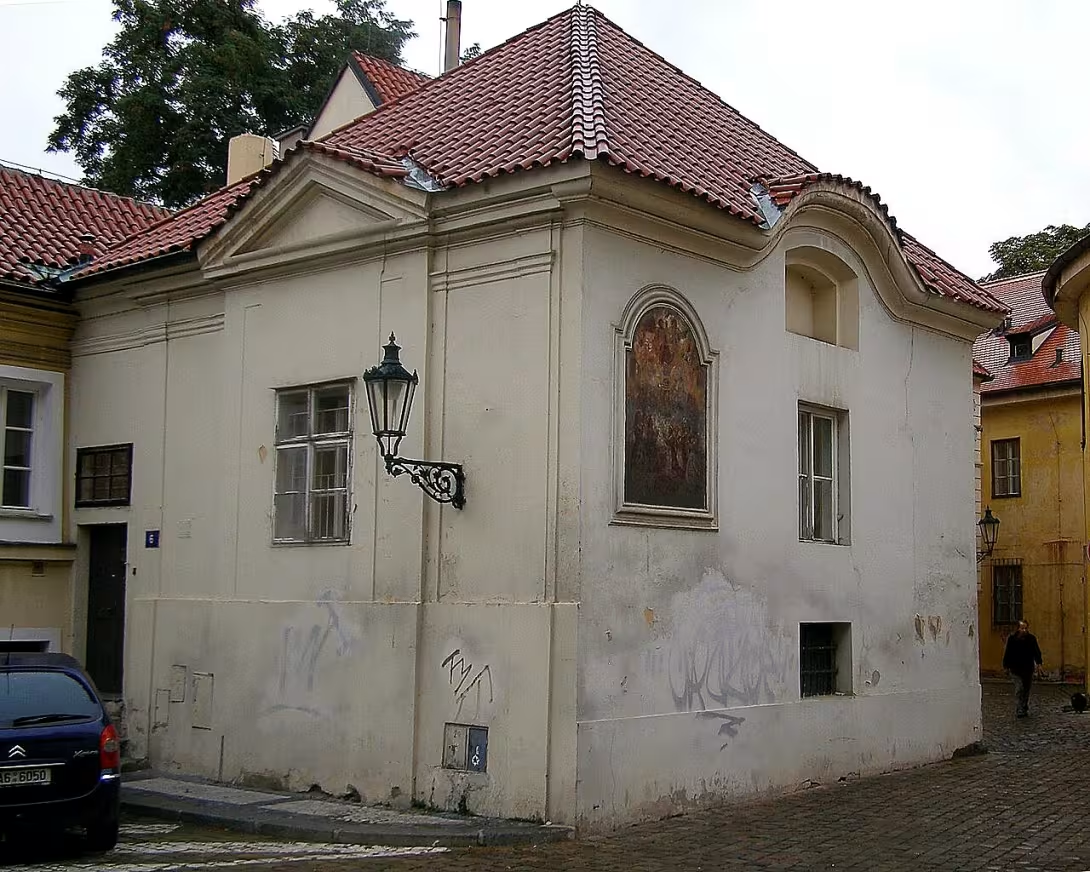
The Chapel of the Holy Trinity, formerly known as the Haštalská Bones, is a baroque building located in the place of the former Saint-Hashtali cemetery in Prague's Old Town. This monument is significant thanks to historical changes, when it served as a skeleton, chapel and later as a church dwelling.
The first written mention of the skeleton dates back to 1601. In 1702, the building burned down along with the church of St. Hastala. The new rover was raised this year thanks to Marty Lochman's legacy. In 1717 a new skeleton was built, which performed its original function for approximately another hundred years. After the abolition of the Saint-Hashtali cemetery in 1832, the building was transformed into the church's residence, which included, for example, the abolition of the original rise from the west and the change of disposition, creating a corridor leading to today's kitchen.
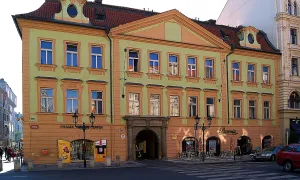
The architectural issue is the construction of a trapezoidal plan coming from the high baroque. The facade in the west facade is not an axis, but it's moved south. There is a flat risalite with a window in the middle and above it is a small triangular front with an engraved year 1660. On the southwest corner is placed the painting of the Holy Trinity from 1717 with the Latin inscription Sancta Trinitas miserere nobis. The building is decorated with traces of painted rustic on a yellow base and the window of the original skeleton along with a deep segment-top niche is visible in the south front.
The interior of the building is now divided into different spaces. The entrance is located in the west facade on the left, from where the stairs lead to the floor and further to the apartment space. The chapel's space has a rectangular floor plan with scuttled corners in which half-circle niche is excavated. The ceiling of the chapel consists of a dome in the shape of a compressed ellipse, on whose face the presence of a fresco from the construction period is assumed. A kitchen with a half-circle vaulted vault is adjacent to the chapel space.
This object represents a fascinating testimony about changes in Prague's Old Town and changes in the perception of the area of cemetery buildings. It is recommended to visit this place so that visitors can explore the details of Baroque architecture and understand the history that took place at this place.
Historical milestones
- 1601
- First written mention of the skeleton.
- 1702
- Burning the skeleton together with the church.
- 1717
- Position of a new skeleton and creation of a painting on the facade.
- 1832
- Cancellation of St. Hashtali cemetery and change of function of the building.
Architectural development
The construction has a flattering plan and comes from the period of the high Baroque. After the fire in 1702, a new skeleton was built, which was later rebuilt into a chapel. The architecture contains elements such as segment niche, triangular front and the painting of the Holy Trinity from 1717.
Historical events
In 1601, the first written references to the skeleton appear. In 1702 she burned down together with the church of St. Hastalus. In 1832, the St. Hashtali cemetery was abolished.
Points of interest
- The Chapel of the Holy Trinity was formerly known as the Haštalská Skeletka and is located in the place of the former Saint-Hashtali cemetery in Prague's Old Town. - The first written mention of the skeleton dates back to 1601, but the building burned down along with the church of St. Hashtala in 1702. The new rover was built thanks to Marty Lochman's legacy. - After the abolition of the cemetery in 1832, the building was transformed into a church's residence, which included a change of disposition and a cancellation of the original entrance from the west. - Architecturally, it is the construction of a trapezoid floor plan from the high baroque with a facade moved south, a flat risalite and a painting of the Holy Trinity from 1717. - The interior is divided into areas of the chapel and apartment space with dome in the form of compressed ellipse, which is expected to contain fresco.
Guide
Show guide text
This text was created by artificial intelligence and has not been editorially reviewed. It may contain inaccuracies.
Welcome to the Old Town, right here in front of you is one of the most distinctive and wonderful monuments of this place. You're standing in front of a building that hides stories of centuries, whose purpose has changed almost every generation over time. It's a Haštal skeleton, now known as the Holy Trinity Chapel. Its quiet, almost sheltered facade may surprise you with its modesty, but beneath it lies a rich and sometimes dark history.
Let's take a look together at how this house came into being and how its fate evolved. The first written mention of this building dates back to 1601, when it served as part of the St. Hashtal cemetery. But it was a different time, full of different dangers. And just one of them hit her fully. In 1702, the whole building, along with the nearby church of St. Hashtala, burned down. But the fiery doom did not mean its complete demise. In 1717 it was built again, as a new skeleton. On that occasion there was also a painting on the facade that was characteristic of this type of building. However, the time was relentlessly running and in 1832 the Holy Hashtali cemetery was definitively abolished. Since then, the building has lost its original function and its purposes have been constantly changing - from the skeleton to the church's residence. Today's design of the building is later modifications, which have significantly changed its original disposition.
Now that you stand before her, pay attention to her facade. Note how the individual parts of the building are aligned, even if they were created at different times. It's proof of how architecture adapted to the needs of every era. Although the name of a particular architect was not preserved, it is clear that it was a man who understood the needs of the place. Among the personalities associated with this building, we will also find the name Marty Lochman, who was involved in his fate.
One of the greatest attractions of this monument is its transformation. It's magical how one building could serve as a cemetery skeleton, then as the chapel of the Holy Trinity, and eventually as a common house. It's a story about the life and adaptability of architecture that survived fires, changes in society and changes in purpose. It's a little mystery what all the sentences were written on her walls before she became what she is today.
Thank you for having this moment with us. If you feel like it, continue down the street and discover more gems of Old Town. Every building, every stone has a story. We look forward to meeting again.
Tips for visitors
The best time to visit Hashtalská kostnice a kaple Nejsvětější Trojice is in the spring or autumn period. In these months the weather is pleasant, which allows comfortable exploration of historical buildings without excessive heat or humidity. Visit the place in quiet time, for example Sunday afternoon to make less people.
It is appropriate to use public transport for access to the Hashtali Cube. The location is located in the center of Old Town and is easily accessible by tram or bus, which passes the proximity of the church of St. Hasthal. Parking can be limited, therefore we recommend using public transport. Check the current connection and parking possibilities before visiting.
When planning a visit to the Hashtalské koska, remember the appropriate clothes, especially if you visit during the winter. It may be useful to carry a purse or blankets, because some parts of the building may not be warm. Also remember the camera to capture historical details and architecture.
Photography in the Hastal Cube offers interesting possibilities, especially because of the light that penetrates through the chapel windows. The best times for pictures are in the morning or in the evening when light is softer and shading contributes to dramatic effects. The inner space of the chapel offers beautiful possibilities for detailed images.
In the vicinity of the Hashtalská Koštěch there is the Church of St. Hashtala, which is an exceptional architectural monument and offers beautiful interiors for sightseeing. This church can be an interesting addition to visiting the Hashtalské kopelka, especially if you are interested in the history and architecture of Old Town.
For families with children, the Haštal skeleton is an interesting place to learn about history. Children may notice old burial tombstones and architecture, which may be an opportunity to discuss the past and historical care. Visit the Church of St. Hashtala, which offers beautiful rooms for a fun tour.
Businesses nearby
Do you run a restaurant, accommodation, shop, museum, rental, wellness or other visitor service near this monument? Show yourself directly to the people heading to it — this is how they will see you in the app and on the web:
Events nearby

Zdroj akcí: otevřená data měst a obcí ČR (Národní katalog otevřených dat) a kalendář akcí Národního památkového ústavu.
Nearby
Kostel svatého Haštala, Staré Město v Praze.
Accommodation nearby
Trips and activities nearby
Guided tours, tickets and activities nearby from GetYourGuide
Affiliate link: if you buy from the partner, we may receive a commission. The price for you does not change.
Search tours and activities →Themed route
Church of St. Hashtala - Baroque church - beautiful interior with altar and shaded frescoes, gives a feeling of medieval traditions. Chapel of the Holy Trinity - painting chapel - unique gazebo architecture and illuminating paintings, ideal for blue religious impression. Staré Město - historical village - smooth street, old building and market, ideal to relax and see the full history of Prague.
Path: From the Church of St. Hashtala (300m) passes through the bed, where it then goes to the Chapel of the Holy Trinity (400m), and finally goes to Staré Město (400m) to laugh at the Old Town Square and the streets. All places are part of the submitted "Surrounded" and contain no other monuments.
Seasonal recommendations
Spring: In the spring season the atmosphere around kostnice a kaple Nejsvětější Trojice in Old Town is beautiful because of the amazing sun rays that illuminate ancient architecture. Flowers begin to bloom around the monument and add to the region the breath of life. For the visit it is advisable to go in the early afternoon time when the temperature is quietest and the crowd is less. It is recommended to wear clothes with the possibility to adapt to mild cool winds.
Summer: The summer is Staré Město full of life and the skeleton along with the chapel of the Holy Trinity offers a beautiful opportunity for relaxation under warm sunlight. Imagine smiling days when everything is green and blooming, which gives the visit a romantic feeling. The best time to walk is morning or evening to avoid the main crowds. It is advisable to take sunglasses and UV protection cream with you.
Autumn: In autumn months, Staré Město offers a unique atmosphere when the surrounding area is covered with yellow leaves and the sun is hidden soon beyond the horizon. This season brings a quieter attendance of the monument, which allows a better tour without unnecessary crowd pressure. We recommend wearing warmer clothes and perhaps an umbrella in case of first rainy days.
Winter: Winter Staré Město is full of magic when kostnice a kaple Nejsvětější Trojice shines under the snow cover. Sun rays light up snowy alleys and create beautiful contrasts on ancient facades. This season the opening hours are usually shorter, so you better leave early. It is necessary to carry a warm coat and protective shoes for snow conditions.
Visualizations and artistic views

The visualisations are generated by artificial intelligence and serve as inspiration.
Photos from the area
Real photos taken near the monument

Zdroj a licence jsou uvedeny u každého snímku.
Tips from visitors
No tips yet. Be the first!
Log in and add your tip.
Sources and literature
Photos: Michal Kmínek / CC BY-SA 3.0 — Wikimedia Commons. The author and licence also appear when you hover over the image.
Faktickým podkladem tohoto textu byl článek na Wikipedii, jehož autory jsou přispěvatelé Wikipedie. Článek je dostupný pod licencí CC BY-SA 4.0.
Location on the map

Příběhy a pověsti
Legendy, pověsti a příběhy spjaté s touto památkou

Fotografie návštěvníků
Zatím žádné fotografie. Buďte první, kdo přidá fotografii z návštěvy!
Log in a přidejte svou fotografii nebo hodnoťte.
Za ověřenou návštěvu v aplikaci získáte víc bodů — poznáme podle GPS, že jste na místě.
Reviews and comments