



Litinová kašna Fountain
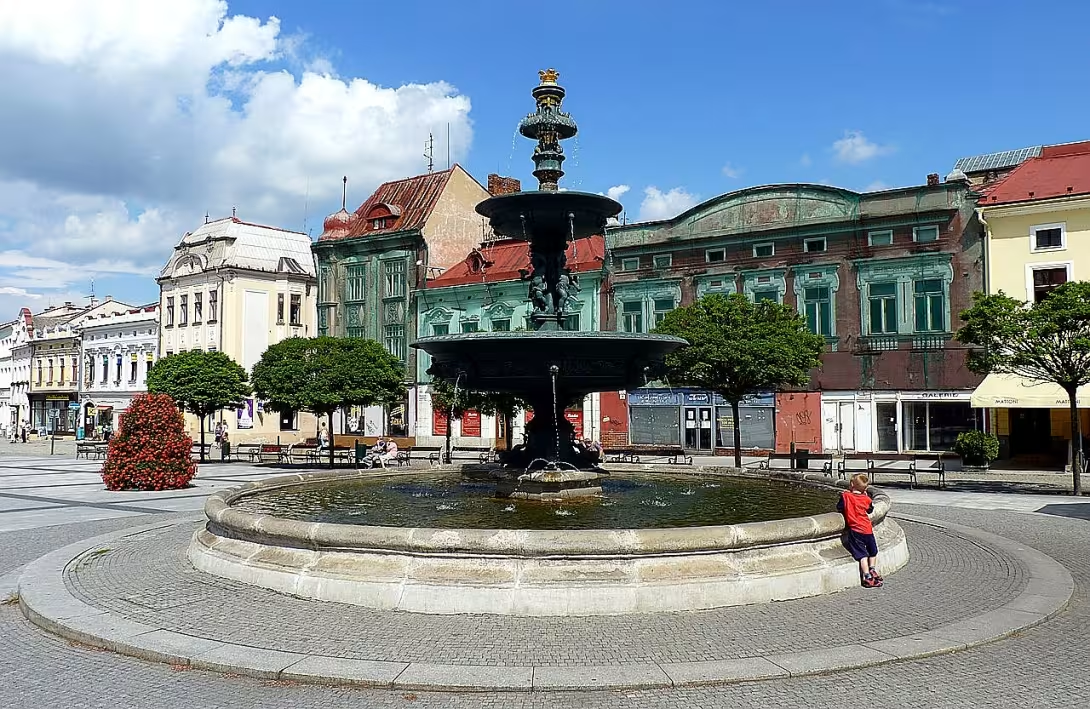
Litinová kašna is a historic water work located in the middle of Masaryk Square in Fryštát, Karviná district. This building is a cultural monument of the Czech Republic and represents the main dominant part of the local square.
The history of the water works in this place dates back to the 16th century, when there was a wooden tank. In 1539, it was invented by masons. The original construction was replaced by a new brick tank in 1793, to which running water was brought from the well Pod Lipami in Paradise. The current cast iron fountain was built in 1900 according to drawing No. 1416 of the company George Wirth from Vienna. The installation was carried out by the installer of the company Wirth-Georg Meurer and the plumbing was performed by Mr. Spangarc from Těšín. The restaurant and gilding of the building took place in 1983.
The architectural solution of the fountain includes a circular sandstone tank with a diameter of seven meters with a profiled stone railing on the base. On this is the dating 1900 and the bronze emblem of Karviné. Above the tank is a cast iron fountain five meters high, consisting of a joint leg and two narrowing up decorated bowls. The bottom bowl has a diameter of approximately 3.7 meters, while the top bowl has a diameter of two meters.
The visual aspect of the work is richly decorated with motifs of plant ruins, wreaths, volutes, fallopian and pearl. The bottom part of the cast iron fountain is decorated with dolphin sculptures, while in the middle part above the bottom bowl is placed four putts representing four seasons. The peak of the fountain ends with a golden rose and water from the bowl flows through the lion's head.
This object is a valuable historical element that documents the development of water management and craft work in the region. It is a suitable destination for visitors interested in historical architecture and detailed decoration.
Then and now
Drag the slider to compare how the landmark may have looked when it was built with the view today.
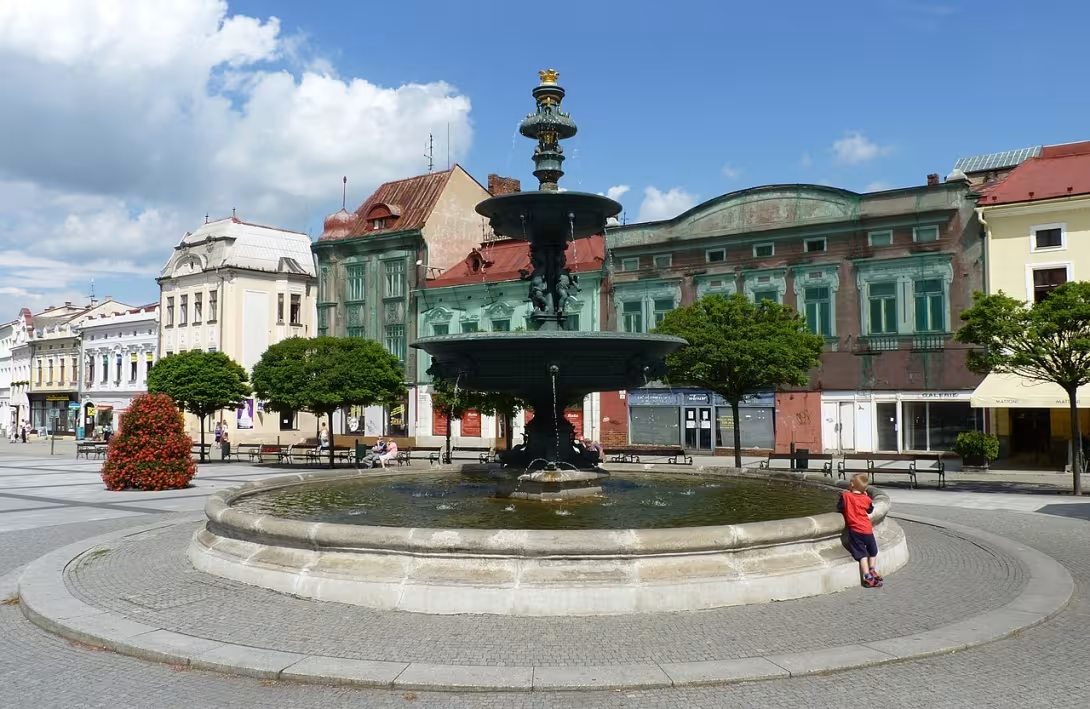

The historical appearance on the left is an AI-generated visualisation and serves as inspiration only.
Historical milestones
- 1539
- Vomiting of wood tank by masons
- 1793
- Position of new masonry tank
- 1900
- Position of new cast iron fountain according to the drawing by George Wirth
- 1983
- Restaurant and gilding fountain
Architectural development
Originally, there was a wooden tank from the 16th century, which was picked up in 1539 by masons. In 1793 it was replaced by a new wall tank with water supply from the well Pod Lipami. The current cast iron fountain was built in 1900 according to a drawing by George Wirth from Vienna.
Historical events
1539 - emesis of wood tank by masonry; 1793 - construction of a new brick tank; 1900 - installation of new cast iron fountain; 1983 - restaurant and gilding fountain.
Points of interest
Four-stage decoration includes putta representing four seasons. The peak of the fountain ends with a golden rose. The water from the bowl flows through the lion's head.
Guide
Show guide text
This text was created by artificial intelligence and has not been editorially reviewed. It may contain inaccuracies.
Welcome to Fryštát. You have just stopped in the heart of this place, in Masaryk Square, where you are welcomed by this incredible water unit. You're standing right in front of a cast iron fountain, which is the absolute dominance of this entire space. If you look around you, you'll see how this water part immediately attracts the attention of every bystander and becomes the center of everything. It's a place where history, art and living water meet. The whole building is very high and looks very noble, as it reaches a height of five meters. The whole structure is built on a wide circular sandstone tank with a diameter of seven metres. This sandstone base gives the whole part a sense of stability, strength and deep connection to the soil, while the cast iron part itself excels with its fineness and rich decoration.
Let us now move further into the past together so that we can understand how this water world was created and how it changed over the centuries. The history of this place is not short, it's a long story that stretches back hundreds of years. Already in the year one thousand five hundred thirty-nine here, the village bricklayer had removed the original wooden tank. Imagine the work at that time, with the help of masters from far-off landscapes, creating this place for water at a time when every building was a great effort. Over time, however, the needs of the city and technology changed, and in the year one thousand seven hundred ninety-three a new, stronger brick tank was built. But what you admire today with admiration is a work from another, more industrialized period. In a thousand and nine hundred, according to the precise drawings of Master George Wirth, this new cast iron fountain was built. It was this moment that made a big difference to Fryštát because the fountain gained its present form and elegance. But in order for this treasure to survive for centuries and still to please us so beautifully, in the year one thousand nine hundred and eighty-three a thorough restaurant and gilding had to be carried out, thanks to which the fountain shines again with its original shine and beauty.
Now pay attention to all the wonderful details that are right in front of your eyes. While you're looking at the cast iron body of the fountain, notice how richly decorated it is with plant motifs. These shapes of leaves and flowers give metal a sense of nature and life, as if metal plants really intersect with living water. If you look closer, you can see other fascinating creatures. There are dolphin sculptures that, by their motion, provide a whole dynamic and remind us of the endless movement of water. And then there are those little gentlemen, putta. There are just four of them, and each of them has an important mission. Each putto represents one of the four seasons, which reminds us of the constant cycle of nature. And if you raise your eyes even higher to the top, you will see the most beautiful ending. It is a gilded rose, which in the rays of the sun must sparkle beautifully and act as the crown of the whole work. And of course, the most important thing is the water itself. Watch how it comes out of the bowl and how it flows beautifully through the heads of the lions. These lion heads add grandeur, strength and a certain majestic gesture to the whole structure.
This beauty is also supported by prominent personalities who have left their mark in the history of this place. The main architect whose vision and precise drawings allowed us to see this work was Georg Wirth. His work was absolutely crucial to the creation of this cast-iron beauty that you see right now. In the history of this place and its development there are also other names associated with the care of this square and its monuments such as Meurer or Spangarc. Their contribution and work helped keep this place in beauty and ensure that these monuments remain a part of the city's life for future generations.
If you want to find something that really surprises you and captures you, focus on the fascinating four-stage level of decorating. Each level is like another chapter in a book that tells the story of the world around us. The putts I was talking about are not just an ordinary ornament, but a symbol of life in its full diversity and constant transformation. And the golden rose on top? It's not just for decoration, but it serves as a symbol of perfection that closes this whole water track and connects it to the heavens. It is fascinating how in one work the strength of a lion, the fineness of plants, the playfulness of children and the shine of gold in one harmonious whole.
I hope you enjoyed this short tour and that you enjoyed seeing this beauty. But don't stop at this one place. Fryštát has many more surprises and secrets waiting for you to discover. So continue along the square, feel the atmosphere of this historic city and enjoy your trip every moment. Thank you for being with us. Goodbye.
Tips for visitors
The best time to visit is in the morning or late afternoon, when the sun hits the fountain at an angle that highlights the details of cast iron and texture of sandstone. At noon, the shadow can be too sharp and glitter from the water disturbing. The fountain is freely accessible at Masaryk Square, so there is no need to deal with the entrance or opening times, just come in hours when the square is safe and quiet.
If you arrive by public transport, the city stop is usually in a short walk from the square; Check the current connection and departure times in the search engine or information panels at the station.
What to take with you: As it is an outdoor monument, take comfortable shoes to walk on the pavement square. In summer, it is advisable to carry a drink and a hat, because there are not many shadows in the open. In colder months, pack your jacket because it can be cold by the water and by the wind.
Photography: The best shots are obtained from an angle that captures the entire circular tank and the height of the structure. Try shooting from the corner of the square to see the context with the surrounding architecture. The morning or evening light creates long shadows and warm colors that beautifully underline the historical nature of cast iron. Watch out for reflections from the water level that can be disruptive, so try to change the angle of the lens.
Tips for families with children: Masaryk Square is usually spacious and suitable for walks. Children can enjoy a view of the water and sculpture elements of the fountain. However, it is important to ensure that children do not come too close to the edge of the tank and do not scratch the cast iron. There are often cafes around the square where you can take a break.
Frequently asked questions
Can the monument be visited?
This is a structure in a public space that can usually be seen from outside free of charge. We have not verified that this particular one is freely accessible.
Where is the monument?
Location: Fryštát. The map on this page shows the exact spot.
Why is the monument protected?
It is listed in the Central List of Cultural Monuments of the Czech Republic as a cultural monument (register no. 1000144393).
Businesses nearby
Do you run a restaurant, accommodation, shop, museum, rental, wellness or other visitor service near this monument? Show yourself directly to the people heading to it — this is how they will see you in the app and on the web:
Nearby
Masarykovo náměstí ve Fryštátě.
Accommodation nearby
Themed route
1. Masaryk Square (Type: Square) - Space in the centre of the village, which serves as the starting point of the journey. 2. Litinová kašna (Type: water work) - The main objective of the visit, which is remarkable by its execution. 3. The immediate surroundings of the fountain (Type: space) - A place for detailed examination of the decoration and shapes of the water work.
Seasonal recommendations
In the spring, nature blooms around the cast-iron fountain and fresh smells flow through the air. The soft spring light highlights the details of the metal working. I recommend you put on a lighter jacket and visit the place in the morning when it is quiet and fewer people.
In the summer months the water works a refreshing impression in the middle of a hot day. The sun falls to the water level and creates bright reflections. Due to the great crowds in the high season come very early in the morning and don't forget light, breathtaking clothes.
Autumn brings golden leaves to the surroundings of the fountain and frequent morning fog, which give the place a mysterious atmosphere. The walks are pleasant in the afternoon when the light is softest. It will be practical to wear moisture resistant shoes and a warm sweater.
In winter, the metal structure can be covered with a fine layer of snow or frost, which looks very elegant. In advent time, the surroundings are lit and cozy. Due to the frost, choose warm laminated clothes and plan to visit before dark.
Visualizations and artistic views


The visualisations are generated by artificial intelligence and serve as inspiration.
Photos from the area
Real photos taken near the monument


Zdroj a licence jsou uvedeny u každého snímku.
Tips from visitors
No tips yet. Be the first!
Log in and add your tip.
Sources and literature
Photos: Michal Klajban / CC BY-SA 3.0 — Wikimedia Commons. The author and licence also appear when you hover over the image.
Faktickým podkladem tohoto textu byl článek na Wikipedii, jehož autory jsou přispěvatelé Wikipedie. Článek je dostupný pod licencí CC BY-SA 4.0.
Location on the map
Příběhy a pověsti
Legendy, pověsti a příběhy spjaté s touto památkou
Fotografie návštěvníků
Zatím žádné fotografie. Buďte první, kdo přidá fotografii z návštěvy!
Log in a přidejte svou fotografii nebo hodnoťte.
Za ověřenou návštěvu v aplikaci získáte víc bodů — poznáme podle GPS, že jste na místě.
Reviews and comments