



Loucký mlýn Water mill
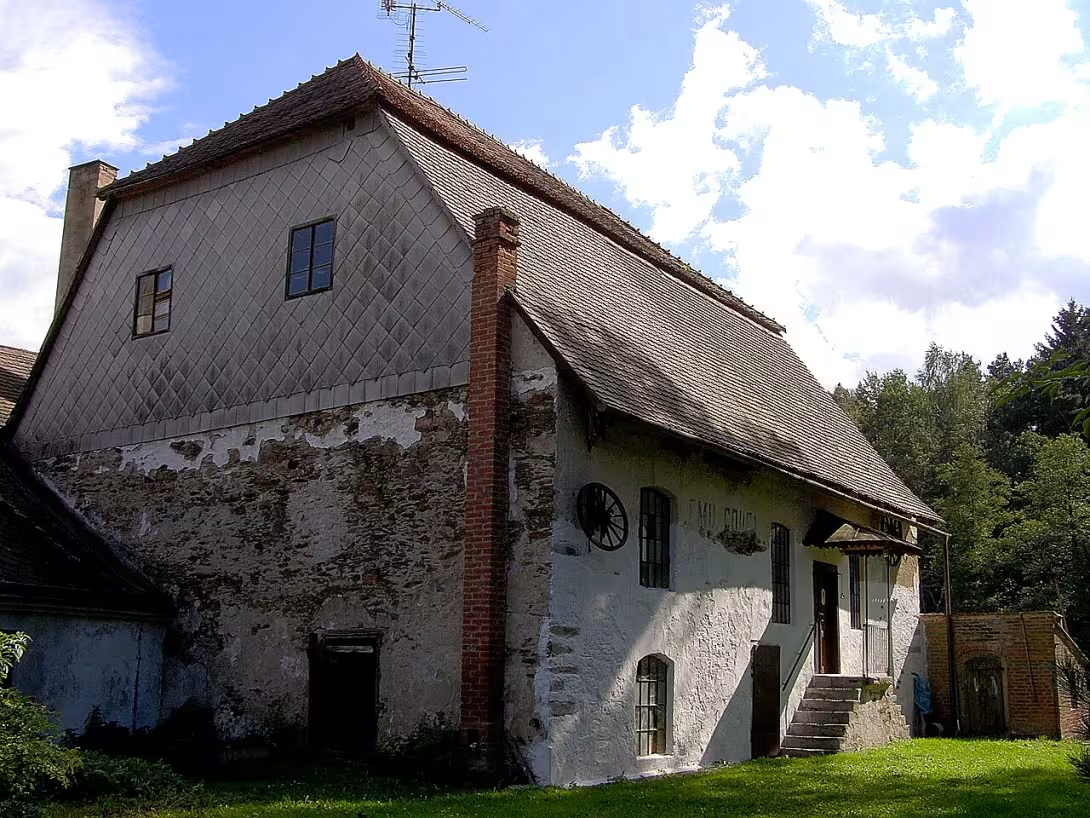
Loucký mlýn, also known as Bruckmühle, is a water mill located west of the village Staré Hobzí in the district of Jindřich Hradec. It is located on the bank of the river Moravská Dyje and its existence is confirmed by written documentation from 1190, which makes it one of the oldest preserved industrial buildings in this area. The mill is protected as a real-estate cultural monument of the Czech Republic and its present appearance is the result of extensive reconstruction after a large fire from 1901.
The history of this mill goes deep into the Middle Ages. The first written mention dates back to 1190, when Otto Český donated the mill along with the village, pub and chapel of St. Andrew's Premonstrati monastery in the Louka near Znojmo. This act points to the important position of the mill already in the early Middle Ages and its integration into the monastery economy, which then underwent development. For centuries, under the rule of the monastery, the mill remained until the New Testament. In 1801 the building was awarded a sum of 1070 gold pieces, which indicated its sufficient capacity for local needs.
The change of ownership and fate of the mill occurred at the turn of the century. In 1901 a tragic event occurred when the mill burned down. The burning ground was purchased by Vojtěch Špulák from Jemnice, who took over its restoration. After four years of reconstruction, the mill was operational again and sold on July 23, 1910. A year later, in 1911, there was another sale. The new owner was Josef Coufal from Jemnice, who also bought the nearby Felix Mill, also known as Máchov's to the Loucký Mill. This created a larger milling economy, which was in operation until the mid-20th century.
The architectural form of today's building is strongly influenced by the restoration of the fire from 1901. The mill consists of two separate buildings: a residential house and a mill. Stone columns from the original border were used during the reconstruction, which now support the ceiling beams of grinding floors in the mill. The completion was probably mainly related to the residential building. In the 1920s, other buildings were added to the premises, including the Chapel of the Holy Trinity of 1920, which served as thanks for the survival of the owner's son during the First World War. At the same time, an exception and a turbine house were built, which was evidenced by the modernization of technical equipment of the mill.
Technical equipment corresponded to his function as a periodic mill with artistic composition. The mill had a separate milling part for rye and wheat, which allowed for more efficient processing of grain. The original water wheel was replaced or supplemented by turbine drive. The water for the water wheel was driven by a flood drive and a drain channel returning to the Moravian Dyje River. The Francis turbine has been preserved, which is an important sign of the transition to more modern turbine technology in the first decade of the 20th century.
The fate of the mill is closely linked to the Coufala family and later Shantouček. Josef Coufal, owner since 1911, married Karolina Shantoučková from Hradištka from Peck Mill. His son Emil died tragically in Jemnice on 14 July 1932. The last miller and owner was Valdemar Šantůček, Karolina's brother. The mill was officially abolished in 1952, which ended its more than 700 years long history as a functional mill.
Today's Loucký mlýn represents a valuable example of rural industrial construction that has undergone many changes. Although it is no longer in operation, its physical form retains authentic elements of medieval and modern construction. The separate position of the residential house and the mill, the preserved Francis turbine and additional buildings from the 20th century form a complex that allows you to see the functioning of the traditional water mill. The Holy Trinity Chapel adds a spiritual dimension to the industrial character of the object that reflects the personal stories of its owners.
The monument value of the Loucký mill lies in its long history, documented since 1190, and in the preservation of technical equipment, including turbine. The building is protected as a real-estate cultural monument, which ensures its protection from extinction. For visitors, it offers the opportunity to become familiar with the history of miller industry in the area of Moravian Dyje and architectural solutions that enabled the efficient use of hydroenergy. The mill stands west of Staré Hobzí and its location on the river is key to understanding the original function.
A visit to the Loucký Mill offers a view of the object that survived fire, wars and changes of ownership. The preserved elements, such as stone columns and turbine, show the resistance and adaptability of this building. Although the mill was abolished in 1952, its material form remains an important proof of the cultural heritage of the region. For tourists and history lovers, this monument is an interesting goal that combines the natural beauty of the Moravian Dyje flow with the historical context of the medieval and modern economy.
Historical milestones
- 1190
- Otto Český dedicated the mill, the village with pub and chapel of St. Andrew's Premonstrati monastery in Louka near Znojmo.
- 1801
- The mill was awarded at 1070 gold, with three compositions and a saw.
- 1901
- The mill burned down.
- 1920
- Building a chapel The Holy Trinity as thanks for surviving the owner's son in World War I.
- 1952
- The mill was canceled.
Architectural development
After the fire of 1901, the mill was restored in the original layout range, with stone columns from the mill border being used as supports of the ceiling in the mill. In the 1920s, the Chapel of the Holy Trinity, the exception and the Turbine House were added. Francis's turbine was preserved in the building.
Historical events
1190: Dining out the mill of the monastery in Louka, 1901: Burning out the mill, 1952: Cancellation of the mill
Owners
Premonstrate monastery in Louka (from 1190), Vojtěch Špulák (from 1901), Josef Coufal (from 1911), Valdemar Šantůček (last owner)
Points of interest
- In 1190 Otto Český donated the mill together with the village, tavern and chapel of St. Andrew's Premonstrat monastery in Louka near Znojmo. In 1801, the building was awarded 1070 gold coins. - The current appearance of the mill is a result of extensive reconstruction after a large fire in 1901. - Stone columns from the original border were used during the reconstruction, which now second support the ceiling beams of grinding floor in the mill. - In 1920 a chapel of the Holy Trinity was added to the premises as a thank you for the survival of the owner's son during the First World War.
Guide
Show guide text
This text was created by artificial intelligence and has not been editorially reviewed. It may contain inaccuracies.
Welcome to Louckie Mill. You're standing in a place where history meets the constant movement of water and where every stone and every roof tells a story over nine centuries. In front of your eyes is a set of structures that form a harmonious whole right by the river Moravská Dyje. Please feel the atmosphere of this place, feel the calm that exists here, but at the same time remember how much this place has had an impact on the lives of the people who lived here, worked and fought for their future. Right now, you're standing in front of a historical monument, which is not just a set of buildings, but a living witness for centuries.
Let's go back deep into the past together to understand how everything started. The history of this place is incredibly old. The first written traces of the Loucký mill appear in our chronicles in 1190. Imagine that time, the Middle Ages, when the country was different. In that year Otto Český made a major gesture that determined the fate of this place for centuries. He dedicated the mill with the whole village, the local pub and chapel dedicated to St. Andrew's Premonstrati monastery in Louka near Znojmo. With this act the mill became part of a wider spiritual and economic entity that influenced the lives of the entire region. This link to the monastery in Louka was the cornerstone on which the identity of this place was built.
Now pay attention to the buildings you are currently observing. Even though the roots of this place are medieval, what you see in front of you right now is the result of much later events. The current appearance of the whole complex is not original, but is the result of a large test which the mill had to take under. In 1901 something tragic happened - the mill burned down. The Great Fire almost destroyed everything back then, but the people didn't let themselves be broken. What you see today is the result of the extensive reconstruction and reconstruction that followed this disaster. The whole building, which consists of a separate residential house, mill and other additional buildings, bears the features of architecture from the beginning of the twentieth century. When you look at these buildings, remember how they combine the functionality of water management with the aesthetics of the time. The whole complex is today protected as a real-estate cultural monument of the Czech Republic, which tells us how valuable it is for our heritage.
If we want to look at the economic side of things, we have to move on to 1801. At that time, this mill was a very important property. At that time the mill reached an incredible sum of seventy gold. That wasn't a small amount. The mill was not only a simple bouquet at the time, but a complex operation that had three different compositions and saw. Imagine the excitement, the constant sound of drinking and water, the movement of people coming here to process their crops. It was the heart of the local economy.
But behind all these figures and buildings, there are real human stories and personalities that have left their mark. We can name characters like Vojtěch Špulák, Josef Coufal or Valdemar Šantůček. Although their names may not be developed immediately in the general sense, they are of great importance to this place and its history. It was people who lived here, who cared for the operation of the mill, who solved problems caused by water or fire, and who were part of this community.
And it is about fire and faith that talks about one of the most touching stories this place has to offer. After a devastating fire in 1901, the mill was reborn, but another important moment took place here in 1920, which was no longer about construction, but about deep human feeling and gratitude. At that time, the world was hit by the First World War. The mill owner had a tough time back then, and the biggest concern was his son's safety in combat. But when the son miraculously returned and survived, the family wanted to express this grace with something lasting. That's how the Holy Trinity Chapel was built in 1920. It is a symbol of hope and gratitude, which stands here as a reminder that even in the darkest times light can prevail over darkness.
However, there is also one sad chapter that closes the era of active operation. In 1952 the mill was abolished. This meant the end of a long chapter, where there was always work, drinking wood and grinding grain. Since then, the place has become a quieter space, a memory that serves merely observation and memories.
The interesting thing that might interest you is the incredible resilience of this place. Think about how many events this mill must have survived. From the gift of the King in 1190, to the high financial value of the nineteenth century, to the devastating fire and subsequent restoration. Each of these layers of history adds to the mystery of this place. What did these walls hear? What secrets do those additional buildings from the early 20th century carry? It's a fascinating mix of survival, recovery and deep faith.
Now that you have met the main milestones of the history of the Loucký mill, I suggest you continue your walk. Take a look at the surrounding terrain, see the proximity of the Moravian Dyje River and try to imagine in your mind what this place looked like hundreds of years ago. Let yourself drift through the atmosphere of this historic space and enjoy the peace it offers. Thank you for stopping by and paying attention to this memory. We wish you a nice continued journey around Old Hobza.
Tips for visitors
For the best experience we recommend a visit in spring or autumn months when nature around the mill is the most colorful and air fresh. The ideal time for observation is in the morning when it is calmer and light is more natural.
Transportation to the mill is possible by combination of car and public transport.
When visiting, it is worth taking with you comfortable clothes and shoes suitable for movement near the water. For families with children, the space at the flow is a great place to observe nature and take a peaceful walk.
If you are taking pictures, the best light can be found by the water in the morning or evening. You can also visit the river Moravská Dyje itself, which offers beautiful views.
Frequently asked questions
Can the monument be visited?
This is a technical monument. Some are open as exhibitions, others are out of use or on private land. We have not verified whether this one is accessible.
What are the opening hours and admission?
We have not verified the opening hours or admission. Current information is published by the operator. Official website: http://www.louckymlyn.cz/
Where is the monument?
Location: Staré Hobzí, Jihočeský kraj. The map on this page shows the exact spot.
Why is the monument protected?
It is listed in the Central List of Cultural Monuments of the Czech Republic as a cultural monument (register no. 1000136328).
Businesses nearby
Do you run a restaurant, accommodation, shop, museum, rental, wellness or other visitor service near this monument? Show yourself directly to the people heading to it — this is how they will see you in the app and on the web:
Nearby
The river Moravian Dyje
Accommodation nearby
Trips and activities nearby
Guided tours, tickets and activities nearby from GetYourGuide
Affiliate link: if you buy from the partner, we may receive a commission. The price for you does not change.
Search tours and activities →Themed route
1. Loucký mill tank (type: complex) - Place for first familiarization with the atmosphere and architecture of the whole complex. 2. Loucký mlýn (type: mill) - The main destination of the journey where historical mechanisms and the way of grinding can be admired. 3. Mill wheel (type: technical equipment) - Fascinating view of the transfer of hydropower to the mill machines. 4. Moravian river Dyje (type: water flow) - A walk along the shore that shows the natural source of the mill drive.
Seasonal recommendations
Spring brings the awakening of nature and a stronger flow of water, which gives the mill a dynamic atmosphere. The first spring flowers rise around the building and the light is fresh and bright. We recommend moisture-resistant shoes for wet journeys and layered clothing to protect you from changing weather.
In the summer months, the landscape is dominated by greenery and the sound of a working mill wheel makes a soothing impression. The sun creates a game of shadows on historical walls, which is ideal for photography. Due to the high season and higher temperatures, it is best to come first thing in the morning wearing light clothes to avoid the biggest groups of visitors.
The autumn mill covers the golden and red colors, while the morning fog above the water creates a mysterious mood. The lighting is softer and very atmospheric in this period. It is practical to take a warm sweater with you and plan a visit to the afternoon when the colours of the leaves are the most distinctive.
Zimą is ruled by quiet and freezing air in the surrounding area, which in combination with a possible snow blanket will highlight the architecture of the building. The contrast of dark stone and white snow is very minimalist. Remember warm shoes and gloves and count on shorter opening time, so we recommend a visit in the morning.
Visualizations and artistic views


The visualisations are generated by artificial intelligence and serve as inspiration.
Photos from the area
Real photos taken near the monument


Zdroj a licence jsou uvedeny u každého snímku.
Tips from visitors
No tips yet. Be the first!
Log in and add your tip.
Sources and literature
Photos: Daniel Baránek / CC BY-SA 3.0 — Wikimedia Commons. The author and licence also appear when you hover over the image.
Faktickým podkladem tohoto textu byl článek na Wikipedii, jehož autory jsou přispěvatelé Wikipedie. Článek je dostupný pod licencí CC BY-SA 4.0.
Location on the map




Příběhy a pověsti
Legendy, pověsti a příběhy spjaté s touto památkou
Fotografie návštěvníků
Zatím žádné fotografie. Buďte první, kdo přidá fotografii z návštěvy!
Log in a přidejte svou fotografii nebo hodnoťte.
Za ověřenou návštěvu v aplikaci získáte víc bodů — poznáme podle GPS, že jste na místě.
Reviews and comments