



Marian Column (Mnichovo Hradiště) Marian column
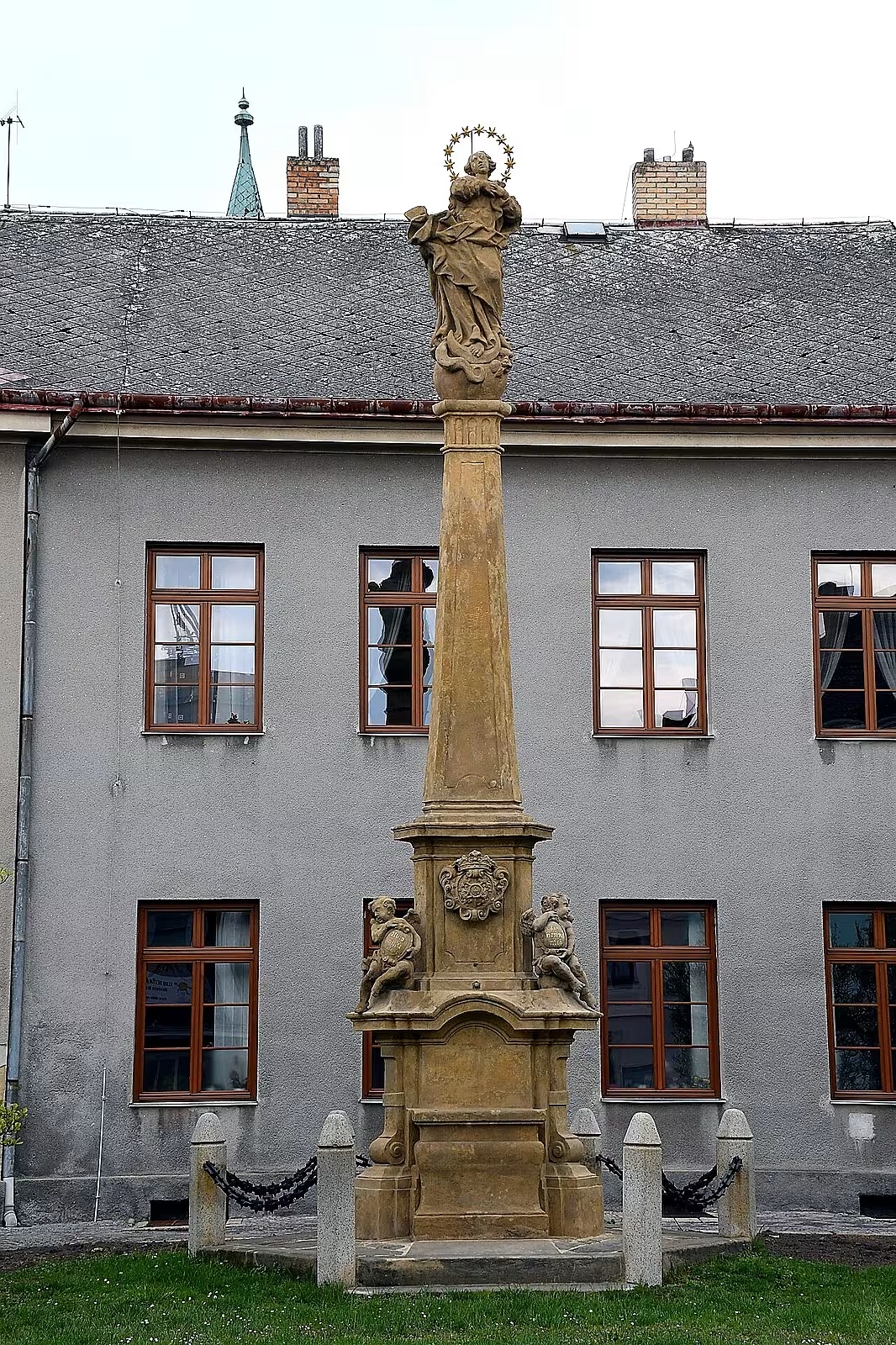
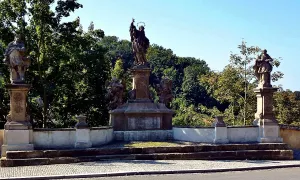
The Baroque Mariánský sloup v Mnichově Hradišti is a protected cultural monument standing in a small park in front of the town hall on Masaryk Square in the Mladá Boleslav district. This structure, which dates back to the Baroque period, is notable for its rich decoration, including statues of little angels, the coat of arms of the Waldstein family, and the culminating sculpture of the Virgin Mary. It has been protected as a heritage site since 1958.
During the Baroque period, numerous Marian and plague columns were erected on Czech squares as an expression of religious piety, Counter-Reformation efforts, and as thanksgiving for the averting of epidemics or misfortunes. These monuments significantly shaped the urban appearance of towns and cities in the Czech lands. However, determining the exact year of origin and authorship of the column itself in Mnichovo Hradiště is not unanimous in expert literature. The historian Josef Vítězslav Šimák dates the creation of the monument to the era of Dean Jan Julius Rucký, which falls between 1684 and 1706, and attributes the authorship to Martin Jelínek st.. In contrast, Emanuel Poche attributes the authorship to Martin Jelínek ml., also known as Martin Ignác Jelínek, born in 1728, which would push the creation of the work to the second half of the 18th century.
The architectural design of the work consists of several specific elements. The base is formed by a hexagonal pedestal, which is accessible via a low step and enclosed by a chain attached to hexagonal posts. This is followed by a stylobate formed by a triangular prism with concave walls and cut sides with volutes. On the facade, there is a protruding slab resembling an altar table (mensa). On the top slab of the stylobate, at the corners, stand three statues of little angels with oval inscription cartouches bearing the Czech inscriptions Pozdrawenj nemocznich, Autoczisste hrissniku, and Potessenj zarmauczenich. In the middle of the upper plinth on the facade is an oval cartouche decorated with acanthus leaves and a crown at the top, featuring a sculptural depiction of the Waldstein coat of arms. Beneath this cartouche, a decorative wrought-iron lantern was formerly placed. From the top of the upper stylobate emerges the shaft of the column in the shape of a triangular pyramid. This is topped by a cornice capital, upon which rests a globe encircled by a snake and a crescent moon. The culminating sculpture consists of a life-sized statue of the Virgin Mary of the Immaculata type, depicted in a strong contrapposto, with dramatically folded drapery and a head adorned with a gilded halo.
The fate of the monument is tied to a series of structural interventions and restorations. In 1971, the top sculpture was repaired, and during the 1980s, the original column on-site was replaced by a copy. Subsequent restoration work was carried out by Josef Vitvar in 2002 and 2010. The most recent restoration of this structure was performed in 2017 by Martin Pokorný.
A key moment in the modern history of the monument was its official inclusion among protected sites in 1958. Among its points of interest are the preserved inscriptions on the angel cartouches and the historical presence of the wrought-iron lantern beneath the Waldstein coat of arms. Expert debate regarding the authorship between Martin Jelínek st. and Martin Jelínek ml. continues to this day.
This historic structure in the heart of the town offers visitors an example of Baroque sculpture and the urban arrangement of the square. A tour of the column in front of the town hall in Mnichovo Hradiště presents an opportunity to become acquainted with regional history and sacred art.
Historical milestones
- 1958
- The column was declared a cultural monument.
- 1971
- Restoration of the top sculpture took place.
- 2002
- The column was restored by Josef Vitvar.
- 2010
- Another restoration by Josef Vitvar was carried out.
- 2017
- The column was most recently restored by Martin Pokorný.
Architectural development
The monument features a hexagonal base surrounded by a chain on columns, along with a stylobate characterized by concave walls and volutes. The top is crowned by a three-sided, spire-like shaft supporting a statue of the Virgin Mary. The literature does not definitively establish the year of creation or the authorship, which is attributed either to Martin Jelínek st. or Martin Jelínek ml.
Historical events
In 1971, the top sculpture of the column was restored. In the 1980s, the original column was replaced with a copy. Further restoration work was carried out by Josef Vitvar in 2002 and 2010. The latest restoration was performed in 2017 by Martin Pokorný.
Points of interest
– Notable features include the preserved inscriptions on the cherubs' cartouches, as well as the historical presence of a wrought-iron lantern beneath the Wallenstein coat of arms. – Scholarly debate regarding the authorship between Martin Jelínek st. and Martin Jelínek ml. continues.
Guide
Show guide text
This text was created by artificial intelligence and has not been editorially reviewed. It may contain inaccuracies.
Welcome to Mnichovo Hradiště. You are now standing in front of a magnificent Baroque monument, the Mariánský sloup (Mnichovo Hradiště). This column rises in the small park in front of the town hall on Masarykovo náměstí and immediately captures your attention with its elegance and rich ornamentation. Take a moment to enjoy this peaceful spot, soak in the atmosphere of the historic center, and let us guide you through the story of this exceptional work of art.
Let's take a look at how this monument came to be and the history it carries. The Baroque Marian column was built in times when people often looked to the heavens with prayers for protection from all the hardships of life back then, such as diseases or wars. Although the exact date of its original creation and the names of its creators remain shrouded in mystery, we know that it has stood in this place for many long decades and forms an integral part of the local landscape. The column has witnessed the transformations of the entire town, its prosperity as well as its difficult moments, and yet it still stands here as a silent witness to days gone by.
Now focus on the architecture itself and the details you can observe right in front of you. The base of the entire structure consists of a hexagonal foundation and a stylobate with a triangular prism. When you raise your eyes to the corners of this prism, notice the three statues of little angels holding inscription cartouches in their hands. These preserved inscriptions are a testament to the skill of the old masters. Shift your gaze to the facade of the upper plinth, where there is an oval cartouches bearing the coat of arms of the prominent aristocratic Waldstein family. Historically, a wrought-iron lantern also used to hang beneath this coat of arms, giving the entire place a unique charm. The shaft of the column, shaped like a triangular pyramid, then rises from the top of the structure.
Interesting figures and professional debates that continue to this day are associated with this place. Historians and art circles still engage in lively academic discussions about who the true author of this masterpiece actually is. Names like Jan Julius Rucký, Martin Jelínek st., and Martin Jelínek ml. are in play. This question of authorship still occupies the minds of experts who examine period sources and compare the artistic styles of individual creators. Every detail on the column may thus conceal the answer to this artistic mystery.
The column has been cared for over the years to preserve its beauty for future generations. The first major official milestone in modern history was the decisive recognition of its value when it was declared a cultural monument in 1958. However, time leaves its mark on stone statues, and intervention was therefore necessary. In 1971, the restoration of the top sculpture took place. Decades later, in 2002, restorer Josef Vitvar took over its care. He returned to this site a few years later, specifically in 2010, to carry out further necessary restoration work. The last major restoration took place in 2017, when the work was entrusted to the restorer Martin Pokorný. Thanks to these people, we can admire the shapes and details today in the form in which they have survived to the present day.
I hope you enjoyed the tour of this Baroque gem. I invite you to further explore Masarykovo náměstí and the surrounding streets of Mnichovo Hradiště, where other interesting stories and monuments await you. Thank you for your attention and I wish you a wonderful rest of your day.
Tips for visitors
The best time to visit the Mariánský sloup (Mnichovo Hradiště) is early in the morning or during the morning hours, when the historic square is quiet and you can peacefully examine the detailed sculptural decoration on the hexagonal base and triangular prism without large crowds. Bring comfortable shoes for walking on the historic cobblestones, a camera, and in warmer months also a bottle of drinking water, as the column stands in an open park without its own refreshment facilities. For photography, choose the morning sunlight, which ideally illuminates the front side of the statue standing directly in front of the town hall building in the Mladá Boleslav district. In the surrounding area within the historic core of the town of Mnichovo Hradiště, you can visit other interesting places within walking distance, as the column is located in the very heart of this urban conservation zone.
Frequently asked questions
Can the monument be visited?
This is a structure in a public space that can usually be seen from outside free of charge. We have not verified that this particular one is freely accessible.
Where is the monument?
Location: Mnichovo Hradiště. The map on this page shows the exact spot.
Why is the monument protected?
It is listed in the Central List of Cultural Monuments of the Czech Republic as a cultural monument (register no. 1000143780).
Businesses nearby
Do you run a restaurant, accommodation, shop, museum, rental, wellness or other visitor service near this monument? Show yourself directly to the people heading to it — this is how they will see you in the app and on the web:
Events nearby

Zdroj akcí: otevřená data měst a obcí ČR (Národní katalog otevřených dat) a kalendář akcí Národního památkového ústavu.
Nearby
Sloup se nachází v historickém jádru města Mnichovo Hradiště přímo před budovou radnice na Masarykově náměstí v okrese Mladá Boleslav.
Accommodation nearby
Trips and activities nearby
Guided tours, tickets and activities nearby from GetYourGuide
Affiliate link: if you buy from the partner, we may receive a commission. The price for you does not change.
Search tours and activities →Themed route
I suggest a walking route right in the historical center of Mnichovo Hradiště, which will guide you through the immediate vicinity of the main destination.
1. Mariánský sloup Type: Statue Why it's worth visiting: This historical column is located in the very center of the town on Masarykovo náměstí. It is a significant artistic and sacred monument of the region.
2. Town Hall Building Type: Office and historical building Why it's worth visiting: This building forms a natural backdrop to Masarykovo náměstí in the Mladá Boleslav district. It is located right next to the main destination of the trip.
3. Masarykovo náměstí Type: Public space Why it's worth visiting: The entire historical center of the town offers a pleasant environment for a peaceful stroll. Both the statue and the town hall are located here.
Seasonal recommendations
Spring at this location offers the observant pilgrim awakening greenery that contrasts with the clean stone surface of the Baroque masterpiece, which in the early morning hours is shrouded in a gentle haze and bathed in soft sunlight. I recommend visiting in the morning when it is quiet and uncrowded; due to the changeable spring weather and occasional cold winds, sturdy footwear and a waterproof windbreaker are recommended.
Summer brings lush surrounding nature with deciduous trees in full bloom, where sunbeams create sharp shadows that lend the sacred sculpture a unique sense of plasticity and drama. To avoid the main tourist rush, I suggest planning your visit for the early morning before nine or, alternatively, in the late evening when the heat subsides; remember to bring a hat and a bottle of water.
The autumn months reveal a melancholic mood, enhanced by the falling colorful foliage of the surrounding trees and a muted, misty light that lends the entire area a profound historical atmosphere. A practical tip is to wear warm layers, as damp days can be quite cold, and the best time for photography is early afternoon when the sun sits lower in the sky.
Winter wraps the monument in silence, occasionally covering it in a blanket of snow, while the early onset of darkness, aided by local street lighting, creates a mysterious and intimate atmosphere. As temperatures drop below freezing, be sure to wear a winter coat, gloves, and a hat; the best time for a stroll is at midday, when it is warmest and the surface around the statue is at least partially warmed by the daylight.
Visualizations and artistic views

The visualisations are generated by artificial intelligence and serve as inspiration.
Photos from the area
Real photos taken near the monument


Zdroj a licence jsou uvedeny u každého snímku.
Tips from visitors
No tips yet. Be the first!
Log in and add your tip.
Sources and literature
Photos: Ben Skála, Benfoto / CC BY-SA 4.0 — Wikimedia Commons. The author and licence also appear when you hover over the image.
Faktickým podkladem tohoto textu byl článek na Wikipedii, jehož autory jsou přispěvatelé Wikipedie. Článek je dostupný pod licencí CC BY-SA 4.0.
Location on the map



Příběhy a pověsti
Legendy, pověsti a příběhy spjaté s touto památkou
Fotografie návštěvníků
Zatím žádné fotografie. Buďte první, kdo přidá fotografii z návštěvy!
Log in a přidejte svou fotografii nebo hodnoťte.
Za ověřenou návštěvu v aplikaci získáte víc bodů — poznáme podle GPS, že jste na místě.
Reviews and comments