






městská kašna v Poděbradech Fountain
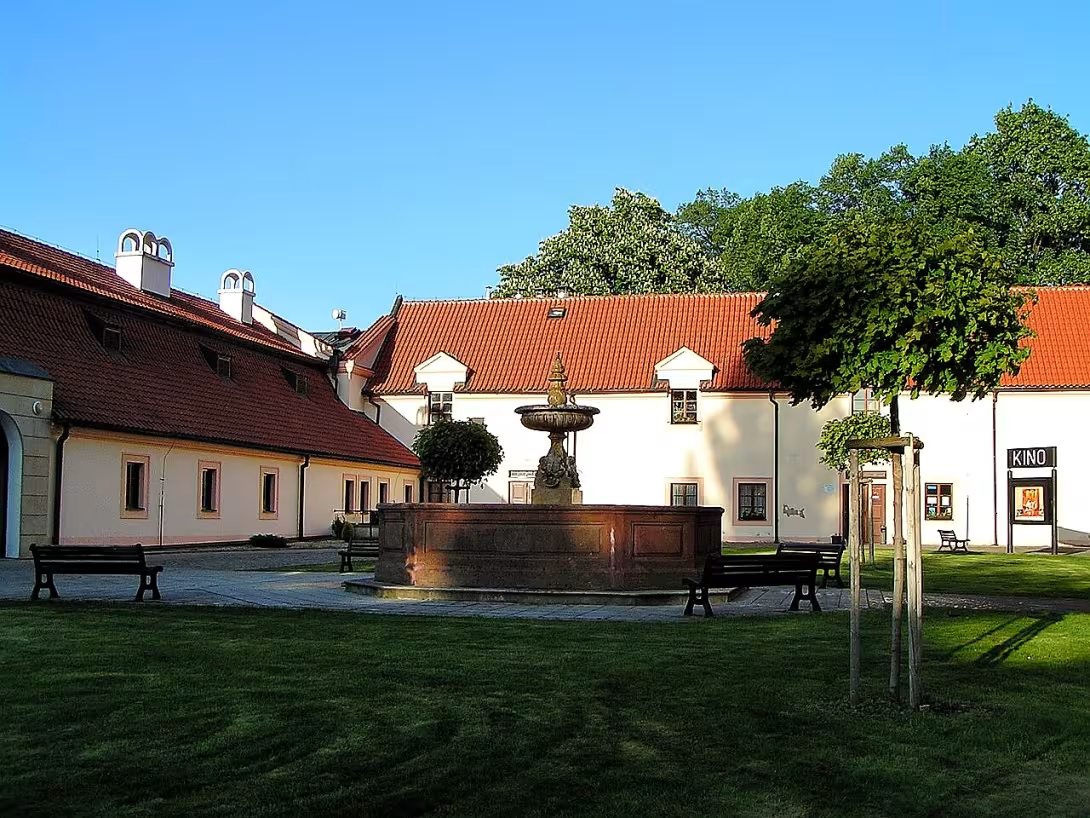
The town fountain in Poděbrady is a Baroque monument from the 18th century, which today decorate the first courtyard of Poděbrady castle. Since 1987, the building has been protected as a cultural monument. It represents an important document of urban architecture, which in the 19th century underwent modifications under the leadership of sculptor Bohuslav Schnirch.
The original Baroque work was created in the 18th century on the east side of the then square in front of the castle, today's Jiří Square. At that time, the Czech countries experienced the peak of Baroque culture and the boom of urban construction, while Europe went through the era of enlightenment and the transition to modern government.
The building has a square ground plan with scraped corners and is made of red sandstone. The outer walls break down mirrors and moldings. Inside the tank is a concrete column with decorative spray. It supplements four masks - two male and two female - which have nozzles placed directly in the mouth. Part of the spray is also a sandstone circular vase with decorative tip in the middle.
The fate of the fountain was very variable during the 20th century. In 1884 the sculptor Bohuslav Schnirch made modifications in which he installed a decorative element in the centre of the tank. In 1938 the fountain was removed from the square and stored in the town yard. In the 1950s they moved it to the park near the Czechoslovak church and in the 1970s it followed the movement to the park near the Church of the Holy Cross. After the complete repair, the monument was definitively installed in 2001 in its current place in the revitalized first castle courtyard.
Thanks to its history and visual rendition, this fountain is a valuable element of the Podebrad Monument Zone. Visitors can see it directly in the castle grounds, where it completes the historic courtyard area. The tour offers the opportunity to become familiar with the Baroque tradition and changes of the urban mobility over the centuries.
Historical milestones
- 1884
- The sculptor Bohuslav Schnirch made modifications to the fountain and installed decorative spray.
- 1938
- The fountain was removed from the square and stored in the town yard.
- 1987
- The object was declared a cultural monument.
- 2001
- After repair, the fountain was placed on the first castle courtyard.
Architectural development
The original Baroque building was supplemented by decorative elements by sculptor Bohuslav Schnirchem in 1884. The fountain is broken down by external mirrors and ledge. The construction uses red sandstone and concrete elements in the interior.
Historical events
In 1938 the fountain was removed from the square and stored in the town yard. In the 1950s it was moved to the Czechoslovak church and in the 1970s it was moved to the park near the Church of the Elevation of the Holy Cross. It was installed in the castle courtyard in 2001 after repair.
Points of interest
- The fountain is a Baroque monument from the eighteenth century, which has been protected since 1987 as a cultural monument. - The building has a square floor plan with scraped corners and is made of red sandstone. - Inside the tank there is a concrete column with decorative spray, which complements four masks with nozzles in the mouth. - In the nineteenth century, the sculptor Bohuslav Schnirch led modifications of the fountain, which installed a decorative element in the centre of the tank. - The monument was moved several times in the past before it was installed in the first castle courtyard in 2001.
Guide
Show guide text
This text was created by artificial intelligence and has not been editorially reviewed. It may contain inaccuracies.
Welcome to Podebrady, the city of medicine, peace and history. Right now, stop and focus fully on what you see right in front of you. You are standing in the first courtyard of the castle and your view is now dominated by the city fountain. It is an object that at first sight looks very robust and at the same time elegant. Notice the rich, warm color of the material from which the entire building is made. It is a red sandstone, a stone that gives the monument its characteristic appearance and a sense of endurance. Look at her shape. The fountain has a square plan, but its corners are not sharp, they are finely cut, which gives the whole building a much lighter and more harmonious expression.
If you stop now and begin to perceive the history of this place, we must return far back in time. This fountain is not just an ordinary source of water, but a Baroque monument that dates back to the eighteenth century. So imagine the time of wigs, lace and expansion of baroque art, when such decorative elements began to appear in the cities, which served not only practical purposes, but mainly to represent the city's wealth and taste. The Baroque loved decorating and playing with forms, and that's what we feel in this porridge.
However, what you see today is not exactly what people saw three years ago. The history of monuments is often a story of constant changes and modifications. Let's move on in time to the nineteenth century, namely the year one thousand eight hundred eighty-four. At that time, a talented sculptor named Bohuslav Schnirch entered the building. He was the one who modified the fountain and gave her the details that make it so special. Schnirch brought his art vision into it and installed a decorative spray, a system through which the water produced its flow.
Now, I want to invite you to take a closer look into the inner space of the tank. Pay attention to the centre where the concrete column is held. It's this column that carries the decorative spritzer we talked about. But that's not all. Look carefully at the walls and details around this central point. You'll see four masks here. They're carved faces that serve as nozzles. The water in the past came out of their mouths, creating an interesting visual effect and providing certain life and dynamics to the porridge. The sandstone vase, which complements composition and concludes the aesthetic intention of both sculptor and original creators, contributes to the whole.
But the life of this fountain wasn't just about beauty and admiration. It's also a story about oblivion and subsequent rebirth. Imagine the year one thousand nine hundred thirty-eight. At that time, the fountain was removed from its original place in the square for reasons that history did not exactly tell us. Instead of being destroyed, it was stored in a town yard. Imagine the contrast where this beautiful baroque piece with details from the sculptor Schnirch lay hidden from the public's eyes, probably covered in dust and forgotten in the corner of the city. For decades, this monument has been waiting to be saved.
The break came in a thousand nine hundred eighty-seven. This year, the city and experts realised the value of this building and the fountain was officially declared a cultural monument. This meant that it would no longer be a forgotten stone in the yard, but a protected piece of history to be cared for. But recognition of the status of a monument is one thing and a real renewal is another. The fountain needed care, repairs, and a new place to shine again.
This path to rectification culminated in two thousand one. After a thorough repair which returned the red sandstone to its former and repaired the details of the inner space, the fountain was placed right here, on the first castle courtyard. This step has closed a long circle of her history. From the square through oblivion in the yard to the honorary place near the castle.
Now, if you look at those four jet masks again, try to imagine how many people have stopped at this water over the centuries, how many conversations she's had and how many views she's had on her red stone. It is fascinating how one object can survive changes in regimes, wars and periods of disinterest and still stand here as a witness to the past.
The contrast of the materials is interesting. We have a Baroque foundation from the eighteenth century, the nineteenth century in the form of modifications of Bohuslav Schnirch and modern elements such as a concrete column that holds the entire construction of the spray. It's like a stone notebook where every generation wrote their own chapter.
Now that you know the story of this city fountain, I suggest you go around it for a while. Note how light is reflected from the scaled corners of the square plan and how the red sandstone responds to the surrounding area of the courtyard. Feel the calm of this place and imagine how in the year one thousand eight hundred eighty-four the sculptor Schnirch stood beside it and proudly watched the water flow from the masks in the mouth.
This concludes a short chapter on the Podebrad porridge. I hope this story about the red sandstone and perseverance interests you. We now invite you to explore the beauty of this city and its surroundings. Look around you, feel the atmosphere of the castle grounds and let yourself follow the other traces of history that await you in Poděbrady. I wish you a pleasant continued journey and many new discoveries. I bid you farewell and have a lovely day.
Tips for visitors
The best time to visit is in the morning or in the evening, when the sun is low and beautifully depicts the details of the red sandstone. In these times the square is quieter and you avoid direct noon heat during summer days.
The location is located in the heart of the city, where you can easily walk from the train and bus station. If you arrive by car, use public parking in the vicinity of the centre; Check current standing options and traffic restrictions in map applications.
Take the camera with you with the lens for detailed footage of the statue decoration by Bohuslav Schnirch. The best images are taken from angles that capture the square floor plan of the fountain in contrast to the surrounding historical development.
Walk to the monument is ideal for families with children due to flat terrain. In the immediate vicinity you can visit the Poděbrad Castle, Jiří Square, the Church of the Holy Cross Elevation or take a walk around the spa colonnade where you will find a quiet environment for rest.
Businesses nearby
Do you run a restaurant, accommodation, shop, museum, rental, wellness or other visitor service near this monument? Show yourself directly to the people heading to it — this is how they will see you in the app and on the web:
Nearby
Poděbradský zámek, Jiřího náměstí, kostel Povýšení sv. Kříže, lázeňská kolonáda.
Accommodation nearby
Trips and activities nearby
Guided tours, tickets and activities nearby from GetYourGuide
Affiliate link: if you buy from the partner, we may receive a commission. The price for you does not change.
Search tours and activities →Themed route
Thematic cruise route Poděbrady
1. City fountain in Poděbrady
Type: Monuments
Why is worth a visit: The city fountain is a symbol of the city and points to the rich history of the village. Its architecture attracts attention with its unique design and location in the city centre.
2. Podibrad Castle
Type: Historical building
Why is worth a visit: The castle is a key historical location that offers a view of the rich past of Poděbrad. Its beautiful garden spaces and architecture are ideal for relaxation and sightseeing.
3. Jiří Square
Type: Public space
Why is it worth a visit: The square is the heart of Podebrad, where history and modernity meet. It is a place for relaxation, trading and participation in local events.
4. Church of the Elevation of the Holy Cross
Type: Religious building
Why is worth a visit: This church is an important spiritual and architectural monument that attracts its history and beautiful interior decoration.
5. Spa Colonnade
Type: Architectural structure
Why is worth a visit: Colonnade is famous for its elegant architecture and history associated with the Podebrad spa industry. It is an ideal place for a short rest and photos.
This route offers a comprehensive view of the cultural and historical wealth of the village Poděbrady, each point connected with another in logical order.
Seasonal recommendations
In spring, the fountain shines along with the awakening nature and the first flowers. The atmosphere is fresh and light soft, which highlights the details of the stone. We recommend to wear a lighter jacket and visit the place in the morning when the air is the cleanest.
The summer season brings a radiant sun and a refreshing feeling of running water. There is live activity and bright colors around the monument. To avoid the biggest crowds and heat, it is best to come first thing in the morning in light summer clothes.
The space around the fountain is wrapped in golden colours of fallen leaves and morning fog. There is a quieter mood that encourages thought. A waterproof cloak and a walk in the afternoon in the mild sun is suitable.
In winter the monument is very sober, often with a layer of frost or snow on the edges. Evening lighting creates a cosy contrast with the cold surrounding. It is necessary to have warm clothes and count on a shorter day, therefore it is ideal to have a short visit before dark.
Visualizations and artistic views

The visualisations are generated by artificial intelligence and serve as inspiration.
Photos from the area
Real photos taken near the monument

Zdroj a licence jsou uvedeny u každého snímku.
Tips from visitors
No tips yet. Be the first!
Log in and add your tip.
Sources and literature
Photos: Czeva / CC BY-SA 3.0 — Wikimedia Commons. The author and licence also appear when you hover over the image.
Faktickým podkladem tohoto textu byl článek na Wikipedii, jehož autory jsou přispěvatelé Wikipedie. Článek je dostupný pod licencí CC BY-SA 4.0.
Location on the map
Příběhy a pověsti
Legendy, pověsti a příběhy spjaté s touto památkou

Fotografie návštěvníků
Zatím žádné fotografie. Buďte první, kdo přidá fotografii z návštěvy!
Log in a přidejte svou fotografii nebo hodnoťte.
Za ověřenou návštěvu v aplikaci získáte víc bodů — poznáme podle GPS, že jste na místě.
Reviews and comments