

Městské opevnění (Klatovy) Town walls
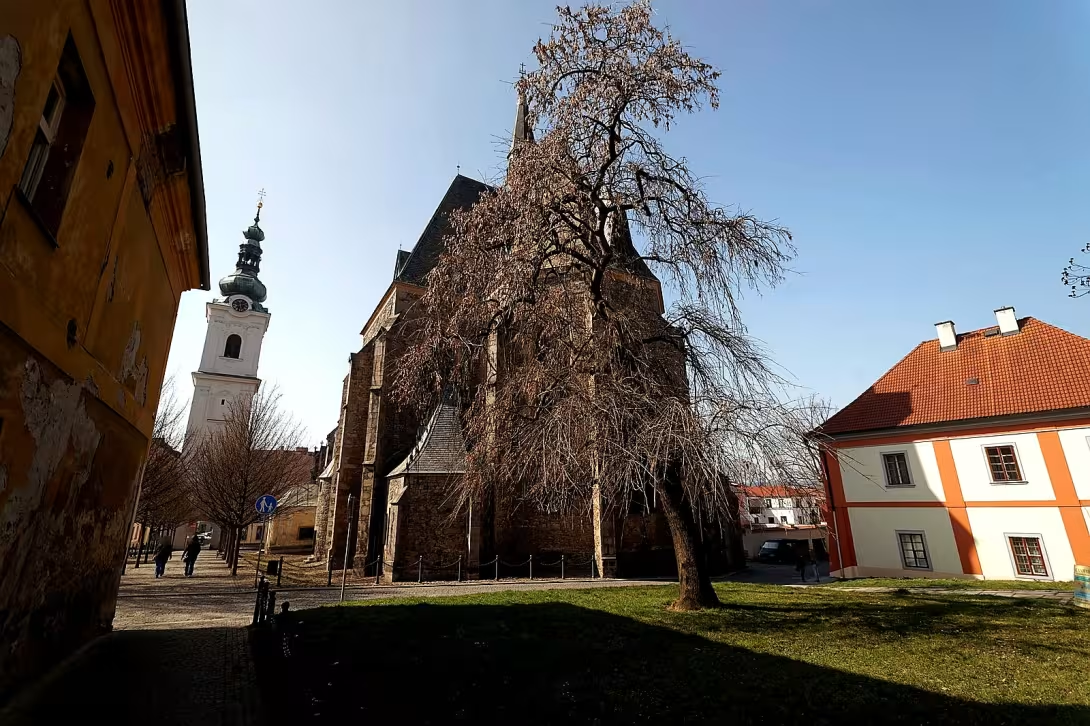
The town fortifications in Klatovy in the Pilsen region represent a partially preserved system of medieval walls, towers and baskets dating from the thirteenth to sixteenth centuries. The remains of this historical system, best preserved on the eastern and northeast sides of the city, are protected as a cultural monument. Although the Klatovy townspeople participated in many military events, the city itself was never conquered during the Middle Ages.
Klatovy was founded by King Přemysl Otakar II. at the beginning of the second half of the 13th century. The construction of stone walls at this time reflected the need to protect emerging urban centres and to ensure their strategic importance as a support for sovereign power. The creation of the city fortification itself dates back to a more unknown time. However, archaeological research has shown that the foundations of the main wall have been dug into the cultural layer of the 13th century. The construction was not created at the same time as the city, but was probably related to its reconstruction, which followed the fire in 1288.
The main defensive element was a wall between 180 and 200 centimeters wide. According to Willenberg's Vedute, it was finished by a cimmer, from which only relics of the pre-breast wall were preserved. This wall was reinforced by semi-circular towers 25 to 30 metres apart, which were preserved on the east side in modified form. In the former corners, there are two cylindrical towers, or around eight meters in diameter. With their mass, they protruded significantly before the outer face of the wall. The northeast tower has an entrance from the castle gallery with a portal on the first floor and two other floors with beam ceilings and slot firing points. The southeast tower had shooting rooms on the first floor with fallopian sockets to get the hooks on and other four shots fired on the second floor. From the younger prismatic towers, the strongly rebuilt tower east of the Church of the Birth of the Virgin Mary, whose sides exceeded the length of eight metres, was best preserved. The peak form of the fortifications consisted of a main wall, about ten metres wide, surrounded by a park wall with prismatic bastions, an internal ditch, a wall and an outer fortification. The outer side of the wall was reinforced by about one metre wide wall, which was broken by square gunners. This wall has been reinforced by semicircular and french bastion. The city was originally accessed by three gates called Lubská, Špital and Monasterska and one smaller goal. All the gates have gradually died.
Numerous preserved written springs for fortification relate mainly to its repairs. In 1387, King Václav IV. liberated the city for two years from all taxes and allowed him to collect the duty. These funds should have been used by townspeople to repair walls, ditches and towers. The monarch made it possible to collect additional duties on horses, cattle and other goods for 20 years also in 1402, again with the allocation of money for rebuilding towers, walls and digging ditches. Since the first half of the nineteenth century, individual parts of the Klatovy fortification have been gradually demolished.
At present, the fortification fragments on the eastern and northeast sides of the city are best preserved. A preserved moat and an outer wall can be seen in the area northeast of the Church of the Birth of the Virgin Mary and north of Zlatnik Street. The historical centre of Klatov is located on the right bank of the Urge on an area of approximately 11,5 hectares with an ovaloid plan. There is also the Church of the Birth of the Virgin Mary, the hill Horka and the hill above the Planický suburb.
The remains of the Klatovy fortification offer a unique view of the development of medieval defence construction in Czech countries. Visiting this place allows every interested person in history to personally explore preserved fragments of walls and towers that have protected a significant royal city for centuries.
Then and now
Drag the slider to compare how the landmark may have looked when it was built with the view today.
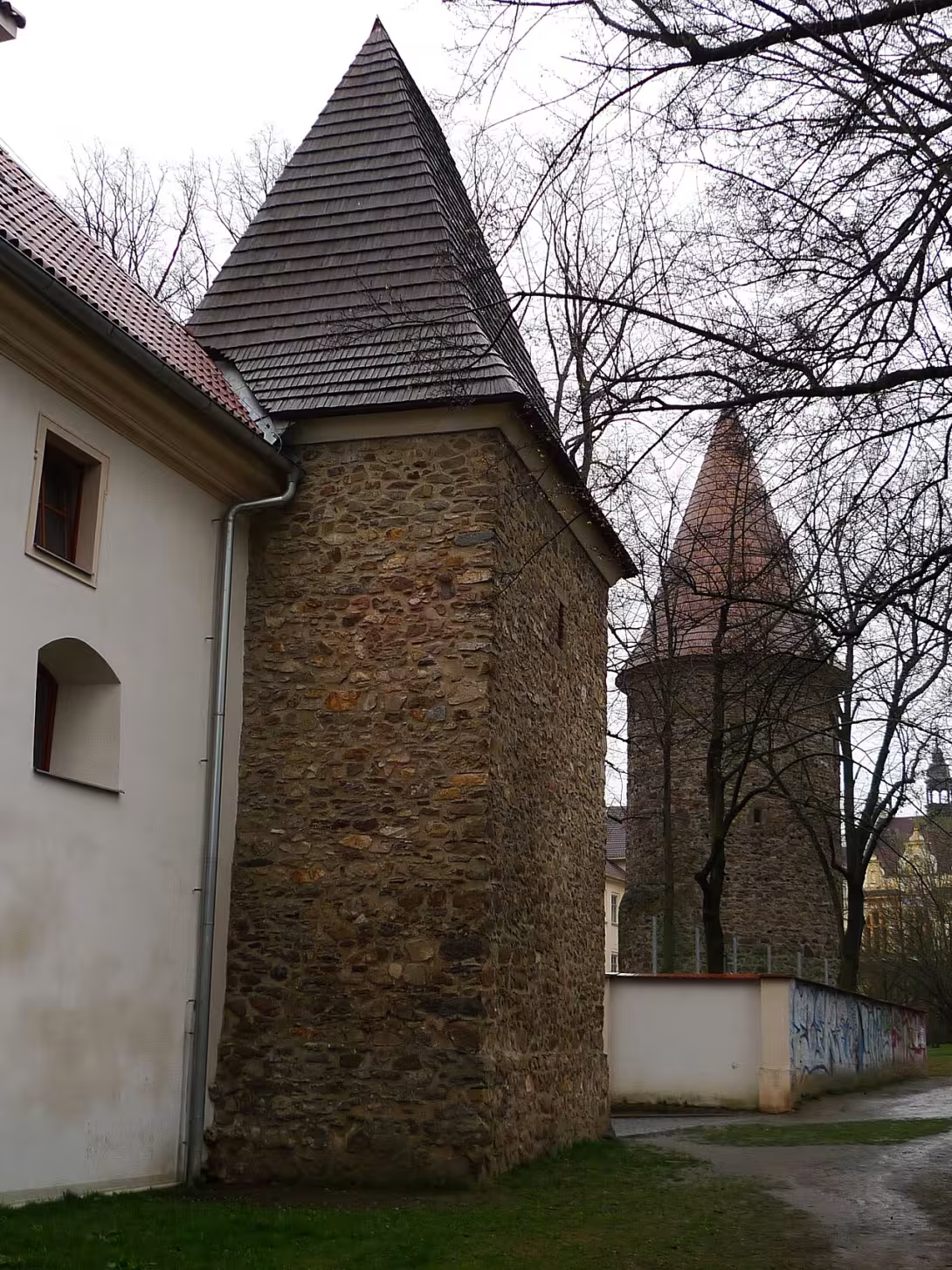
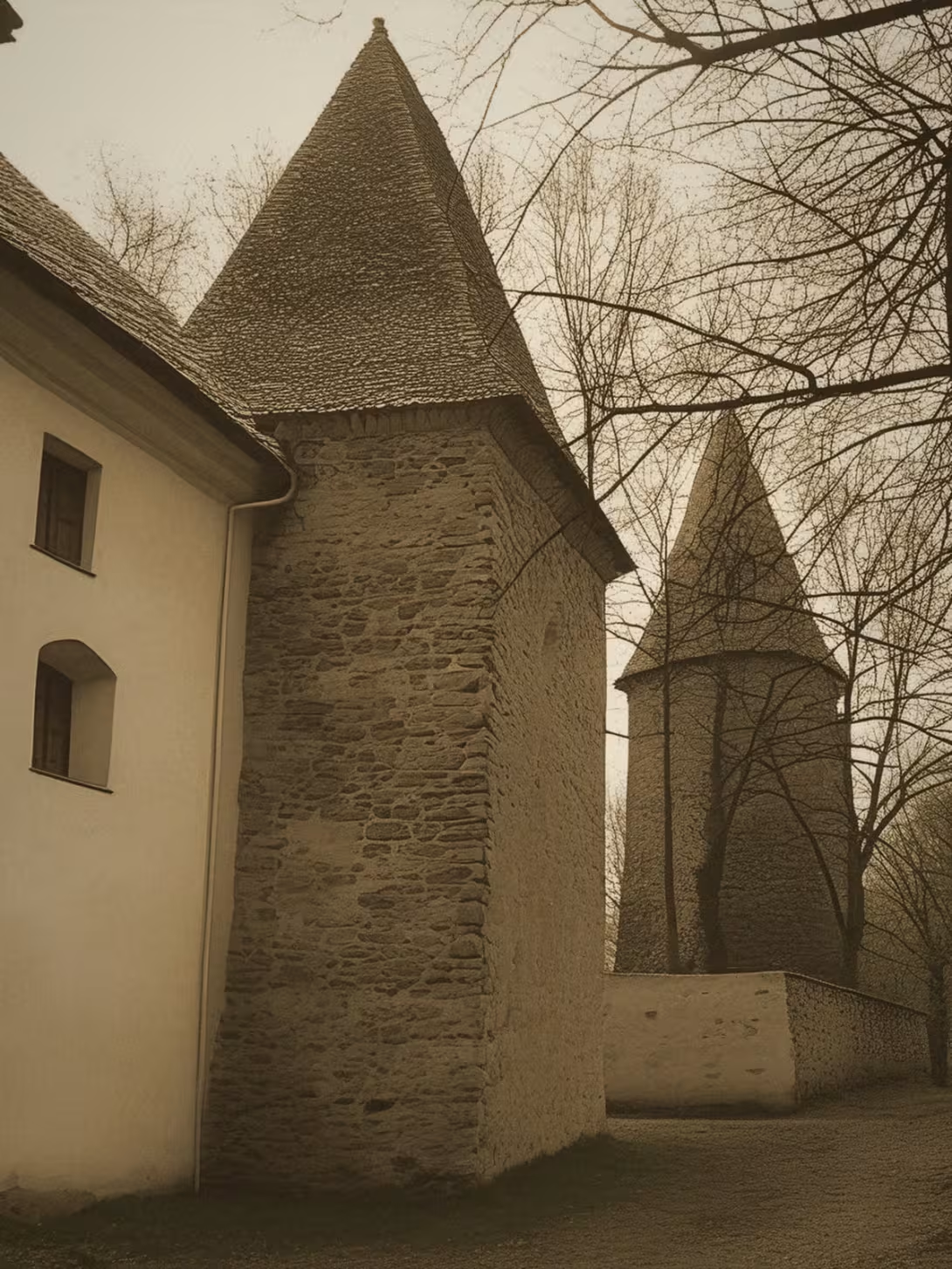
The historical appearance on the left is an AI-generated visualisation and serves as inspiration only.
Historical milestones
- 1288
- The city fire followed by reconstruction and probably building walls.
- 1387
- King Václav IV. liberated the city for two years from taxes and allowed the collection of customs duties to repair walls, moats and towers.
- 1402
- The sovereign has made it possible to collect additional duties for 20 years to rebuild towers, walls and dig ditches.
Architectural development
The foundations of the main wall were dug into the cultural layer of the 13th century after the fire in 1288. At the same time as the main wall was formed round and semi-round inside the open tower, while the prism towers are of younger origin. The peak form of fortifications included the main and park walls, moat, wall and outer fortifications. Since the first half of the nineteenth century, individual parts have been gradually cut down.
Historical events
City fire in 1288 followed by reconstruction and construction of fortifications. Exemptions and permission to collect duties by King Vaclav IV in 1387 to repair walls.
Points of interest
- The system of medieval walls, towers and bastion dates from the thirteenth to sixteenth centuries and the city itself was never conquered during the Middle Ages. - The construction of the walls was not created at the same time as the city, but was probably related to its reconstruction after the fire in 1288. - The main defense element was the wall of a hundred and eighty-two centimeters wide, which, according to Willenberg's vedute, was terminated by the battlements. - The city was originally accessed by three gates called Lubská, Špitálská and Špitálská and Monasterská and one smaller gate, all the gates gradually disappeared. - In 1387, King Václav IV. liberated the city for two years from all taxes and allowed him to collect customs duties so that the townspeople could use the money to repair the walls, ditches and towers.
Guide
This guide is narrated by a synthetic voice generated by artificial intelligence.
Show guide text
This text was created by artificial intelligence and has not been editorially reviewed. It may contain inaccuracies.
Welcome to the picturesque Klatovy. Right now, you're standing in front of one of the most important witnesses of the old days of this town. When you raise your eyes from the ground, there is a mighty ancient city fortification before you. Inhale the unique atmosphere while I start to uncover the story of stone walls in your headphones, which have guarded the safety of the inhabitants for centuries. Today's form of this defence system is the result of human skill, courage and ant work ranging from the thirteenth to the sixteenth century.
Let us return together in time to the time when the idea of defending the city was born. The construction of these walls was not created at the same time as the town began. An important impetus to their construction was the great and devastating fire that hit the city in 1280. This event was followed by a complete reconstruction of the city and is likely to be related to the decision to circumvent Klatov's fixed wall. Important rulers on the Czech throne contributed to the development of the fortress. This place is associated with the famous figure of King Premysl Otakar the Second and a little later also King Václav the Fourth. It was King Wenceslas the Fourth who showed great favor to the city when he freed Klatovy for two years from paying taxes in 13 hundred and 80 years. At the same time, he authorised the collection of duties, the proceeds of which had to be used exclusively for the necessary repair of damaged walls, deep moats and defensive towers. The monarch's support did not end this, because in 14200 it allowed for the collection of another duty, this time even for 20 years. This money was used to rebuild towers, fixed walls, and to further dig down the trenches that protected the city from outside danger.
Now pay attention to the architecture itself and the details you have right in front of you. The historical center of this town has an oily plan and once it was around the main wall. Its width was up to two hundred centimeters, making it an admirable and difficult to break. This main defense element was not alone, but formed part of a sophisticated system. The main wall was supplemented by a park, an inner moat, a ground wall and an outer fortification, which together formed several layers of defense. In addition, the entire defense system was bravely reinforced by a series of round and prismatic towers. These towers did not only fulfil the aesthetic role, but were of fundamental strategic importance. In fact, they allowed effective side sniping, i.e. so-called flanking, which allowed defensemen to hit the attackers before they could get close to the main wall itself. Unfortunately, the names of the builders and architects who designed and brought this admirable fortress to life have not been preserved until today and remain covered with secrets.
When you look at stone blocks and imagine life at the time, you realize the power of human determination. Klatovy fortifications carry stories of endurance, where people, after every blow of fate, such as the Great Fire, were able to rebuild and strengthen the city even more. Our ancestors were able to make great use of the defence art at the time. The fortification, which is partly in preserved form here before you, was at the top of defense construction at its time.
Let us now stop at one of the absolutely fascinating attractions that makes this place an extraordinary historical jewel. Although the Middle Ages were a period of constant wars, siege and struggles for power, the Klatov city fortification fulfilled its purpose perfectly. Thanks to the strong system of medieval walls, towers and baskets, the city itself has never been conquered throughout the Middle Ages. Enemy troops surrounded the city and tried its fortress, but the ingenious combination of walls, trenches and towers proved to be an insurmountable obstacle for every attacker.
I hope this view of history brings you closer to where you're standing right now. Follow the lines of old walls, imagine the violence of medieval craftsmen and perceive the proud atmosphere of the Klatovy past. When you're ready, go on to explore the secrets of this beautiful city. Thank you for your attention, I wish you a wonderful experience the rest of the day and goodbye.
Tips for visitors
The best time to visit is spring and autumn months. Nature stands out in these times around the walls and mild temperatures are ideal for walking around the historical centre, where you can watch the remains of medieval fortifications in peace.
Take comfortable shoes for walking on city streets and roads. We recommend that you have a city plan with you, which will help you to easily search for individual preserved towers and bastions spread over the egg floor of the centre.
For the best photos we recommend late afternoon, when the low sun will highlight the texture of the old stone and the details of the walls. Interesting views from outside can be obtained by walking along the walls and from elevated points around.
During the visit of the walls, remember to explore the area. You can visit the Church of the Birth of the Virgin Mary, walk through the historical centre on the right bank of the River Urge, or get off on the hill of Horka and the hill above the Planický suburb from where you will see the layout of the entire fortification.
For families with children, walking through walls is an interesting adventure.
Frequently asked questions
Can the monument be visited?
This is a structure in a public space that can usually be seen from outside free of charge. We have not verified that this particular one is freely accessible.
Where is the monument?
Location: Klatovy I. The map on this page shows the exact spot.
Why is the monument protected?
It is listed in the Central List of Cultural Monuments of the Czech Republic as a cultural monument (register no. 1000147745).
Businesses nearby
Do you run a restaurant, accommodation, shop, museum, rental, wellness or other visitor service near this monument? Show yourself directly to the people heading to it — this is how they will see you in the app and on the web:
Events nearby
Zdroj akcí: otevřená data měst a obcí ČR (Národní katalog otevřených dat) a kalendář akcí Národního památkového ústavu.
Nearby
🏰 Historic sites (90)
- Bílá věž 0.1 km
- Svatý Václav 0.2 km
- Panna Marie 0.2 km
- Dr. Jan Krejčí 0.2 km
- Přemysl Otakar II. 0.2 km
- Vlastivědné muzeum Dr. Hostaše 0.2 km
- Barokní lékárna u Bílého jednorožce 0.2 km
- Galerie Klatovy 0.2 km
- PASK 0.3 km web
- Černá věž 0.3 km
- Klatovské katakomby 0.3 km web
- Pomník Obětem holokaustu 0.3 km
- sv. Jan Nepomucký 0.4 km
- Pomník Antonína Švehly 0.6 km
- Svatý Antonín 0.6 km
- Tvrz Štěpánovice 3.8 km
- Kaple sv. Jana Nepomuckého 4.7 km
- Památník rodáků a přátelům Obce Bolešiny 4.9 km
- Zámek Obytce 5.6 km
- Komošín 5.7 km
🍽️ Restaurants and dining (90)
- ZRNO 0.0 km Pavlíkova 7 +420 776 340 088
- Čajovna U Naší milé Paní 0.0 km Václavská 215 web
- Pizzerie Segafredo 0.1 km
- U Bílé věže 0.1 km
- Rock Pub & Cafe 0.1 km
- San Martino 0.1 km
- Gastroclub 0.2 km
- Piccolo 0.2 km Náměstí Míru 170 +420724857329; +420376315887 web
- U Radů 0.2 km
- Žíznivej kozel 0.2 km +420731377479 web
- Slávie 0.2 km
- Kulick Bar 0.2 km
- Poprda 0.2 km +420 376 316 297 web
- pivní studio Modrý abbé 0.2 km Dobrovského 150 web
- Van Gogh 0.2 km
- Efes Kebab 0.2 km
- DAT FOOD 0.2 km Zlatnická 27 +420 776 244 728 web
- Pilsner Urquell Original Restaurant Střelnice 0.2 km Pražská 22
- Vitalka 0.2 km web
- Mléčná kavárna a cukrárna 0.2 km
🏨 Accommodation (16)
- Hotel Ennius 0.2 km +420376320567 web
- Beránek 0.3 km +420 376 312 348; +420 604 285 942 web
- Rozvoj 0.5 km +420 376 311 609 web
- U Parku 0.6 km +420 376 310 083
- Klatovský Dvůr 1.1 km +420 376 321 517 web
- Hotel Karafiát 1.2 km +420 376 310 321
- Sport 1.4 km Domažlická 609/III +420 376 310 910; +420 376 310 751; +420 602 429 413; +420 602 439 809 web
- Autocamping Klatovy 2.3 km
- Statek česká lípa 7.0 km
- Pension Kalista 7.6 km +420739088336 web
- Švihovský dvůr 9.5 km nám. Dr. E. Beneše 200
- Eurocamp Běšiny 11.3 km
- Lazensky dum Chudenice 11.8 km +420 606 806 232 web
- Výletní hostinec Na poustevně 12.0 km web
- Úžlebec 12.6 km
- Zámecké apartmány Jindřichovice 13.0 km +420 605 556 402 web
🚲 Rentals and sport (11)
- Husky 0.2 km
- Jizdni 0.3 km
- Cyklosport-pitstop.cz 0.4 km
- Intersport 0.8 km
- sportovní hala 0.8 km
- Mercandinovy sady 0.9 km web
- Centrum míčových sportů 1.4 km +420 376 361 813 web
- Krytý plavecký areál Klatovy 2.3 km
- dětský bazén 8.3 km
- Maxbike 9.6 km
- Koupaliště Strážov 11.8 km
🥾 Hiking and nature (191)
- Městské hradby 0.1 km
- Vrchlického sady 0.2 km
- sady Na valech 0.3 km
- Sady Mistra Jana Husa 0.7 km
- Studánka Klatovka 0.8 km
- Mercandinovy sady 1.0 km
- Křesťanský vrch 1.2 km
- Klatovská hůrka 1.8 km
- Zaječí vrch 1.9 km
- Markyta 2.1 km
- Švejcký vrch 2.3 km
- Bor 3.3 km
- Výhořice 3.4 km
- Bůrky 3.6 km
- Husín 3.7 km
- Šumavská vyhlídka 3.7 km
- Sedlákův les 3.8 km
- Ve chvoji 3.8 km
- Kozí zadek 3.9 km
- Plánický hřeben 4.0 km
Accommodation nearby
Themed route
Proposed cruise route in Klatovy:
1. Urban fortification Type: Historical construction Why is it worth a visit: These massive walls define the historical core of the city and resemble medieval defence architecture. Here you can see the preserved parts of the fortification on the right bank of the Instruction.
2. The historical centre Klatov on the right bank Úšuk Type: Urban zone Why is it worth a visit: The core of the city offers picturesque streets and examples of ancient urban buildings. It is located in the immediate vicinity of the fortifications and forms the natural heart of the entire location.
3. Church of the Birth of the Virgin Mary Type: Sacral monument Why is it worth a visit: This important church building dominates urban space attracts its noble architecture and rich history. It's an integral part of the ancient face of the city.
4. Top of the Peak Type: Elevation Why is it worth a visit: This natural and grand place on the outskirts of the city offers a beautiful view of the surrounding countryside. The top forms a natural dominance and goal for a peaceful walk.
5. Top over Planický suburb Type: Elevated location Why is worth a visit: This location provides interesting views of the city and its peripheral parts. The walk here closes the circuit around the historic places of Klatov.
Seasonal recommendations
The spring awakening of the ancient mountain-mir fortifications in Klatovy attracts walks along the stone valleys, which slowly grow fresh green grass and first spring flowers. The sun's rays are nice and warm, but the wind is usually cold, so a lighter windbreaker and solid shoes are useful on a humid terrain. The morning clock offers the most peaceful atmosphere for admiring historical architecture from the outside without disturbing influences, while the low sun creates interesting shadows on old bricks.
During the main summer season, the surrounding greenery will fully develop and provide shade beneath the growing trees growing in close proximity to the defensive walls. The atmosphere is lively, the air is warm and the sunlight takes the longest, allowing longer late evening walks around the entire historical district of the city. On warm days you will appreciate breathtaking clothing, sunglasses and a bottle of drinking water, the best time for a quiet exploration of the exteriors is early morning or late evening when there is a pleasant cold outside.
The autumn moons cover Klatovy bastion and walls in melancholic mood, supplemented by colorful leaves falling from trees to ancient masonry. The frequent fog and silenced light of the cloudy sky give the outside views of the strength system a very photogenic and mysterious character. For these walks in dry weather, it is necessary to wear a waterproof jacket, a warm hat and shoes with anti-slip soles, because wet leaves on the sidewalks can slide.
The winter season brings silence and occasional snow cover, which picturestively covers the crowns of old walls and creates a clean, peaceful scenery throughout the public space. Early dimming changes the nature of the landscape already in the late afternoon, when the background of snow is sharpened by the contours of stone blocks. Quality winter clothes, thick gloves and warm shoes are essential for staying out in the freezing weather, while the best time for walking is noon when there is at least a little daylight outside.
Visualizations and artistic views


The visualisations are generated by artificial intelligence and serve as inspiration.
Photos from the area
Real photos taken near the monument


Zdroj a licence jsou uvedeny u každého snímku.
Tips from visitors
No tips yet. Be the first!
Log in and add your tip.
Sources and literature
Photos: H2k4 / CC BY-SA 3.0 — Wikimedia Commons. The author and licence also appear when you hover over the image.
Faktickým podkladem tohoto textu byl článek na Wikipedii, jehož autory jsou přispěvatelé Wikipedie. Článek je dostupný pod licencí CC BY-SA 4.0.
Location on the map
More monuments – Klatovy I
Show all in the municipality

Příběhy a pověsti
Legendy, pověsti a příběhy spjaté s touto památkou
Fotografie návštěvníků
Přidat fotografiiZatím žádné fotografie. Buďte první, kdo přidá fotografii z návštěvy!
Máte k místu vzpomínku nebo zajímavý příběh?
Log in a přidejte svou fotografii nebo hodnoťte.
Za ověřenou návštěvu v aplikaci získáte víc bodů — poznáme podle GPS, že jste na místě.
Reviews and comments