



Černá věž (Klatovy) Tower
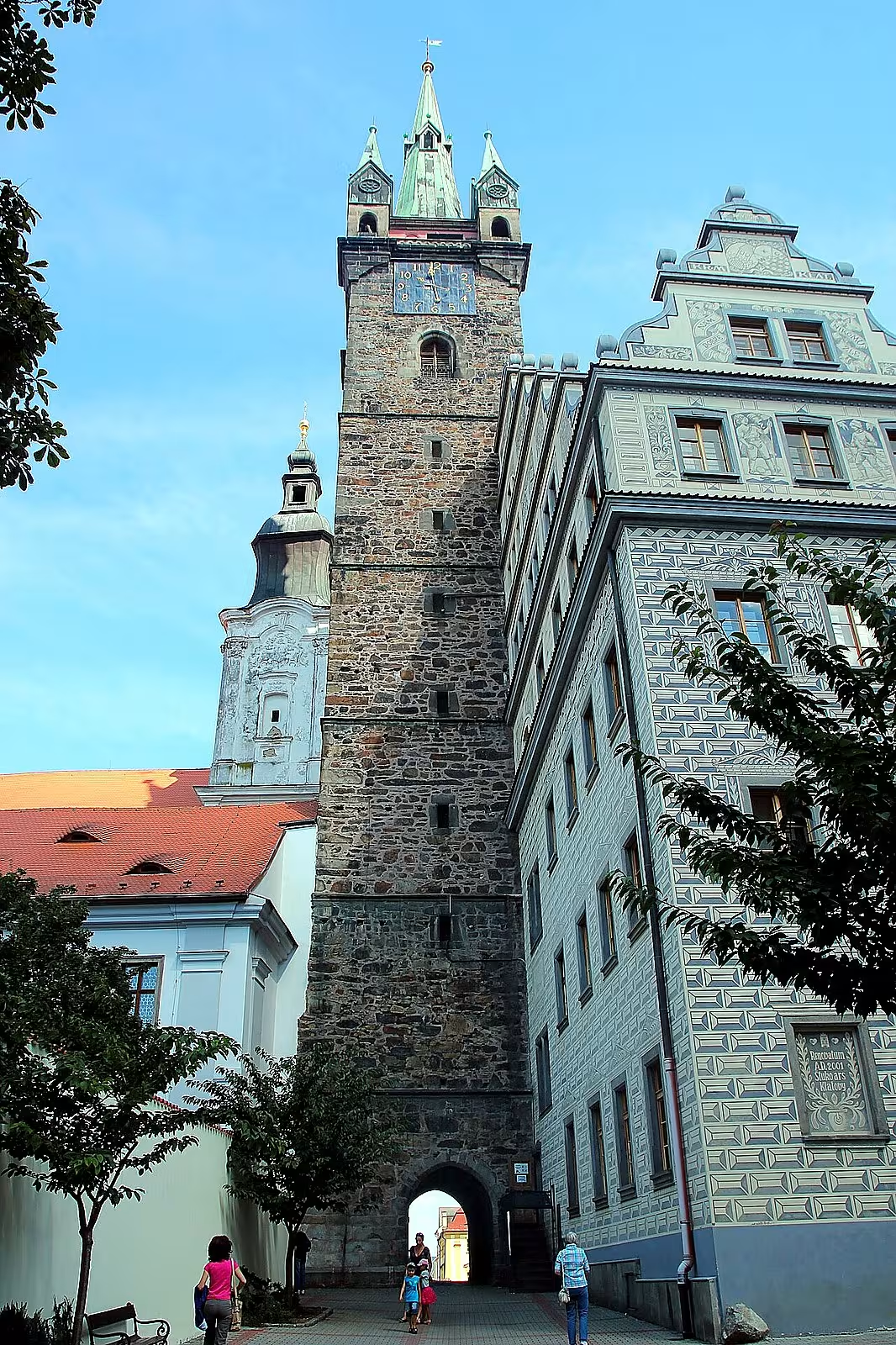
The Black Tower in Klatovy is a late-Gothic clock tower, a bell tower and a lookout tower in Peace Square. It was built between 1547 and 1557 by Italian builder Antonio de Salou as proof of the wealth of the city and for defence purposes. This invisible dominance reaches 81.6 metres. The observation gallery at a height of approximately 50 metres, where 226 stairs lead, offers a view of the city and its surroundings.
The construction was built in 1547 by a prosperous royal city. In the mid-16th century, Czech cities experienced a period of economic prosperity within the Habsburg monarchy. Renaissance architecture and city representation developed through spectacular buildings, such as city halls and towers. The plans of the builder assumed that the town hall building would be adjacent to the building later. The stone monument was completed in 1557 after ten years of work. Originally, it was independent, but in the second half of the 16th century, the Renaissance Town Hall, completed in 1559, and later the Jesuit Dorm with the church, grew first. The owner was the royal city of Klatovy.
The Black Tower stands on a floor plan approximately 10 times 11 meters in the village Klatovy I at an altitude of 412 to 422 metres. The quarry stone was used to build it in the form of a plastered block. The walls are approximately 2.7 metres wide at first and the facade is divided by five stone rims. The bell floor has large broken windows and the beams of the inner wooden structure lie on the stone consoles. Today's appearance of the roof dates back to 1872, when this historic building acquired a new Gothic jehlanová roof with four smaller towers in the corners. In the lower part towards the square there is a twenty-storey clock designed by Professor Ferdinand Vaněk and repaired in 2000 after a long period of malfunction. Just under the roof on all four sides lies a large square clock with dimensions 4,26 times 4,26 meters, made by the Jan Bošek mechanic. The clock machine, located in the middle of the building, is 208 centimetres wide, 47 to 49 centimetres high and 71 centimetres deep, with a pendulum measuring over 150 centimetres. The hand drive is provided by a system of gears and trays, and the clock beats for quarters and hours.
Over the centuries, the tower has passed through a number of building modifications and events. In 1583, the bell of Bartholomew cast on it by the bell man Martin Jindra. When repaired in 1727, the crows were replaced and gold-plated bays were applied to two jars. The great fire of the city in 1758 ironed and melted the original bell, resulting in its present name. A new bell called Bartholomew Ondřej or Vondra with a weight of nearly 4.5 tonnes and a diameter of almost two metres was made in 1760 by Italian bell-worm P. A. Jacomini. This bell burst in 1938, but in 1940 it was repaired in the bell shop of Rudolf Manoušek older and still hangs here. On 26 October 1870, a strong whirlwind knocked down the original copper onion roof, which hit the square, and the impact site is still marked. The last overhaul took place in the 1960s and 1970s.
The object served many specific purposes. On the first floor there was a torture chamber in operation until the 18th century. Kat had reserved his own entry because he was considered an unclean person. In the upper part of the house used to live with the family in two small rooms. His job was to oversee the city, announce time by honking and, in the event of a fire, alarm by hitting the heart of the bell. A hand pulley elevator or rumpál was used to transport heavier material. The last tower was Antonín Kubík, who served here until 1962. After he left, no administrator worked at the building. The bell of Vondra went silent after the last tower, but since 1989 it has been rocked again by a team of ten under the direction of Ján Hudač during major holidays and events. The tragic moments of history include cases of suicide, which in 2025 a stainless steel network was installed on the observation gallery.
The Black Tower is currently accessible as a popular tourist attraction. Every day from 21:00 to 2:00, every hour, there's a jingle honked to all four of the world.
Visiting this historic building offers a unique view of the development of Czech cities and the life of our ancestors. Come personally to admire the architecture and views that this Klatovy dominance has provided for centuries.
Then and now
Drag the slider to compare how the landmark may have looked when it was built with the view today.
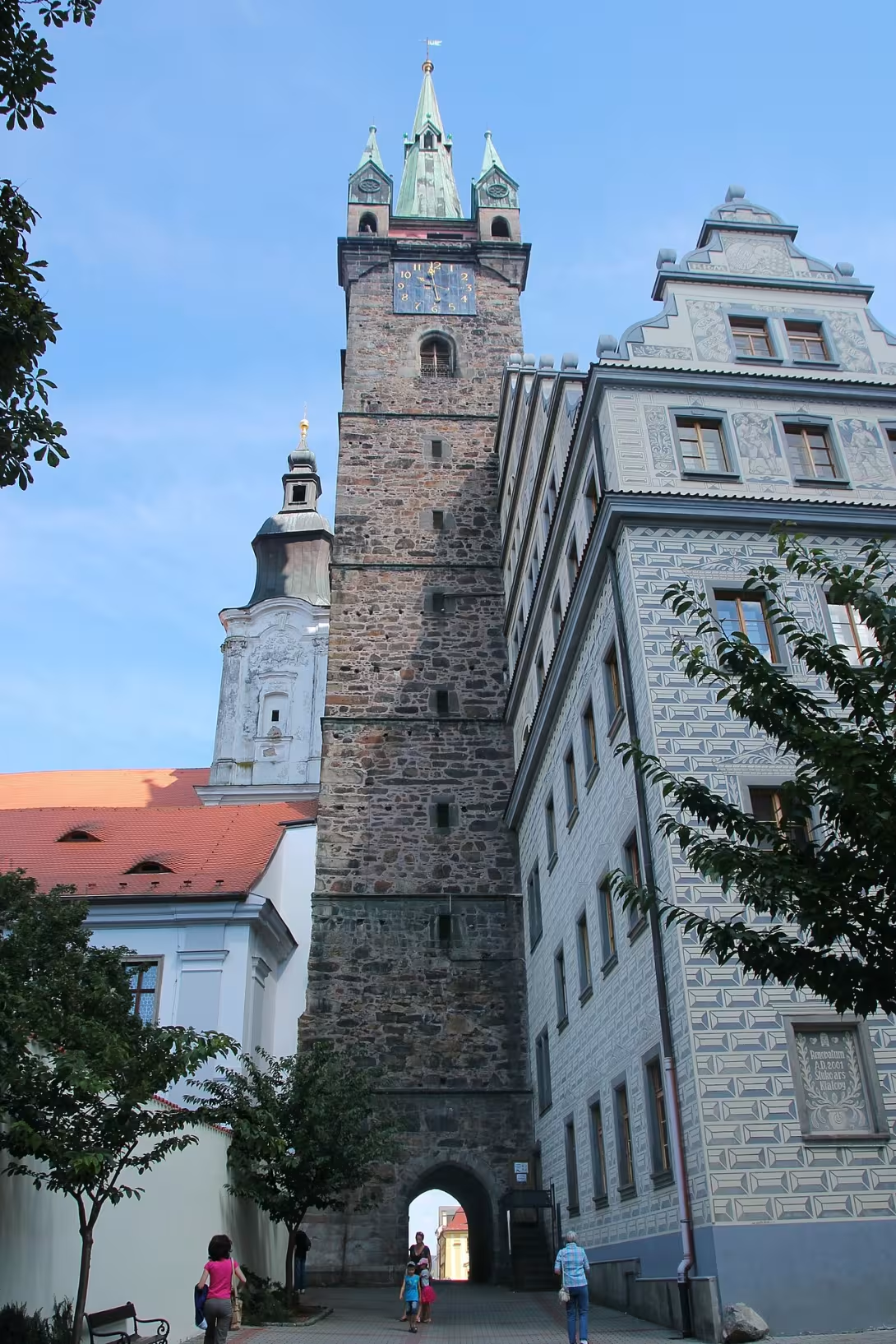

The historical appearance on the left is an AI-generated visualisation and serves as inspiration only.
Historical milestones
- 1547
- The tower was built by the Italian builder Antonio de Salou.
- 1557
- The construction of a stone tower after ten years.
- 1758
- The big fire of the city burned the tower, resulting in the nickname Black Tower.
- 1870
- A powerful storm has knocked down the original tower pit.
Architectural development
The stone tower was built in late Gothic style and finished in 1557 after ten years of work. Originally it was finished with an onion roof covered with copper sheet, but after the storm damage in 1870, it acquired a new needle roof with four smaller towers in the corners. Over the centuries, it has undergone numerous repairs, roof changes and clock dial installation.
Historical events
In 1547 the construction of the tower began by an Italian builder. In 1758 the city was hit by a big fire, after which the tower became known as Black. In 1870, a strong storm knocked down the original pit.
Owners
royal City of Klatovy
Points of interest
- The Black Tower in Klatovy is a late Gothic clock tower, a bell tower and a lookout tower on Peace Square, built between 1547 and 1557 by Italian builder Antonio de Salou as proof of the wealth of the city and for defence purposes. - This unobstructed dominance reaches 81.6 metres and the observation gallery at approximately 50 metres, where 226 steps lead, offers a view of the city and its surroundings. - In the lower part towards the square there is a twenty-storey clock designed by Professor Ferdinand Vaněk and repaired in 2000 after a long period of malfunction. - The great fire of the city in 1758 ignited and melted the original bell, resulting in its present name. - On 26 October 1870, a strong whirlwind dropped the original copper onion roof that hit the square, and the impact site is still marked.
Guide
Show guide text
This text was created by artificial intelligence and has not been editorially reviewed. It may contain inaccuracies.
Welcome to the beautiful city of Klatovy. Right now, you're standing on the Square of Peace, and right in front of your eyes, the most distinctive building in the whole area is erected. Look up, the massive tower that dominates the whole horizon and its shadow can cover a large part of the square. It's the Black Tower. Her presence is felt all around you, it's an incredible sight that will instantly charm you with its size and its unwavering strength. This building is not just an ordinary stone piece, it is a symbol of the power, pride and wealth of this city, which stands here as a witness for many centuries.
Let us now return together deep into the past to understand why this tower was created and how it became such an important part of this place. Imagine that we are now returning to a time when the city of Klatovy has only just been formed into its present form. It's a thousand five hundred forty-seven. In these days, when life has not yet been as fast as it is today, the city's fate and future have been decided in the council halls. The royal city of Klatova felt at that time a strong need to create something extraordinary, something that could be seen from miles away, telling a story about their prosperity. That's why it was assigned to build this monumental tower. In order to be truly dignified, the city has chosen an expert from far-off regions, an Italian builder named Antonius de Sala.
This process was not fast. Imagine the huge work, the constant noise of hammers, the smell of work and the decades of effort of many people. The whole construction took ten long years. Only in the year of a thousand five hundred fifty-seven was this stone tower finally completed. But it wasn't built just for its beauty. She was supposed to have very serious and practical purposes. As a high tower, it was meant to defend the city so that people could see the danger approaching in time. At the same time, it should have been a clear proof of how rich and successful this royal city was at that time.
Now pay attention to the very form of this building that you are currently observing. Notice her style, which is a late goth. It's a fascinating combination of several important functions. It is a clock tower that measured time for all residents, it is a bell tower whose voice has spread all around, and it is also a lookout tower that offers a view of the whole world around you. Now, if you look at its total height, you realize that it's reaching the 80-foot limit. It is truly an incredible height that makes it a dominant one that cannot be overlooked. The architecture that Antonius de Sala left in people and later also Ferdinand Vaněk is seen in every detail that you manage to capture with your view.
Maybe someone will ask you why this building is called the Black Tower. It's a very interesting story that isn't connected to the color of the stones at the beginning of its existence. The whole story changed in a thousand seven hundred fifty-eight. That's when the city was hit by a huge and devastating fire. The fire was so strong and hot, the tower ironed itself. Her surface has gone dark, and no one has called her anything since. This name became part of her identity and became her permanent nickname, which carries the memory of the disaster that the city had to overcome at that time.
But the history of this tower is not just about fire. It's also a story about the constant struggle with elements and the power of nature. In the year one thousand eight hundred seventy came a storm so strong and devastating that it knocked down the original pit that decorated the tower. It's a reminder of how fragile what seems to be eternal can be. And when you look at these walls, remember also the names that are closely linked to this place. In the history of the tower, names like Martin Jindra or Jan Bošek appear. These are the figures that are connected to this place, and their presence in history reminds us that every such building is the result of the work and life of specific people.
Now that you know its rich history, its creation and the moments that changed its appearance, I suggest you continue your walk along the square and other streets of the city. The Black Tower will still be here as a silent and majestic witness for many years to come. Enjoy the beauty of Klatov, look at the other details of this city and be carried away by its atmosphere. Thank you for spending time here with us. We wish you a wonderful journey and many other experiences.
Tips for visitors
Best time to visit Black towers are during spring or autumn, when the weather is mild and sunny days allow a beautiful view from the lookout tower. This time of year also offers pleasant temperatures for walking around the Square of Peace.
The current connection should be checked before the journey.
When visiting the Black Tower, take a comfortable suit with you because walking around the sights may include walking down stairs. It is advisable to photograph during the day when the sun illuminates the tower and surrounding the Square of Peace.
In the vicinity of the Black Tower you can visit the Renaissance building of the Town Hall and Jesuit College, which add historical context to your walk.
For families with children, the Black Tower is an interesting place to enjoy a view of the city from the lookout tower. Children can also enjoy walking around the square and exploring historical buildings nearby.
Frequently asked questions
Can the monument be visited?
We have not verified whether this monument is accessible. Please ask the owner or operator, or the local municipal office.
Where is the monument?
Location: Klatovy I. The map on this page shows the exact spot.
Why is the monument protected?
It is listed in the Central List of Cultural Monuments of the Czech Republic as a cultural monument (register no. 1000126574).
Businesses nearby
Do you run a restaurant, accommodation, shop, museum, rental, wellness or other visitor service near this monument? Show yourself directly to the people heading to it — this is how they will see you in the app and on the web:
Events nearby
Zdroj akcí: otevřená data měst a obcí ČR (Národní katalog otevřených dat) a kalendář akcí Národního památkového ústavu.
Nearby
Sousedící renesanční budova radnice, jezuitská kolej a kostel na náměstí Míru v Klatovech.
Accommodation nearby
Themed route
1. Renaissance building of the town hall, building: See this historic building with beautiful architecture. 2. Church of Peace Square, religious object: Visit this important place in the middle of the city. 3. Jesuit College, Building: Discover the interesting history of this neighbouring building. 4. Black tower, monument: The main destination of your trip, which offers a unique view of the city.
Seasonal recommendations
Spring awakens the surrounding parks and squares into fresh green, while the rays of the sun warm pleasantly but not yet burning, creating ideal lighting conditions for the photography of stone masonry. It is recommended to wear a light windbreaker and fixed shoes on a longer walk, the best time for visiting is in the morning when urban tourism wakes up.
Summer brings long sunny days and a hot afternoon when the surrounding trees provide shade on the historic square and strong light highlights the details of ancient architecture. In this period, it is reasonable to choose breathtaking clothes, sunglasses and headgear, with the best time to climb the view being late afternoon hours when the sun is weakening and the landscape is getting a golden touch.
Autumn offers a colorful view of the surrounding nature, where the leaves change colour to yellow and red, and morning fog gives the whole place a mysterious atmosphere. For colder days, a warmer sweater, long pants and waterproof shoes are suitable, while the ideal time for admiring the landscape is around noon, when the fog dissolves and the daylight is brightest.
Winter covers the whole area in a freezing silence, sometimes covers the roofs of the house with snow and early dimming creates a romantic atmosphere early in the evening under the street lamps. The need is a quality winter coat, hats, gloves and firm anti-slip shoes for safe outdoor movement, while the best time for walking is early afternoon until you can still see the surrounding snowy roof.
Visualizations and artistic views


The visualisations are generated by artificial intelligence and serve as inspiration.
Photos from the area
Real photos taken near the monument


Zdroj a licence jsou uvedeny u každého snímku.
Tips from visitors
No tips yet. Be the first!
Log in and add your tip.
Sources and literature
Photos: Draceane / CC BY-SA 4.0 — Wikimedia Commons. The author and licence also appear when you hover over the image.
Faktickým podkladem tohoto textu byl článek na Wikipedii, jehož autory jsou přispěvatelé Wikipedie. Článek je dostupný pod licencí CC BY-SA 4.0.
Location on the map
More monuments – Klatovy I
Show all in the municipality



Příběhy a pověsti
Legendy, pověsti a příběhy spjaté s touto památkou

Fotografie návštěvníků
Zatím žádné fotografie. Buďte první, kdo přidá fotografii z návštěvy!
Log in a přidejte svou fotografii nebo hodnoťte.
Za ověřenou návštěvu v aplikaci získáte víc bodů — poznáme podle GPS, že jste na místě.
Reviews and comments