



Městské opevnění v českém Brodě Town walls
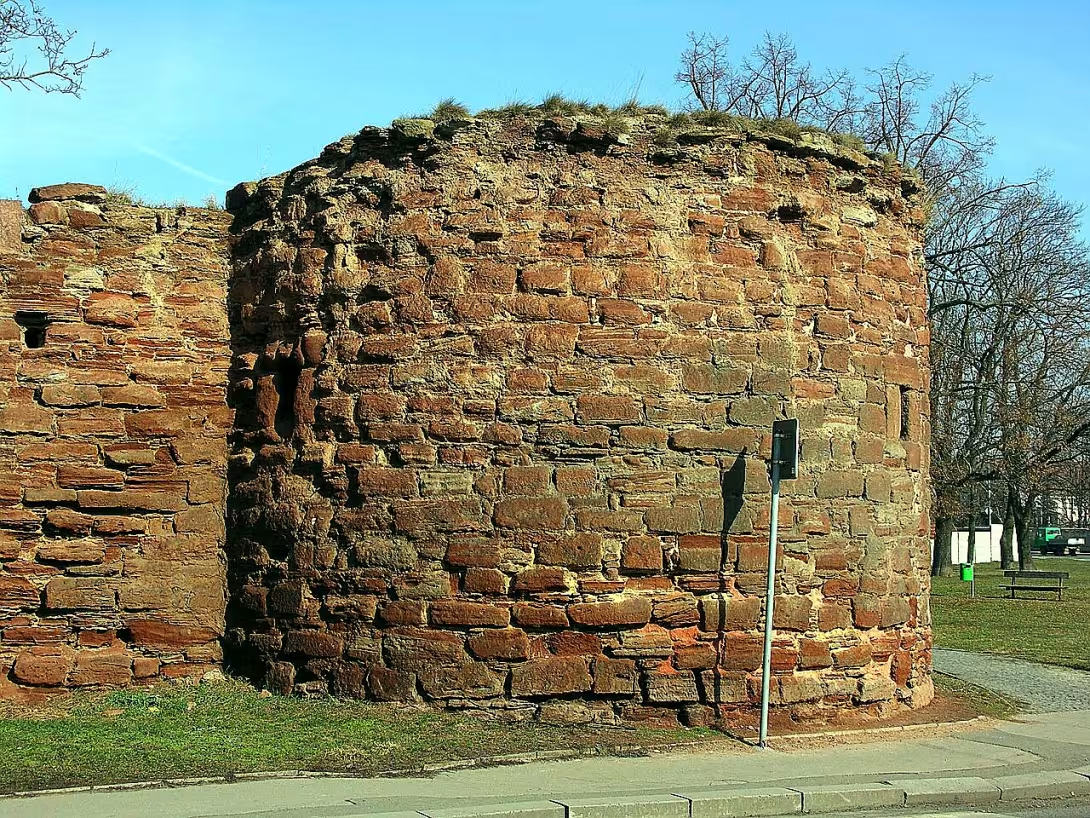
The city fortification in Český Broda is an important example of the Gothic fortification system, which in the past protected the historical core of the city. This complex of two lines of stone walls with a park and a system of bastion has been established gradually since the 14th century and still resembles the strategic importance of the mansion.
The beginnings of the fortifications date back to the period before the end of the Přemyslíková government, when the church town was protected by wooden walls, meadows or trenches. The fundamental development took place under Bishop Tobias of Bechyne after 1289 or 1303. A significant shift in building the stone system occurred in the middle of the 14th century when Archbishop Arnošt z Pardubic let the city round the walls and moats. This costly project included two lines of walls, which consisted of 9 to 14 metres wide parks.
The architectural appearance of the walls was fundamentally influenced by the reconstruction in the 15th century, started in 1451 and completed by the master G. in 1487, as evidenced by the stone plate in the local museum. A new outer wall was added to the inner wall about 5 metres high, supplemented by a battlements and six semi-circular baskets. The building material was used by the local red-brown Czech-brod sandstone, which was extracted behind the Šembre stream. Three gates led to the city: Liblická, Prague and Kouřímská, which were gradually supplemented by overarches.
The city that Emperor Zikmund Lucemburský promoted to royal in 1437 was in 1421 during the Hussite wars conquered by Pražani. The fortifications suffered considerable damage in a major fire in 1628 and subsequently during the Thirty Years' War. After it ended the importance of the walls fell and in 1781 he began to sell parks to townspeople for the establishment of gardens. Most of the gates were demolished in the 19th century due to emergency conditions; The Prague Gate disappeared in 1867.
From historical attractions it can be noted that water from the Šembery stream was held in the trenches outside the outer wall, if necessary, which, at a time of peace, caused problems for the population to experience mosquitoes. At each of the gates there was a so-called guard who was in charge of locking up the city and often being a bell tower. Six baskets and a unique section of the outside wall behind house No. 62 have been preserved from the original system until today, where medieval shooters with wooden fossils and routable partitions are visible.
Today, preserved remnants of walls are valuable evidence of medieval construction and historical development of Český Brod. These fragments represent a unique opportunity for visitors to see the way in which the security of royal cities has been ensured in the past. Walk along these structures offers authentic testimony about the craftsmanship of our ancestors.
Historical milestones
- 1345
- Archbishop Arnošt z Pardubic had the city fortified with walls and moats.
- 1451
- Opening of construction work on the walls completed by mistr G. in 1487.
- 1781
- The start of the city fortification sale to townspeople to set up gardens.
Architectural development
The development began with a wooden fortification, which was replaced by a stone wall with two lines of walls in the middle of the 14th century. In the 15th century there was a major reconstruction, supported by a stone plate from 1487. Later, semi-circular bastions and overarching were added, and in the 18th century the importance of fortification began to fall and the walls were gradually sold.
Historical events
1421: Conquest of Prague City during Hussite Wars. 1437: The promotion of the Czech Brod to the royal city by the Emperor Zikmund of Luxembourg. 1628: Extensive damage to fortifications in a major city fire.
Owners
Prague Bishop, then royal city Český Brod.
Points of interest
- The fortifications consisted of two lines of stone walls, between which between 9 and 14 metres wide a park. - A local red-brown sandstone was used as a building material, which was extracted behind the Šember stream. - In the trenches in front of the outer wall, water from the Šembera stream was held, if necessary, which caused problems with mosquitoes in times of peace. - At each of the gates there was a so-called guard who was in charge of locking up the city and often being a bell tower. - Six baskets and a section of the outside wall behind house No. 62 have been preserved from the original system, where medieval shooting sites with wooden foils and routable partitions are visible.
Guide
Show guide text
This text was created by artificial intelligence and has not been editorially reviewed. It may contain inaccuracies.
Welcome to Czech Broda. You are standing right in front of one of the most important symbols of this city, before its historic fortifications, which for centuries have formed an impenetrable boundary between the safe interior of the city and the dangerous outside world. Look around you and try to imagine what these walls looked like at the time of their greatest glory. Can you feel the weight of history that radiates from every stone? These walls are not just passive shadows of the past, they are monumental witnesses to the rise, wars and profound social changes that this city has undergone. Right now, when you look at these massive structures, you're facing the result of a work that took decades and required a huge amount of human power and technical art.
To understand why these walls are standing here, we have to go back deep into the 14th century. In 1345, Archbishop Arnošt z Pardubic, one of the most important figures at the time, decided that the city must be protected. At that time, it was not about stone walls, as we see them today, but about a much simpler system of wooden walls and coves supplemented by moats. It was necessary because the city grew strong and the safety of its people was a priority. However, over time the need for defence changed, and the old wooden structures were no longer enough to meet the demands of the time. The real break came after the devastating Hussite wars. It is these conflicts that have shown that the city needs something much stronger and more resilient. At this time, the city was promoted to royal, which gave it a new status while increasing its strategic importance. As a royal city, Český Brod could no longer have any weakness in defense.
Now pay attention to what you see right in front of you. What you're seeing today is the ultimate example of the Gothic Fortification System. If you look at the structure of the fortifications, you notice that this was not one simple wall, but a very sophisticated and costly system of two wall lines. Between these two lines, there was a so-called park, which is a space between nine and 14 metres wide. This space served as a strategic zone that made it impossible for the enemy to access the inner core of the city easily. The whole complex, which included three main gates and a system of baskets, was the result of long and precise work. The main architect of this work was mistr G., which started costly construction work on stone walls in 1451 and worked on them until 1487. Imagine the decades of effort, the patience and precision that mistr G. and his workshop had to spend on each laid stone.
Notice the color of these walls. If you approach the surface of the stone, you'll see its specific shade. This material is not random. The whole fortification was built from a local red-brown sandstone. This stone was not imported into the city from far-off regions, but it was extracted in the vicinity, behind the river Šembre. This proximity to the material was crucial for such a huge construction, but it also gives the whole city its unique character. That red-brown touch of sandstone gives the walls the feeling of an organic whole as if the city grew up right out of this country.
When looking at these walls, you can also recall the names of the great personalities associated with this place. In addition to the Archbishop Arnošt of Pardubice, other important people have left a trail here in history. We can remember here Zikmund of Luxembourg, whose reign was crucial to the city, or Tobias of Bechýn. These people were not just names in textbooks, they were people who decided on the fate of this place, on its protection and on its future flourishing. Every stone you see right now was at some point part of their vision or their political world.
Now, I would like to invite you to think of one technical interest that was an incredible advantage at the time. There were trenches outside the outer wall. They weren't just empty cuts in the ground. If necessary, when the enemy tried to attack, these moats were filled with water from the nearby Shembera stream. Imagine the obstacle - the enemy had to not only overcome walls and bastions, but also fight the water that made every move difficult. The strategic use of natural elements, such as river water, made the Czechoslovak fortification a real fortress that was not easy to conquer.
But the history of this place is full of contrasts. While in the fifteenth century these walls were a symbol of strength, military readiness and impenetrability, in the eighteenth century their roles changed completely. In 1781 there was a major decision that affected the city's appearance and these monuments. City fortifications began to sell to townspeople. The reason was not weakness, but desire for a new lifestyle. Instead of the walls being used to defend against the enemy, townspeople started using them to create private spaces, specifically to set up gardens. This transformation from military stronghold to quiet, green spaces is a fascinating story about how humanity's needs change - from survival and struggle to beauty and rest.
Today we look at these remnants of fortifications as a rare historical unique, but for people living here centuries ago, it was everyday reality, the protection of their homes and their livelihood. You're facing something that survived wars, political upheavals, and urban architecture.
I hope that this view of the history of the Czechoslovak walls has helped you better understand their importance. Please continue your walk and pay attention to other details of this city. Every alley and every stone here has a story waiting to be discovered. I wish you a nice tour and enjoy the atmosphere of this historic place. Goodbye.
Tips for visitors
A tour of the walls I recommend planning for the morning hours during the working week when the historic centre has a quieter atmosphere.
For a walk along the walls take comfortable shoes suitable for movement in historic streets and terrain around the fortifications. Due to the open space, don't forget the headgear in the summer months and the water bottle.
The game of light and shadows on the stone wall excels best in the low sun during the late afternoon.
For families with children is a walk along the walls of easy trip, which can be combined with a visit to the historical centre of Český Brod. In the vicinity there is a stream of Šembera, whose surroundings offer a pleasant environment for a short rest in nature.
Frequently asked questions
Can the monument be visited?
This is a structure in a public space that can usually be seen from outside free of charge. We have not verified that this particular one is freely accessible.
Where is the monument?
Location: Český Brod, Středočeský kraj. The map on this page shows the exact spot.
Why is the monument protected?
It is listed in the Central List of Cultural Monuments of the Czech Republic as a cultural monument (register no. 1000142121).
Businesses nearby
Do you run a restaurant, accommodation, shop, museum, rental, wellness or other visitor service near this monument? Show yourself directly to the people heading to it — this is how they will see you in the app and on the web:
Nearby
The river Šembera, the historical centre of Český Brod.
Accommodation nearby
Themed route
1. Historical Centre of the Czech Brod (Type: City section). Explore the atmosphere of old streets and historical architecture. 2. Městské opevnění v českém Brodě (wall) (Type: Monuments). Admire the historical masonry that once protected the city. 3. Schembera stream (Type: Water flow). Enjoy a quiet walk along the water bank.
Seasonal recommendations
Spring: During the spring season, the town fortifications in Czech Broda illuminate with beautiful flowering, when green meadows and trees begin to leave their winter clothes. The atmosphere is full of renewal and new beginnings. When visiting this time, remember that flowers are at the top of their beauty, which may be an ideal opportunity to take beautiful photos. It is recommended to visit the fortifications in the early afternoon when the temperature is most favourable and the crowds are less. A good idea is to wear light clothes with the possibility of adding a layer because the weather can be variable.
Summer: In June to August, the city fortification in Czech Broda takes over its full summer shine. The sun illuminates the walls, which is ideal for taking photos and exploring historic rooms. The atmosphere is full of life, often there are various summer events and events. Summer is the period of the highest attendance, so we recommend to come earlier at the beginning of the day to avoid long fronts. Remember the sun protection - wear a tie or hat and always carry a supply of drinking water.
Autumn: During autumn, especially in October, fortifications take on a unique atmosphere thanks to golden leaves and lighter temperatures. This time of year is ideal for a quiet walk and enjoy a quiet neighborhood without too many crowds. When visiting during this period we recommend wearing warmer clothes because the weather can be colder and damp. Beautiful autumn light is also a great opportunity to photograph historical buildings.
Winter: Winter visit to the city fortification in Czech Broda offers a completely different view, where the walls and surrounding countryside are covered by snow. The atmosphere is calm and quiet, which can be ideal for those looking for rest in the historic environment. We recommend wearing warm clothes, including hat and gloves, and fastening your feet with a warm shoe for a more comfortable walk on the snow surface.
Visualizations and artistic views


The visualisations are generated by artificial intelligence and serve as inspiration.
Photos from the area
Real photos taken near the monument


Zdroj a licence jsou uvedeny u každého snímku.
Tips from visitors
No tips yet. Be the first!
Log in and add your tip.
Sources and literature
Photos: H2k4 / CC BY-SA 3.0 — Wikimedia Commons. The author and licence also appear when you hover over the image.
Faktickým podkladem tohoto textu byl článek na Wikipedii, jehož autory jsou přispěvatelé Wikipedie. Článek je dostupný pod licencí CC BY-SA 4.0.
Location on the map


Příběhy a pověsti
Legendy, pověsti a příběhy spjaté s touto památkou
Fotografie návštěvníků
Zatím žádné fotografie. Buďte první, kdo přidá fotografii z návštěvy!
Log in a přidejte svou fotografii nebo hodnoťte.
Za ověřenou návštěvu v aplikaci získáte víc bodů — poznáme podle GPS, že jste na místě.
Reviews and comments