



mlýn u Guthů Water mill
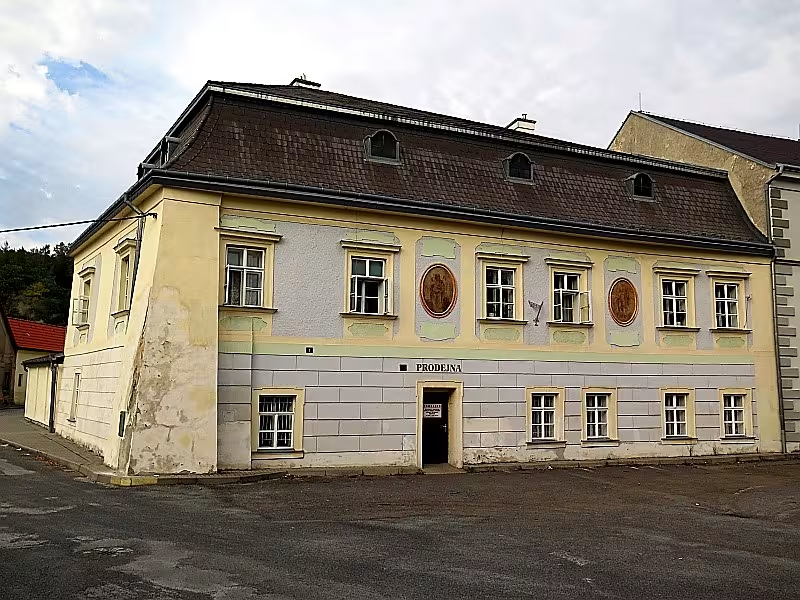
The mill near Guthas, also known as Muchkovský or Koček's Mill, is a monument protected water building on the Klabava River in the Rokycan part of Plzeňské Předměstí. The history of the object dates back to the 16th century. The current design of the building is a valuable example of industrial architecture from the end of the 19th century when the original mill was replaced by a new building.
The first written mention of the mill dates back to the second half of the 16th century. During this period, which was the Renaissance under the rule of the Habsburgs in the Czech countries, the construction performed its traditional miller function. However, few concrete reports have survived on its oldest form. A significant break in the history of the mill occurred in 1877. At that time the old mill was replaced by a new construction, which determines the appearance of the building today. This reconstruction coincides with the expansion of the industrial revolution in Austria-Hungary.
It's an architectural wall, a one-storey corner building whose main facade is headed towards the city. The facade on the ground floor is broken by a flat barefoot, while the floor is decorated with Lizzy frames. Two oval frames with wall paintings of St. Joseph and St. Florian, located between the window axes, are a remarkable artistic element. The entrance door is planted in the stucco frame. The ground floor interior uses vaults; The middle corridor has Prussian vaults and side rooms have cross vaults. The floor is flat ceiling. The technical background of the mill in the past used the drive and Francis turbine with a power of 10.7 horsepower, a vortex of 0.82 cubic meters per second and a drop of 1.4 meters.
The property history of the building was significantly changed in 1897. Until then, the mill was owned by Vilemína Jágrová, which rented it to the locksmith Julius Guth of Brandýs nad Labem and Prague sewing machine dealer Julius Neumann. These tenants adapted the premises to the production of hardware. This was the time of progressive use of the mill wheel and transformation of traditional operation to modern industrial production.
Today the Mill is protected as a real-estate cultural monument of the Czech Republic. The building illustrates the transformation of the mill industry and its subsequent adaptation for industrial production in the late 19th century. This mill represents an important point for interested parties about the history of technical constructions and the architecture of the region, which resembles the industrial history of Rokycan. Visiting the location in Plzeň Suburb offers the opportunity to see preserved architectural elements and to learn about the history of the building in its authentic environment near the Klabava River.
Historical milestones
- 1550-1599
- First written mention of the mill.
- 1877
- Old mill replaced by new construction.
- 1897
- Adaptation of the mill for the production of hardware.
Architectural development
The original mill was replaced in 1877 by a new construction, which is today's form of the building. The facade is decorated with lizen frames and barefoot on the ground floor. The inner spaces use a combination of vaults and flat ceilings, and the technical equipment included Francis' turbine.
Historical events
The first written mention dates back to the second half of the 16th century. In 1877 a complete reconstruction of the mill was carried out. In 1897 there was a rental and subsequent adaptation of the premises for the production of hardware.
Owners
Vilemína Jágrová (until 1897), Julius Guth and Julius Neumann (since 1897).
Points of interest
- The mill at Guthas is also known as Muchkovský or Koček Mill and is located on the River Klabava. - The current form of the building dates back to the late nineteenth century when the new building replaced the original mill. - On the facade there are two oval frames with wall paintings of St. Joseph and St. Florian. - The technical background of the mill in the past was used by a turbine with a power output of ten and seven tenths of the horsepower. - In the year eighteen hundred ninety-seven, the mill was adapted for the production of hardware, which was the progressive use of the water jet at the time.
Guide
Show guide text
This text was created by artificial intelligence and has not been editorially reviewed. It may contain inaccuracies.
Welcome to the Rokycans, the part called Plzeňské Předměstí. Stop for a moment, take a breath and feel the atmosphere of this place. Right now, you're standing in front of a building that carries hundreds of years of history and human work. The mlýn u Guthů stands before you, a building that is today protected as a real-estate cultural monument. Look at her. You see a single-storey brick object in front of you telling the story of the transformation of time, the industrial expansion and the relationship between man and nature, namely the Klabava River, which flows through here and has been the main source of energy for centuries for everything that happened in this mill.
Let us now look deeper into the past together to understand how this form of the building came to be. The history of this place goes far beyond what the appearance of the current walls tells us. The first written mention of the mill in this place dates back to a period between a thousand five hundred fifty and a thousand five hundred ninety-nine. So imagine that already in the 16th century there was a noise of a mill wheel and dust from ground grain was flying through the air. For centuries, there was an old mill, but over time it stopped meeting the needs of its owners and period technology. The break came in a thousand eight hundred seventy-seven. It was this year that the old building was replaced by the new construction that you see before you. This building from the end of the nineteenth century is an example of the then approach to architecture, where the practical purpose of the building was associated with aesthetic value.
Now pay attention to the architecture itself and look carefully at the facade of the building. Notice how rich it is. The architects, whose names we don't know today, have put a lot of detail into the facade, which makes the building more than just a simple production space. If you look up, you'll see two oval frames. In them are preserved wall paintings of saints. You will find St. Joseph and St. Florian. At that time, it was customary to entrust buildings to the protection of saints who were supposed to protect their property from disaster or fire, which was very important for mills where there was a risk of burning money. These paintings are now a rare testament to the then faith and aesthetics.
If you're looking at the building from the outside, maybe you're wondering what's inside. Although we are now staying outside, we can imagine an inner space that is just as fascinating as an exterior. On the ground floor there are Prussian and cross vaults that provide space for stability and the specific character of old craft workshops. The upper floor is already flat-ceiling, which reflected the functional distribution of space for traffic needs. The whole object combines the robustness of the walled structures with the fineness of the facade details.
But this building was not only about stones and paintings, but mainly about the people who lived and worked here. The names of the personalities who left their mark at this place are linked to the mill. Among them was Julius Guth, after which the mill bears its present name, and also Julius Neumann. The important figure was also Vilemína Jágrová. These people weren't just owners, they were managing a place that had to keep up with the times. And it is the ability to adapt in this story that is crucial.
Look at the building again and try to imagine the year one thousand eight hundred ninety-seven. There was a fundamental change this year. The mill stopped serving only the milling of grain. The building was adapted to produce hardware. Imagine the contrast. Instead of silence and flour dust, the sound of metals, hammers and machines began to be heard here. The mill thus became part of the industrial revolution, which at that time changed the face of the entire region. This transformation from food operations to the metal industry shows how dynamic this place was and how important it played in Rokycan's economic life.
Now, I'm going to lead you to one interesting thing that might seem like a little mystery. If you talk to the locals or browse through the old records, you'll find that this mill doesn't have just one name. In addition to the name mlýn u Guthů it is also known as Muchkovský or Koček Mill. Why is that? In the history of mills, it was common that the name changed depending on who was the owner at the time or the family stories that were attached to the place. Each of these names represents a different layer of history, a different family and a different section of time that helped keep this building alive. It's fascinating how one building can have so many identities and still remain the same point in the landscape of the Klabava River.
When you stand before this monument today, see it as a bridge between centuries. From the first mention of the sixteenth century, to the great new construction of the year eight hundred seventy seven, to the industrial era of iron production at the end of the nineteenth century. It's all encoded in these walls, in the paintings of saints on the facade and in the vaults on the ground floor. It's a place where water, craft and human ambitious spirits meet.
Before we say good-bye and you go your way, I suggest you go around the building again slowly, see the noise of the Klabava River and try to imagine what life was like in this mill a hundred years ago. Who was going through what people were talking about at the entrance and how they felt when they saw St. Florian watching their work.
Thank you for accompanying me on this short trip to the history of the Guthas Mill. I hope this view of the building has helped you see more than just an old brick house. I will now invite you to further explore the surroundings of Pilsen Suburb and discover other hidden corners of Rokycan. I wish you a pleasant continued walk and many new experiences. Goodbye.
Tips for visitors
The best time to visit is during the morning when the sun illuminates the face of the mill from the Klabava River, which creates ideal conditions for capturing details of historical architecture. At this time there is also a quieter atmosphere in the surroundings for the tour.
You can easily reach the monument by car and public transport, as it is located in the part of Rokycan called Plzeňské Předměstí. For precise travel planning, we recommend using internet connection search engines that offer up-to-date transport options up to the nearby mill.
For photography we recommend to use the bank of the Klabava River, where the best view of the whole building is. The best pictures can be taken in clear weather, when the reflection of the mill on the water surface is beautifully supplemented with the surrounding greenery.
When visiting with children we recommend a walk along the River Klabava, which offers a pleasant environment for a family trip. Don't forget to take comfortable shoes suitable for moving near the water stream and possibly a snack you can enjoy on the shore.
In the immediate vicinity of the mill you can visit the center of Rokycany, which is just a short walk away from the monument. Take the time to explore the history of this area and enjoy the quiet atmosphere at the Klabava River.
Frequently asked questions
Can the monument be visited?
This is a technical monument. Some are open as exhibitions, others are out of use or on private land. We have not verified whether this one is accessible.
What are the opening hours and admission?
We have not verified the opening hours or admission. Current information is published by the operator.
Where is the monument?
Location: Plzeňské Předměstí, Plzeňský kraj. The map on this page shows the exact spot.
Why is the monument protected?
It is listed in the Central List of Cultural Monuments of the Czech Republic as a cultural monument (register no. 1000148316).
Businesses nearby
Do you run a restaurant, accommodation, shop, museum, rental, wellness or other visitor service near this monument? Show yourself directly to the people heading to it — this is how they will see you in the app and on the web:
Events nearby
Zdroj akcí: otevřená data měst a obcí ČR (Národní katalog otevřených dat) a kalendář akcí Národního památkového ústavu.
Nearby
Mlýn se nachází v Rokycanech na Plzeňském Předměstí, v blízkosti řeky Klabavy a nedaleko centra města.
Accommodation nearby
Trips and activities nearby
Guided tours, tickets and activities nearby from GetYourGuide
Affiliate link: if you buy from the partner, we may receive a commission. The price for you does not change.
Search tours and activities →Themed route
Thematic cruise route: Mill near Guthas and surroundings
1. Mill at Guthas (Mill)
Why is it worth a visit: This historic mill is a view of the past where you can learn about the traditional way of drying grain. Its location near the Klabava River gives it a calm and attractive atmosphere.
2. Klabava River (River)
Why is it worth a visit: Shortly after the visit to the mill we will look at the river that has given energy to its operation. It is an ideal place for relaxation and a short walk in the natural environment.
3. Center of Rokycany (historical center)
Why is it worth a visit: After a tour of the mill and afternoon rest on the river we will go to the city centre. Here we can find historical architecture, cafés and shops offering a view of contemporary Czech culture.
4. Club Rokycany (culture)
Why is worth visiting: If you like cultural events, the club in Rokycany offers various concerts and performances. It's a great way to relax after a full day's viewing.
5. Park by the Klabava River (park)
Why is it worth a visit: At the end of the day we return to the park by the river where you can walk in a quiet environment or relax on the bench. It is an ideal place to close the day with beautiful views and peace.
This route offers a combination of history, nature and culture near Rokycan and the city of Plzeňské Předměstí.
Seasonal recommendations
Spring: During the spring season, mlýn u Guthů appears in the living green, when trees and bushes start to spruce. The sun rays illuminate the memory pleasantly, creating an ideal atmosphere for walking or relaxing on the outside. Natural sounds of birds give peace and comfort. It is recommended to visit in early afternoons when the temperature is pleasant and the crowd is minimal. A good idea is to wear light clothes with the possibility of adding a layer for cooler moments.
Summer: In summer mlýn u Guthů is transformed into a place full of light and heat, when the lighting is long due to the length of days. Nature swells in its best shade and green vegetation provides natural shade. The atmosphere is full of vitality, which makes the memory a favourite goal for families and lovers of nature. Visitors are advised to come earlier on the day to enjoy the place before the crowd gathers. Don't forget the protective sunglasses and enough fresh connection.
Autumn: In autumn mlýn u Guthů swells in beautiful colour shades, when tree leaves go green to yellow and red. The lighting is softer, and the sun's rays are projected through the morning mist, creating a magical effect. The atmosphere is quiet and friendly, ideal for relaxing on the outside or for a short walk. Visitors are advised to wear warmer clothes for colder noon and evening temperatures, while the less demanding period of the day offers a pleasant visit.
Winter: In winter mlýn u Guthů is transformed into a place covered with snow or ice, which gives its historic buildings a unique character. Lighting is cold and soft, with trees without leaves allowing a view of the overall structure of the monument. The atmosphere is calm and quiet, creating a sense of relief from the winter noise of the city. Visitors are advised to wear warm clothes and shoes suitable for snow. Remember that some part of the monument can be closed or restricted in winter due to natural conditions.
Visualizations and artistic views


The visualisations are generated by artificial intelligence and serve as inspiration.
Photos from the area
Real photos taken near the monument

Zdroj a licence jsou uvedeny u každého snímku.
Tips from visitors
No tips yet. Be the first!
Log in and add your tip.
Sources and literature
Photos: Sovicka169 / CC BY-SA 4.0 — Wikimedia Commons. The author and licence also appear when you hover over the image.
Faktickým podkladem tohoto textu byl článek na Wikipedii, jehož autory jsou přispěvatelé Wikipedie. Článek je dostupný pod licencí CC BY-SA 4.0.
Location on the map
More monuments – Plzeňské Předměstí
Show all in the municipality


Příběhy a pověsti
Legendy, pověsti a příběhy spjaté s touto památkou
Fotografie návštěvníků
Zatím žádné fotografie. Buďte první, kdo přidá fotografii z návštěvy!
Log in a přidejte svou fotografii nebo hodnoťte.
Za ověřenou návštěvu v aplikaci získáte víc bodů — poznáme podle GPS, že jste na místě.
Reviews and comments