






Musconský palác Palace
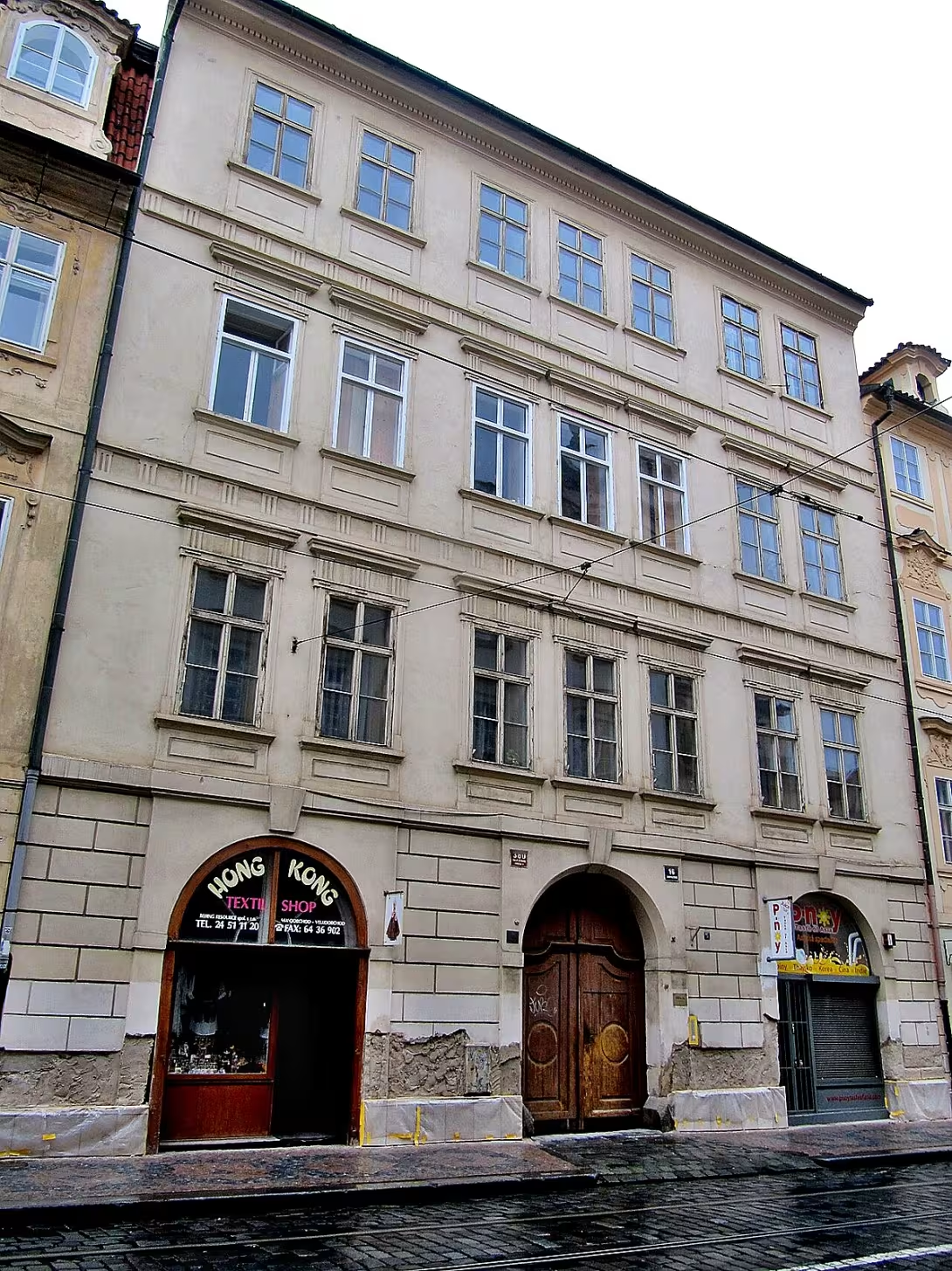
Musconský palác, also called the Great Musconský palác or Harbuval-Chamaré Palace, is a classical building in Carmelite Street No. 380 / 16 in Prague 1-Malá Strana. Since 1964, it has been protected as a cultural monument. The land was built by the garden of Maltese knights and its история dates back to the Middle Ages - already in 1346 there were two malts and two residential houses.
The decisive change came after 1611, when František Ludvík Muscon built a new house on a vacant parcel. Later, in 1637, creditors took over the property and managed it in accordance with Maltese jurisdiction. The Grand Prior Ferdinand Ludvík Kolovrat-Libštejnský paid off the main creditor in 1682, leaving the house to Maria Cecilia Renata for life. At the same time, the masonry master Hans Glier repaired it, rebuilt the rear building and made further minor modifications. In 1694 the house was bought by a lawyer and rector of Charles University Jan Jindřich Turba, who was also Chancellor of the Maltese Order. For its ownership, the front wing had two floors, the courtyard wings one and the first floor of the rear wing were connected to the house in Maltese Square.
In the early 19th century, the palace underwent the most important architectural transformation. In 1800 it was bought by Rosa kněžna Kinská, the widow of Josef Arnešt Kinský, and had it rebuilt according to the plans of builder Josef Zobel. The house gained its contemporary classical form: the front wall was raised by the third floor and the north wing by the second floor. In 1834 the owner became Jan Ludvík hrabě Harbuval-Chamaré, whose family owned it until the beginning of the twentieth century.
Today, the palace serves practical purposes - its premises are rented as apartments, offices and shops. It is architecturally characterized by a three-story west street wing and a north courtyard wing adjacent to the Thun-Hohenstein Palace. Together with the rear construction, the rectangular courtyard is bordered, which complements the classicist elements - the nobodies in the wall and the fountain from the time of the classical form of the palace.
Then and now
Drag the slider to compare how the landmark may have looked when it was built with the view today.
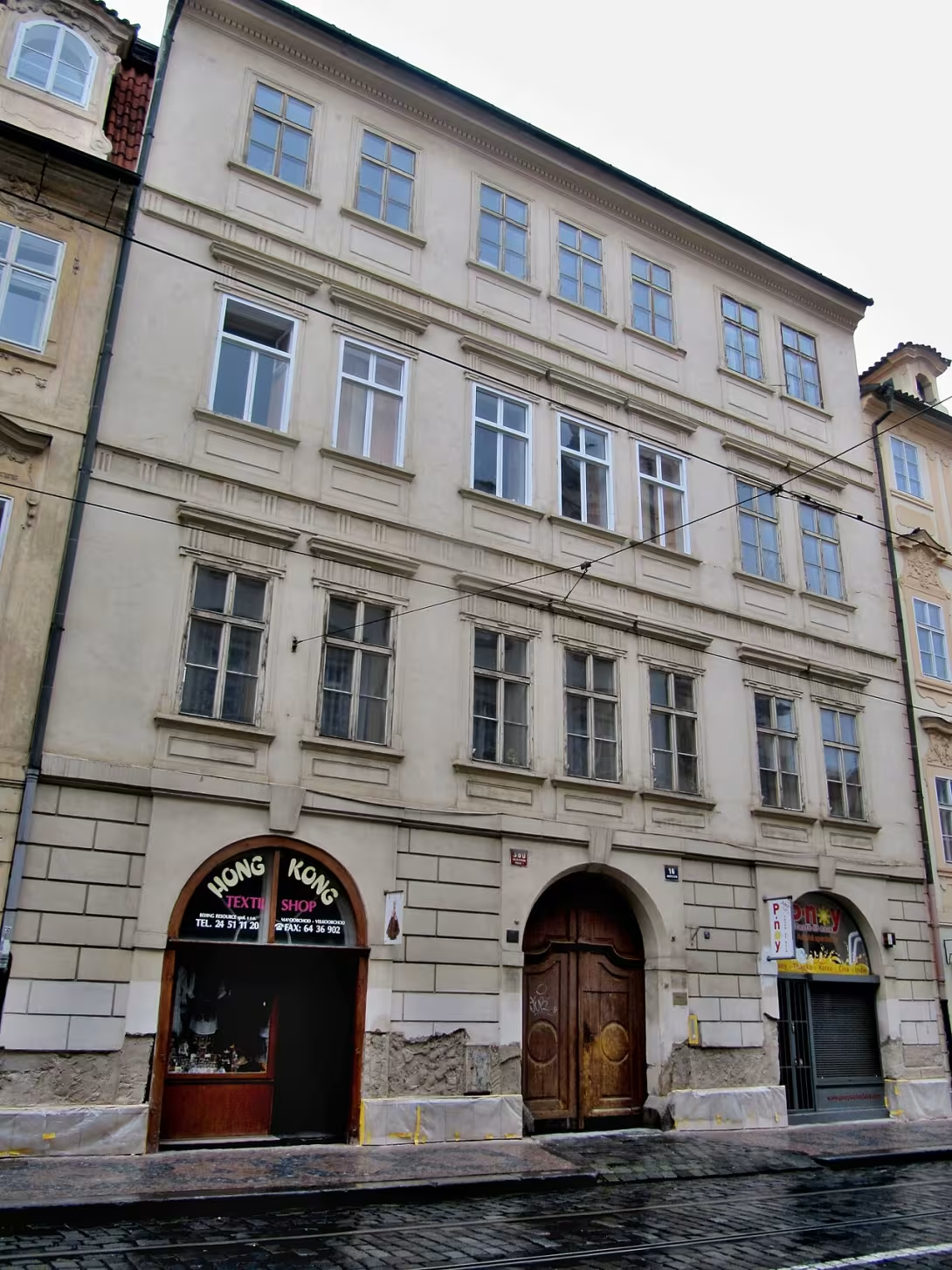

The historical appearance on the left is an AI-generated visualisation and serves as inspiration only.
Historical milestones
- 1346
- construction of two malts and two houses on the property
- 1611
- construction of a new house by Franz Louis Muscone
- 1800
- classical reconstruction according to plans of Josef Zobel
- 1964
- the object is protected as a cultural monument
Architectural development
The original Gothic building underwent a late Gothic and Renaissance reconstruction, followed by an early Baroque repair by Master Hans Glier. In 1800, the palace was increased by floors according to Josef Zobel's plans and gained a classical appearance. The interior has preserved craft equipment.
Historical events
1611: construction of a new house by František Ludvik Muscon; 1800: essential classical reconstruction for Rosa, Princess Kinsky; 1964: Declaration for cultural heritage.
Owners
František Ludvík Muscon (after 1611), creditors (from 1637), Ferdinand Ludvík Kolovrat-Libštejnský (1682), Jan Jindřich Turba (1694), Jan Baptist Procházka (1787), Rosa kněžna Kinská (1800), Jan Ludvík hrabě Harbuval-Chamaré (1834).
Points of interest
Since 1964, the palace has been protected as a cultural monument. - Already in 1346 there were two malts and two residential houses. - In 1800, Rosa kněžna Kinská bought it and had it rebuilt according to Josef Zobel's plans. The palace premises are now rented as apartments, offices and shops. - The rectangular courtyard is complemented by classical elements such as nobodies in the wall and fountain.
Guide
This guide is narrated by a synthetic voice generated by artificial intelligence.
Show guide text
This text was created by artificial intelligence and has not been editorially reviewed. It may contain inaccuracies.
Welcome to the heart of Prague's Little Party, one of the most beautiful and atmospheric neighborhoods of our capital. You're standing in Carmelite Street right now, and in front of you is Musconský palác. Stop for a moment, take a breath and just feel the space around you. Look at the building that welcomes you now. It is an object with a very balanced, rectangular disposition, which in its face represents peace and order. What you see is not just an ordinary house, but a layered story of several centuries of Prague history, which gradually evolved from craft spaces into a representative aristocratic residence.
Let us now return together in time, far deeper than your view. To understand exactly where we are and how this place evolved, we have to move to 1346. Imagine this street at the time. There was no palace as we know today. The land was used for very practical and craft purposes. It was here at that time that two malts and two houses were built. Malting was a key craft at the time, so this part of the Little Party was a place of work, noise and the specific smell of malt malt. It is fascinating to think that under the present facade and the noble form of the building lies this medieval, almost industrial history.
Time passed and with it the face of this place changed. In the seventeenth century, a fundamental change is coming. The property was owned by František Ludvík Muscon, after which the palace now bears its name. He is the one who built a new house here, which laid the foundations for the future representative character of the whole building. At that time, Malá Strana became the center of power, elegance and diplomatic relations, where nobles and rich townspeople built their homes to reflect their status and taste. The building of František Ludvik Muscono subsequently went through several phases of reconstruction, adapting to the new trends and needs of its owners who sought security and prestige.
Now please look again at the facade of the building before you. What you're seeing today is the result of a massive adjustment of 1800. In this year the palace gained its present form in the spirit of Classicism. Classicism was a style that returned to ancient patterns, emphasized symmetry, purity of lines and a reasonable spatial organization. Notice how the building looks harmonious and balanced. This transformation was realized by architect Josef Zobel. His intervention turned the house into a true palace that radiated dignity and stability. When you look at the building, feel this effort for order and balance, which is so typical of Zobel's plans.
But who was behind this ambitious reconstruction and why was it carried out? It was in 1800 that Rosa kněžna Kinská bought the building. She was a woman with taste and vision who wanted her mansion to match the latest standards of that time. It was her decision to bring Joseph Zobel defined the appearance of the palace you see before you. Priestess Kinska basically inhaled the building's present face. But the story of the palace does not end with the Princess Kinsky. Over the next decade, there have been other important owners and personalities who have left their mark in the history of this house. These included Ferdinand Ludvík Kolovrat-Libštejnský, Jan Jindřich Turba or Jan Ludvík hrabě Harbuval-Chamaré. Each of them brought new energy to the building and a new chapter in its history, although the outer face of the palace remained faithful to the original plans of 1800.
Now let's move on to the latest history and think about what this building means to us today. In 1964, Musconský palác was officially declared a cultural monument. This means that the state has recognised its irreplaceable value for our architecture and the overall history of Prague. It is a recognition that this building is a living witness to the transformation of our city, from medieval malts to the Baroque house to the Classicist Palace. It is a monument that has survived changes in regimes, wars and social upheavals.
What's interesting is how the building evolved into use. If you look at the windows and entrances now, you will see that the building lives in the rhythm of the modern city. Today the palace is no longer the only noble residence for one family. The premises are now rented as apartments, offices and shops. It is a beautiful example of how the historical monument can adapt to the present without losing its identity. There may be a modern office in one part of the building right now, while someone in another part lives in the space where the nobles of the Kolovrat-Libstejn family once walked. This combination of old and new is precisely what makes Prague's Little Party so unique.
Now try to imagine the contrast. In one place where you're standing, so different things happened in the space of several centuries. From the hand of 1346, when there was probably the smell of malt and the noise of craftsmen, to the ambition of Franz Louis Muscone, to the refined taste of the Princess Kinsky and the precise work of Josef Zobel. All of these layers of time are encoded in this rectangular structure.
I suggest you take a moment to perceive the atmosphere of this place. Walk slowly around the building, perceive its dimensions and try to imagine what kind of interviews were held in these walls two years ago. You may have heard of many magnificent Prague palaces with giant gardens, but Musconský palác is proof that even to cut cities, in the narrow streets of the Little Party, can create a space full of elegance and history.
This concludes our short journey through the history of the Musconi Palace. I hope this view behind the facade helped you better understand the value of this place. It is now up to you to continue to explore other hidden corners of Carmelite Street, or to pursue new discoveries in other parts of the Little Party. I wish you a pleasant walk and many other fascinating experiences in our beautiful city. Goodbye.
Tips for visitors
For the best experience we recommend a visit in the morning when there are fewer people in the streets and the atmosphere is quieter. You can easily reach the monument by foot or by public transport; the current connection is best checked in the traffic controller. In this part of town it is difficult to find a parking space, so it is better to use public transport.
When visiting, it is recommended to bring comfortable shoes, which is suitable for walking on historical surfaces. The most suitable moments around the sunrise or sunset are photography, when the light beautifully highlights the classical shapes of the building and its details.
After the tour you can go for a short walk in the area. In the vicinity there is Maltez Square and Thun-Hohenstein Palace, which are ideal goals to complete your trip within Prague's Small Party.
Families with children will appreciate the possibility of free walks along the surrounding historic streets, which offer many attractions. For all visitors we recommend to monitor the current information about the availability of the property, which can be found on the official website.
Frequently asked questions
Is Musconský palác open to the public?
Musconský palác is not currently open to the public because it serves as the seat of the national constitutional court. But you can enjoy his exterior facades and architectural beauty from the street.
How do I get to the place by car / public transport?
If you arrive by car, we recommend parking in nearby garages. For public transport it is best to use the metro (Malostranská station) or buses that stop on the squares and streets of the Small Party.
How much is the entrance fee and is it paid on the spot?
Since Musconský palác is not open to the public, there is no admission fee.
Is the tour suitable for children and seniors?
Although the palace interior is unavailable, its external views are accessible to all. Walk on the streets of the Little Party is also suitable for children and seniors.
How long does the tour take?
Exploring the outside facades and surrounding streets can take from 30 minutes to a few hours, depending on how far you want to explore.
What are the opening times and booking is required?
Musconský palác is not open to the public, so there is no specific opening hours or need for reservations.
What's interesting in the immediate vicinity?
Close to Muscona there is a Carmelite monastery, Maltese Square and other historical buildings. Malá Strana offers many restaurants and cafes for the afternoon stop.
For kids
Imagine going back to the past and standing on the Little Party in Prague, where the great Musconský palác is located. It's a place full of secrets and stories, like you're going into a book with ghosts from the past.
Businesses nearby
Events nearby

Zdroj akcí: otevřená data měst a obcí ČR (Národní katalog otevřených dat) a kalendář akcí Národního památkového ústavu.
Nearby
Thun-Hohenstein Palace, Maltese Square, Prague Malá Strana.
Accommodation nearby
Trips and activities nearby
Guided tours, tickets and activities nearby from GetYourGuide
Affiliate link: if you buy from the partner, we may receive a commission. The price for you does not change.
Search tours and activities →Themed route
Thematic cruise route from the Musconi Palace
1.Musconský palác - Type: Historical Palace - Why is it worth a visit: Musconský palác is one of the oldest buildings on Prague's Malá Strana, which attracts many visitors with its architectural wealth and history. It is an ideal place for those who want to experience the atmosphere of old Prague.
2. Thun-Hohenstein Palace - Type: Historical Palace - Why is it worth a visit: Located just a few minutes walk from the Musconi Palace and is known for its impressive architecture and history. The palace was formerly the seat of the Thun-Hohenštejn family, which adds an interest to visitors interested in Czech aristocracy.
3. Maltese Square - Type: Square - Why it is worth a visit: Maltese Square is the key centre of Prague's Malá Strana, where the famous Maltese Chapel is located. The square offers a beautiful opportunity to relax and explore local architecture in a quiet atmosphere.
4.Malá Strana - Type: Historical district - Why is it worth a visit: Total walks on the streets of the Small Party are invaluable because they offer a view of many other historic buildings and beautiful views of Prague. It's the perfect way to dive into the atmosphere of the old Prague district.
This route offers a compact tour of the most distinctive places on the Lesser Side, which are all close to the Musconi Palace.
Seasonal recommendations
Spring brings freshness and fine colors of blooming nature to the surroundings of the palace. Lighting is soft in this period and very pleasant for observing historical details without sharp shadows. We recommend wearing layered clothes because morning temperatures can still be cold. The best thing is to visit a place in the morning when people's movement is still mild.
In the summer months the atmosphere of the Little Party is very lively and full of energy, but also hot. The sun shines intensively, highlighting the colors of the facades, but it can be unpleasant in direct light. Due to the great strain of people in the high summer season, it is best to arrive at the very beginning of operation. Dress lightly and don't forget enough water while walking the historic streets.
Autumn offers a nostalgic and calm atmosphere, complemented by golden shades of leaves and occasional morning fog. The light is deep in this period and ideal for photography architecture. Choose high-quality shoes and warmer clothing layers for comfortable movement along the surrounding streets. We recommend a visit in the afternoon when the sun creates beautiful shadows and colors.
Zimą makes the palace very noble and in the cold air it feels a special calm. Days are short and light is weak, which creates an intimate mood, but requires better preparation for the cold. You must wear very warm clothes, including coat and scarves. There are more people in the area in Advent time, so plan a visit to make the opening hours shorter in winter.
Visualizations and artistic views


The visualisations are generated by artificial intelligence and serve as inspiration.
Photos from the area
Real photos taken near the monument


Zdroj a licence jsou uvedeny u každého snímku.
Atmosphere of the place
This atmospheric visualisation of the place and period was generated by artificial intelligence. It is not real footage of the location.
Tips from visitors
No tips yet. Be the first!
Log in and add your tip.
Sources and literature
Fotografie: Palickap / CC BY-SA 3.0 — Wikimedia Commons. The author and licence also appear when you hover over the image.
Faktickým podkladem tohoto textu byl článek na Wikipedii, jehož autory jsou přispěvatelé Wikipedie. Článek je dostupný pod licencí CC BY-SA 4.0.
Location on the map

Příběhy a pověsti
Legendy, pověsti a příběhy spjaté s touto památkou

Fotografie návštěvníků
Zatím žádné fotografie. Buďte první, kdo přidá fotografii z návštěvy!
Přihlaste se a přidejte svou fotografii nebo hodnoťte.
Za ověřenou návštěvu v aplikaci získáte víc bodů — poznáme podle GPS, že jste na místě.
Reviews and comments