






Německá Lhota Defunct village
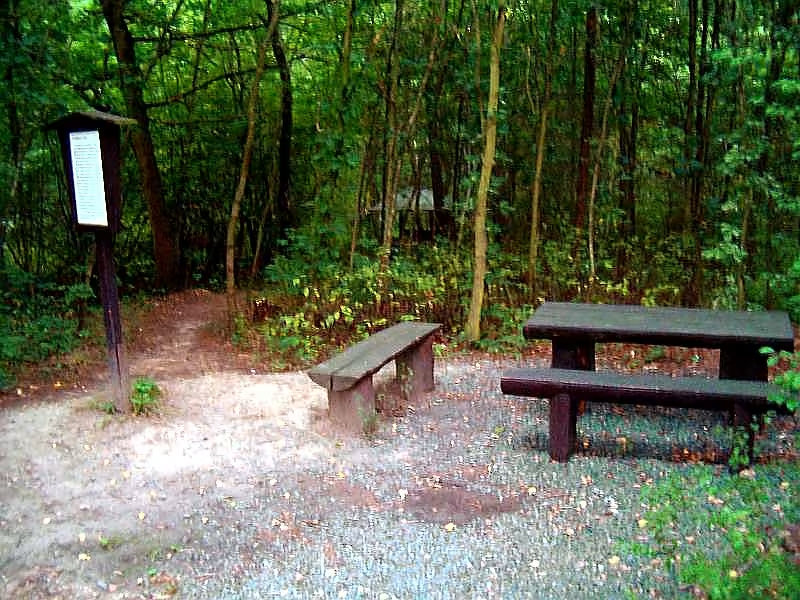
Německá Lhota is an extinct medieval village located about two hundred metres south of Kamenné Žahrovice railway station. Today, it is an archaeological site, which resembles the residential development of the 14th century. His remains were partially destroyed during the construction of the railway station. This is an important historical place that is linked to the epoch of the Thirty Years' War and the subsequent disappearance of the settlement.
The creation of this village falls into the 14th century. At this time, under the rule of Luxembourg, new villages were set up in Czech countries and rural settlements were developed. Historical sources suggest that this site has gradually become part of the junkyard.
From the point of view of construction and materials, a report on the preserved grafted well was preserved from 1904, as Stanislav Velc said at the time. Earlier in 1717, a schematic drawing of the extinct village was created, which documented its former existence.
During its history, this place changed its owners and faced fundamental historical breakthroughs. The first written mention dates back to 1436, when the village was donated by císař Zikmund to the Knight of Nedovkov. Later, the settlement became part of the junkyard. A 30-year war contributed to its gradual demise, during which it was destroyed by passing troops. The last written record of the village's existence dates back to 1634. The final end of the settlement was caused by the following plague epidemic.
Key events and attractions include the donation of the village by Emperor Zikmund in 1436. Today, the former village's place is one of the stops of Drvot's teaching path. However, part of the remains of the extinct village disappeared irreversibly when building a railway stop.
Today, this site is a subject of professional interest and archaeological research that took place here after 1970. Interested people can visit this historic place within the educational trail of Drvot in the immediate vicinity of the train station Kamenné Žehrovice.
Visiting this archaeological site offers a unique view of medieval history and reminds of the fated fates of extinct settlements in Czech countries. Follow the footsteps of history and discover the less known testimony of our past.
Historical milestones
- 1436
- The first written mention of the village and its donation by Emperor Zikmund to Knights of Nedovkov.
- 1634
- Last written record of the village.
- 1717
- The creation of a schematic drawing of a extinct village.
- 1904
- Stanislav Velc reported information about the preserved grafted well.
Historical events
In 1436, the village of císař Zikmund donated to the Knight of Nedovkov. During the Thirty Years' War, the village was destroyed by passing troops. After the plague epidemic, the village was definitely extinct.
Owners
pashenian manor
Points of interest
- Německá Lhota is a desolate medieval village and today's archaeological site, which resembles residential development in the 14th century and is located about 200 metres south of Kamenný Žehrovice Train Station. - The remains of this place were partially destroyed and disappeared irretrievably during construction and construction of railway stops. - The first written mention dates back to 1436, when the village was donated by císař Zikmund to the Knights of Nedvědkov, with a 30-year war contributing to its gradual demise, followed by a plague epidemic and the last written record dating back to 1634. - From 1904 a report was preserved on the preserved grafted well, which was introduced by Stanislav Velc, and already in 1717 a schematic drawing of the extinct village was created. - Instead of a former village, it is now one of the stops of Drvot's teaching path and archaeological research took place here after 1970.
Guide
Show guide text
This text was created by artificial intelligence and has not been editorially reviewed. It may contain inaccuracies.
Welcome to the place where time has stopped and where history touches the earth itself under your footsteps. It is in the territory that once formed the living heart of the farming community that you are standing in, but today only serves as a silent archaeological site. It may seem to you now that there is not much visible around you that you are looking at empty space or just the usual landscape, but please try to stop and listen to what this country can tell us. In front of you is the Německá Lhota. It's not a monumental castle or a decorated cathedral, but a place with incredible power of memory. It's a place where the dust of the past meets the present and where every clue in the country tells the story of the people who once lived here, worked and dreamed.
Let us now return together to the deep Middle Ages to understand how everything began. Imagine the 14th century. This village was not only a random cluster of houses, but a part of the solid order of the world, a part of the junkyard. At that time Německá Lhota was a place where everyday life revolved around fields, farms and neighboring relationships. It was a period of construction and establishment when the settlement of this region became stable and permanent. This village was at the time full of life, sounds of work and human voices, which we now only hear in our imagination.
Now pay attention to what remains of the village and what you can realize when looking at this place. Even if you don't see any more roofs or walls here, the very structure of the landscape tells you that there once were houses. As a visitor to the archaeological site, you look not at the buildings, but at their shadows in the ground. Feel this atmosphere of emptiness, but it is not a real emptiness, but rather the presence of something that has disappeared. Notice how the terrain lines can differ from the surrounding area, how the air movement itself can affect this place. Although there are no tall towers or decorative facades that you can see, the very existence of this site is proof of human effort. There's also a memory of something very specific that was trying to survive time. In 1904, Stanislav Velc introduced information about the preserved grafted well. Imagine that little wooden structure that served people to live, drink and meet. Although you may not see it right in front of you today, it is a symbol of the stability and life force that this village once had.
However, in order to truly understand the importance of this place, we must mention the names that once resonated in it and which made it part of great history. The first paper trail that allows us to materialize this world dates back to 1436. In this important year, it is written about Lhota in documents as a place given to a knight whose name is Yours from Nedvědkov. This gift was not only granted by an ordinary man, but by císař Zikmund itself. Imagine the weight of the decision and the power that shaped the fate of the whole settlement. Your knight has become master of this land and his character is firmly linked to the bloom of this place. This event shows that Německá Lhota was not just an ordinary wsi, but a place that had its position in the hierarchy of the then society.
But history can be cruel and unpredictable. The village, which was so firmly rooted in the ground, faced fateful trials that eventually led to its demise. Let's see why this living community has ceased to exist. The first major impact was the Thirty Years' War. This conflict has brought chaos, fear and destruction to this peaceful region that has struck every family. But another blow followed, which was perhaps even more devastating to human lives - a plague epidemic. Diseases that could not be stopped easily at the time depleted the people's forces and left behind a void that could no longer be filled. By 1634, the existence of the village is no longer mentioned in written records. Lhota gradually disappeared from maps, from people's memory and reality. And as a final, relentless plot, this place has hit modern times. The remains of this entire historical site were partially destroyed in the construction of the railway, another layer of history that has carved into it and has definitely changed its shape.
You may now wonder how this whole village can just disappear from history. And right here is one of the most interesting mysteries of this place. In 1717 a schematic drawing of this extinct village was created. Imagine the artist who tried to capture the face of a place that was already a shadow of the past. What did he see when he drew with his pencil a map of a village that probably no longer existed in its original form? The sketch is like a map to a forgotten world, an attempt to capture something that could not be returned. It's a fascinating connection between reality and memory that makes us think about how quickly the world around us can change.
Now, please, continue to search this area. Walk around this place, perceive its silence and try to imagine how people lived, worked and built their fates here hundreds of years ago. Německá Lhota is not just an archaeological site; It is a vivid reminder of the permeability and resilience of the human spirit, which, even after centuries, can leave traces that make us stop and think. Thank you for choosing to make this journey over time and for stopping by this silent witness to history.
Tips for visitors
To visit the extinct medieval village Německá Lhota, choose the ideal spring or autumn months when vegetation falls and the terrain remains are better visible in the forest. The location is freely accessible all year round and the best atmosphere offers morning light between trees.
For transport use the train station Kamenné Žehrovice, located just 200 metres from the archaeological site. Car arrival is possible near the location, we recommend parking in the village Kamenné Žehrovice in dedicated places from where you can walk.
As it is the forest terrain of a former degraded village, bring with you firm shoes, clothes suitable for nature and also insect repellent in summer. Snack and drinking water are convenient because right in the forest there is no refreshment.
For photography we recommend focusing on field inequalities and surrounding forest nature, the best lighting conditions are early morning or late afternoon. In the vicinity you can visit the educational trail of Drvota, located in the immediate vicinity of the site.
For families with children, the visit presents an interesting lesson in history in nature associated with a short walk from the train station. Children will certainly be interested in tracing the dead medieval village, but care must be taken for uneven forest terrain.
Businesses nearby
Do you run a restaurant, accommodation, shop, museum, rental, wellness or other visitor service near this monument? Show yourself directly to the people heading to it — this is how they will see you in the app and on the web:
Nearby
Train station Kamenné Žehrovice, the educational trail of Drvota.
Accommodation nearby
Trips and activities nearby
Guided tours, tickets and activities nearby from GetYourGuide
Affiliate link: if you buy from the partner, we may receive a commission. The price for you does not change.
Search tours and activities →Themed route
1. Train Station Kamenné Žehrovice Type: Transport and historical point Why is it worth a visit: The starting point of the whole trip where the journey to the surrounding nature and history begins. From here, you will follow the trail of local attractions.
2. Teaching Drvot's Stezka Type: Tourist trail Why is it worth a visit: This trail will guide you through a picturesque landscape around the village and offer you interesting information about local nature and history. It's ideal for a hiking trip.
3. Německá Lhota (archaeological site) Type: Archaeological site Why is it worth a visit: The main destination of the trip is an important historical location associated with the old settlement of the region. You can discover traces of ancient history here.
Seasonal recommendations
Spring: During the spring season, Německá Lhota will turn into a quiet refuge, where the newly blooming flowers and trees will color the landscape with vivid colors. The sunny days bring a warm light that stands out on the dust traces of archaeological findings. Nature awakens and restores, creating a calm atmosphere suitable for relaxation and reflective walk. Visitors should choose warm clothes with the possibility to zoom in on gloves or umbrellas because spring weather can suddenly be variable. The best time to visit is an eccentric day when we avoid the crowd and they can enjoy a quiet place.
Summer: During the summer season Německá Lhota will offer full sun and warm weather that emphasizes the greenness of nature. Long days allow a long walk in peace and beautiful landscape frames, but they can also attract more visitors. It is advisable to visit the place sooner or later in the day to avoid the peak of the crowd during the summer solstice. The important thing is to prepare sun protection and sufficient hydration - guide, hat and hinge are essential parts of summer equipment.
Autumn: In autumn, Německá Lhota turns into a sensual paradise with leaves that adds a lot of colors to the landscape panorama. The climate is usually mild and calm, which means that the visit offers a comfortable way to enjoy natural beauty without excessive heat. In this season it is advisable to design clothes in many layers because the weather can be variable and cooler evenings require a thermal clothing item. The best place to visit is at the beginning of the day or in the midday hours when we avoid the crowd.
Winter: A winter visit to the German Lhota will offer a peaceful and quiet atmosphere with covered snow landscapes or snowy horizons. Cold weather can be surprisingly warm, when the sun shines on dust findings and reveals their beauty under snow. It is necessary to equip yourself with heat - this includes an insulated suit, warm shoes and wind protection. Opening hours may be shorter due to winter weather, so it is advisable to check the current time of visit. The best time to visit is an early afternoon when the sun lights up the landscape and the temperature is a little more pleasant.
Visualizations and artistic views

The visualisations are generated by artificial intelligence and serve as inspiration.
Photos from the area
Real photos taken near the monument


Zdroj a licence jsou uvedeny u každého snímku.
Tips from visitors
No tips yet. Be the first!
Log in and add your tip.
Sources and literature
Fotografie: Kriplozoik / CC BY 3.0 — Wikimedia Commons. The author and licence also appear when you hover over the image.
Faktickým podkladem tohoto textu byl článek na Wikipedii, jehož autory jsou přispěvatelé Wikipedie. Článek je dostupný pod licencí CC BY-SA 4.0.
Location on the map
Příběhy a pověsti
Legendy, pověsti a příběhy spjaté s touto památkou
Fotografie návštěvníků
Zatím žádné fotografie. Buďte první, kdo přidá fotografii z návštěvy!
Přihlaste se a přidejte svou fotografii nebo hodnoťte.
Za ověřenou návštěvu v aplikaci získáte víc bodů — poznáme podle GPS, že jste na místě.
Reviews and comments