






Nová scéna Národního divadla Theatre building
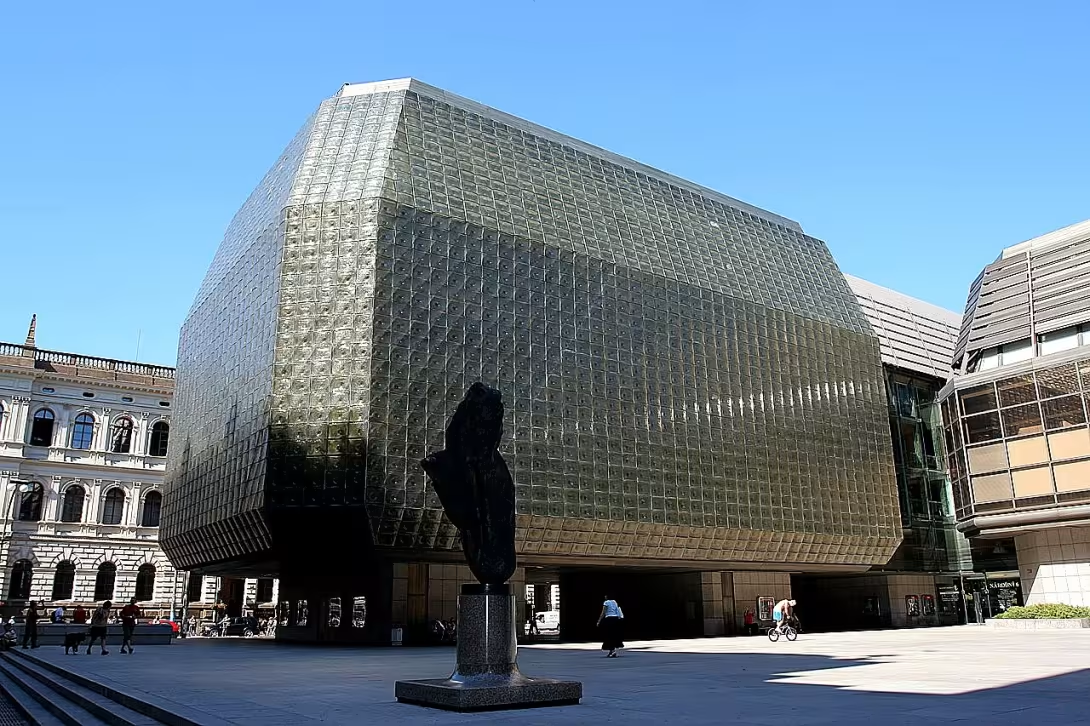
Nová scéna Národního divadla is a post-modern building in Prague, located in New Town. It originated between 1977 and 1983 as part of the extensive reconstruction of the National Theatre complex. Since 2021, it has been officially declared a cultural monument and serves as a space for the operation of Laterna magic.
The building was built on the site where the so-called Chour houses were demolished in 1958. Between 1953 and 1964 several architectural competitions took place, the winner of which was Bohuslav Fuchs. His original project included modern objects surrounding the square below the ground level. After his death in 1973, copyright was transferred to the State Institute for Reconstruction of Monuments and Objects, where in 1976 the team under the direction of Pavel Kupka drew up plans for the operating building.
In 1980, the project was affected by the set-up Josef Svoboda, which advocated the change of use of the building to the theatre building for Laterna magic. This led to a new competition where they participated in Karel Prager and team Josef Svoboda with Zdenek Kuna. Due to the time pressure, the Karl Prager project was selected, which had to count on the construction already built up.
The architecture of the building combines postmodernism and brutalism. In order to isolate the hall from the noise from the National Class, a coat of green Cuban marble, more precisely the serpentinite received by the CSSR from Cuba in exchange for agricultural technology, was used. For further insulation, a wall of glass fittings from Kavalier in Sazava was placed in front of the stone casing, a total of 4306 SIMAX fittings.
The opening ceremony took place on 19 November 1983, and the second day was the premiere presented the variability of space in the arena arrangement. In practice, however, it turned out that the reconstruction of the auditorium was challenging, which led to the abandonment of the idea of variability. The operation of the building was complicated by poor acoustics and excessive heat conditions.
This monument represents the architecture of late socialism, its facade of Cuban serpentinite and SIMAX glass is a unique technical solution of its time. The building is open to the public as part of theatre performances and is worth a visit as a significant representative of post-modern architecture in the centre of Prague.
Historical milestones
- 1958
- demolition of Choura houses
- 1976
- presentation of final plans by Pavel Kupka team
- 1980
- participation of Josef Svoboda and change of use of the building to theatre hall
- 1983
- completion of construction and opening of the premises
- 2021
- declaration of the building as a cultural monument
Architectural development
The building was built in post-modern style with elements of brutalism. The original project Bohuslav Fuchs was subsequently redesigned by Pavel Kupka's team and finally implemented by Karel Prager. During the construction, there was a fundamental change in the use of the building from the social hall to a full theatre building.
Historical events
1958: the demolition of Choure houses has made room for construction; 1983: opening of the premises for the 100th anniversary of the opening of the National Theatre; 2021: Declaration of the building as a cultural monument.
Points of interest
- Nová scéna Národního divadla is a postmodern building in Prague, located in New Town. - It originated between 1977 and 1983 as part of the extensive reconstruction of the National Theatre complex. - Since 2021 it has been officially declared a cultural monument and serves as a space for the operation of Laterna magic. - The architecture of the building combines postmodernism and brutalism, with a cover made of green Cuban marble (serpentinite) and a wall made of SIMAX glass fittings. - The facade of Cuban serpentinite and SIMAX glass is a unique technical solution of its time.
Guide
Show guide text
This text was created by artificial intelligence and has not been editorially reviewed. It may contain inaccuracies.
Welcome to the heart of Prague, the part called Nové Město. Stop for a moment, take a breath and look in front of you. You're standing in front of a building that looks very brave and unshakeable in this historic area. It's Nová scéna Národního divadla. Perhaps at first glance you will be interested in its distinctive appearance, which is fundamentally different from that of the older Prague palaces. It's an architecture that doesn't scream with decorating, but it speaks in its form and volume. Feel this atmosphere of modernity which is inserted into the tissue of the old town and thus creates a fascinating contrast.
Now let's look together at how this building came into being and what its story is. To understand why this building is standing here, we need to go back much further in time than you might expect. It all started in the year nine hundred and fifty-eight. At that time, the so-called Choura houses were demolished, allowing space for future development of the National Theatre. It was a decision that changed the face of this part of town and prepared the ground for something completely new.
The path to the form you see today was long and accompanied by the cooperation of several important creators. In the year nine hundred seventy-six final plans were presented, on which the team under Pavel Kupka worked. Bohuslav Fuchs and Karel Prager also contributed to the production. These men wanted to create a space that would match the modern needs of the theatre and at the same time be a significant architectural gesture of its time. The construction took place in the years nine hundred seventy-seven to one thousand nine hundred eighty-three. It was a process of extensive reconstruction of the entire complex, in which the old were associated with the new.
Now pay attention to the architecture itself. Look at the facade and see the building lines. This building is a representative of post-modernism, but in its shape you can also find elements that are called brutal. What does that even mean in practice? Notice the raw and honest nature of materials, bold surfaces and geometric purity. The architects didn't try to disguise the building or embody it in historical style, but they wanted the building to express its time and function clearly. See how the building fills the space and how its mass works in the New Town space. It's an architecture that makes us think about space and how our understanding of beauty and usefulness changes.
However, when we ask why the building looks like this, we must mention one key person. In the year nine hundred and eighty entered the project Josef Svoboda. His involvement was crucial because he brought about a change in how the object will be used. His vision turned space into a theatre hall. Freedom was the master of scenography and space, which is why this building is set internally and externally to serve as an art machine. The entire complex was subsequently completed and officially opened in the year one thousand nine hundred eighty-three. Since then this scene has become a home for some of the most interesting performances in Prague.
And this is where we come to one of the greatest attractions of this place. The new scene isn't just an ordinary theater. It serves as a space for the operation of Laterna magic. If you've heard of it, you know it's a unique combination of film, theater and dance. It's a place where the boundaries between reality and painting are blurred, and this post-modern building is an ideal framework for such experimental art. It's fascinating to think that in these modern walls new magic is still being created that fascinates viewers from all over the world.
You may also be interested in how quickly our perception of architecture changes. Until a few decades ago, this building was perceived as controversial or too remote from the area. But time works in favor of courage. In two thousand twenty-one, the building was officially declared a cultural monument. That's a very significant recognition. It means that the state and experts have recognised that this post-modern building has an irreplaceable value for our history and that it deserves protection, as well as hundreds of years old temples or palaces. It's proof that concrete and modern lines can have their soul and their history.
Now try to imagine what it was like in a thousand nine hundred eighty-three when the building first opened. People came from the streets of the old town and suddenly this monumental, modern building stood before them. It was in many symbols of a new beginning and courage to seek new ways in art and architecture. Today, this building is a natural part of the Prague panorama, but it still raises questions and incentives in us.
Imagine all the people who walked through here, all the actors who walked into the halls and the thousands of spectators who walked away with new experiences. This building is not just from piles of material, it is a living organism that breathes through culture and history over the last few decades. It is a place where the technical precision of architects such as Pavel Kupka or Karel Prager meets the visionalism of Josef Svoboda.
Now that you know the story of this building, I suggest you go around the building and watch from different angles how light hits it and how it changes its expression depending on where you're looking at it. Feel its stability and at the same time its modern lightness which it carries. It really is a fascinating example of how our understanding of space changed in the second half of the twentieth century.
Thank you for accompanying me on this short trip to the history and architecture of the New Scene of the National Theatre. I hope you're interested in this space and that looking at its walls now you see more than just a modern building, but the whole story of courage, change and art. Now invited to explore the surroundings of New Town and discover other hidden treasures of our beautiful Prague. I wish you a pleasant continuation of your journey and many new inspiring experiences. Goodbye.
Tips for visitors
Best time to visit New Scene The National Theatre is an autumn or spring period where fewer people and the atmosphere in the area is quieter. This time of year also offers beautiful lighting conditions for photography architecture of the building.
Parking near the New Scene can be challenging, therefore we recommend using public transport. Local buses and trams provide comfortable access to the National Theatre area. The current connection can be detected using an online search engine.
When visiting, remember the comfortable shoes, because exploring surrounding historical buildings and walking on the urban surface can be exhausting. The sun cream can be added to the trip, especially if you visit a place in spring or summer.
For photography it is best to wait for late afternoon when light becomes warmer and less powerful. Don't forget to also view the interior of the New Scene building, which offers interesting views from and near the distance.
It is possible to visit the historical building of the National Theatre and the Vorshilská monastery. These places offer rich cultural experiences that are suitable for combining with a visit to the New Scene. For families with children, it is advisable to visit the national grade and its surroundings where children can explore the historical space.
Businesses nearby
Do you run a restaurant, accommodation, shop, museum, rental, wellness or other visitor service near this monument? Show yourself directly to the people heading to it — this is how they will see you in the app and on the web:
Events nearby

Zdroj akcí: otevřená data měst a obcí ČR (Národní katalog otevřených dat) a kalendář akcí Národního památkového ústavu.
Nearby
Historická budova Národního divadla, voršilský klášter, Národní třída.
Accommodation nearby
Trips and activities nearby
Guided tours, tickets and activities nearby from GetYourGuide
Affiliate link: if you buy from the partner, we may receive a commission. The price for you does not change.
Search tours and activities →Themed route
Thematic cruise route: Nová scéna Národního divadla
1. Historical building of the National Theatre - cultural monument Start your trip at the historical building of the National Theatre, which is an icon of Prague architecture. This building was designed by outstanding architect Josef Zítek and opened its door in 1881. It is a great opportunity to explore the rich history of the theatre, which is home to many classical and modern productions.
2. Vorshil monastery - spiritual and cultural place About 10 minutes' walk from the National Theatre is the Vorshilský monastery. This monastery is not only an important religious location but also a place associated with the life and creation of Czech poet Jaroslav Vrchlický. Visiting his burial ground is an opportunity to appreciate the importance of this literary hero for Czech culture.
3. National Class - Historical Square Shortly after visiting the Vorshil Monastery, you can reach the National Square, one of the most important and famous squares in Prague. This place is known for its history, architecture and cultural life. There are many monuments in the National Class, such as the National Theatre or the National Museum, which are important cultural institutions.
4. Nová scéna Národního divadla - Main Target After exploring the historical and cultural places around you will return to the main destination of your trip - the new scene of the National Theatre. This modern building, designed by architect Jean Nouvell, is a symbol of modern theatre art and technology. It's a great way to end your trip by getting to know the latest trends in the theater world.
This route offers a combination of historical, cultural and modern elements that together form a rich landscape of Prague's artistic life.
Seasonal recommendations
Spring: In the spring season Nová scéna Národního divadla offers visitors an unforgettable view of flowering trees and surrounding green nature, which is beginning to awaken. Sunny days with mild temperatures create a pleasant atmosphere for walking around the theatre. The important thing is not to sleep on clothes that will protect against a cold vortex - a short-winded woman or a cloak can be useful. The best time to visit is in the morning or at noon, when the crowd will not rise.
Summer: In the summer, the new scene offers long sunny days with warm evenings that are ideal for visiting. The atmosphere is full of life and energy, which can lead to larger crowds at popular attractions. It is recommended to come earlier afternoon or evening to avoid long fronts. It is advisable to wear light clothes and not miss sun protection - hat and hat are good choices.
Autumn: In autumn days, the surroundings of the New Scene turn into the colours of golden and red leaves, creating a beautiful atmosphere for visiting. Sunshine days are still common, but temperatures are dropping, so it is advisable to wear more layers of clothing and perhaps even an umbrella for surprising rain. The best time to visit is at noon, when the crowd doesn't rise and temperatures are the hottest.
Winter: Winter will offer the new scene an atmosphere covered with snow, which can be very interesting, especially in advent time. The temperatures are cold and the theatre opening hours can be shortened, so it is important to plan a visit according to the calendar. It is necessary to wear warm clothes and wind protection - hat, scarf and umbrella are essential objects. Visiting is best in the middle of the day so that it can be used with a sunny season.
Visualizations and artistic views

The visualisations are generated by artificial intelligence and serve as inspiration.
Photos from the area
Real photos taken near the monument


Zdroj a licence jsou uvedeny u každého snímku.
Tips from visitors
No tips yet. Be the first!
Log in and add your tip.
Sources and literature
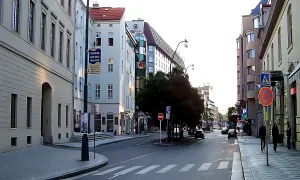
Photos: che / CC BY-SA 2.5 — Wikimedia Commons. The author and licence also appear when you hover over the image.
Faktickým podkladem tohoto textu byl článek na Wikipedii, jehož autory jsou přispěvatelé Wikipedie. Článek je dostupný pod licencí CC BY-SA 4.0.
Location on the map
More monuments – Nové Město
Show all in the municipality


Příběhy a pověsti
Legendy, pověsti a příběhy spjaté s touto památkou
Fotografie návštěvníků
Zatím žádné fotografie. Buďte první, kdo přidá fotografii z návštěvy!
Log in a přidejte svou fotografii nebo hodnoťte.
Za ověřenou návštěvu v aplikaci získáte víc bodů — poznáme podle GPS, že jste na místě.
Reviews and comments