






Novákovy garáže Other
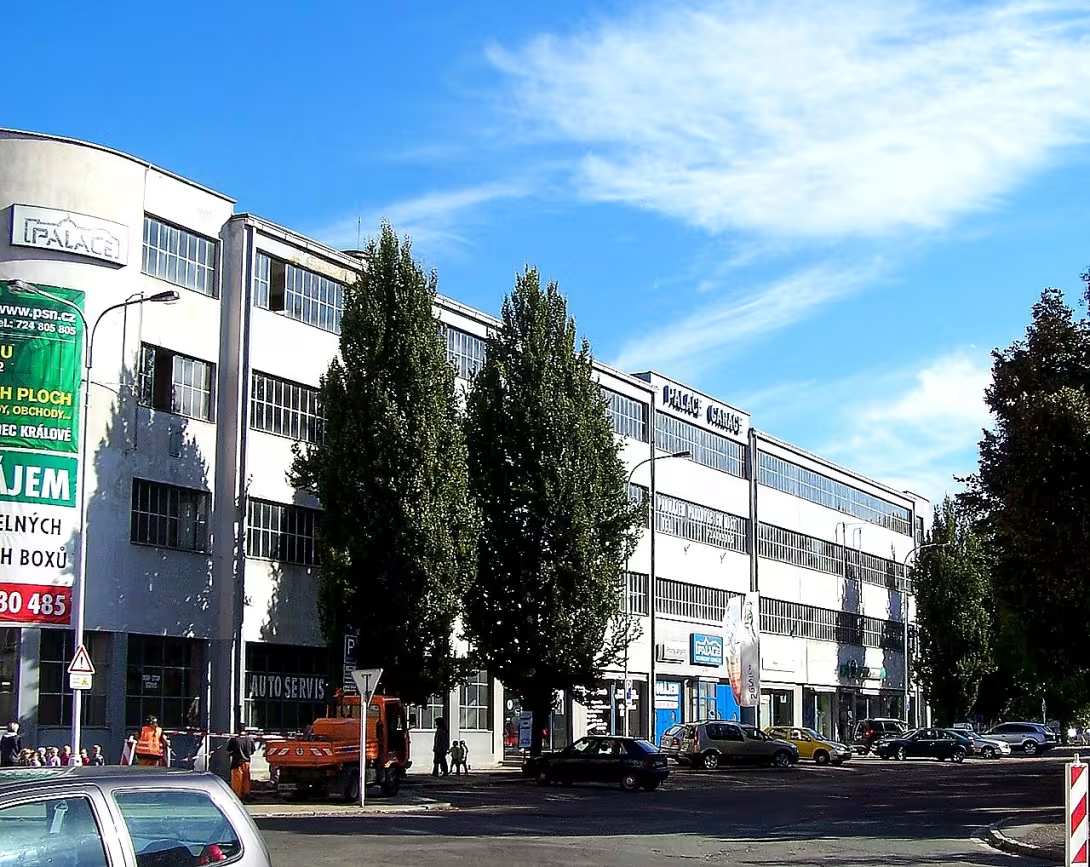
Novákovy garáže, also known as Garáže Palace, is a functionalist building in Hradec Králové completed in 1932. It is notable as the first standalone garage building in the republic.
The project was commissioned by Jaroslav Novák, an automotive enthusiast and representative of Laurin & Klement. Between 1910 and 1911, Novák developed a different concept for an automobile service house on the site where the current winter stadium stands. Designed by architect Oldřich Liska, this earlier project featured two rows of fired-brick garage boxes surrounding an open courtyard. It provided various services, including a shop, a car wash with an Art Nouveau lantern, fuel, workshops, and toilets. The administrative building featured a glazed tile mosaic by the firm Graniton Rydl & Thon, now preserved in the National Technical Museum in Prague. In 1932, the city repurposed the original land and provided Novák with a replacement plot on the right bank of the Labe.
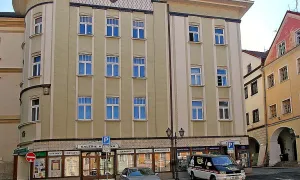
Josef Fňouk, a motoring enthusiast and former executive of the Východočeský autoklub, designed the current building, which was constructed by Josef Vyleťal. Construction began in July 1932 and concluded on December 11, 1932. The three-story structure emphasizes strong horizontals and occupies the entire north side of náměstí 5. května, with side wings following the adjacent streets. Built from reinforced concrete with brick infill, the architecture features rounded corners and long strips of pane windows with original glazing in blue-painted frames and doors. A six-meter-wide circular ramp connects the floors. This central shaft, featuring spiral windows and topped by a copper dome with a chimney, is a prominent element of the northern facade. Each floor contains 51 parking spaces, and the rounded corners house two car washes. Although most technical equipment is gone, some original garage bays separated by mesh remain on the second and third floors, and several vintage motoring advertisements are still visible on the entrance ramp's exterior.
Following World War II, the building was nationalized. In 1952, the company Mototechna converted some areas into offices, and by 1954, two petrol pumps were installed in front of the facility. By 1962, the complex became a Technical Service Station and was later used by ČSAO repair shops. A painting booth was installed between 1974 and 1975. The complex was officially listed as a cultural monument in 1981. In 1992, the property was returned to Jaroslav Novák's descendants through restitution.
The site's history includes several unrealized or altered plans. Josef Fňouk's 1931 project included a residential building adjacent to the eastern wing on Smetanovo nábřeží, but this was never built. In the 1990s, a reconstruction plan by architect Milan Rejchl and his son Ivo led to minor modifications on the eastern wing's ground floor to create a Škoda showroom. These changes involved removing partitions to reveal original supports and adding an interior corner fountain with mirrors. Between 1997 and 2000, a petrol station was built in the opposite park; its blue-and-white color scheme and glass dome were designed to echo the main building. More recently, the area saw the completion of the Palace Office administrative building on Průmyslová street and the Riverside residential building on Smetanovo nábřeží in 2020.
Novákovy garáže remains a significant landmark of functionalist architecture and early automotive culture. It is worth visiting to observe the circular ramp and the preserved historical details of this pioneering facility.
Then and now
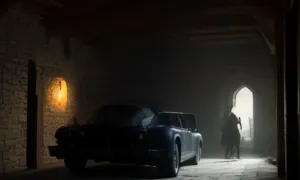
Drag the slider to compare how the landmark may have looked when it was built with the view today.
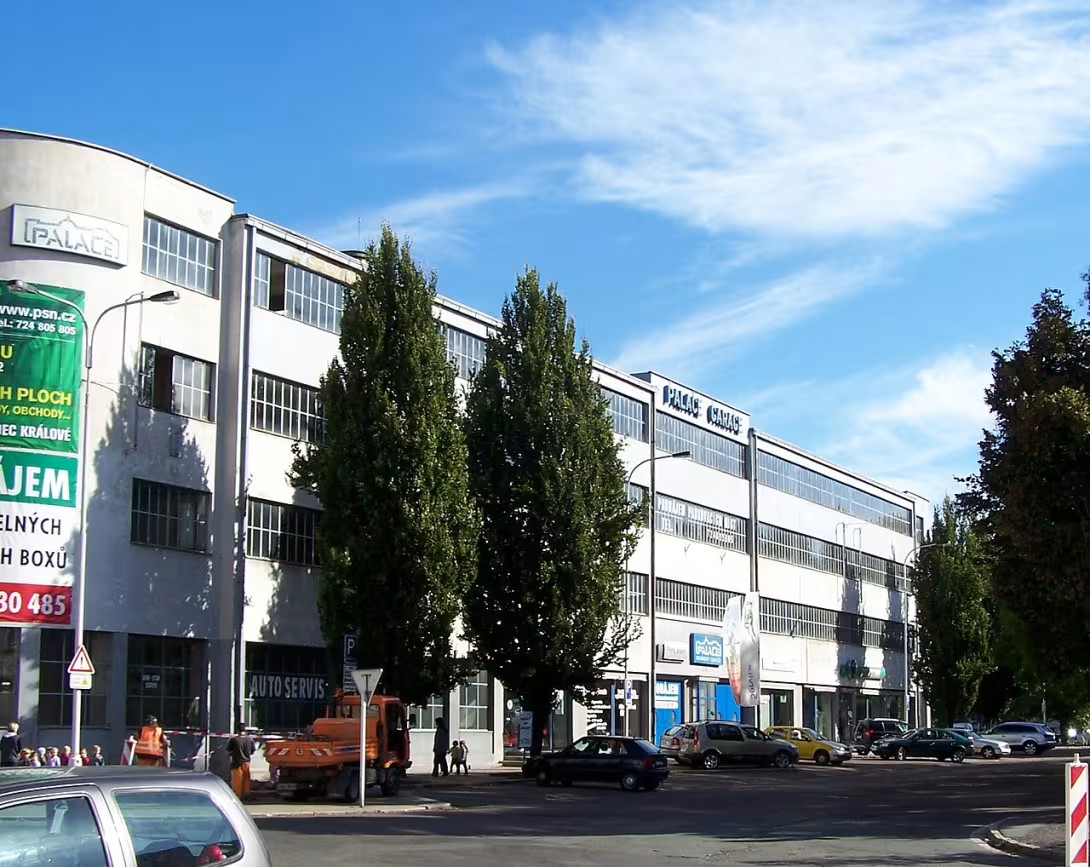
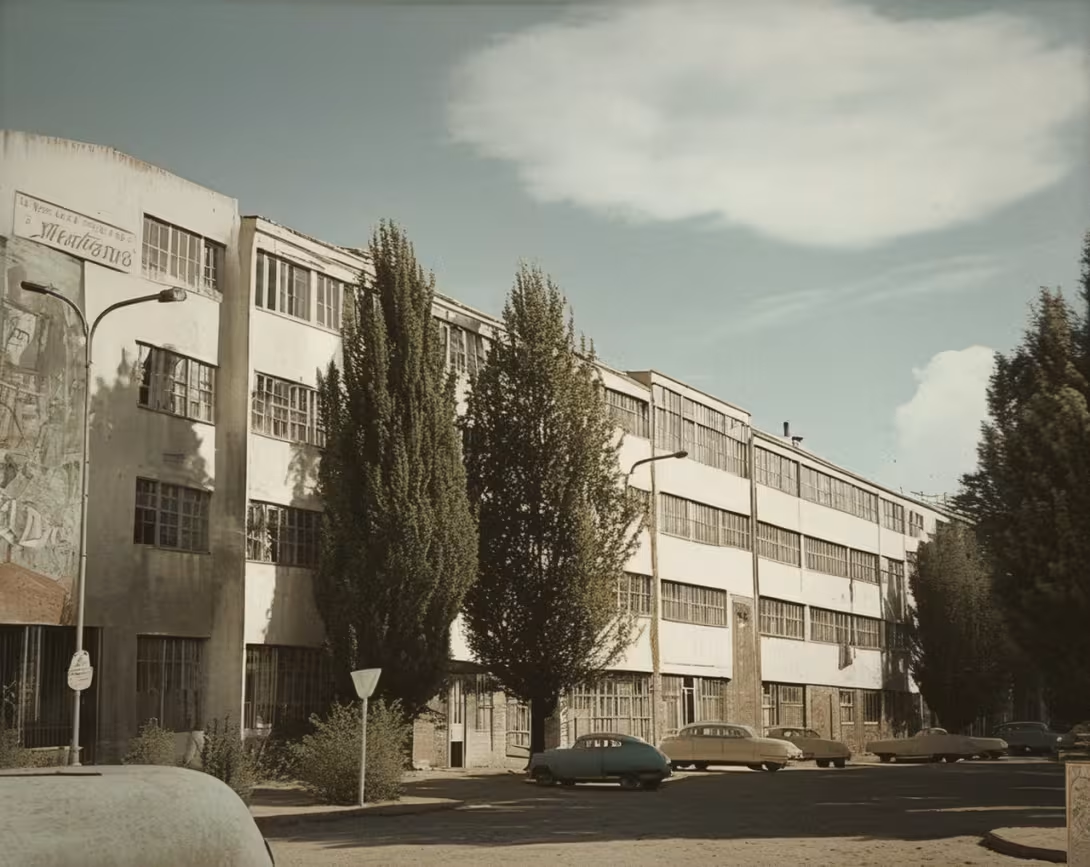
The historical appearance on the left is an AI-generated visualisation and serves as inspiration only.
Historical milestones
- 1910
- Jaroslav Novák develops a concept for an automobile service house.
- 1911
- Construction of the initial automobile service house project by Oldřich Liska.
- 1932
- Novákovy garáže completed and opened as the first standalone garage building in the republic.
- 1945
- Post-World War II nationalization of Novákovy garáže.
- 1952
- Conversion of some areas into offices by Mototechna.
- 1981
- Novákovy garáže listed as a cultural monument.
Architectural development
The original design by Josef Fňouk included plans for an apartment building, which was never realized. The garage complex underwent several modifications over the decades, including office adaptations and the addition of a painting booth. In the early 1990s, partial reconstruction aimed to restore its original appearance while adding modern elements like an interior fountain.
Historical events
Construction completed on December 11, 1932.
Nationalized after World War II and adapted for various uses by Mototechna and ČSAO.
Declared a cultural monument in 1981.
Owners
Jaroslav Novák (1932), Mototechna (1950s), ČSAO (post-1960s), Restituted to Jaroslav Novák's descendants in 1992
Points of interest
- Novákovy garáže, also known as Garáže Palace, is notable for being the first standalone garage building in the republic, completed in 1932. - The original project on this site was developed by Jaroslav Novák between 1910 and 1911, featuring a design with two rows of fired-brick garage boxes surrounding an open courtyard. - Architect Josef Fňouk designed the current building, which was constructed from July to December 1932, emphasizing strong horizontals and featuring rounded corners and long strips of pane windows. - The complex became a Technical Service Station by 1962 and was officially listed as a cultural monument in 1981. - In 1992, the property was returned to Jaroslav Novák's descendants through restitution.
Guide
Show guide text
This text was created by artificial intelligence and has not been editorially reviewed. It may contain inaccuracies.
Welcome to Hradec Králové. Please, take a moment to settle in and look around you. You are standing before a building that might seem modest at first glance compared to the grand cathedrals or ornate town halls of the city, but in the world of architecture and automotive history, you are looking at a true pioneer. Before you is Novákovy garáže, also known as the Garáže Palace. As you look at the facade, try to imagine the city as it was nearly a century ago. In an era when the automobile was still a luxury, a novelty, and a symbol of daring modernity, this structure stood as a bold statement. You are looking at the very first standalone garage building in all of Czechoslovakia.
To understand why this building is so significant, we have to step back in time and meet the man behind the vision: Jaroslav Novák. Novák was not merely a businessman; he was a passionate automotive enthusiast. More importantly, he served as a representative for Laurin & Klement, the legendary automotive brand that would eventually become a cornerstone of the Czech industrial identity. For a man like Novák, the car was not just a tool for transport; it was the future. He recognized very early on that as cars became more common, the city would need a new kind of infrastructure. People could no longer simply park their carriages in a backyard or a stable. The automobile required specialized care, professional service, and a dedicated home.
The journey to the building you see today was actually a very long one, spanning over two decades of planning and evolution. The seed for this project was planted as early as 1910, when Jaroslav Novák first developed the concept for an automobile service house. He wanted to create a hub where the needs of the modern driver could be met under one roof. By 1911, an initial project was actually put forward, designed by Oldřich Liska. If you could travel back to that original 1911 plan, the building would have looked quite different. It was envisioned as a more traditional structure, featuring two rows of fired-brick garage boxes. It was a practical design for its time, but as the years passed, the world changed, and so did the philosophy of architecture.
By the time the building was finally completed and opened its doors in 1932, the architectural landscape had shifted toward a movement known as functionalism. This is where the talent of the architect Josef Fňouk comes into play. Instead of the brick-heavy look of the earlier decade, Fňouk embraced the functionalist ethos, where form strictly follows function. As you observe the building now, notice the clean lines and the lack of unnecessary ornamentation. Functionalism was about efficiency, light, and practicality. Everything about the layout of Novákovy garáže was designed to facilitate the movement of vehicles and the efficiency of automotive service. It wasn't meant to be a palace of gold and marble, but a palace of steel, rubber, and gasoline. It was a machine for housing machines.
Take a moment to really look at the exterior. While it may appear simple, that simplicity was a radical choice in 1932. It signaled a break from the past and an embrace of the industrial age. The practical layout was a direct response to the needs of the drivers of the 1930s, providing a streamlined experience that was unheard of at the time. Jaroslav Novák’s persistence paid off, and he succeeded in creating a landmark that was not just a business venture, but a piece of architectural history.
However, the story of Novákovy garáže does not end with its triumphant opening. Like so many landmarks in this region, the building had to weather the storms of the twentieth century. Following the end of the Second World War, the political climate shifted dramatically. In 1945, the building underwent nationalization, meaning it was taken from private ownership and became the property of the state. The era of the independent automotive enthusiast was replaced by state-managed industry. By 1952, the building's purpose began to evolve once again. A company known as Mototechna took over, and some of the areas that were once dedicated to the grease and oil of garage work were converted into offices. The building transitioned from a pure service center into a hybrid of administrative and technical space, reflecting the bureaucratic nature of the era.
Despite these changes in ownership and use, the intrinsic value of the building never faded. Those who understood its historical importance continued to advocate for it. In 1981, Novákovy garáže was officially listed as a cultural monument. This designation ensured that the legacy of Jaroslav Novák and the vision of Josef Fňouk would be preserved for future generations. It was a recognition that this building was more than just a place to park a car; it was a monument to the birth of the automotive age in this country.
One of the most fascinating things to consider while you stand here is the sheer audacity of the original idea. Think about the year 1910. Most people were still relying on horses and carts. For Jaroslav Novák to conceive of a dedicated service house for automobiles at that time was almost prophetic. He saw a world that didn't exist yet. The gap between his first concept in 1910 and the completion of the building in 1932 tells us a story of patience and an unwavering belief in progress. It is a reminder that true innovation often takes time to catch up with the reality of the world.
As you stand here today, you are not just looking at a piece of concrete and glass, but at the physical manifestation of a passion for speed, engineering, and modern living. From the early sketches of Oldřich Liska to the functionalist mastery of Josef Fňouk, this building represents the evolution of how we interact with technology.
Now that you have a sense of the history and the spirit of this place, I invite you to take a slow walk around the perimeter. Notice how the building fits into the urban fabric of Hradec Králové. Imagine the sound of early engines idling in the driveway and the smell of oil and leather that would have filled the air in the 1930s. Consider how this single building paved the way for every parking garage and service center we take for granted today.
Thank you for stopping here to discover the story of Novákovy garáže. It is a small building with a massive legacy. Please feel free to explore the surrounding area at your own pace, and when you are ready, continue your journey through the fascinating streets of Hradec Králové. Enjoy the rest of your visit.
Tips for visitors
The best time to visit Novákovy garáže, or Garáže Palace, is during the late spring through early fall months when the weather is pleasant for exploring both historical and modern architecture in Hradec Králové. This period offers vibrant surroundings near Smetanova nábřeží and along the Labe River, enhancing your experience with beautiful natural light that complements the building's unique design. Additionally, visiting during weekdays can help avoid larger crowds, allowing for a more intimate appreciation of this pioneering structure.
Businesses nearby
Do you run a restaurant, accommodation, shop, museum, rental, wellness or other visitor service near this monument? Show yourself directly to the people heading to it — this is how they will see you in the app and on the web:
Nearby
Located near Smetanova nábřeží and close to the Labe River, the area features a mix of historical and modern architecture.
Accommodation nearby
Themed route
1. Labe River (Natural landmark) – Start your journey with a peaceful walk along the banks of this major waterway.
2. Smetanova nábřeží (Promenade) – Stroll along this scenic route to admire the diverse mix of historical and modern architecture.
3. Novákovy garáže (Specialized site) – Conclude your trip at this main destination to explore its unique features.
Seasonal recommendations
In spring, Novákovy garáže benefit from the refreshing atmosphere as the nature surrounding Hradec Králové begins to bloom. The lighting is soft and gentle, which is ideal for those who enjoy photography without harsh shadows. Since the weather can be quite unpredictable during this transition period, it is best to dress in layers and carry a light jacket. This is a relatively quiet time to visit, making mid-morning an excellent period to explore the site in peace.
During the summer, the area is filled with bright, intense sunlight and a vibrant energy. The warmth makes it a popular time for visitors, so the atmosphere can feel much more bustling. To avoid both the midday heat and the larger crowds, it is highly recommended to arrive as early as possible. Wear light, breathable clothing and ensure you have water and sun protection to stay comfortable while exploring.
Autumn brings a nostalgic and moody atmosphere to the site, characterized by golden hues in the surrounding landscape and perhaps a touch of morning mist. The lighting becomes more dramatic and warm, highlighting the unique textures of the monument. As the temperature begins to drop, especially toward the end of the season, you should wear comfortable walking shoes and a warm coat. Visiting in the afternoon is best to capture the beautiful, low-angled sunlight.
In winter, Novákovy garáže take on a quiet, almost somber character. The days are shorter and the light is dim, which can lend a sense of stillness to the entire area. Because of the cold, it is essential to wear heavy, warm clothing to ensure a pleasant visit. Since daylight is limited and visiting hours may be shorter during this season, plan your arrival for the middle of the day to make the most of the available light.
Visualizations and artistic views


The visualisations are generated by artificial intelligence and serve as inspiration.
Photos from the area
Real photos taken near the monument


Zdroj a licence jsou uvedeny u každého snímku.
Tips from visitors
No tips yet. Be the first!
Log in and add your tip.
Sources and literature
Fotografie: Kixx / CC BY-SA 3.0 — Wikimedia Commons. The author and licence also appear when you hover over the image.
Faktickým podkladem tohoto textu byl článek na Wikipedii, jehož autory jsou přispěvatelé Wikipedie. Článek je dostupný pod licencí CC BY-SA 4.0.
Location on the map
More monuments – Hradec Králové
Show all in the municipality
Příběhy a pověsti
Legendy, pověsti a příběhy spjaté s touto památkou
Fotografie návštěvníků
Zatím žádné fotografie. Buďte první, kdo přidá fotografii z návštěvy!
Přihlaste se a přidejte svou fotografii nebo hodnoťte.
Za ověřenou návštěvu v aplikaci získáte víc bodů — poznáme podle GPS, že jste na místě.
Reviews and comments