






Palackého most Bridge
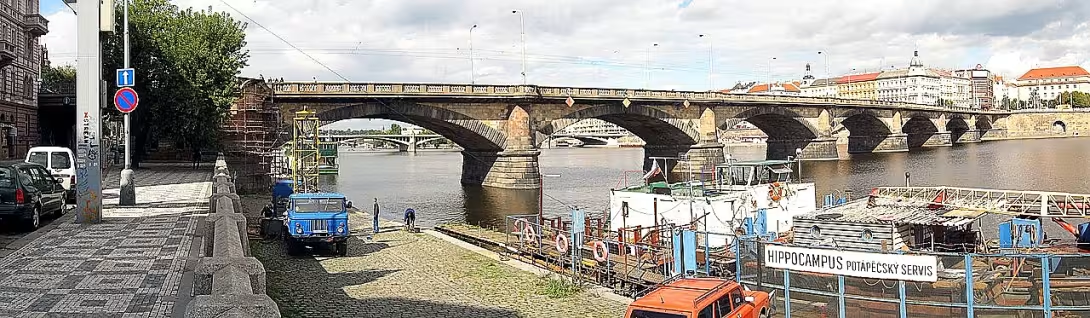
Palackého most is a road bridge through Vltava in Prague, built between 1876 and 1878 and opened to the public on 22 December 1878. The construction responded to the acute need to connect rapidly developing industrial Smícheov to other Prague. As early as 1871, the local cooperative initiated the construction, but in 1873 the economic crisis interrupted the work. The city of Praha then took over the costs from the cooperative and the project continued.
The construction was led by Czech engineer Josef Reiter, who originally designed the iron solution, but since it did not meet the reception, a stone bridge was created. Bedřech Münzberger prepared the architectural form. The base stone was laid on May 13, 1876. The construction was realized by the Viennese company Brothers Klein together with A. Schmoll and E. Gärtner. A world premiere was awarded to the builders: for the first time in Prague, the construction of the pillars used a cason foundation, which provided Ringhoffer races directly in Smíchov.
The bridge has seven stone vaults. The centre of the vault reaches a diameter of 32 meters, the rest gradually 30,4, 28,8 and at the banks 27,2 meters. The bridge length is 228.8 metres. Pillar and vault blocks are made of blue granite, white carara marble railing and red sandstone breast walls. Originally, the bridge had "colored" elements with national colours, but it resisted with exhalation over time.
Since 1897 there have been four sculptors of Josef Václav Mybek on the bridge representing a pair of figures from the Czech reputation and the Manuscript of the Royal Court: Honorary and Sark, Libusha and Remysl, Lumíra and Song, Fighting and Slavovy. Soon after opening - from 1883 onwards - the bridge became part of the Prague tram network as the first Prague bridge with a common tram line connecting Palacký Square on the right bank with Smíchov.
The bridge was noticed by Albert Einstein. Between 1911 and 1912 he passed it when he worked as a professor at the German University in Prague. He travelled from Forest Street to Smíchov, where he lived, to Viničná Street.
During World War II, he suffered a bridge in February 1945 during an air raid. Mybek's sculpture was badly damaged and later moved to the Vysehrad orchards. As part of the removal of the bombing damage, the bridge was extended to its present form between 1950 and 1951 - the width increased from the original 10.7 to 13.9 metres and the road from 7.7 to 10.3 metres.
The name changed in time. It was formerly called the Podskalský or Stone Bridge at Smíchov. Soon he was named after František Palacký, during World War II he was briefly Mozart Bridge (1940-1945), then the original name returned.
Then and now
Drag the slider to compare how the landmark may have looked when it was built with the view today.
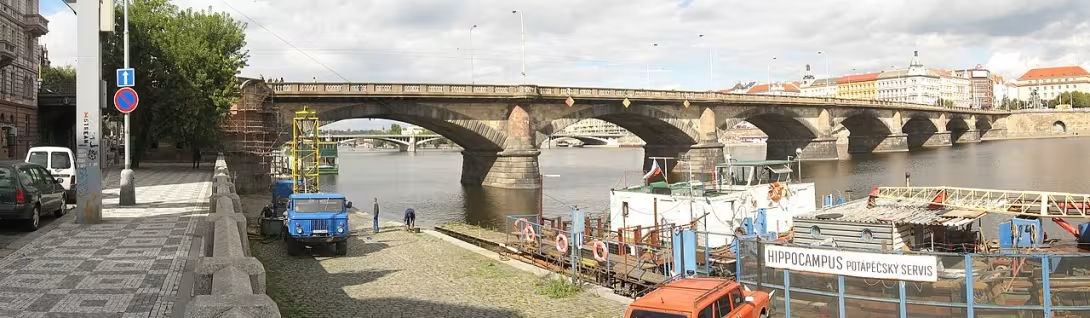

The historical appearance on the left is an AI-generated visualisation and serves as inspiration only.
Historical milestones
- 1876
- Opening of bridge construction, laying of base stone.
- 1878
- Opening a bridge for the public, naming Palackého most.
- 1883
- Start of operation of the cross-track tram on the bridge.
- 1897
- Location of four sculptures of Josef Václav Mysbek at the end of the bridge.
- 1945
- Damage to the sculpture during the raid, subsequent removal.
Architectural development
The bridge was built in 1876-1878 as a stone structure with seven vaults. Originally, it had a width of 10.7 m, reaching 13.9 m after enlargement in 1950-1951. The original decor with national colors has disappeared from the atmosphere. The bridge was designed in view of the future expansion that took place after World War II.
Historical events
- 1878
- Opening a bridge for the public, the first Prague bridge with tram tracks.
- 1945
- Damage to sculpture during air raid, subsequent removal and transfer to Vysehrad orchards.
- 1950
- Expanding the bridge to today's width after war damage.
Points of interest
- The bridge was built between 1876 and 1878 and opened on 22 December 1878 to combine the rapidly growing industrial Smíchov with other Prague.
- For the first time in Prague, the construction of the pillars was used with a kesson foundation which provided Ringhoffer races directly in Smíchov.
- The bridge has seven stone vaults with diameters from 27.2 to 32 meters and a total length of 228.8 meters.
- Since 1883 he was the first Prague bridge with a common tram line connecting Palacký Square with Smíchov.
Guide
This guide is narrated by a synthetic voice generated by artificial intelligence.
Show guide text
This text was created by artificial intelligence and has not been editorially reviewed. It may contain inaccuracies.
Welcome to one of the most important points of Prague's landscape. You are standing right in front of the Palacky Bridge, a monumental building that surpasses Vltava with unwavering certainty and combines two different worlds - the dynamic, industrial heart of Smíchov and historical, expanding Nové Město. Feel this moment, feel the cold breeze from the river and the constant movement of water under your feet. In front of you is a link that is not just a stone structure, but a living organism of the city through which life, history and modern times flow. Look at the mighty pillars that rely with dignity on the riverbed, and remember that this is where the technical genius meets artistic perception.
Let us now return together in time to understand why this bridge was created. Imagine Prague in the late nineteenth century. The city is going through a huge transformation, is on the move, is ambitious and needs new arteries for its growth. This is why the construction of this bridge started in 1876. The need was clear: the fast-growing industrial Smíchov had to be effectively and quickly connected to other parts of the metropolis. The laying of the base stone in 1876 meant the beginning of a great era. The whole building was demanding, but ambitious, and lasted two years. When the bridge was finally open to the public in December 1878, it became an immediate symbol of progress. To make it even deeper, it was named after František Palacký, the great historian and spiritual leader of the nation, which gave him an irreplaceable weight in the hearts of the people.
Now pay attention to the architecture itself and to what you see right in front of you. Notice how the bridge waves above the surface. Its entire structure is built on seven stone vaults, which seem extremely stable and at the same time very elegant. Architects Bedřich Münzberger and Josef Reiter created a work that is a visual celebration of materials. Take a look at the texture of the surface formed by a combination of stone, marble and sandstone. This choice was not random. Each of these materials gives the bridge a different character - sandstone brings warmth and organic structure, while marble and stone provide the whole necessary strength and grandeur. Feel the game of light and shadow on these surfaces as it changes depending on how the sun travels through the sky.
If you look at the end of the bridge now, you can imagine its richer artistic dimension, which it has emphasised even more in the past. In 1897 four important sculptures were placed at the end of the bridge by Josef Václav Mysbek. These statues were meant to give the bridge a spiritual and artistic dimension that would match its meaning. Unfortunately, history was very cruel to this place at some point. During World War II, specifically in 1945, the sculpture suffered damage during air strikes, which subsequently led to their elimination. Despite the fact that the statues are no longer there, the spirit of Mysbek's creation and overall artistic sensations of architects in every stone and in every curve of the vaults still resonates and gives this place its unique atmosphere.
In this period, when Praha became the center of science, technology and art, people who changed the world moved here. At a time when this bridge was formed and flourished, personalities who shaped modern thinking, as well as the great thinkers of times, including the names we now know from world textbooks, such as Albert Einstein, moved in the intellectual space of the city. This bridge witnessed an era when human courage in technology met the highest art.
And now I'm going to tell you something you may not see at first sight, but what was the real technical miracle of your time. The so-called keson foundation was used for the first time in Prague to build pillars. Imagine the difficulty of building solid foundations right in the deep river. This revolutionary way of ensuring the stability of the pillars was ensured by Ringhoffer's races directly from Smíchov, which shows how closely the bridge was linked to the industrial heart of the city. This bridge wasn't just for pedestrians, it was for movement. Even in 1883, the horse-drawn tram started to work here, which made it the first Prague bridge equipped with tram tracks. It was a real breakthrough in traffic that changed the way people perceived distance and time in the city.
Now that you know the story of this stone painting that connects the banks of the Vltava, we have you to continue your walk. Walk around his arches, perceive the feeling of stability and the dynamics surrounding you. Look at the horizon, at Smíchov and at Nové Město, and remember that it is here, at this point, that the past meets the present. Let yourself drift through the atmosphere of this place and continue to discover other secrets of our city. We thank you for your journey together and we will wait you out at another historic monument.
Tips for visitors
{'paragraph': 'The best time to visit Palackého most is in the morning when the bridge has minimal excitement and you can easily see its architectural details. Another suitable time is the late afternoon when the sun lights up the bridge from one side and creates interesting shadows. Avoid visiting when concerts or other events take place on the bridge, because then access can be restricted.'}
{'paragraph': 'Palackého most is available by car and public transport. If you arrive by car, find the nearest parking lot near Palacky Square or Smíchov Square. It is recommended to use public transport because parking is often difficult in the centre of Prague. Check current connection and paths in the search engine or mobile phone application.'}
{'paragraph': 'When visiting the bridge, wear comfortable shoes because the pavement can be slippery, especially in the rain. It is also appropriate to take a map or navigation with you, because some parts of the bridge may be less familiar. If you are planning to photograph, bring a lens with you with a larger field of view to capture the entire bridge and its surroundings.'}
{'paragraph': 'The best places for photography are the end of the bridge, where there is a view of the Vltava and surrounding architecture. Solar light is ideal in morning or late afternoon hours, when light falls sideways and creates interesting effects. Make sure that the photos do not contain disturbing elements such as crowds of people or cars.'}
{'paragraph': 'In the vicinity of Palackého most it is worth visiting Vysehrad orchards, which are located just near the bridge. Here you will find a natural park with moved sculpture from Palackého most, which is an interesting addition to the monument itself. Another interesting thing is Palacký Square, where you can observe the beginning of the bridge and surrounding architecture. Smíchov Square (U Andela) offers additional possibilities for walking and exploring.'}
{'paragraph': For families with children Palackého most is a great choice because children can see interesting statues and stone details. You can also tell stories about bridge history. In the vicinity you will find Vysehrad orchards where children can run and play among the greenery. It is also recommended to visit Palacký Square, where there is enough space for children's activities and observations of the surroundings. '}
Frequently asked questions
Is Palackého most open to the public?
Yes, Palackého most is publicly available. You will find it on the east side of Vltava in the centre of Prague.
How do I get to the place by car / public transport?
Palackého most is available by car or public transport (tram No 6, 15 or 20). The parking lot can be found nearby.
How much is the entrance fee and is it paid on the spot?
Admission to Palackého most is free. There's no admission fee.
Is the tour suitable for children and seniors?
Yes, Palackého most is suitable for visiting families with children and seniors. The tour is disabled.
How long does the tour take?
The Palackého most tour usually takes about 30 minutes.
What are the opening times and booking is required?
Palackého most is available year-round, without exception. There's no need for a reservation.
What's interesting in the immediate vicinity?
In the immediate vicinity of Palackého most you will find other important Prague monuments such as the Old Town Hall or the Crožovnik Monastery.
For kids
Imagine coming back 156 years and finding yourself on the banks of the Vltava River in Prague. The city was young then, but it had its full form. There were only two bridges across the river - Charles Bridge and Judith Bridge. And then, in 1870, something new was built - Palackého most.
How did it look here? Who lived here? What happened here? The city was full of people who made a living in trade or craft. There were also officials and nobles who held power in the city institutions. The river Vltava was the main transport artery of the city, which attracted fishermen and boatmen.
Businesses nearby
Events nearby

Zdroj akcí: otevřená data měst a obcí ČR (Národní katalog otevřených dat) a kalendář akcí Národního památkového ústavu.
Nearby
- Natural park with moved sculpture from Palackého most.
- A square on the right bank of the Vltava, where the bridge begins.
- Crossing on the left bank, where the bridge ends.
- The river over which the bridge leads.
Accommodation nearby
Trips and activities nearby
Guided tours, tickets and activities nearby from GetYourGuide
Affiliate link: if you buy from the partner, we may receive a commission. The price for you does not change.
Search tours and activities →Themed route
Thematic cruise route: Palackého most and its surroundings
1. Palacky Square * Type: * Historical Square * Why visit? * This square on the right bank of the Vltava is the entrance gate to the bridge. Here is a statue of František Palacký, after which the bridge is named, and offers a view of the bridge construction. The surrounding houses and atmosphere resemble the Prague architecture of the 19th century.
Palackého most * Type: * Iron concrete bridge * Why visit? * The unique bridge with 12 statues of Czech historical personalities (e.g. Svatopluk Bohemia, Jan Hus) is a symbol of Czech identity. The crossing on the bridge connects Palacký Square with Smíchov Square and offers a panoramic view of Vltava.
3. Smíchov Square (U Angel) * Type: * Crossing with historical core * Why visit? * On the left bank the bridge ends at this square, where stands the statue of the angel (hence the name) and where significant Smíchov streets converge. It is an ideal place for a short break overlooking the bridge and the Vltava.
4. Vyšehrad Sets * Type: * Natural park Why visit? Here are some of the original sculptures from Palackého most, which was moved for reconstruction. The park offers a quiet environment overlooking Vltava and is suitable for short rest.
* The route is closed and can be walked in about 1.5 hours. *
Seasonal recommendations
Spring In spring, Palackého most offers not only awakened nature, but also a unique combination of historical atmosphere and living colors. The blooming trees and green leaves on the surrounding waterfront create a picturesque contrast with the stone arches of the bridge, while the sun's rays reflected from the Vltava give the scene light. The morning hours when the bridge wakes up from silence are ideal for quiet walks without crowds, while in the afternoon cyclists and tourists come here. It is recommended light, but wind protecting clothing - spring winds on the bridge can be surprisingly cold, even in sunny weather. The best time to visit is early morning or late afternoon, when the light changes and the bridge gets a golden touch.
Summer The Palackého most summer visit is connected to a busy but varied environment where the bridge becomes one of the most frequent tourist routes in Prague. Warm evenings and extended light create a pleasant atmosphere, but since morning, crowds have been pouring in, especially in the main summer season. The best strategy is to arrive before eight o'clock in the morning, when the bridge is still relatively calm and photography without disturbing people. Comfortable shoes and light but sufficiently covering clothing are recommended - the sun on the bridge stones can be unpleasantly hot. In the afternoon avoid walking directly on the bridge, you better head towards the surrounding parks or waterfront, where there is more shadow.
Autumn Autumn brings a quieter and melancholy atmosphere to Palackého most where green leaves turn into golden and brown shades and are reflected in Vltava water. Freezing morning fog and sunlight penetrating the trees create dramatic effects, especially in September and October. The bridge becomes a place for romantic walks or photography, but also for those who want to enjoy silence before winter. Layer clothing is recommended - autumn weather on the bridge can be very variable, from sunny to rainy days. The best time is the late afternoon when the bridge lights up with artificial light and is reflected in calm water while the surrounding area gains mystery.
Winter Winter visit Palackého most is magical, especially in advent time when the bridge is surrounded by shining lamps and Christmas decorations. The freezing air and the ice crust on the bridge rocks create a unique atmosphere, while the reflective light lamps in the frozen water of the Vltava give the scene a fairy tale. In winter, however, it is necessary to count on shorter opening times for some of the surrounding monuments and possible restrictions for hikers due to ice. It is recommended that warm but comfortable clothes, including waterproof shoes - the bridge can be slippery even when dry. The best time is the afternoon when the bridge lights up and the crowds are smaller than in pre-Christmas madness.
Visualizations and artistic views


The visualisations are generated by artificial intelligence and serve as inspiration.
Photos from the area
Real photos taken near the monument


Zdroj a licence jsou uvedeny u každého snímku.
Atmosphere of the place
This atmospheric visualisation of the place and period was generated by artificial intelligence. It is not real footage of the location.
Tips from visitors
No tips yet. Be the first!
Log in and add your tip.
Sources and literature
Fotografie: Ludek / CC BY-SA 3.0 — Wikimedia Commons. The author and licence also appear when you hover over the image.
Faktickým podkladem tohoto textu byl článek na Wikipedii, jehož autory jsou přispěvatelé Wikipedie. Článek je dostupný pod licencí CC BY-SA 4.0.
Location on the map
More monuments – Nové Město
Show all in the municipality


Příběhy a pověsti
Legendy, pověsti a příběhy spjaté s touto památkou
Fotografie návštěvníků
Zatím žádné fotografie. Buďte první, kdo přidá fotografii z návštěvy!
Přihlaste se a přidejte svou fotografii nebo hodnoťte.
Za ověřenou návštěvu v aplikaci získáte víc bodů — poznáme podle GPS, že jste na místě.
Reviews and comments