



Památník padlým partyzánům výsadku Jana Koziny Memorial
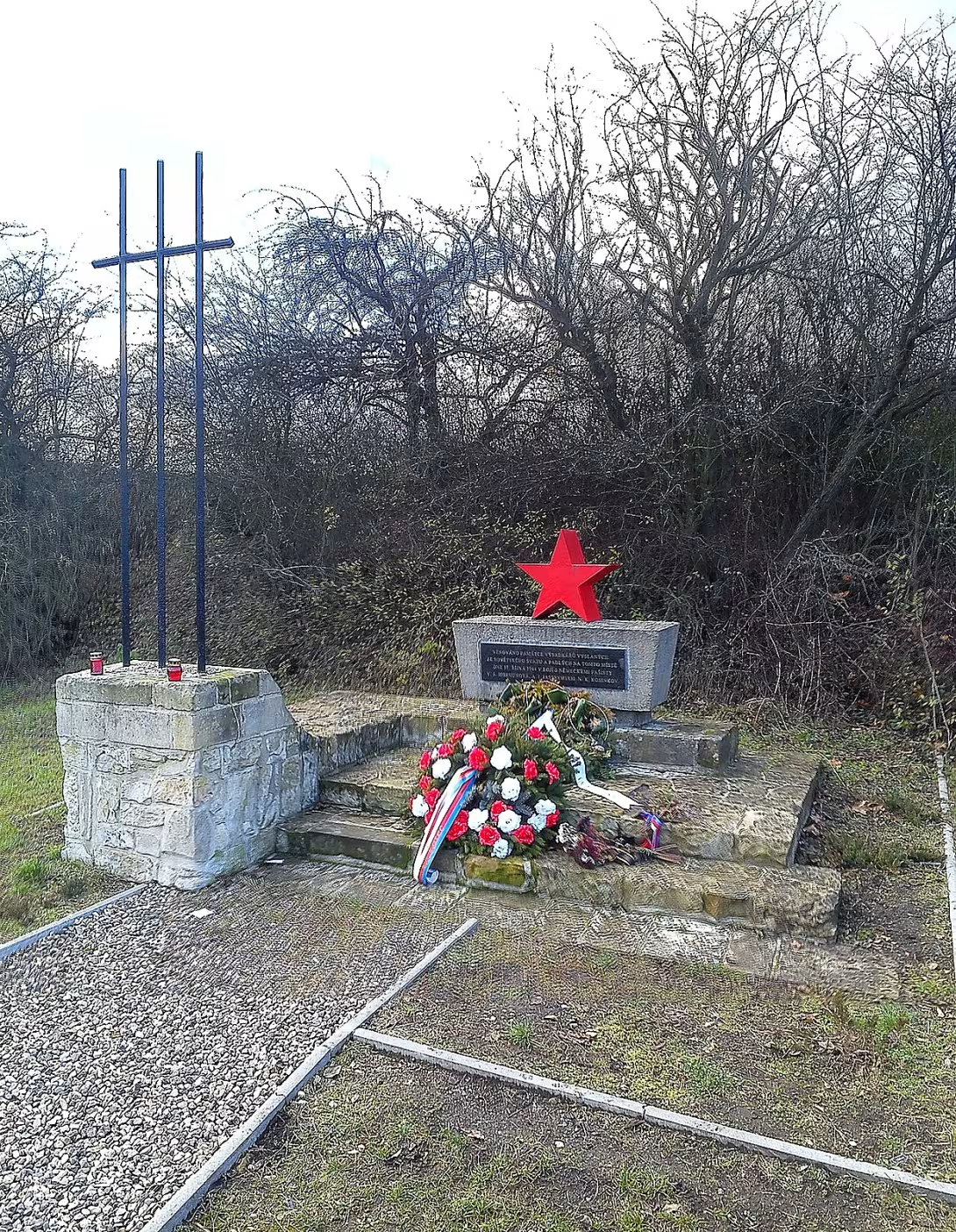
Památník padlým partyzánům výsadku Jana Koziny at Louns is a collection of two memoirs commemorating Soviet paratroopers who died in battle in October 1944. The main building from 1946 is located on the surface of Mělka and is protected as a cultural monument. This monument commemorates the tragic fate of three soldiers in the event of the liberation of Czechoslovakia.
The historical context of the monuments is closely related to Operation Jan Kozina, which began on October 16, 1944 with the take-off of Skytrain aircraft from the Polish military airport Řešov. Under Lieutenant Vasil Kisha's command, the group was responsible for forming guerrilla troops from local residents, sabotage and organising the formation of the National Committees. The navigator lost direction because of the continuous bombardment of the aircraft and the paratroopers jumped about 150 kilometers north of the planned destination in Šumava. Part of the group fell near Lipna and Tuchořice, the other group of nine members near Louns.
The Ukrainians captured Věra Morhunovová and Arkadyj Jastremskyj and Belorus Nikita Kosinkov on the surface of Mělka. On the morning of October 17, 1944, they were surrounded by German search parties. Věra Morhunovová, a 20-year-old member of the Ukrainian staff of the guerrilla movement, injured several Germans and then committed suicide. A similar fate met Nikita Kosinkov, who shot himself after the ammunition was exhausted. Arkadyj Jastremskyj, born in 1922 in Morohivka, fought to the end in the skulls where the Germans shot him with 27 bullets. On the German side, one SS member was killed and one wounded.
The bodies of the fallen were taken by a carriage drawn by horses to the west edge of the Louns to the intersection of the roads to Žatec and Chomutov, to a place called U Paryzka. Here the bodies were briefly buried in a shallow grave where people carried flowers. By order of the government commissioner Dr. Heinz Rochlitzer, the bodies were moved to the cemetery and then transported to the concentration camp Terezin, where they were burned and the ashes were dumped into the Ohra River.
The main monument in Mělce was festively revealed on 15 September 1946 according to the design of the Lounian native Pavel Bareš. It's brought out in a constructive spirit. The dominant is a red five-pointed star on a low stone plate, which stands on a wide three-stage pedestal from an optic wall. On the left, three iron black crosses are held from the block of the draught. The original bronze memorial plate was replaced in times by stone; the last exchange took place in 2016. The building has been protected as a cultural monument since 26 June 1973.
The second, smaller monument from 1976 is located at the site of the first deposit of bodies on the west edge of the Louns. It was created by artist Vladislav Mirvald as a narrow standing stone with a memorial plate.
In 2014, on the 70th anniversary of the event, both monuments were reconstructed for a subsidy of CZK 90.5 thousand from the Ministry of Defence. On Mělce was repaired opacek wall, built access road and replaced bench. A bench was added for the second monument, the wreaths were extended and the information table was restored. The green was radically reduced so that the monument would not cover up, and only those separating the place from the electrical line and intersection were left.
The monuments at Louns are an important witness to the courage and tragedy of Jan Kozina's away team. Visiting these places allows a deeper understanding of the specific events of the end of World War II.
Then and now
Drag the slider to compare how the landmark may have looked when it was built with the view today.
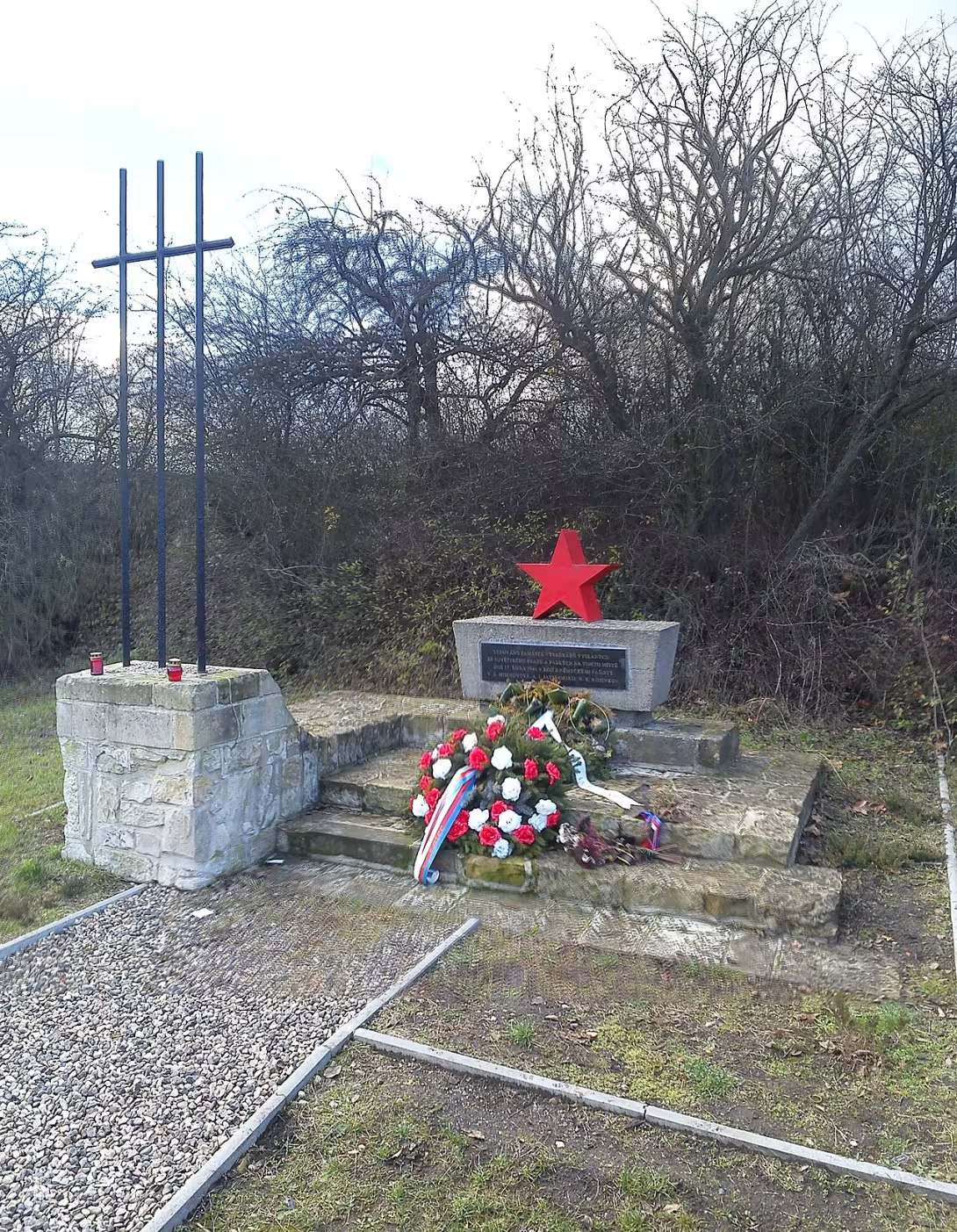
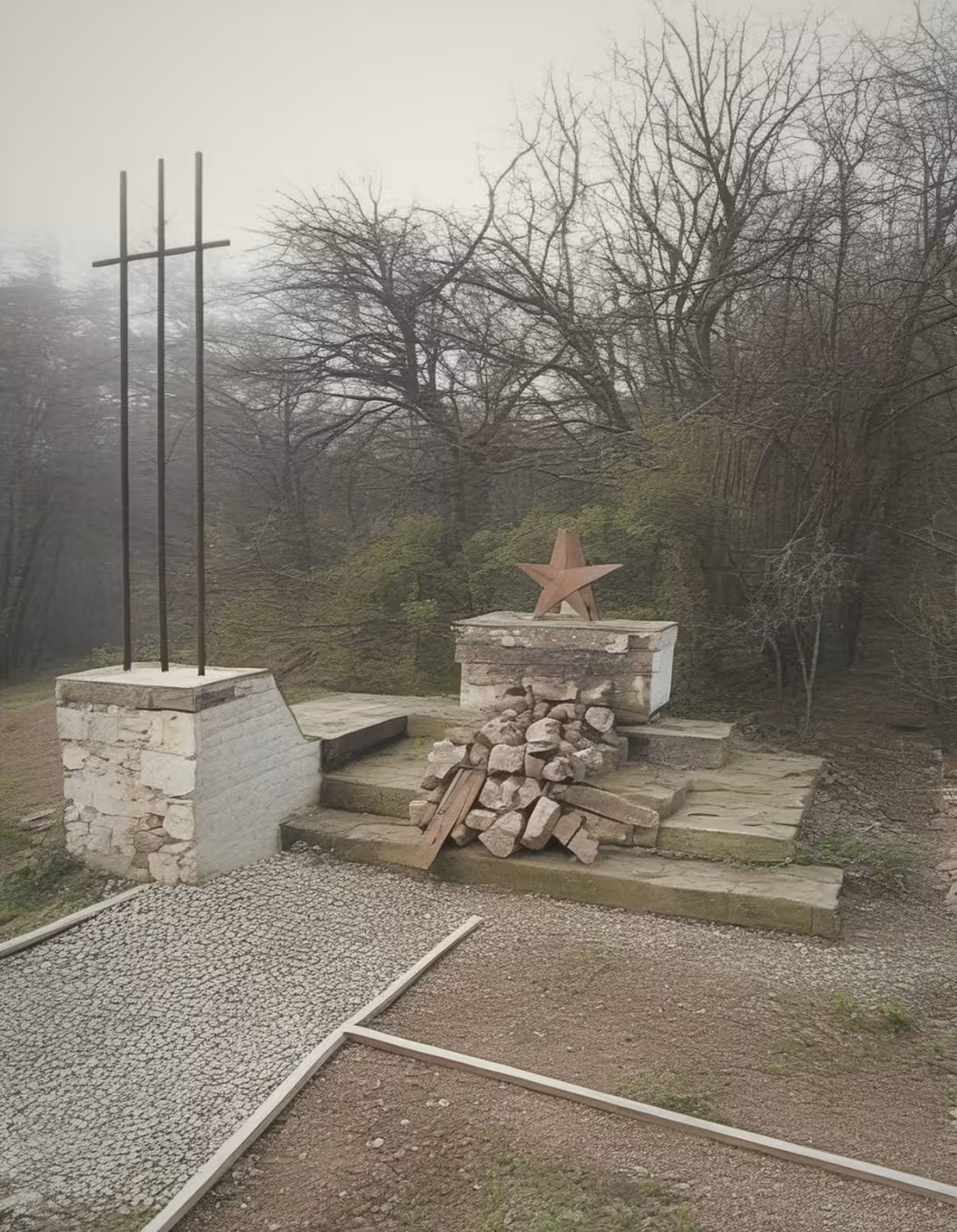
The historical appearance on the left is an AI-generated visualisation and serves as inspiration only.
Historical milestones
- 1946
- festive unveiling of the monument in Mělce
- 1973
- declaration of the monument as cultural monuments
- 1976
- the creation of a second memorial at the site of the first body deposit
- 2014
- total reconstruction of both monuments for the 70th anniversary of the event
Architectural development
The main monument is built from an abandoned wall with a red star and an iron cross. The original bronze commemorative plate was replaced in times by stone. In 2014, the entire complex was renovated, including repair of masonry and modifications of the access route.
Historical events
october 17, 1944: the fight and death of three soviet paratroopers; september 15, 1946: festive unveiling of the memorial.
Points of interest
Jan Kozina's away team landed due to a sniper shooting and a navigator's loss of direction about 150 km north of the planned destination in Šumava. The memorial on Mělce originally had a bronze plate which was later replaced with a stone. The second, smaller monument was created 30 years later.
Guide
Show guide text
This text was created by artificial intelligence and has not been editorially reviewed. It may contain inaccuracies.
Welcome here, on the top of Mělka near Louns. Stop for a moment, take a breath and look in front of you. Right now you're standing in front of a place that carries the heavy weight of history and reminds us of the courage of people who risked everything for freedom. The first thing you're probably interested in in this space is a distinctive red five-pointed star. It is located high on a stone pedestal and its colour contrasts sharply with the surrounding landscape and grey shade of stone. If you look a little to the left now, you'll see three iron black crosses protruding from a stone block. This composition is simple, but it is also very strong and it talks to us after many decades.
Let us now take a look together at why this monument is here and what exactly it reminds us of. This building is not only an architectural element in the landscape, but a profound expression of gratitude and memory of the tragic event of the Second World War. The memorial is dedicated to three Soviet paratroopers who, in this area, fell in the fight on the 17th October of the year a thousand nine hundred forty-four. Imagine the tension and danger that accompanied their last hours. They fought in a foreign country, far from home, hoping to help free Europe from Nazi oppression.
When we think about the view of this place, notice that the monument is not decorated with unnecessary decorations. It's brought out in a so-called constructive spirit. This means that architects were betting on clean lines, geometric shapes and functionality to create a sense of stability and urgency. Pavel Bareš and Vladislav Mirvald were responsible for this proposal. Look again at the base of the red star. It's made out of an opal wall. Opuka is a specific type of limestone that gives the whole building some roughness and nature, which in contrast to smooth areas of crosses creates interesting visual tension. The entire building was inaugurated on the 15th of September in the year one thousand nine hundred forty-six, shortly after the war was over, when it was necessary to build a place to remember with the pain of the beams.
Now, I'd like to take you deeper into the story of the people who are connected to this place. The main character of the entire away team was Jan Kozina. His name is today a symbol of courage, but the way to this hill was full of dramatic twists. We remember specifically three heroes who lost their lives here. It was Věra Morhunovová, Arkadyj Jastremskyj and Nikita Kosinkov. It is fascinating and at the same time sad to think that there was a woman among them, Vera, which at that time was not quite common as a paratrooper. These people have suffered the tragedy of a war that knows neither gender nor age, only duty and sacrifice.
And here we come to the part that may surprise you. The entire Jan Kozina away team was not supposed to reach the Louns. The plan was for the paratroopers to land in Shumava, in dense woods in the south. So what happened? During the flight, the plane was shot, causing chaos and panic. The navigator lost course and the plane was flying in the clouds and smoke from the shots away from the target. Paratroopers have landed approximately 150 kilometers north of the planned location. Imagine their shock when they discovered, after the impact, that they were not in the woods of Šumava, but in a completely different part of the country where they were much more exposed to revelations and enemies. This error in navigation changed the fate of many people and brought these three fighters here on the surface of Mělka.
When you go around the monument, look at the details that were changing over time. Originally, a bronze plate was placed on the monument, which carried inscriptions and information. Later, however, this plate was replaced with a stone, which is more weather resistant and fits better into the overall appearance of the building. It's a little detail, but it shows us how memory care has evolved over the years.
If you look around, you'll notice there's not just one object. In the year one thousand nine hundred seventy-six a second, smaller monument was created. It was placed exactly where the bodies of the fallen were first stored. This second monument was created up to thirty years later than the main one, which reminds us that the process of processing pain and recognising heroism sometimes takes a very long time. In order to preserve these two places for future generations, in the year two thousand and fourteen total reconstruction of the two monuments. It was the 70th anniversary of the events that took place here.
So you're standing in front of a place that's been protected as a cultural monument since the year one thousand nine hundred seventy-three. It is a recognition not only of the architectural value of the work of Pavel Bareš and Vladislav Mirvald, but above all of the historical significance. The Red Star, the Black Cross, and the Oppository Stone together tell the story of the navigator's mistake, the fight in a foreign land and the immortal name of Vera, Arkady and Nikita.
Now, all I'm recommending is that in silence, you go around the entire space, you perceive the atmosphere of this hill, and maybe you imagined the fateful moments of October of the year a thousand nine hundred forty-four. Let yourself be guided by silence and respect to those who remain here. When you are ready, you can continue to explore the Louns and discover the other traces of history that this city and its surroundings conceal. Thank you for your attention and I wish you the peaceful and inspiring rest of your journey.
Tips for visitors
The best time to visit the monument is in the spring or autumn period when the surroundings are green and pleasant to view. The sunny day provides ideal light for photography, especially in the morning or in the evening when the light is softer.
We recommend you prepare a map or use GPS for comfortable arrival.
When visiting the monument, it is recommended to take the camera with you, especially if you are interested in shooting in a constructive style. It is also important to carry shoes suitable for walking on the top.
For families with children, the memorial is an interesting place to remember historical events. In the surrounding area you can visit other places, such as the Mělce design, which offers beautiful views of the Louny and surrounding landscape.
Frequently asked questions
Can the monument be visited?
This is a structure in a public space that can usually be seen from outside free of charge. We have not verified that this particular one is freely accessible.
Where is the monument?
Location: Louny. The map on this page shows the exact spot.
Why is the monument protected?
It is listed in the Central List of Cultural Monuments of the Czech Republic as a cultural monument (register no. 1000155441).
Businesses nearby
Do you run a restaurant, accommodation, shop, museum, rental, wellness or other visitor service near this monument? Show yourself directly to the people heading to it — this is how they will see you in the app and on the web:
Nearby
Návrší Mělce poblíž města Louny.
Accommodation nearby
Themed route
Thematic cruise route "Památník padlým partyzánům výsadku Jana Koziny"
1.Památník padlým partyzánům výsadku Jana Koziny
Type: Historical monument
Why is it worth a visit: This monument is dedicated to men who took part in combat actions against the occupation forces during World War II. It is a place of memory and worship of the heroics of those who have sacrificed their lives for freedom.
2. Top of the Shoulder
Type: Historical design
Why is it worth a visit: The Mělce hill is historically important for its role during war events. Here is a memorial that reminds of the fighting and the victims of the guerrillas. When browsing, you can appreciate panoramic views of the surrounding landscape.
3. Ambient forests
Type: Forest area
Why is worth a visit: This area provides a quiet and natural environment where you can enjoy the beauty of nature. It was also a place of hiding for guerrillas during the war years, which adds to the path of historical context.
4. Walkways around the surfaces
Type: Walk
Why is it worth a visit: The walkways offer an opportunity to explore the surroundings and enjoy mild marches. They are ideal for family trips or quiet moments alone while you appear in historical context.
5. Information board at the memorial
Type: Historical information
Why is it worth a visit: Information boards provide important historical data about the events that took place here. They are a great addition to exploring the monument and help to better understand the importance of the site.
This route offers a combination of historical learning, natural beauty and peaceful experience of the surrounding environment.
Seasonal recommendations
In spring the monument surrounds the awakening green and the first flowers that give the place a sense of hope. Soft spring light gently highlights the details of the monument. We recommend that you dress in layered clothes so that you don't get caught in the weather, and head out for the morning dew when the air is the cleanest.
The summer season brings rich green trees that provide a pleasant shade. The sharp shining sun creates significant shadows on the surface of the monument, underlining its shapes. It is advisable to choose light summer clothes and visit the place in late afternoon when it is no longer so hot.
In autumn, the surroundings are coloured in golden and brown tones, which match with a respectful and melancholy atmosphere of memory. Frequent fog gives the monument a serious look. Don't forget the waterproof shoes and the warm sweater, the perfect time to visit is a short time before sunset.
In winter, the monument acts in contrast to the white snow or grey sky very grisly and dignified. Empty branches of trees reveal the entire form of the object without unnecessary obstacles. Hot gloves and hats are necessary due to the frost, and we recommend planning the journey in the morning so that daylight is sufficient.
Visualizations and artistic views


The visualisations are generated by artificial intelligence and serve as inspiration.
Photos from the area
Real photos taken near the monument


Zdroj a licence jsou uvedeny u každého snímku.
Tips from visitors
No tips yet. Be the first!
Log in and add your tip.
Sources and literature
Photos: Palu / CC BY-SA 4.0 — Wikimedia Commons. The author and licence also appear when you hover over the image.
Faktickým podkladem tohoto textu byl článek na Wikipedii, jehož autory jsou přispěvatelé Wikipedie. Článek je dostupný pod licencí CC BY-SA 4.0.
Location on the map


Příběhy a pověsti
Legendy, pověsti a příběhy spjaté s touto památkou
Fotografie návštěvníků
Zatím žádné fotografie. Buďte první, kdo přidá fotografii z návštěvy!
Log in a přidejte svou fotografii nebo hodnoťte.
Za ověřenou návštěvu v aplikaci získáte víc bodů — poznáme podle GPS, že jste na místě.
Reviews and comments