



Pomník Františka Palackého Memorial
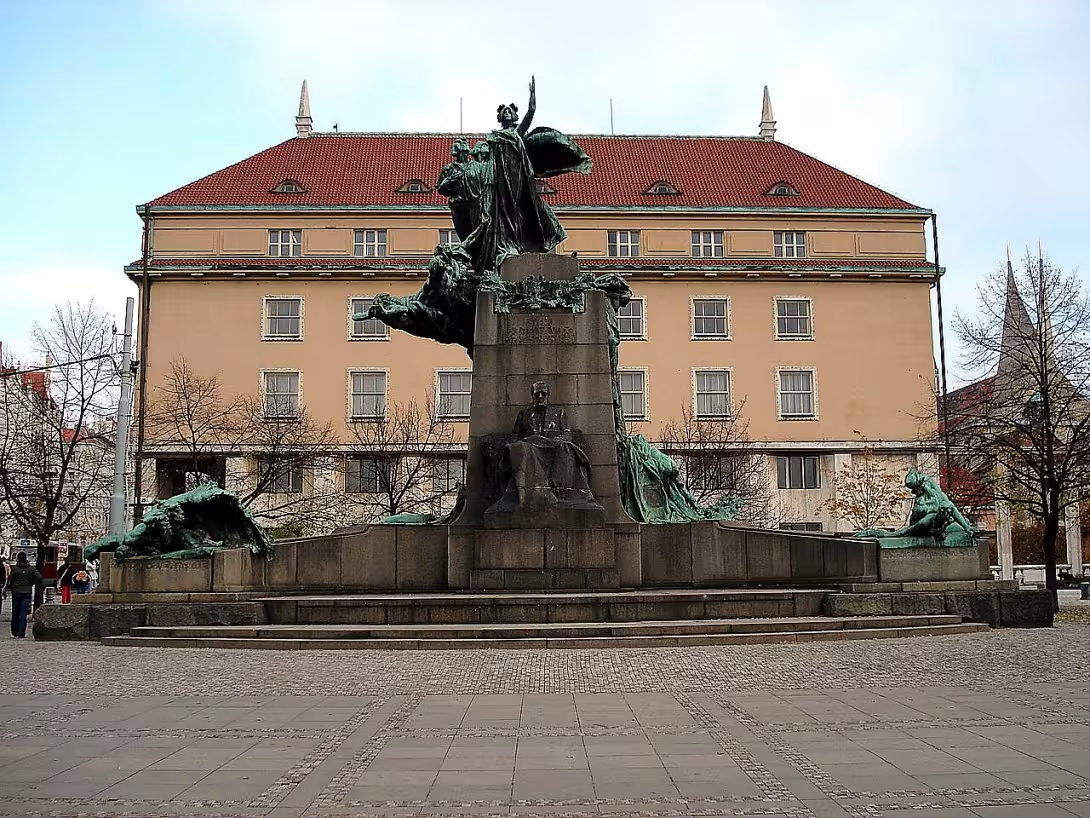
Pomník Františka Palackého, located on the Palacky Square in Prague 2, dominates the northern foothills of the Palacky Bridge and symbolizes the successful emancipation of the Czech nation. This nine-metre monument was built as the work of sculptors Stanislav Suchard and architect Alois Dryák in 1912, which represents a key time for Czech history and its path to independent statehood.
The history of the monument dates back to 1876, when the intention to build the memory of František Palacký was already established. After his death, the idea of the monument was directly linked to the construction of the Palacky Bridge and subsequently to the creation of the Palacky Square which evolved after the flood of 1890. The competition for the construction of the monument started in 1897 when 14 sculptors participated. In 1901, the jury selected the proposal of Stanislav Suchard and Alois Dryák, which led to the laying of the base stone in 1898 on the anniversary of the 100th birthday of Palacký. The monument was built between 1901 and 1912 and festively revealed on July 1, 1912.
The architecture of the monument is remarkable by its rugged and artistic processing. The base consists of 111 four-metre reinforced concrete pilot and a central structure lined with light granite plates. The monument has a horseshoe pedestal, which is a top plinth with bronze leaves. On this plinth is the sitting stone figure František Palacký, created by Stanislav Suchard from twelve blocks of granite. The monument is decorated with multi-figure ensembles and inscriptions that tell about historical events and Palacky influence on Czech culture.
During his existence, the monument passed through various fates. In 1942 it was dismantled during the Nazi occupation, but thanks to the personal bravery of the administrator of the Municipal Court at Břetslav Zeman's Invalido and his assistants, the statues were hidden. After the war, the statues were repaired and reinstalled between 1947 and 1950.
The monument is a cultural monument of the Czech Republic, registered in the Central List of Cultural Monuments under the number 40076 / 1-1209. Today it is worth visiting not only as a monument to František Palacký and his contribution to the Czech national movement, but also as an architectural milestone in the history of Prague. The monument is located in a central location, making it easily accessible and visible for tourists and locals.
Pomník Františka Palackého is not only a monument to an important personality, but also a testimony about the historical events and processes that shaped Czech national identity. His presence in Palacký Square is an essential part of the Prague panorama and is worth visiting to understand the deeper historical context of Czech emancipation.
Then and now
Drag the slider to compare how the landmark may have looked when it was built with the view today.
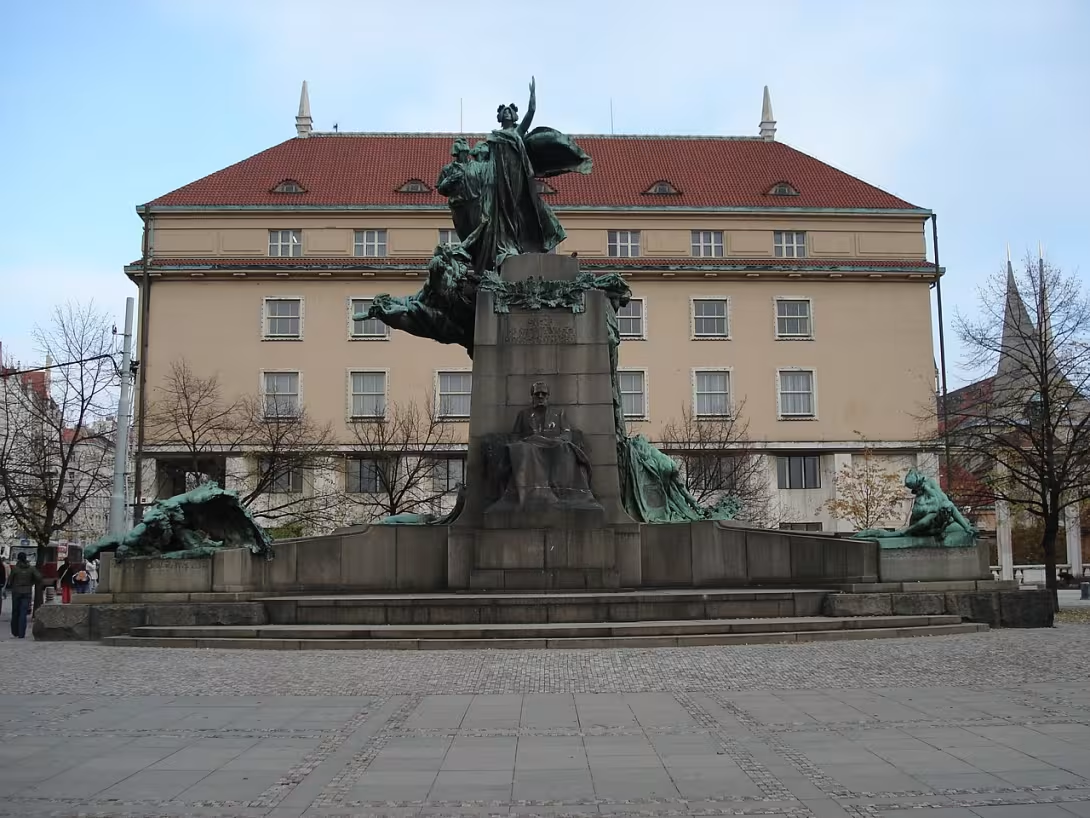

The historical appearance on the left is an AI-generated visualisation and serves as inspiration only.
Historical milestones
- 1876
- There was an intention to erect the memory of František Palacký.
- 1890
- The flood led to the creation of Palacky Square.
- 1897
- The competition for the building of the monument has begun.
- 1898
- The base stone was laid in the year of Palacky's 100th birthday.
- 1901
- Selected design by Stanislav Suchard and Alois Dryák for memorial.
- 1912
- The ceremonial revelation of František Palacký's memorial.
- 1942
- The memorial was dismantled during the Nazi occupation.
- 1947
- The repairs and reinstallation of statues after the war started.
Architectural development
The memorial was built between 1901 and 1912. Its foundation is made up of reinforced concrete pilots and a structure lined with light granite plates. Statue of Franz Palacký is composed of twelve blocks of granite, and the statues were cast by the company Bohdana Tomáš Srpka.
Historical events
- 1898
- The foundation stone of the monument was laid.
- 1912
- The memorial was festively revealed.
- 1942
- During the Nazi occupation, the monument was dismantled and the statues hidden.
Points of interest
- The Pomník Františka Palackého is located on Palacky Square in Prague 2 and dominates the northern foothills of the Palacky Bridge. - The monument was built as the work of sculptors Stanislav Suchard and architect Alois Dryák in 1912, which is a crucial time for Czech history and its path to self-statehood. - The monument has a horseshoe base with bronze leaves and a stone figure, František Palacký, created by Stanislav Sucharda from twelve blocks of granite. - During the Nazi occupation, the monument was dismantled, but the statues were hidden and were reinstalled between 1947 and 1950 after the war. - The monument is a cultural monument of the Czech Republic, registered in the Central List of Cultural Monuments under the number 40076 / 1-1209.
Guide
Show guide text
This text was created by artificial intelligence and has not been editorially reviewed. It may contain inaccuracies.
Welcome to Palacky Square in the heart of Prague 2, where today we will look at one of the most important monuments of our nation. You are standing in front of the monumental monument of František Palacký, which dominates the northern foothills of the Palacky Bridge and forms a significant part of the landscape character of this place. A monument with its impressive attitude and a noble position has the ability to bring us immediately to the depths of our history.
Pomník Františka Palackého was born when the Czech nation tried to emancipate and consolidate itself within European states. In 1876 she began to plan this monument in honor of František Palacký, Czech historian and political thinker, who became a symbol of national revival. After the foundation of Palacký Square in 1890, a competition for its implementation was held. In 1898 the foundation stone was laid in connection with the 100th birthday of Palacký, which symbolized the beginning of a new era. Finally, it was decided on the design of Stanislav Suchard and Alois Dryák, whose work embodies exceptional artistic and historical values.
Look up at the monument. A nine-metre statue made of bronze and stone is built on a flat base. Note the detail in Palacky's face: the strength and depth of the ideas that represented his life's journey. His hands are laid so that they seem to hold something invisible - perhaps the spirit of Czech history and the future. This monument is not just a monument to individuals; It's a symbol of an entire nation waking up to a new age.
František Palacký was a key figure in Czech history. As a historian and politician, he tried to document and celebrate the Czech past, which was intended to strengthen national identity when it was subordinate to other powers. His work "History of the Czech people" is considered essential for understanding our history and Palacký became one of the most important figures in the Czech revival.
The interesting thing about this place is its architectural heritage. The memorial was festively revealed in 1912, which falls into the key period for Czech history and its path to self-statehood. It is fascinating to realize how this monument was part of a wider movement towards independence.
Let's move closer and look at the inscriptions around the monument. These inscriptions can remind of important events and personalities that have influenced Czech history. Every stone and every detail here has its meaning, let it not be clear to us yet.
Before we say goodbye to this monument, we invite you to explore the surrounding neighborhoods. Palacký Square and its surroundings offer many opportunities to discover the heritage of our nation. Whether you return here or go to other parts of Prague, remember this moment and the feelings you share with this monument.
Thank you for your attention and friendship to our history. Let there be many more attractions and beauties on the road around our country!
Tips for visitors
The best time to visit is early morning or shortly before sunset. At these times, soft light hits the monument, highlighting the details of the statue and the texture of the stone, which helps to better sense the plasticity of the work.
We recommend taking comfortable shoes to walk around and a camera to document this important work that symbolizes the emancipation of the Czech nation.
For the best pictures we recommend search for angles from the edges of the square, which allow you to capture the total height of a nine-metre monument in contrast to the sky. Watch the shadow game on the statues that give the monument depth.
In the immediate vicinity is the Palacky Bridge, which offers a pleasant walk. It is an ideal supplement to visit the monument and allow a short rest by the river.
For families with children, a visit is an appropriate opportunity to tell about Czech history in simple form.
Frequently asked questions
Can the monument be visited?
This is a structure in a public space that can usually be seen from outside free of charge. We have not verified that this particular one is freely accessible.
Where is the monument?
Location: Praha 2. The map on this page shows the exact spot.
Why is the monument protected?
It is listed in the Central List of Cultural Monuments of the Czech Republic as a cultural monument (register no. 1000152127).
Businesses nearby
Do you run a restaurant, accommodation, shop, museum, rental, wellness or other visitor service near this monument? Show yourself directly to the people heading to it — this is how they will see you in the app and on the web:
Events nearby

Zdroj akcí: otevřená data měst a obcí ČR (Národní katalog otevřených dat) a kalendář akcí Národního památkového ústavu.
Nearby
Palacký most
Vyšehrad s přemístěnými sochami J. V. Myslbeka
Accommodation nearby
Trips and activities nearby
Guided tours, tickets and activities nearby from GetYourGuide
Affiliate link: if you buy from the partner, we may receive a commission. The price for you does not change.
Search tours and activities →Themed route
1. Pomník Františka Palackého, memorial. This statue worships an important Czech historian. 2. Palacky bridge, bridge construction. This way across the river offers an interesting view of the surroundings. 3. Vyšehrad with relocated statues J. V. Mysbek, historical area. Here you can admire the artwork of a famous sculptor in his new environment.
Seasonal recommendations
In spring, the space around the monument comes alive thanks to flowering green and fresh air. The morning sun hits the rock gently, creating a calm atmosphere. I recommend wearing a lighter jacket and visiting a place in the early hours where there are fewer people around.
Summer months bring thick shade of trees and intense colors of surrounding nature. The sun shines long into the evening, making it the perfect time for late walks when the air is colder. Light summer clothes and plenty of fluid are suitable.
Autumn is characterized by golden leaves and melancholy mood. The light is softer in this period and the colors of the surroundings are more saturated. It's reasonable to bring a waterproof coat and choose the time around noon when it's the hottest.
In winter, the monument acts in contrast with naked branches and a possible layer of snow very sparsely. Evening city lighting gives the place a special atmosphere, especially in advent time. Hot shoes, hats and a fat sweater are essential.
Visualizations and artistic views


The visualisations are generated by artificial intelligence and serve as inspiration.
Photos from the area
Real photos taken near the monument

Zdroj a licence jsou uvedeny u každého snímku.
Tips from visitors
No tips yet. Be the first!
Log in and add your tip.
Sources and literature
Photos: Rémi Diligent / Public domain — Wikimedia Commons. The author and licence also appear when you hover over the image.
Faktickým podkladem tohoto textu byl článek na Wikipedii, jehož autory jsou přispěvatelé Wikipedie. Článek je dostupný pod licencí CC BY-SA 4.0.
Location on the map
Příběhy a pověsti
Legendy, pověsti a příběhy spjaté s touto památkou

Fotografie návštěvníků
Zatím žádné fotografie. Buďte první, kdo přidá fotografii z návštěvy!
Log in a přidejte svou fotografii nebo hodnoťte.
Za ověřenou návštěvu v aplikaci získáte víc bodů — poznáme podle GPS, že jste na místě.
Reviews and comments