



pomník Karla Ditterse z Dittersdorfu Memorial
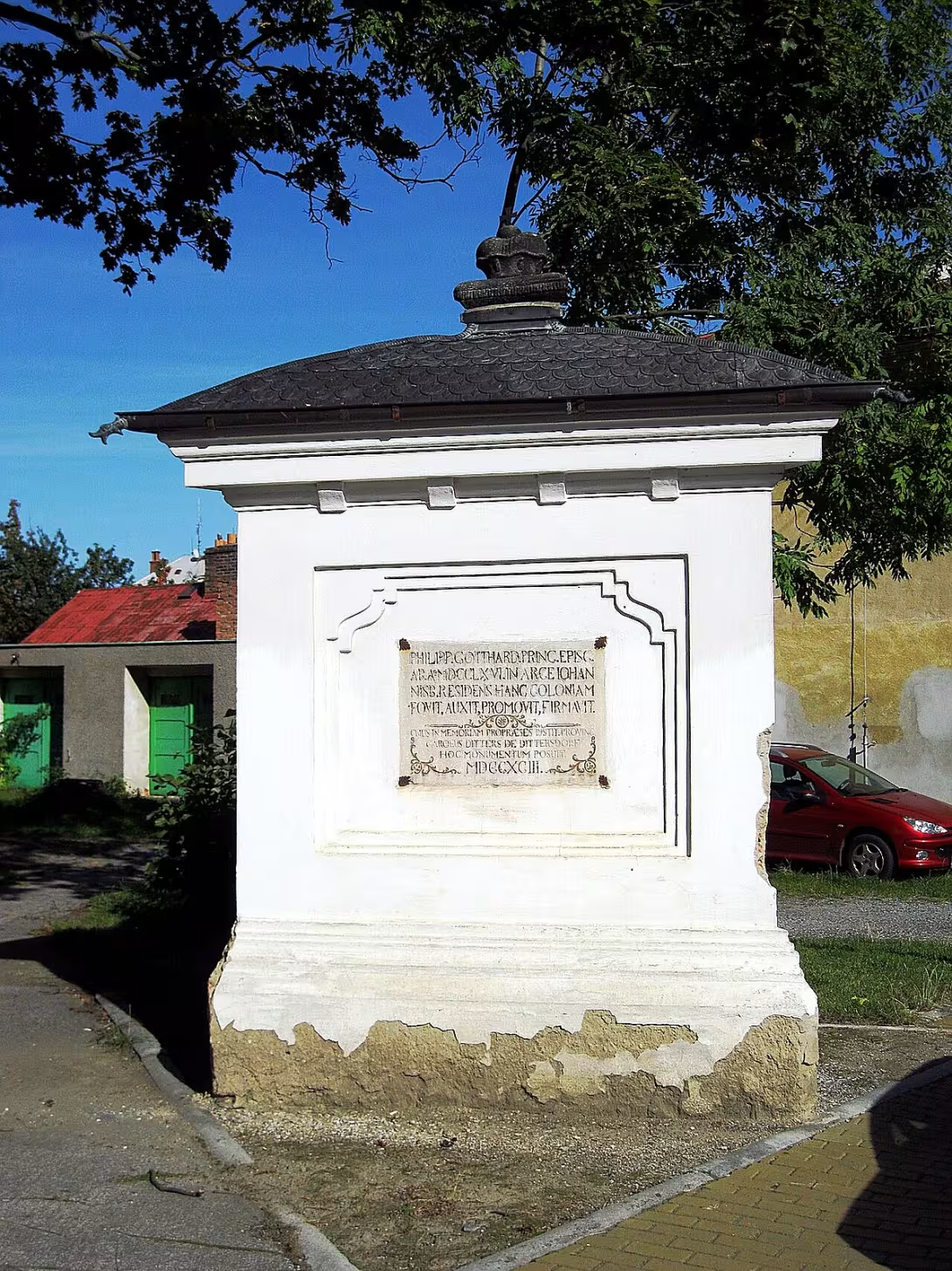
Karl Ditters Memorial of Dittersdorf is a Baroque building from 1793 in Pushkin Street in Javorník in Jeseník district. The building is registered as a cultural monument of the Czech Republic and forms part of the town monument zone.
The monument was built by composer and band Karel Ditters z Dittersdorfu. He dedicated it to the Bishop of Vratislav, the Count of Philip Gotthard Schaffgotsch, who lived from 1747 to 1795. The construction expressed the appreciation of the bishop's merits in the establishment of the village of Janská vrch, which was promoted to a separate municipality in 1793.
It is an architectural object on a triangular plan. A three-sided prism comes out of the triangular tray with the side fillings. The brick masonry construction has a smooth white limestone plaster and a tin roof with a gutted gargoyle. On the wall facing the square there is a marble plate with inscription. The whole prism is closed by a ledge and a roof in the shape of a compressed needle, on top of which stands a stone cushion with a prince's crown.
In 1963 the monument was officially included in the list of cultural monuments of the Czech Republic. It underwent extensive repairs in 2017. There was drainage for drainage of the building and restoration of MgA Jakub Gajda has restored the plaque.
The monument is in the immediate vicinity of Karl Ditters' house from Dittersdorf. It represents a concrete historical document on the relationship of the composer to the bishop and on the administrative development of the surrounding settlements at the end of the 18th century.
This object is a valuable witness to local history and baroque art in Javorník. His visit offers the opportunity to look into the history of the region and remind himself of the personalities who shaped him.
Historical milestones
- 1793
- building a monument
- 1963
- registration in the list of cultural monuments of the Czech Republic
- 2017
- repair, drainage and restaurant commemorative plates
Architectural development
The monument is built from brick wall with smooth white limestone plaster and tin roof. It has a triangular plan with a three-sided prism, which ends with a ledge and a headliner with a stone crown. On the wall there is a marble plate with inscription and the gutter is finished with a gargoyle.
Historical events
1793: construction of a monument in honor of Bishop Schaffgotsch; 1963: registration in the list of cultural monuments of the Czech Republic; 2017: repair of building and restaurant commemorative plates.
Points of interest
- It's a Baroque building from 1793, which is registered as a cultural monument. - The composer Karel Ditters z Dittersdorfu donated it to Bishop Philip Gotthard Schaffgotsch. - The building gave its appreciation for the Bishop's merit when he founded the village of Jane Vrch. - The object has a triangular plan and on top is a stone cushion with a prince's crown. - In 2017 the monument underwent extensive repair, including restoration of the memorial plate.
Guide
Show guide text
This text was created by artificial intelligence and has not been editorially reviewed. It may contain inaccuracies.
Welcome to Javorník. Right now, you're facing one of the very interesting testimonies of local history. There is a monument before you, which may not be the city's largest building work, but carries deep meaning and a story of gratitude and recognition. Feel the atmosphere of this place in the street, which today bears the name of a famous poet, and let yourself pass back in time by more than two centuries.
When you look at this structure, you see the result of the work from the late eighteenth century. In particular, seven hundred ninety-three years ago, this monument came into the world. But it was not built randomly or as a mere ornament of the city. It came as a gift, as a tangible token of respect. The author of this act was the famous composer Karel Ditters z Dittersdorfu. Imagine that time when music and art were closely linked to high ecclesiastical and noble circles. It is in that spirit that this object was built.
Now pay attention to whoever this monument is dedicated to. It is not a celebration of the composer himself, but a recognition of the merits of a man named Filip Gotthard Schaffgotsche, who acted as a bishop in Wroclaw. But why should a composer dedicate such a significant work to the Bishop? The answer lies in the development of the surrounding region. This memorial commemorates the bishop's merit in establishing the village of Janská vrch. It was a gesture of gratitude for the possibility of a new life and a new community in this area thanks to his activities and support. It is a beautiful example of how recognition for good governance and helping people has been expressed in the past.
Let us now focus on the very form of the construction. Although we do not know the names of the particular architects who designed this project, it is clear that they followed a very popular baroque style. Notice the overall appearance and think about the shape of the object. If you could look at it from above, you would find it has a very specific triangle plan. It is this geometric element that gives the construction its unique character. Take a look at the top where the whole composition is shut down. Everything about this work is aimed at expressing stability and endurance.
If you go around the memorial, focus on the memorial plate. This is the key element that tells us who we're talking about. It's important to know that this record went through a very thorough restaurant in two thousand and seventeen years. Together with the repair of the plate at that time was also made important repair of the drainage to prevent damage to the construction of moisture and to keep this piece of history preserved for future generations. It's fascinating to realize that people have been taking care of this object for hundreds of years.
So the key personalities of this place are two men. On the one hand Karel Ditters z Dittersdorfu, a man of music and creativity, and on the other side Filip Gotthard Schaffgotsche, a man of power and faith, who used his power to build. Their connection in the form of this monument shows us how in the eighteenth century the art world intertwined with the rule of state and church. He is a silent witness to a time when the destinies of people in small settlements, such as the Janský Hill, were decided in the palace of bishops, but were also appreciated by the talent of composers.
The interesting thing that might interest you is that this object is not just a local corner of the monument, but it has a much wider appreciation. Already in the year one thousand nine hundred sixty-three it was officially included in the list of cultural monuments of the Czech Republic. This means that the state has recognised its irreplaceable value for our national culture. In addition, the monument is part of the entire urban monument zone Javorníka, which means that it forms one of the many contacts in the mosaic of the historical city centre.
Stop for a moment and try to imagine what this street looked like in a thousand seven hundred and ninety-three. Who walked through here, what sounds accompanied people and what impression this new Baroque element had to give in the landscape. It's a place where music, architecture and history meet in one small but important building.
Now that you know the story of this grateful gesture from composer to bishop, I suggest you continue to explore the beautiful Javorníka. The city has hidden many other secrets and historical layers that await your discovery. Go through the surrounding alleys, see the rhythm of this city and be accompanied by its history.
Thank you for spending time with us at this Baroque monument. We hope this short trip to the past has helped you better understand the relationships between the people who lived and formed here centuries ago. We wish you a pleasant continued journey and many other wonderful experiences in discovering our cultural treasures. Goodbye.
Tips for visitors
For a tour of the Baroque memorial in Javorník on the street Pushkinova is best chosen in the morning hours, when the sunlight ideally illuminates the details of this historic building from the year thousand seven hundred ninety-three. The surrounding area of the sights in the public area is easily accessible by foot from the city centre, and Javorník can be transported comfortably by car and by common public transport connections. We recommend taking with us a camera to capture the Baroque architecture, which was dedicated to Vrocław Bishop Philip Gotthar, as well as comfortable shoes to walk through the city. The best pictures can be taken from the front view of the street, where the sun creates fine shadows highlighting the artistic elements of the work built by the music composer Karel Ditters z Dittersdorfu himself. In the immediate vicinity of the memorial, don't forget to visit Karl Ditters' house from Dittersdorf, which is closely related to the history of this place.
Frequently asked questions
Can the monument be visited?
This is a structure in a public space that can usually be seen from outside free of charge. We have not verified that this particular one is freely accessible.
Where is the monument?
Location: Javorník. The map on this page shows the exact spot.
Why is the monument protected?
It is listed in the Central List of Cultural Monuments of the Czech Republic as a cultural monument (register no. 1000142118).
Businesses nearby
Do you run a restaurant, accommodation, shop, museum, rental, wellness or other visitor service near this monument? Show yourself directly to the people heading to it — this is how they will see you in the app and on the web:
Nearby
V blízkosti se nachází dům Karla Ditterse z Dittersdorfu.
Accommodation nearby
Themed route
1. Karl Ditters' House from Dittersdorf Type: Historical House Why is it worth a visit: In the immediate vicinity of the main destination is this house which is closely related to the life of the famous composer and clerk. Visitors can admire historical architecture associated with this important personality.
2. The memorial of Karl Ditters from Dittersdorf Type: Monument Why is it worth a visit: The main destination of the whole trip is a monument to the stay and activity of this musical artist in the village Javorník. The site offers a dignified reminder of his legacy in a quiet environment.
Seasonal recommendations
Spring on Javornicka brings awakening nature, when the surrounding trees begin to green and snow retreats from the foothills. The sun's rays penetrate through not entirely foliated branches and pleasantly irradiate the stone details of the art. During this period you will appreciate fixed and waterproof shoes because the roads are muddy on the melting snow and also a light windbreaker against the cool spring wind blowing from nearby hills. The best time to stop this exterior work is in the morning, when soft light creates ideal conditions for taken pictures of the monument.
The summer months cover the whole area in thick green leaves, providing a welcome shadow during hot days. The sun stands high in the sky and strong rays illuminate reliefs sharply, which makes all artistic details stand out. The best time for a quiet study of the work is early morning or late evening, when the sun falls lower and temperatures fall to tolerable values.
Autumn turns the surrounding slopes into a colorful palette of shades of yellow, red and brown, creating a very impressive and melancholy atmosphere for every bystander. The low sun creates long shadows and gives the whole area a mysterious impact that amplifies the falling leaves. Practical equipment should include a warm sweater, scarf and waterproof coat as the weather is variable and often raining. The ideal time of day for visiting is around noon, when daylight has the greatest strength and can drive away the autumn cold for a while.
Winter turns this public space into a quiet snow fairy tale, where the white blanket surrounds the whole monument and creates a festive and peaceful mood. Early dimming and early morning fog give the place a distinctive character, while snow reflects the light of street lamps. Very warm winter clothes, thick gloves, hats and shoes with anti-slip soles are essential for outdoor stopping. The best time for an outside tour is in the afternoon shortly before dark, when the first lights in the surrounding streets are lit up.
Visualizations and artistic views

The visualisations are generated by artificial intelligence and serve as inspiration.
Photos from the area
Real photos taken near the monument


Zdroj a licence jsou uvedeny u každého snímku.
Tips from visitors
No tips yet. Be the first!
Log in and add your tip.
Sources and literature
Photos: Lehotsky / CC BY-SA 3.0 — Wikimedia Commons. The author and licence also appear when you hover over the image.
Faktickým podkladem tohoto textu byl článek na Wikipedii, jehož autory jsou přispěvatelé Wikipedie. Článek je dostupný pod licencí CC BY-SA 4.0.
Location on the map
More monuments – Javorník
Show all in the municipality
Příběhy a pověsti
Legendy, pověsti a příběhy spjaté s touto památkou
Fotografie návštěvníků
Zatím žádné fotografie. Buďte první, kdo přidá fotografii z návštěvy!
Log in a přidejte svou fotografii nebo hodnoťte.
Za ověřenou návštěvu v aplikaci získáte víc bodů — poznáme podle GPS, že jste na místě.
Reviews and comments