



Radnice – Andělská kolej Town hall
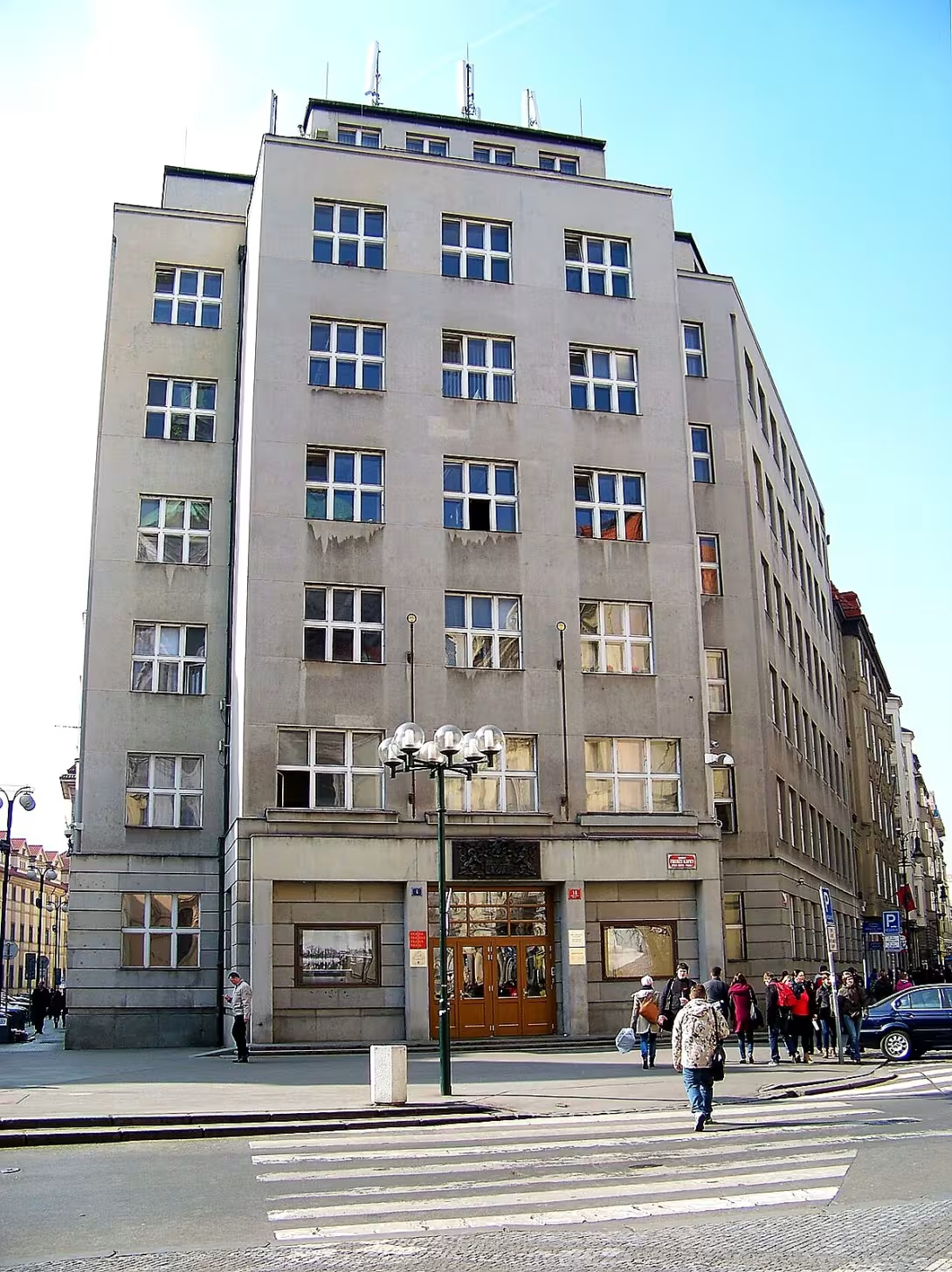
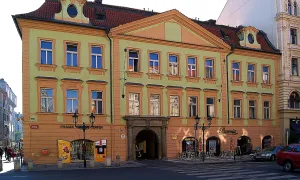
The town hall known as the Angel College is the house No. 16 / I on the corner of Franze Kafka and Kaprovy street in Old Town. The building consists of a new building of the town hall from 1926 to 1928. Below it are preserved Romanesque basement spaces, which have been a registered cultural monument since 1958.
The oldest reports of the original house in the archives are missing, the site records it only around 1344. At that time the house was won by Jan IX. ze Středy, the scribe of King John of Luxembourg, the later Chancellor of Charles IV and the Bishop. Subsequently, the building was occupied by the master of the college of All Saints of Prague University, Vincenc Nidek ze Zhořelce, who lived there with students. By his testament the house bequeathed the capitals of All Saints at Prague Castle and the university dorm in which he remained until the 19th century.
The original medieval house was extended in the goth by floors with ribs, whose fragments showed a pear profile. However, as part of the rendering of old Prague, the building was largely demolished between 1908 and 1911, although the Club for Old Prague and other experts tried to stop the demolition. Only the ground floor, now used as a basement, was preserved from the original building. The main hall has a square plan and is glazed with four arches of cross arches without ribs. These converge into a central column with a cubic head and a base with corner claws. In the wall, there was a connection with an engraved motif of five-leaf roots. The entrance portal niche with a semicircular enchantment is only 155 centimetres high, which is evidenced by a smaller increase in the then population.
The current building of the town hall was built according to the design of architects Vladimir Jezek and Oktav Koutský, the construction was carried out by František Strnad. After the demolition of the original house, the site remained unused for a long time and until 1995 the Romanesque remains were accessible only occasionally. Today, part of these premises are integrated into the tour route of the exhibition World Franz Kafka, while fragments of architectural articles have been transferred to the depository.
This monument represents a unique connection of a modern administrative building from the 1920s and rarely preserved Romanesque kernel, which survived extensive rendering interventions in the centre of Prague. A visit to the basement offers a direct insight into the medieval building history of the city and commemorates the fates of the objects that had to give way to modernization of the metropolis.
Historical milestones
- 1344
- The first written mention of a house in a post office.
- 1911
- Completion of the demolition of above ground floors in the framework of rendering.
- 1928
- Completion of city hall new construction.
Architectural development
The original Romanesque house was extended in the goth with floors with ribs. During the rendering in 1911, most of the building was demolished and only the basement remained preserved. The current above ground building was built in the 1920s according to the design of the architects Ježek and Koutsky.
Historical events
1908-1911: Asana and demolition of the original medieval house. 1926-1928: Construction of the new building of the town hall. 1958: Registration of underground spaces among cultural monuments.
Owners
Originally a private house, since the 14th century in the capital of All Saints and Prague University, later Prague Magistrate.
Points of interest
- Under the new building of the town hall there are preserved Romanesque basement spaces, which since 1958 are a registered cultural monument. - The entrance portal niche with a semi-circular enchantment measures only 155 centimeters in height, which is evidenced by the smaller growth of the then inhabitants. - The original house was acquired around 1344 John the ninth of Wednesday, who was the scribe of King John of Luxembourg and later Chancellor of Charles the fourth. - The building was largely demolished in the years 1908 to 1911 as part of the rendering of old Prague, although experts tried to stop the demolition. - The monument represents a combination of a modern administrative building from the 1920s and a rarely preserved Romanesque core.
Guide
Show guide text
This text was created by artificial intelligence and has not been editorially reviewed. It may contain inaccuracies.
Welcome to the heart of old Prague. You're standing just outside the City Hall of the Angel College, and you've just entered a space where time doesn't flow like a river, but a layer like a sediment in a deep scar of the earth. Feel this atmosphere. There's a city roaring around you, people moving fast, but right here, at this house number 16, time stops. In front of you is a building that acts at first sight as a coherent whole, but in fact it is a fascinating puzzle of various epoch that touches each other but lives in their own worlds. Look at the building ahead. What you see above the street level is the work of architects Vladimir Jezek and Oktav Koutsky. This above ground section was built as a new building in the years one thousand nine hundred twenty-six to one thousand nine hundred twenty-eight. It is the work of its time, which was to bring a new order to the then urban landscape. But don't be fooled by this look. This building is just a mask that covers a much deeper and older truth. To understand it, we need to move deeper into the past, to the very foundations of our civilization in this place. The history of this house is incredibly long. The first written trail of the existence of this place appeared in the year one thousand three hundred forty-four. Imagine the centuries this house has lived. He saw the king, he saw the merchants, he saw the ups and downs of the whole empire. _ Over time, however, the city was changing and old Prague had to give way to a new order. At the beginning of the twentieth century, there was a large rendering process in this area, the process of cleaning and rebuilding old neighborhoods. That was a drastic move. In the year of a thousand and nine hundred members, the process of demolition of the upper floors of the original medieval house was completed. The city tried to be modern, it tried to be clean and broad, but in this process, the soul of the old city was almost lost. And here comes the most important thing. Even though most of the original house was demolished, there was something left. Something that couldn't be destroyed. Under that new layer from the 1920s, there is a valuable Romanesque core. They're underground spaces that form the original medieval core of this house. These basement rooms are so old that their history dates far before the first mention in the year three hundred forty-four. They are stone witnesses of ancient times, who survived everything. Since the year one thousand nine hundred fifty-eight, these premises have been recognised as a registered cultural monument. It's like the roots of a tree that holds this whole building, even though its crown keeps changing. Now pay attention to the details directly at the level of your eyes. If you look at the entrance part, notice the little nickel with the semicircular wedge. It's a portal that might surprise you a little bit. If you look at him carefully, you'll see that his height is very small. They're only five inches tall. It's a fascinating detail that tells us something very human in direct contact with the past. It shows that the people who crossed these thresholds at the time were much smaller than we are today. It's like a window into their physical world, proof of how the human body was and how the world was measured. This house and its surroundings were home to many important characters. There have been stories in his history of people whose names are now written in books. Here we can mention John the ninth of Wednesday or Vincent Nidek of Zřelka. They were the people who formed the society back then. But this place has another, deeper, maybe a little darker quite. Some of these old underground spaces today serve as part of an exhibition dedicated to Franz Kafka. Imagine the sound. Kafka, a man whose work often touched labyrinth, anxiety and hidden structures of reality, is associated with these deep, Romanesque basement spaces. These spaces are like the materialization of his ideas - they are narrow, old, mysterious and deep beneath the surface of ordinary life. In addition, other names like Kamil Hilbert or Karel Chytil are associated with this place, which were part of the wider cultural and social events of Prague. Each name is just another string in the long chain of events that took place here. You may now be asking what is the greatest mystery in this place. It's the dual nature of the building. It's the constant conflict between what we see and what's hidden. On the surface you can see the architecture of the 1920s, pure, clear and arranged. But beneath your footsteps, just a few meters below the pavement, lies dark, cold, and relentlessly old Romanesque stones. It's like walking on the surface of a modern city, but underneath you, the heart of a medieval village would still be beating. The invisible layer of history is what gives this place its true weight. Now I won't hold you any longer. I don't just want to tell you, I want to invite you to look at this house again, but this time in a different way. Not as an ordinary building on the street anymore, but as a living organism that has its roots in a deep past. Look at the details you may have missed. Feel the atmosphere of a place where the modern world connects with ancient darkness and light. I wish you a beautiful further journey along these historic paths of the old town. Enjoy each moment of discovery. Goodbye.
Tips for visitors
To visit, choose the morning hours on working days where there is less movement of people in the historical centre, allowing you to better perceive the atmosphere of Romanesque foundations. The location is accessible by walking from nearby public transport stops; We do not recommend arriving directly to the building due to limited standing possibilities in the historical core. Bring comfortable shoes to move on historic tiles and warmer clothing, because it is colder in underground Romanesque spaces than on the surface. Use the contrast between the modern above ground part and the authentic stone masonry in the underground, with the best lighting conditions for detailed images of historical elements when using your own light source without lightning. In the immediate vicinity you can visit the Old Town Square, the Church of St. Nicholas, the Jewish City or Charles Bridge, all available with a short walk suitable for families with children, whom we recommend to plan the route to include breaks in the open areas of the square.
Frequently asked questions
Can the monument be visited?
Some buildings of this kind are open for guided tours, others serve another purpose or are privately owned. We have not verified whether and when this monument is open – please ask the operator.
What are the opening hours and admission?
We have not verified the opening hours or admission. Current information is published by the operator.
Where is the monument?
Location: Staré Město, Hlavní město Praha. The map on this page shows the exact spot.
Why is the monument protected?
It is listed in the Central List of Cultural Monuments of the Czech Republic as a cultural monument (register no. 1000150200).
Businesses nearby
Do you run a restaurant, accommodation, shop, museum, rental, wellness or other visitor service near this monument? Show yourself directly to the people heading to it — this is how they will see you in the app and on the web:
Events nearby

Zdroj akcí: otevřená data měst a obcí ČR (Národní katalog otevřených dat) a kalendář akcí Národního památkového ústavu.
Nearby
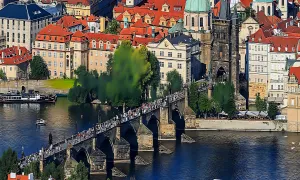
Staroměstské náměstí, kostel svatého Mikuláše, Židovské město, Karlův most.
Accommodation nearby
Trips and activities nearby
Guided tours, tickets and activities nearby from GetYourGuide
Affiliate link: if you buy from the partner, we may receive a commission. The price for you does not change.
Search tours and activities →Themed route
Thematic cruise route: Old town square and surroundings
1. Old Town Square
Type: Square
Why is it worth a visit: This historic heart of Prague is famous for its beautiful architecture and atmosphere. On its surface there are many important monuments such as churches and ancient houses. It's the perfect place to start looking at Old Town's history.
2. Church of St. Nicholas
Type: Church
Why is it worth a visit: This Baroque church is one of the most famous buildings in Old Town Square. Its distinctive facade and rich interiors are attractive for lovers of architecture and history. Besides, the church is known for its bells, which were part of the Old Town clock.
3. Jewish City
Type: Historical Quarter
Why is it worth a visit: This quarter is one of the oldest Jewish regions in Europe. Visit the Old Town Bridge and explore the historic streets that tell stories of the past. It's a place full of culture and history.
4. Charles Bridge
Type: Bridge
Why is it worth a visit: This famous stone bridge connects Staré Město with the Little Party. Its views of the Vltava and surrounding monuments are unforgettable. The bridge is also known for its sculptures, which represent historical figures.
5.Radnice – Andělská kolej
Type: Historical object
Why is it worth a visit: This part of the town hall is the oldest roofed market in Europe. It's the perfect place to understand the history of urban life and trade. In addition, Angel College offers a view of the Old Town Hall, which is one of the most prominent architectural works in Prague.
This route will guide you through the historic heart of Prague and offer a view of the key sights of the Old Town.
Seasonal recommendations
Spring: In the spring, the visit to the City Hall - the Angel College is oddly impressive due to the dazzling colours of flowering trees and shrubs that bring life-multiplying energy to the centre of Old Town. The sun stays longer over the city at this time, allowing long walks and exploring historical details of the monument in light which is more welcoming than in other times. Although visitors eager to explore the new year may appear here, it is recommended to come on an early afternoon when there are fewer people and the opportunity to enjoy a quiet moment with historical monuments. A good idea is to wear clothes suitable for mild temperatures that can change significantly during the day.
Summer: Summer brings the largest crowd of visitors to the historical sites of Old Town, including Radnice – Andělská kolej. This season, the atmosphere is full of life and activity, which can be surprising for those who seek peace. The best time to visit is in the morning afternoon or early evening to avoid the peak hours of crowds. It is advisable to come in warm clothes and with enough drinking connection, especially if you are planning an extended tour. The sun rays particularly illuminate historical architectural elements, making the visit even more attractive.
Autumn: In autumn, the surroundings of the City Hall - the Angel College are transformed into a stunning range of colours from yellow to red and orange, which brings a new view of the famous monument. The sun is shrinking and temperatures are falling, creating an atmosphere of peace and quiet suitable for intensive exploration of historical details without crowd interference. The best time to visit is early afternoon, when the temperature is still pleasant and the sunlight illuminates architecture in the most excellent way. It is recommended to wear multi-layer clothing that allows you to adapt to rapidly changing temperatures.
Winter: Winter visit to City Hall - Angel College offers a unique view of the historical monument, covered with snow and illuminated ice lights. The atmosphere is calm and quiet, which allows you to see the memory in a mild crowd of visitors. Hot clothes and a selection of the right shoes are crucial for a comfortable visit. The sunlight is reflected in architectural elements, which is particularly attractive during this period of the year.
Visualizations and artistic views

The visualisations are generated by artificial intelligence and serve as inspiration.
Photos from the area
Real photos taken near the monument


Zdroj a licence jsou uvedeny u každého snímku.
Tips from visitors
No tips yet. Be the first!
Log in and add your tip.
Sources and literature
Photos: ŠJů / CC BY-SA 3.0 — Wikimedia Commons. The author and licence also appear when you hover over the image.
Faktickým podkladem tohoto textu byl článek na Wikipedii, jehož autory jsou přispěvatelé Wikipedie. Článek je dostupný pod licencí CC BY-SA 4.0.
Location on the map

Příběhy a pověsti
Legendy, pověsti a příběhy spjaté s touto památkou
Fotografie návštěvníků
Zatím žádné fotografie. Buďte první, kdo přidá fotografii z návštěvy!
Log in a přidejte svou fotografii nebo hodnoťte.
Za ověřenou návštěvu v aplikaci získáte víc bodů — poznáme podle GPS, že jste na místě.
Reviews and comments