



Radnice (Slaný) Town hall
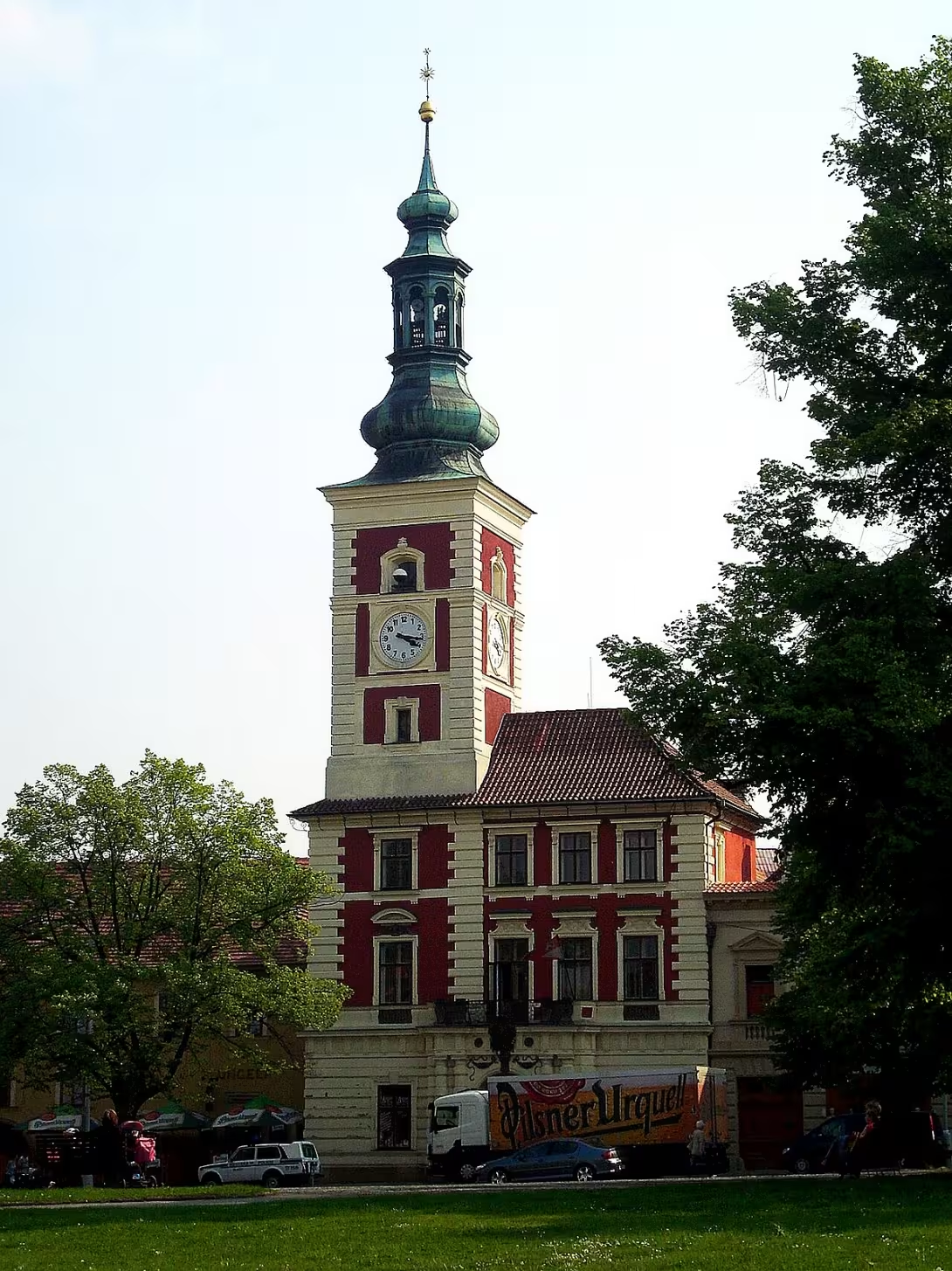
The former town hall in Sláňa is a late Baroque building with neo-Renaissance elements, built in 1796 and situated on the historic Masaryk Square. The most significant element is a tall 40-metre tower with an onion roof, which still fascinates visitors and locals. This monument has been protected as a real-estate cultural monument of the Czech Republic since 1988.
Originally there was a one-storey townhouse, which Emperor Karel IV. gave to the town of Slané in 1378. This original object was built with a high prism tower and an old Czech clock, reflecting the spiritual and political ambitions of the period of the Hussite Revolution. The symbolism of the star on the tower was associated with the chiliastic manifestations of this era and attributed the Slanah an important role between places that were involved in the pro-Hussite movement.
After the fire of 1795, the new town hall was built the following year. In 1895-1896, the Slovak architect Rudolf Štech rebuilt the building into a neo-Renaissance style, which included the location of sandstone city emblem above the entrance portal and the installation of new tower clocks. This reconstruction not only enriched the architectural structure, but also increased the functionality of the building.
The town hall has undergone several changes in owners and purposes over the centuries. After the fire in 1795, the new building was built on the site of the original building, which the Count Michal z Martinic had built already in 1751. Over the years, the building has become a centre of administration and justice, reflecting its historical function as the seat of the city office.
Among the key events in City Hall history are not only the fire from 1795 and subsequent reconstruction, but also the installation of new clock and cymbals on the tower. These elements gave the building a characteristic character and contributed to its cultural heritage.
Today, the former Town Hall serves as the headquarters of the City Police Slaný and part of the space is used by the People's Gallery Dobeška. The reconstruction of the facade towards the Ungelt building, which took place in 2016, and other repairs in 2017 ensure the preservation of the historical appearance of this important building. The total value of these works was CZK 750,000.
A visit to the former town hall in Sláňa offers not only a view of architectural beauty, but also an opportunity to explore the rich history of the city. Its height and location in the middle of Masaryk Square makes it not only the visual but also the cultural centre of the area. This monument is a testament to the changes that the city has experienced from the Middle Ages to the present, and remains an important place for all those interested in the history of Czech cities.
Historical milestones
- 1378
- Emperor Karel IV. gave the city the original medieval house.
- 1795
- City Hall was destroyed by a fire.
- 1796
- The position of the new late Baroque town hall.
- 1895
- The beginning of a neo-Renaissance building reconstruction.
Architectural development
A new town hall was built in 1751, which burned down in 1795. The subsequent construction from 1796 was rebuilt in 1895-1896 by architect Rudolf Štech into a neo-Renaissance style. The building has a two-storey tower with an onion roof with beaten copper.
Historical events
On 23 June 1378 the dedication of the house by the Emperor Charles IV., 2 August 1795 the burning of the town hall, 1895-1896 a new Renaissance reconstruction.
Owners
City of Slaný
Points of interest
- The former town hall in Sláňa is a late Baroque building with neo-Renaissance elements built in 1796. - The most significant element is a tall 40-metre tower with an onion roof, which still fascinates visitors and locals. - This monument is protected as a real-estate cultural monument of the Czech Republic since 1988. - After the fire of 1795, the new town hall was rebuilt in 1895-1896 by architect Rudolf Štech. - Today, the former Town Hall serves as the headquarters of the City Police Slaný and part of the space is used by the People's Gallery Dobeška.
Guide
Show guide text
This text was created by artificial intelligence and has not been editorially reviewed. It may contain inaccuracies.
Welcome to Slaný. You are standing right in the heart of this historic place, on Masaryk Square, where time has stopped and where the daily life of the city meets the legacy of ancient centuries. In front of your eyes is an impressive building that will immediately impress you with its presence and dignity. It's a town hall, a symbol of the local administration and one of the most important building buildings in the whole area. Feel this atmosphere, feel the weight of history that is hidden in these walls here. This building is not just a wall and a roof, it is a living witness to the many events that have taken place here and the human destinies that have intertwined here.
Let's go back deep into the past together to understand why this place is so special. The story of this location does not begin with today's construction, but much earlier, at a time when the kingdom was formed. In the year one thousand and three hundred seventy-eight, in the period when it was very strong, the original medieval house stood here. This house was not an ordinary house, it was dedicated to the city itself as a precious gift from the mighty Emperor Charles the Fourth. Imagine that time when the city was built and expanded under the direct protection of the sovereign. This early foundation, however, had to face severe tests.
History can be unpredictable and sometimes quite cruel. In a thousand and seven hundred and ninety-five, the city had to deal with a great tragedy. The vast fire destroyed the city hall at that time and left nothing but ashes and emptiness. But people never gave up here, and their determination to rebuild the city was unwavering. Just a year later, in the year one thousand seven hundred ninety-six, a new town hall began to be built, which was in the late Baroque style. This building then served the city for many decades, until the year of the thousand eight hundred ninety-five was fundamentally changed again. It was at that time that her great neo-Renaissance reconstruction began, which gave the building its present-day, very distinctive and rich appearance.
Now pay attention to the architecture itself, which now surrounds you. Although the building has undergone many changes and styles, its face is the result of a harmonious combination of different epoch. Feel the interesting interplay between the Baroque foundations and the Neo-Renaissance elements you see here. Now, if you lift your eyes as wide as possible to the sky, you will see what is the real heart and the most significant dominant feature of the entire building. It's the tall, towering tower. It's exactly forty-three meters tall and its top is decorated with a beautiful onion roof. This tower is so distinctive it cannot be overlooked from any corner of this square. It is an element that has fascinated every visitor and local people for many generations. The overall design of the building, as you see it today, was influenced by the important architect Rudolf Štech, who participated in this important reconstruction. Looking at the building, you can see how history intersects with more modern elements that create an overall sense of stability and historical dignity.
When you look at these walls, remember the people who left their mark. The most famous figure is undoubtedly Emperor Charles the fourth, whose generous gesture in the sixteenth century laid the foundations for the future importance of this place. In the history of the city and city hall there are also other important names that have been linked to the flourishing of this region, such as Michal z Martinic or Ferdinand Velc. These people were part of the history that shaped this place, and their names are firmly linked to this place.
You may be interested in how special this building is not only for the city, but also for our whole country. This town hall is not just an ordinary building, it is protected as a real cultural monument of the Czech Republic. This means that its historical value is recognised at the highest level and must be preserved for future generations at all times. And the tower we talked about? Its height and its unique onion roof are precisely what gives the whole square its unique atmosphere and what makes the town hall a real treasure.
Today, the town hall is no longer just a seat of office, but also as a space for a folk gallery where you can go around with art, and also as a seat for the city police. It is a living organism that still serves people and is still part of the daily life of the city of Slaný. I hope that this brief view of City Hall history pleased you and helped you better understand the beauty of this place. Please continue your walk around Masaryk Square and discover the other treasures this city offers. Thank you for your time and we will read you a beautiful and inspiring visit.
Tips for visitors
The best time to visit the City Hall in Salná is during spring or autumn when the weather is pleasant and the sun illuminates the building from different angles. This period also offers a beautiful opportunity to see the city in its most beautiful light.
When visiting City Hall, take a quality camera with you to capture the historical details of the building. It is also good to have a protective umbrella and warm clothes in winter.
Photography City Hall offers the best effects especially in the afternoon when light is fine. Remember also to consider a visit in the morning when there are fewer people and the building is illuminated by sunlight.
The historic Ungelt building is located in the vicinity of the Town Hall. This building is an ideal addition for visitors who are interested in the history of the town of Salné and its architecture.
Frequently asked questions
Can the monument be visited?
The building is in use (offices, a school, shops and the like). The interior is generally accessible only during operating hours and tours are not usually offered; we have not verified the details. You can see the exterior from the street.
Where is the monument?
Location: Slaný. The map on this page shows the exact spot.
Why is the monument protected?
It is listed in the Central List of Cultural Monuments of the Czech Republic as a cultural monument (register no. 1000147203).
Businesses nearby
Do you run a restaurant, accommodation, shop, museum, rental, wellness or other visitor service near this monument? Show yourself directly to the people heading to it — this is how they will see you in the app and on the web:
Nearby
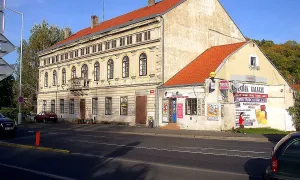
Masarykovo náměstí, budova Ungelt.
Accommodation nearby
Trips and activities nearby
Guided tours, tickets and activities nearby from GetYourGuide
Affiliate link: if you buy from the partner, we may receive a commission. The price for you does not change.
Search tours and activities →Themed route
Radnice (Slaný) Type: Historical building, cultural monument. This is the main objective of your visit. The town hall is dominated by the city and offers a view of the historical core, which makes it a necessary stop for every lover of architecture and history.
Masaryk Square Type: Public space, square. The square is located in the immediate vicinity of the town hall and serves as a central location for orientation. It is an ideal place for a short break where you can enjoy the atmosphere of the historical centre and plan further steps.
Ungelt Building Type: Historical building, department store. This characteristic building is situated around the square and complements the architectural character of the Salan Centre. Its presence resembles the city's rich past and its development as an important commercial and administrative territory.
The route is designed to be as short and clear as possible, because all three points lie in a close neighbourhood in the historical core of the Salt. You start at City Hall, which is a symbol of the city administration. You will then move to Masaryk Square, which acts as a natural link between the monuments. Here you can take a break and enjoy the surrounding environment. Finally, you will visit the Ungelt building that closes this short circle. The whole walk takes only a few minutes to walk, which makes it easy to combine the tour with other activities in the village. This compact route allows you to get a comprehensive picture of the historic centre of Salé without the need for long journeys. Each of these stops has its own unique character, but together they form a harmonious entity that reflects the city's identity. We recommend seeing these places at a quiet pace so you can see the details of the facades and atmosphere of the place.
Seasonal recommendations
Spring: In spring, the town hall's surroundings start to turn green and the air smells fresh. Light is soft and pleasant in this period, which highlights the details of the building beautifully. For a pleasant experience, prepare layered clothes because the morning cold may be present even when the sun is already shining. The best is to come soon after sunrise when everything is quiet and nature wakes up.
Summer: Summer days bring intense sunlight and long hours of bright light. The atmosphere is very lively and warm at this time. We recommend choosing very light clothes and not forgetting the sun protection. The best time for City Hall observation is late in the afternoon, when the intensity of heat rises and light creates interesting shadows on the facade.
Autumn: Autumn season offers a rich palette of golden and brown shades in surrounding vegetation. Frequent fog gives the place a melancholy and quiet atmosphere. It is necessary to wear warmer clothes and possibly waterproof layers, because the rains are common at this time. The best time to visit is in the morning when the fog slowly dissolves.
Winter: In winter, the surrounding area is often covered with snow, creating a quiet and clean look. Days are short and light is weak, so it is best to plan a walk around the noon hours. Prepare a strong jacket, hat and gloves to protect yourself from cold. The atmosphere is the quietest at this time, which makes it possible to perceive architecture in silence.
Visualizations and artistic views

The visualisations are generated by artificial intelligence and serve as inspiration.
Photos from the area
Real photos taken near the monument


Zdroj a licence jsou uvedeny u každého snímku.
Tips from visitors
No tips yet. Be the first!
Log in and add your tip.
Sources and literature
Photos: Trachemys / CC BY-SA 4.0 — Wikimedia Commons. The author and licence also appear when you hover over the image.
Faktickým podkladem tohoto textu byl článek na Wikipedii, jehož autory jsou přispěvatelé Wikipedie. Článek je dostupný pod licencí CC BY-SA 4.0.
Location on the map



Příběhy a pověsti
Legendy, pověsti a příběhy spjaté s touto památkou
Fotografie návštěvníků
Zatím žádné fotografie. Buďte první, kdo přidá fotografii z návštěvy!
Log in a přidejte svou fotografii nebo hodnoťte.
Za ověřenou návštěvu v aplikaci získáte víc bodů — poznáme podle GPS, že jste na místě.
Reviews and comments