






Vodní mlýn (Slaný) Water mill
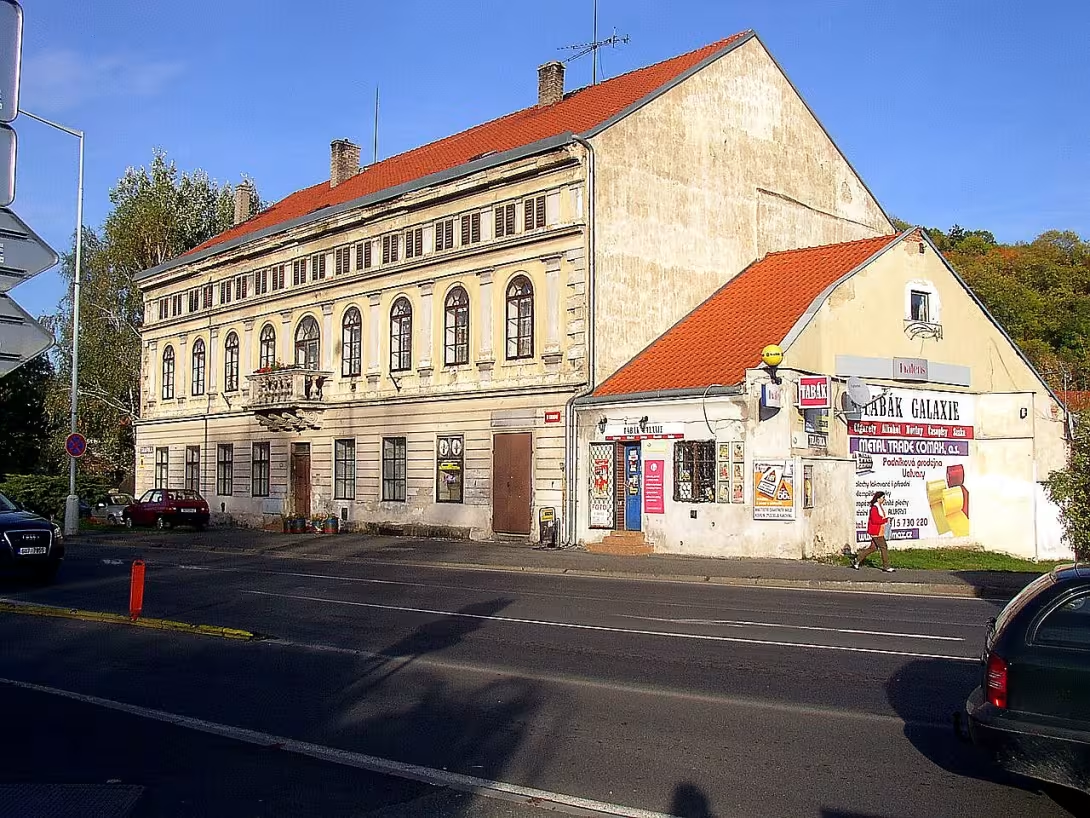
Banek's Mill in Sláňé (Kladno district) is a protected real estate cultural monument. He's standing on the Red River in the eastern part of town. Originally, the Renaissance building excels at the architectural form and technical equipment, which in the 19th and 20th centuries had undergone major changes.
Josef Fischer rebuilt the original Renaissance building after the fire in 1869. The second half of the 19th century brought industrial revolution in Bohemia. This led to technical modernization of mills and the introduction of steam machines alongside traditional water propulsion, which also affected the fate of this mill.
The current appearance of the building is based on reconstruction after a fire and extensive reconstruction in 1908. The one-storey building has a rectangular floor plan and a saddle roof. It's built parallel to the road. The facade facing the street has a richly decorated nine-axis facade, with the soil half-floor divided by eighteen window axes. The main entrance on the ground floor lies on the middle axis, the secondary one in the first axis on the right. High wooden windows have a spreadsheet. Above the main entrance is a balcony with a bowling ball on stone crackers. The floors separate the graduated cordon ledge. The yard facade is smooth, separated by windows and stalls that carry decorative cast iron consoles on the floor.
In 1884 it was probably purchased by the landowner Václav Baňka from Trebiz by Count Martinique. From 1905 to 1911, the flask held the office of Mayor of Salty. In 1908 the mill underwent another significant reconstruction.
After reconstruction in 1908 the mill was powered by a combination of steam engine and water wheel with a diameter of 3 meters. The water flowed to the wheel drive from the waterworks in Forten suburb to the Brod pond through the arched channel. Then she went back to the Red Creek over the canal and the gutter.
Today, the Báňek Mill is protected as a real-estate cultural monument of the Czech Republic (building no. 348 and land parc. no. p. 522 / 1). The building represents an important piece of technical history and architectural development of the area. It is advisable to visit it to see the details of the historical building and understand the connection between industrial modernization and traditional craft.
Historical milestones
- 1869
- new construction after fire by Josef Fischer
- 1884
- purchase of mill Václav Banka from Třebíze
- 1908
- further reconstruction of the mill
Architectural development
Originally a Renaissance building, after a fire in 1869, rebuilt as a single storey building with a saddle roof. Another reconstruction was carried out in 1908. The yard facade is divided by a bilge carried by cast iron decorative consoles.
Historical events
1869: fire and subsequent new construction by Josef Fischer; 1884: probable purchase of the mill by Václav Banka; 1908: extensive reconstruction of the mill.
Owners
Count Martinique (until 1884), Václav Baňka from Třebíze (from 1884)
Points of interest
- Originally it was a Renaissance building, which was rebuilt by Josef Fischer after the fire in 1869. - The front of the building has a richly decorated nine-axis facade and a half-floor with 18 window axes. - Above the main entrance there is a balcony with a bowling ball on stone crackers. - After 1908 the mill was powered by a steam engine combined with a water wheel with a diameter of 3 meters. - The construction was probably purchased in 1884 by Václav Baňka, who later held the position of Mayor of Salty.
Guide
Show guide text
This text was created by artificial intelligence and has not been editorially reviewed. It may contain inaccuracies.
Welcome to Salt, a place where history intersects with every stone and every stream of water. Right now you're standing in front of one of the very interesting local monuments known as the Banyk Mill. Take a deep breath and feel the atmosphere of this place. In front of you is a building that is not just a mill, but a real witness to the changes in time, technical progress and human endurance. Look at the overall design of the building. The first impression is that it is a very representative building, which, with its size and decoration, deviates from ideas that perhaps many of us have about simple mill craft.
This building is closely connected to water, specifically the Red Brook, which gave it energy to live and work. It was the water that was the main engine that drove the mill wheels and allowed the milling of grain, which in the past was the basis for the survival and prosperity of the entire region. But if you look at the building today, you see the result of a long development. The history of this place goes much further than the first sight of the facade could ever see. The Renaissance building was originally built here. So imagine a mill in a completely different form, with different shapes and a different spirit, which served people here in the early days of the New Testament.
But the fate of the mill was dramatic in the nineteenth century. In eighteen hundred and sixty-nine came a fire that destroyed the original Renaissance building. The fires at that time were a frequent and terrifying impact on the whole city and individual buildings, but it was from the ashes that you were born to see now. After this disaster came the turn of Josef Fischer, a man who decided to rebuild the mill. He is the author of the form that defines the building to date. Fischer added not only practical considerations about the operation of the mill, but also aesthetic sense, which is evident from rich decoration.
Now I ask you to pay full attention to the architecture itself. Look right at the front of the building. Notice her rhythm. The facade is nine-axis, which means you'll find nine vertical rows of windows and holes in the width of the building. This number gives the building balance and monumentality. If you look carefully, you will see the so-called cordon mansions. They are horizontal ascending belts that optically divide the facade and give it structure and depth. These details show that the owner didn't just want a working workshop, but a building that would represent his status and success.
Raise your eyes to the main entrance now. Above it is one of the most beautiful elements of the whole house, namely the balcony. Notice his details. The balustrad, the protective barrier, is made up of tapered elements that form a fine, rhythmic line. The entire balcony is supported by stone crackers. Crackers are basically decorative stone consoles that look like carved supports protruding from the wall. It is a detail that required great craftsmanship and which gives the whole facade a touch of elegance.
But that's not all. Look even higher, to the very top of the building. You'll see the ground floor. It's a space just under the roof, which is very distinctive in this case. While the lower part of the facade has nine axes, on this top half floor you will find up to eighteen window axes. This contrast between the lower and upper parts of the building is very interesting and creates the impression that the building is grazing and blooming upwards. This part of the building was probably used to store the grain, where good ventilation was needed in order not to spoil the crops.
When you look at the building like that, let's stop by the people who gave her a name and a purpose. As I mentioned, the foundation of the new building after the fire was Josef Fischer. However, in the year eighteen hundred and eighty-four, the mill came into the hands of a man named Václav Baňka, who came from Třebíz. It was thanks to him that the mill began to be called the Banyk Mill. Václav Baňka was not only the owner, but the person who saw the potential for further development in the mill. By that time, the world began to change quickly, new technology was coming and old ways of working were no longer enough.
This brings us to another important milestone in the chronology of this place. In a thousand and nine hundred and eight, the mill had another significant reconstruction. This time, however, was not primarily about the appearance, but about the inner heart of the construction. The drive has been upgraded. Imagine the noise, the movement and the power that was flowing through the mill at the time. Modernization of the drive meant higher efficiency, faster grinding and the ability to process more grain. It was the period when the craft was turned into industry and Banek's mill kept up with this change.
The interesting thing that may interest you is this particular layer of time. When you're standing in front of a building, you see basically three times in one. The spirit of the Renaissance is hidden in the foundations and place itself, you can feel the atmosphere of the second half of the nineteenth century in the overall appearance and facade, and in the technical improvements of the early twentieth century there is a trail of modernization. It's a fascinating idea that one building can document the development of the entire century.
Now try to close your eyes for a moment and imagine what the mill looked like over a century ago. Do you hear the noise of the Red Creek? Do you smell fresh ground flour? You see a wagon full of grain coming from nearby farmers, and you hear the voices of windmills moving through this complex mechanism? The mill was not just a building, it was a living organism around which many human destinies revolved.
Now you can open your eyes again and take one last look at the beautiful nine-axis facade, the stone supports of the balcony and the dense line of windows on the soil floor. This building is today protected by a cultural monument, because it is a unique example of how an industrial building can also be a beautiful architectural work. It is a reminder of the time when functional structures were also concerned with aesthetics and quality of execution.
Thank you for stopping by Banek's Mill for a moment. I hope this short trip to history helped you see more than just walls and windows, but that you also felt the spirit of this place. Now invited to further explore the Salty. Go around, see the stream of the stream, and look for other clues of the past that still live in this city. I wish you a pleasant continued journey and a wonderful experience in discovering our sights. Goodbye.
Tips for visitors
For the best experience we recommend a visit in the morning or shortly before sunset, when the light is softer and glitter on the water works best.
You can use a passenger car or public transport to get to the place; Please check the current connection in internet search engines.
When preparing for the trip, don't forget to bring drinking water and comfortable shoes suitable for walking in nature by the water. If you plan to photograph, the most suitable places are near the flow where you can capture the historical architecture of the mill in combination with nature.
In the surroundings you can enjoy walking near the Red Brod or visit the Brod pond, which are ideal goals for a short rest. The whole area of Forten suburb offers a quiet environment for observing historical buildings.
For families with children it is ideal to walk along the water, which is interesting for the smallest visitors thanks to the proximity of nature. Always bear in mind, however, safety when moving near watercourses.
Businesses nearby
Do you run a restaurant, accommodation, shop, museum, rental, wellness or other visitor service near this monument? Show yourself directly to the people heading to it — this is how they will see you in the app and on the web:
Nearby
Červený potok, rybník Brod, Fortenské předměstí
Accommodation nearby
Trips and activities nearby
Guided tours, tickets and activities nearby from GetYourGuide
Affiliate link: if you buy from the partner, we may receive a commission. The price for you does not change.
Search tours and activities →Themed route
Thematic cruise route: Vodní mlýn (Slaný)
1. Water mill (mill) - The main objective of our route is the historic Water Mill in Saláme, which represents an architectural monument from the period of industrial revolution. It is worth visiting thanks to its well-preserved condition and the opportunity to learn about the technology of mills of past times.
2. Red stream (stream) - After exploring the water mill we continue to the Red brook, which is not only a natural element of the surrounding area, but also a historical monument. The stream was important for the movement of water into mills and provides beautiful landscape spores.
3. Brod pond (pond) - The next place is Pond Brod, located not far from the creek and served in the past as a water source for the local area. It is interesting with its history and natural conditions that provide an ideal environment for relaxation.
4. Forten suburb (suburb) - To close the visit, we will visit Forten suburb, which is linked by its history to the city's defence structures. This place offers views of the architecture and urban development of the area, which makes it an interesting point for exploring the history of Sláný.
This track offers a combination of technical monuments, natural beauties and historical sites around the town of Sláňé.
Seasonal recommendations
Spring: In the spring season, the water mill Slaný is revived by flowers and new leaves, adding freshness and life to the atmosphere. Sunshine days increase the attractiveness of visitors who enjoy walking around the mill. In this period it is advisable to visit the day with clear weather because flowers and leaves are in their greatest bloom. It is recommended to wear clothes suitable for mild temperatures because the morning may be colder while the afternoon may become warmer.
Summer: The water mill Slaný is the most visited period. Long days and sunny weather will attract families and tourists who enjoy outdoor activities. The atmosphere is full of life, but also more people, which can lead to longer waiting times to visit. It is recommended to arrive early in the morning or late in the afternoon to avoid heat and crowds. Don't forget to wear sun protection, a leash and plenty of drinking water.
Autumn: In autumn the water mill Slaný melancholic beauty gains. Leaves turn into gold and red colors, which provides an impressive background for photos. The atmosphere is quieter and the mild temperature makes the visit pleasant. In this period the weather can be variable, so we recommend clothes suitable for all conditions - from warm dresses for colder days to sun cap. The best time to visit is early afternoon, when the light is best captured.
Winter: Winter brings peace and quiet to the salt water mill. There are usually fewer people visiting, which allows for more intimate exploration of the monument. The atmosphere is peaceful and often covered with snow, which adds a romantic touch. Practical advice includes wearing warm clothes, including hat and gloves because temperatures are usually low. The mill can be partially closed or opened only for a shorter time due to winter conditions, so it is good to inform before the trip.
Visualizations and artistic views

The visualisations are generated by artificial intelligence and serve as inspiration.
Photos from the area
Real photos taken near the monument


Zdroj a licence jsou uvedeny u každého snímku.
Tips from visitors
No tips yet. Be the first!
Log in and add your tip.
Sources and literature
Photos: Miaow Miaow / Public domain — Wikimedia Commons. The author and licence also appear when you hover over the image.
Faktickým podkladem tohoto textu byl článek na Wikipedii, jehož autory jsou přispěvatelé Wikipedie. Článek je dostupný pod licencí CC BY-SA 4.0.
Location on the map


Příběhy a pověsti
Legendy, pověsti a příběhy spjaté s touto památkou

Fotografie návštěvníků
Zatím žádné fotografie. Buďte první, kdo přidá fotografii z návštěvy!
Přihlaste se a přidejte svou fotografii nebo hodnoťte.
Za ověřenou návštěvu v aplikaci získáte víc bodů — poznáme podle GPS, že jste na místě.
Reviews and comments