



Rakouský pomník bitvy roku 1813 se strážním domkem Memorial
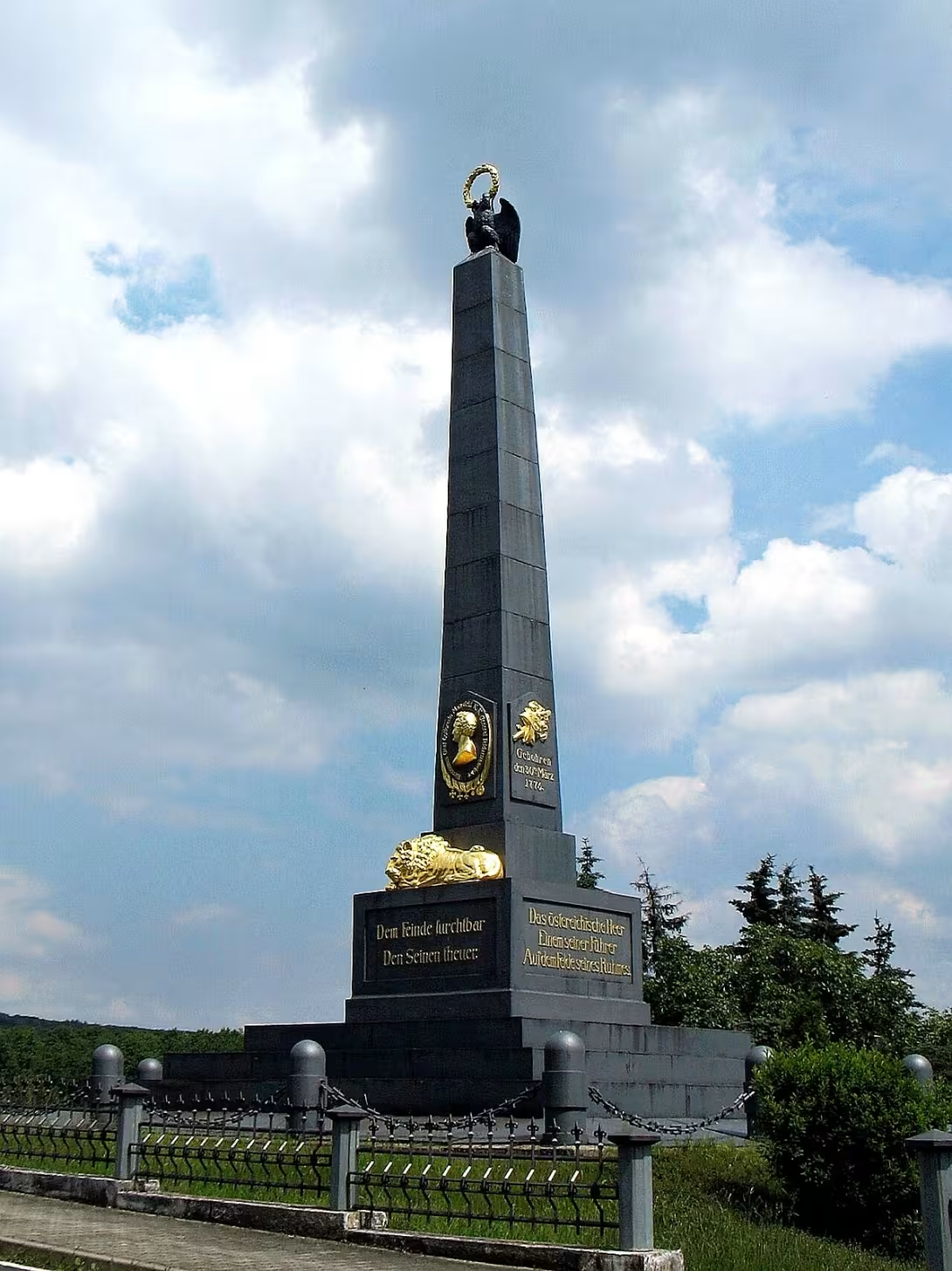
The Austrian memorial, also known as General Colloredo-Mansfeld, is a war memorial located in the village of Telnice, specifically in the village of Varvajov. This classic cast iron monument commemorates the victory of the Austrian troops over the army of Emperor Napoleon I. during the battle of Varvajov on 17 September 1813. The memorial, the author of which is Czech sculptor Václav Prachner, was revealed in 1825 and is dedicated to the memory of Austrian Field Armory Master Count Hieronym Colloredo-Mansfeld. This monument is located at the intersection of the roads I / 13 and II / 248, which makes it an important cultural monument.
The monument was built as part of a wider pietground, which resembles fighting during the Napoleon wars. The Battle of Varvajov was a key event in 1813, when Austrian troops under General Hieronym Colloredo-Mansfeld successfully reflected Napoleon's second attempt to invade the Czech Republic. This battle contributed to the subsequent fall of the Napoleon Empire, which was an important moment in Europe's history.
The architecture of the monument is characteristic of Classicism. The monument consists of an 18-metre-high obelisk, completed by an Austrian eagle, which together with a nearby Prussian monument represents a comprehensive piety complex. The cast iron parts were cast in the ironworks of Prince Charles Egon Fürstenberg in Nový Jáchymov on Rakovnice, while the architectural design was prepared by Lieutenant Colonel Claude-Benoit Duhamel de Querlonde. The design was inspired by obelisks at the entrance gate of the Vienna castle Schönbrunn.
The foundation of the memorial was a military initiative initiated by officers in Czech dislocated regiments. The main architects of the plan to commemorate Field Marshal Hieronym Colloredo-Mansfeld were the field sub-marshal Count Klebelsberg, Major Spinet and Lieutenant Colonel von Ehrenberg. The land for the construction was provided free of charge by the owner of the Puppet Manor Countess von Thun. The funding was provided by a large voluntary collection among the officers' corps.
The ceremonial revelation of the memorial took place on 17 September 1825, on the day of the twelfth anniversary of the battle at Varvajov. The ceremony was a grand military and social event involving honest guests, among them family members of the deceased marshal. After the ceremonial speech, the monument was revealed and consecrated at the sounds of the artillery salvo.
At the same time as the monument, there was also a background for its maintenance and security. The guard house next to the memorial was built as the first piety center where the war veteran Josef Beran worked as a watchman and guide for spa guests from Teplice. In 1912-1955 there was a tram track from Ústí nad Labem through Výbořice to Telnice.
In the 1970s, the surrounding area of the monument underwent a drastic transformation due to the surface mining of brown coal, which led to the destruction of the municipalities of Lower and Upper Varvajov. Yet the site of the Austrian and Prussian monuments was spared due to its historical value. On the occasion of the two-hundred anniversary of the battle in 2013, the whole monument was completely restored.
Today the Austrian monument is a key cultural monument that attracts visitors with its historical value and architecture. Accessibility to the monument is easy due to its location at the intersection of roads I / 13 and II / 248, which makes this building an important place to visit. Let us remember the historical value of this place, which reminds us of the key moments in Europe's history and serves as a monument to the courage and bravery of Austrian troops.
Then and now
Drag the slider to compare how the landmark may have looked when it was built with the view today.
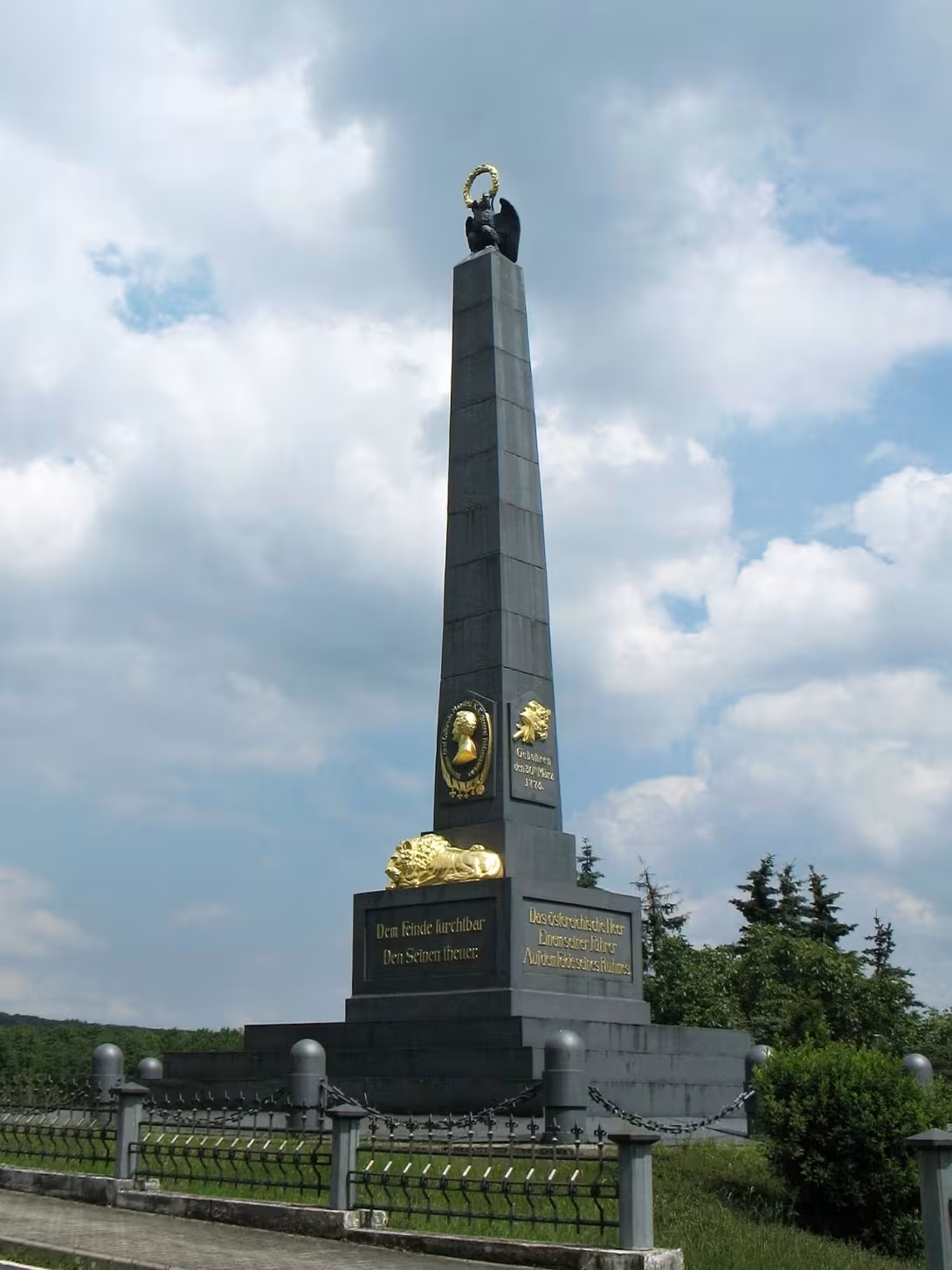

The historical appearance on the left is an AI-generated visualisation and serves as inspiration only.
Historical milestones
- 1813
- The battle of Varvajov.
- 1825
- The unveiling of the monument.
Architectural development
The memorial was designed by Lieutenant Colonel Claude-Benoit Duhamel de Querlonde, who inspired the obelisks at the entrance gate of Vienna's Schönbrunn Castle. The cast iron parts were cast in the iron works of Prince Charles Egon Fürstenberg in Nový Jáchymov on Rakovnice.
Historical events
- 1813
- The Battle of Varvajov, where the Austrian army, led by General Hieronym Colloredo-Mansfeld, reflected a French attack.
- 1825
- The ceremonial revelation of the Austrian memorial.
Points of interest
- Austrian monument is a war monument located in the village of Varvajov in the village Telnice. - The memorial commemorates the victory of the Austrian troops over the army of Emperor Napoleon I. during the battle at Varvajov on 17 September 1813. - The author of the monument is Czech sculptor Václav Prachner, revealed in 1825. - The monument consists of an 18-metre-high obelisk completed by an Austrian eagle and was built as part of a wider drinking area.
Guide
Show guide text
This text was created by artificial intelligence and has not been editorially reviewed. It may contain inaccuracies.
Welcome! You stand before an important historical monument - an Austrian monument to the battle of 1813, which boasts a guard house. This monumental obelisk is located in the village of Varvajov near the city of Telnice and represents a classical architecture with a clear symmetry that stands out on the landscape. In front of you stands an 18-metre cast cast-iron obelisk decorated by an Austrian eagle, reminiscent of the war success of the Austrian troops.
The memorial was built as a memory of the battle of Varvajov on 17 September 1813, when Austrian generals led by Hieronym Colloredo-Mansfeld reflected Napoleon I.'s second attempt to invade the Czech Republic. This historic moment was key to defending the country, and the monument witnessed this victory.
Your view can focus on the elegant details of the obelisk, which are the work of Czech sculptor Václav Prachner and French architect Claude- Benoita Duhamela de Querlonde. The monument was revealed in 1825 and its Classicist style is evident in the symmetrical arrangement of elements and decorating.
This place is also associated with personalities like Hieronym Colloredo-Mansfeld, who led the Austrian army in this battle, and of course Napoleon I, whose forces were defeated here. The monument thus reminds not only of the war history, but also of the strategic genius of Austrian troops.
The interesting thing is that the monument is not only a monument, but also a place where history and the present meet. When you're standing here, you feel like you're part of that history that the monument captures.
I suggest you explore the surroundings and relax into the atmosphere of this historic monument. If you are interested in more details or attractions, do not hesitate to look at the guard house next to the monument.
Thank you for your visit and I wish you a relaxing exploration of this historic place.
Tips for visitors
The best time to visit the Austrian memorial is in the spring or autumn season when the weather is favourable and the place is not crowded. This time also offers beautiful lighting conditions for the photography of the monument.
The location can also be reached by public transport; Check the search engine for the latest connection information.
When you visit, bring suitable shoes because the terrain can be impenetrable. Also remember the sun goat and warm clothes in winter.
To photograph the monument the best lighting conditions offer morning and evening hours when the light is softer. The best places for photography are from both sides of the road, especially where the view of the overall monument opens.
In the surroundings you can visit the spa Teplice, which is famous for its thermal baths and historical architecture. For families with children it can be interesting to explore natural parks nearby.
Frequently asked questions
Can the monument be visited?
This is a structure in a public space that can usually be seen from outside free of charge. We have not verified that this particular one is freely accessible.
Where is the monument?
Location: Telnice, Ústecký kraj. The map on this page shows the exact spot.
Why is the monument protected?
It is listed in the Central List of Cultural Monuments of the Czech Republic as a cultural monument (register no. 1000154460).
Businesses nearby
Do you run a restaurant, accommodation, shop, museum, rental, wellness or other visitor service near this monument? Show yourself directly to the people heading to it — this is how they will see you in the app and on the web:
Events nearby
Zdroj akcí: otevřená data měst a obcí ČR (Národní katalog otevřených dat) a kalendář akcí Národního památkového ústavu.
Nearby
Pomník je umístěn u křižovatky silnic I/13 a II/248.
V okolí se nachází lázeňské Teplice, což přispělo k popularitě místa jako pietního centra.
Accommodation nearby
Trips and activities nearby
Guided tours, tickets and activities nearby from GetYourGuide
Affiliate link: if you buy from the partner, we may receive a commission. The price for you does not change.
Search tours and activities →Themed route
Thematic cruise route around the Austrian memorial battle in 1813
1.Rakouský pomník bitvy roku 1813 se strážním domkem - Type: Historical landmark - Why is it worth visiting: This monument serves as a reminder of the important historical moment from 1813 when the battle took place here. The Watchhouse provides interesting information about this event and is an ideal place to understand the history of the site.
2. Spa Teplice - Type: Spa center - Why is it worth a visit: Teplice is known for its spa and impressive atmosphere, which attracts many people looking for relaxation and therapeutic options. The site has a rich history as a piety center, which makes the visit particularly interesting.
3. Road crossing I / 13 and II / 248 - Type: Historical site - Why is it worth a visit: This intersection is not only an important transport hub but also symbolizes the connection between history and the present. It is a place where paths from the past meet with modern roads, which adds another layer of exploration of this area.
This route offers a combination of historical and cultural experiences around Telnice where you can learn more about the past and enjoy relaxation in the spa environment.
Seasonal recommendations
Spring: In the spring period, the Austrian memorial of the battle of 1813 in Telnice turns into a sunny light, which joins every surface and highlights historical architecture. Flowers begin to bloom around the monument, adding colors to the environment and creating a special atmosphere of renewal. At this time it is advisable to visit the monument early in the morning to avoid the initial consequences of the tourist season. It is recommended to wear clothing with the possibility of adding layers because the temperature can be moderate and constantly change.
Summer: Summer is the best time to explore historical monuments in Telnica. The sunny weather brings ideal conditions for long walks around the guard house and surrounding greenery. However, in the main summer season it can happen that the monument visits more people, so it is good to come early in the morning or in the evening when there is a milder temperature and smaller crowd. Remember the sun protection - short-term clothing, sunglasses and skin drops are essential.
Autumn: In autumn Telnice becomes a place full of colors when leaves fall from trees around the monument. The atmosphere is calmer and slightly colder, which offers a pleasant environment for walking on the monument. At this time the opening time may be shorter due to falling days and it is advisable to visit the memory at noon to use the remaining sunlight. Clothing with possibility of adding layers is recommended due to changing temperatures.
Winter: In winter, the Austrian monument in Telnica is of a mystical and peaceful nature when snow covers the surrounding landscape. The atmosphere is soothing and less demanding for tourists, allowing you to explore the memory in peace. Warm clothes and protection against cold are essential for a comfortable visit during this period of the year.
Visualizations and artistic views


The visualisations are generated by artificial intelligence and serve as inspiration.
Photos from the area
Real photos taken near the monument


Zdroj a licence jsou uvedeny u každého snímku.
Tips from visitors
No tips yet. Be the first!
Log in and add your tip.
Sources and literature
Photos: Marie Čcheidzeová / CC BY-SA 4.0 — Wikimedia Commons. The author and licence also appear when you hover over the image.
Faktickým podkladem tohoto textu byl článek na Wikipedii, jehož autory jsou přispěvatelé Wikipedie. Článek je dostupný pod licencí CC BY-SA 4.0.
Location on the map


Příběhy a pověsti
Legendy, pověsti a příběhy spjaté s touto památkou

Fotografie návštěvníků
Zatím žádné fotografie. Buďte první, kdo přidá fotografii z návštěvy!
Log in a přidejte svou fotografii nebo hodnoťte.
Za ověřenou návštěvu v aplikaci získáte víc bodů — poznáme podle GPS, že jste na místě.
Reviews and comments