



Římovsko Landscape heritage zone
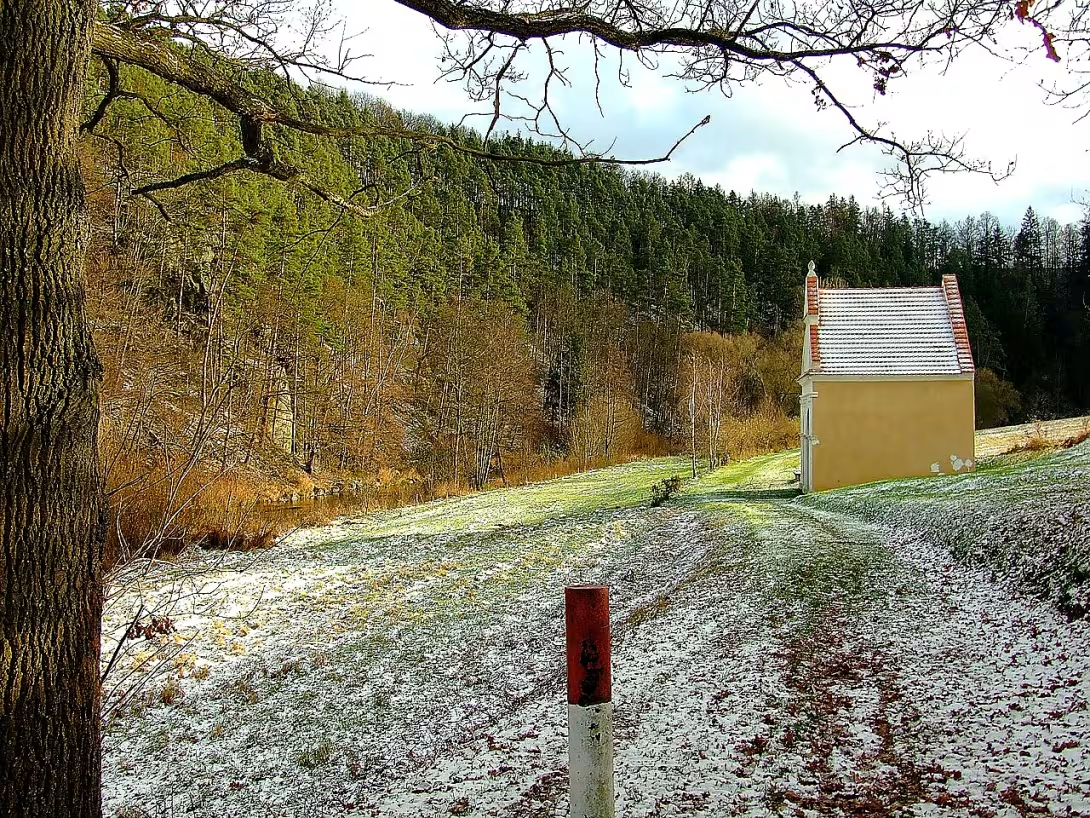
The Landscape Monument Zone Římovsko is an extremely valuable sacral cultural landscape in the middle of the river Malš in the district of České Budějovice. The area of 123 hectares was declared in 1996. It includes the Baroque Loretan Chapel, the Church of the Holy Spirit and a unique Pashian journey with 25 stops to remind believers of the surroundings of Jerusalem.
The first written mention of the village of Rome dates back to 1395. The change of surroundings in the sacral complex began in 1648. At that time, the Archbishop of Prague Arnošt Vojtěch kardinál Harrach gave permission to the pharmacist of the Jesuit Jesuit college of Jan Gurre to build the Loretan chapel and cross roads. This intention falls into the period after the 30-year war, when in the Czech countries the reCatholisation and flowering of baroque culture under the influence of the Church Regulations cultured.
The building development of the complex began between 1648 and 1650 with the construction of the Holy Shack, i.e. the Marian Chapel. Ambit was built around it between 1652 and 1658. Its walls were decorated in the late 17th century between 1686 and 1698 by fresco depicting 34 pilgrimage sites in Czech countries. The Pashij road with 25 stops was gradually replenished in the landscape until the first quarter of the 18th century. From a geomorphological point of view, the area is located in the Novohradské město hill, at an altitude of 400 to 450 metres.
The importance of Rome as a pilgrimage place was confirmed already in 1657 by the pilgrimage to visit the Virgin Mary, which took part in 10,000 people. In addition to the sacral buildings, other buildings, such as the stone road bridge in Lower Stropnica, the castle, the townhouse and two rural settlements in Rome, are subject to monument protection.
The twentieth century has brought considerable risks to monuments in this area. The first manifestations of vandalism and theft of statues were recorded after 1918, but the most intense damage occurred after 1989. In 1994, seven statues of apostles from the Group of the Last Supper of the Lord were stolen from the Pashian Road, and other losses followed in 2000 and 2009. In response to these events, the remaining original statues from the chapel were moved to safety and replaced by photographs; The production of copies is being prepared. Today, new construction without architectural links to the landscape and the existence of chat colonies also threatens the monument nature of the zone.
Římovsko represents the smallest landscape monument zone in the Czech Republic and is a proof of the sophisticated landscape formation in the Baroque. Visiting this place offers the opportunity to recognize the unique connection of sacral architecture with the natural environment, which, despite historical losses, retains its spiritual and cultural value.
Historical milestones
- 1648
- Opening of the structure of the Loretan Chapel and cross roads.
- 1657
- The first great pilgrimage to visit the Virgin Mary.
- 1996
- Declaration of territory for the landscape monument zone.
Architectural development
The building of the sacral complex took place in the Baroque style since 1648 when the Holy hut was built. In 1652-1658 an ambit was built around the chapel, which was later decorated with frescoes in the late 17th century. The Pashij road was gradually supplemented by stopping until the first quarter of the 18th century.
Historical events
1648 start of the building of the loretan chapel, 1657 first great pilgrimage with 10,000 participants, 1996 announcement landscape monument zone.
Points of interest
- Římovsko is the smallest landscape monument zone in the Czech Republic. The Pashian Road contains twenty-five stops to remind believers of the surroundings of Jerusalem. - The walls of ambition were decorated between 1686 and 1698 with frescoes, which depict 34 pilgrimage sites in Czech countries. - In 1657 ten thousand people took part in the pilgrimage to visit the Virgin Mary. Because of the theft of the statues, the originals from the chapel were moved to safety and replaced by photographs.
Guide
Show guide text
This text was created by artificial intelligence and has not been editorially reviewed. It may contain inaccuracies.
Welcome to this special place. You've just entered an area that is far more than just a common area or a cluster of buildings. You're standing in the heart of Rome. While you're looking around, try to perceive the strange atmosphere that exists here. It's not just an ordinary landscape. It is a space where human faith meets nature and where every part of the country has been carefully and intentionally shaped in the past. In front of your eyes is a sacral cultural landscape that can immediately consume you with its peace and sacred sound. Feel this space as a whole, as a work that was not created by accident, but with a clear purpose.
Now let's go back deep into the past to understand why this place is so unusual. This whole journey, this deliberate landscape formation, began in the middle of the seventeenth century. Specifically, we can return to the year one thousand six hundred forty-eight. This was the moment when the Loretan Chapel began to be built and this unique journey began to be created. At the time, people were looking for more than a place to live. They were looking for a connection to the divine. This whole project was designed to bring the faithful closer to what was most important to them. The aim was to create an environment that resembles the surroundings of Jerusalem. Imagine this - people in the then Czech countries did not have to travel thousands of kilometres to the Holy Land to experience a sacred experience. Mogli found it right here in this country, which was created for this purpose.
Now pay attention to what is right in front of you and what you can see during your walk. The main pillars of this place are the Loretian Chapel and the Church of the Holy Spirit. These structures form the spiritual core of the entire territory. But what makes Římovsko truly unique is the Pashian way. When you move through the countryside, you'll find 25 stops. Each is an important point to remind a believer of the events of sacred history. It is a path that is not only a physical movement in space, but also a spiritual journey.
When you then move near the chapel, pay attention to the walls of ambition. If you look at them carefully, you can see an incredible detail in them. Between the years one thousand six hundred eighty six and one thousand six hundred ninety-eight, these walls were decorated with frescoes. These paintings are not just ornaments. They're maps of faith. They display 34 different pilgrimage places located in our Czech countries. It's a fascinating connection between the local space and the entire region of the believers. When you look at these images, you're essentially looking at the entire map of sacred paths that people went through back then.
In order for this place to come into being and to look this beautiful, it needed strong personalities and visionaries. Names such as Arnošt Vojtěch kardinál Harrach and also Jan Gurre play an essential role in the history of this place. Thanks to their will and influence, this place could have evolved into such a rich cultural zone. You can only imagine what effort and the depth of thought they had to make when they decided to create such a complex whole. Their legacy today is that you can move freely in the space that was so carefully planned centuries ago.
But now I want to tell you one thing that may surprise you. If you look at the map or if you ask about the area of this place, you'll find something unusual. Římovsko has an area of only one hundred twenty-three hectares. And that's where his most special feature lies. Although it is a space that is so rich and so extensive within its spiritual meanings, it is the smallest landscape monument zone in the Czech Republic. It's a fascinating paradox. Small space, but extremely high value. Every square foot here has its meaning, and every building, every stop on the road, is part of one large, well-thought out unit. This concentration of history and sacrament on such a small territory is absolutely unique.
In front of you, there are still other possibilities for exploring. The journey that began in the year one thousand six hundred forty-eight continues for you. You can go after the twenty-five stops, you can stop at the chapel and perceive its peace, or you can be swallowed up by the beauty of the painted walls in ambition. Every step can lead you to new knowledge of this place.
Thank you for choosing to devote your time to Rome. We hope that you perceive this space not only with your eyes but also with your heart. We wish you a beautiful and peaceful walk through this smallest but perhaps the richest landscape zone in our country. Continue and be guided by the atmosphere of this place. Goodbye.
Tips for visitors
To visit the landscape monument zone is ideal spring or autumn, when the landscape is the most colorful and the sun is not too sharp, which underlines the spiritual atmosphere of the place.
The village of Římov can be transported by car or public transport. We recommend using connection search engines to find current transport options to this location.
Take comfortable shoes for field walks and the camera. The best light for capturing the Loretan Chapel and the Holy Spirit church is in the morning or before sunset, when soft light highlights the historical details of the buildings.
In the vicinity you can visit the valley of the river Romov, the picturesque river Malš, the historic townhouse and the castle in the village Romov or stone road bridge in Lower Stropnice.
For families with children, the area is suitable for easy walks in nature, where children can discover sacral buildings in the landscape and enjoy time by the water around the tank.
Frequently asked questions
Can the monument be visited?
This is a structure in a public space that can usually be seen from outside free of charge. We have not verified that this particular one is freely accessible.
Why is the monument protected?
It is listed in the Central List of Cultural Monuments of the Czech Republic as a cultural monument (register no. 1000084334).
Businesses nearby
Do you run a restaurant, accommodation, shop, museum, rental, wellness or other visitor service near this monument? Show yourself directly to the people heading to it — this is how they will see you in the app and on the web:
Events nearby
Zdroj akcí: otevřená data měst a obcí ČR (Národní katalog otevřených dat) a kalendář akcí Národního památkového ústavu.
Nearby
Údolní nádrž Římov, řeka Malše, obec Římov s měšťanským domem a zámkem, kamenný silniční most v Dolní Stropnici.
Accommodation nearby
Trips and activities nearby
Guided tours, tickets and activities nearby from GetYourGuide
Affiliate link: if you buy from the partner, we may receive a commission. The price for you does not change.
Search tours and activities →Themed route
1. The village of Římov (type: historical residence) - Visit the local castle and townhouse. 2. The lower tank of Rome (type: water surface) - This tank offers a quiet environment. 3. Malš River (type: water flow) - Follow the course of this river. 4. Stone road bridge in Lower Stropnice (type: historical construction) - This stone bridge is an interesting point of the route.
Seasonal recommendations
Spring in Rome brings soft light conditions and awakening nature. The daylight is prolonged, but the diagonal remains mild, which creates a pleasant environment for an outside view. Clothes should be flat to handle the temperature differences between the sun and the shadow. A good time to visit is the morning hours when the air is fresh and light fine, allowing you to observe details without sharp shadows.
Summer on the ground brings intense sunlight and rich green vegetation, which slowly covers the surroundings. Strong light can create sharp shadows, therefore it is advisable to choose a visit either early morning or late afternoon when heat is less extreme. The practical tip is sun protection - hat or pin and plenty of water. Clothes should be breathable and comfortable, especially when it comes to walking on the outdoor path.
Autumn brings golden colour of leaves and colder air, which changes the atmosphere of the place in a slowly cooling colour palette. The soft autumn light falls low, highlighting the texture and shapes of the surrounding objects. Clothes in warmer layers and solid shoes are suitable for the tour as the journey can be slippery on fallen leaves. The best time is this afternoon when the light is still bright enough, but the temperature is not too high.
Winter on the ground brings low sun and cold air, which gives the environment a calm and sharply marked character. Daily light is short, so it is advisable to plan a tour around noon, when the sun reaches the highest angle and provides the most light to observe details. Clothing should be warm and laminated, taking into account possible ice or damp soil. Fixed shoes and humid-holding layers help to maintain comfort while walking outside.
Visualizations and artistic views

The visualisations are generated by artificial intelligence and serve as inspiration.
Photos from the area
Real photos taken near the monument

Zdroj a licence jsou uvedeny u každého snímku.
Tips from visitors
No tips yet. Be the first!
Log in and add your tip.
Sources and literature
Photos: I would appreciate being notified if you use my work outside Wikimedia. More of my work can be found in my personal gall / CC BY-SA 3.0 — Wikimedia Commons. The author and licence also appear when you hover over the image.
Faktickým podkladem tohoto textu byl článek na Wikipedii, jehož autory jsou přispěvatelé Wikipedie. Článek je dostupný pod licencí CC BY-SA 4.0.
Location on the map




Příběhy a pověsti
Legendy, pověsti a příběhy spjaté s touto památkou

Fotografie návštěvníků
Zatím žádné fotografie. Buďte první, kdo přidá fotografii z návštěvy!
Log in a přidejte svou fotografii nebo hodnoťte.
Za ověřenou návštěvu v aplikaci získáte víc bodů — poznáme podle GPS, že jste na místě.
Reviews and comments