



Rodný dům Mistra Jana Husa Building
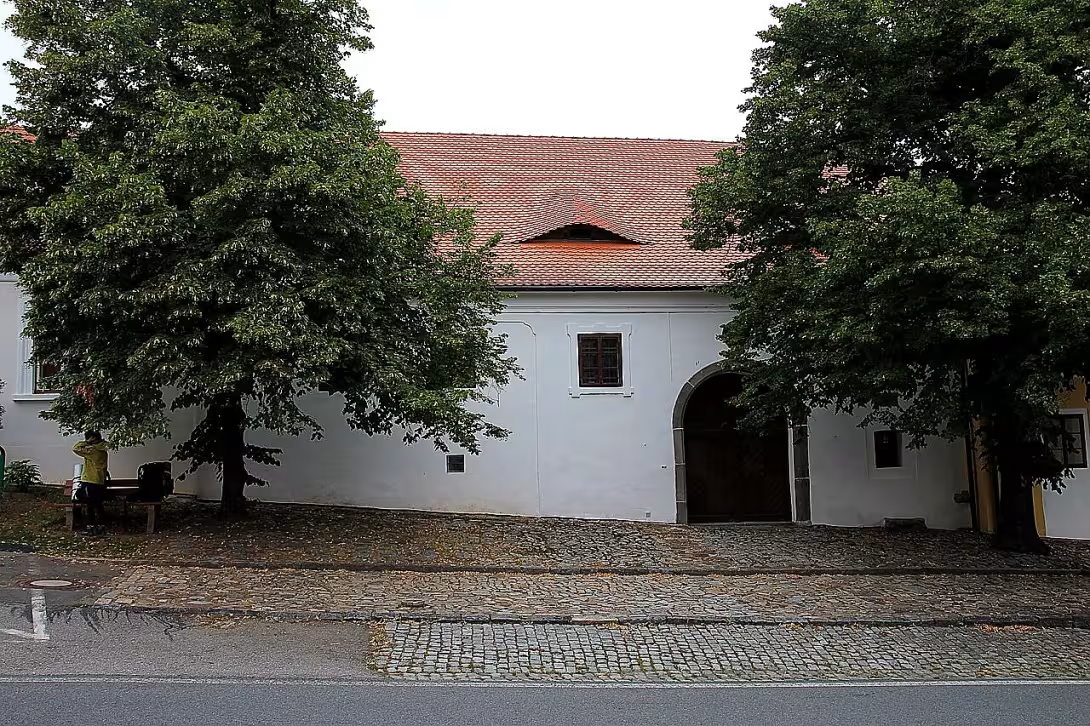
Rodný dům Mistra Jana Husa is a townhouse no. 36 in Husinci in southern Bohemia. The place of birth of the famous priest and preacher Jan Hus is not quite certain - as his birthplace is also listed Husinec near Prague. The construction in the core of the Gothic was gradually rebuilt; today's form is mostly Renaissance, dating back to about 1616. Since 1963, it has been protected as a cultural monument, since 1978 as a national cultural monument.
The house appeared for the first time in written sources in 1633 in a letter from the Archdeacon of Krumlov, Greece, from Klebat to the Archbishop of Prague. The author writes that the Hussy residents are showing the House of Hus and cutting off splinters from it as a remedy for toothache. In the next century, the building was affected several times during the fires. The original owner of Zikmund Nana, recorded in the city book in 1634 and identified as a tailor, experienced a fire in 1654. In the 18th and 19th centuries were owners of the family of Jilečková: first the baker Josef, later his son Vojtěch, who in the house producing hooch disgusted the poet František Turinský during his visit in 1825. Vojtěch's son Ondřej (since 1831) ran a washing shop here and set up a small shop. After the fire in 1859 he asked for the support of the Museum of the Kingdom of Bohemia without success. After Ondrej's death in 1880, Augustine's son inherited the house; The local priest Adolf Rodler sought to buy the house with the intention of tearing it down and building an orphanage.
The comments were saved in 1869 at the celebration of the 500th anniversary of Husova's birth, when Husa's relief of sculptor Bohuslav Schnirch was revealed on the facade. The house became the object of literary pilgrimage - visited by Jan Neruda (1871), Alois Jirásek (1877) and Jaroslav Vrchlický (1880). In 1883 Svatobor bought it from the collection and handed it over to Sokolské Unity in Prague. 1916 The Falcon donated the building to the city, but in 1922, because of the dispute over its use, he repossessed it. In 1928, the building of the museum was acquired by the neighboring house No. 37. After World War II, the building was nationalized. The memorial of Master Jan Husa was opened in 1952, the museum exhibition followed in 1965. In 1991, the municipal office cleared the exhibition of ideological distortions and supplemented it with a memorial hall and gallery of academic painter Josef Krejz.
Since 2010, the Czechoslovak Hussite Church has managed the construction. In 2014- 2015 she performed a comprehensive reconstruction, which from the old memorial was created by the Centre of Master Jan Hus. The current area includes both townhouse and newly built operating building. The opening of the reconstructed centre took place on 30 May 2015. The public are now particularly accessible to Hus's saint, Hus's prayer room and the piety corner. The centre also serves for cultural educational activities - exhibitions, concerts, courses and workshops are organised here.
Then and now
Drag the slider to compare how the landmark may have looked when it was built with the view today.
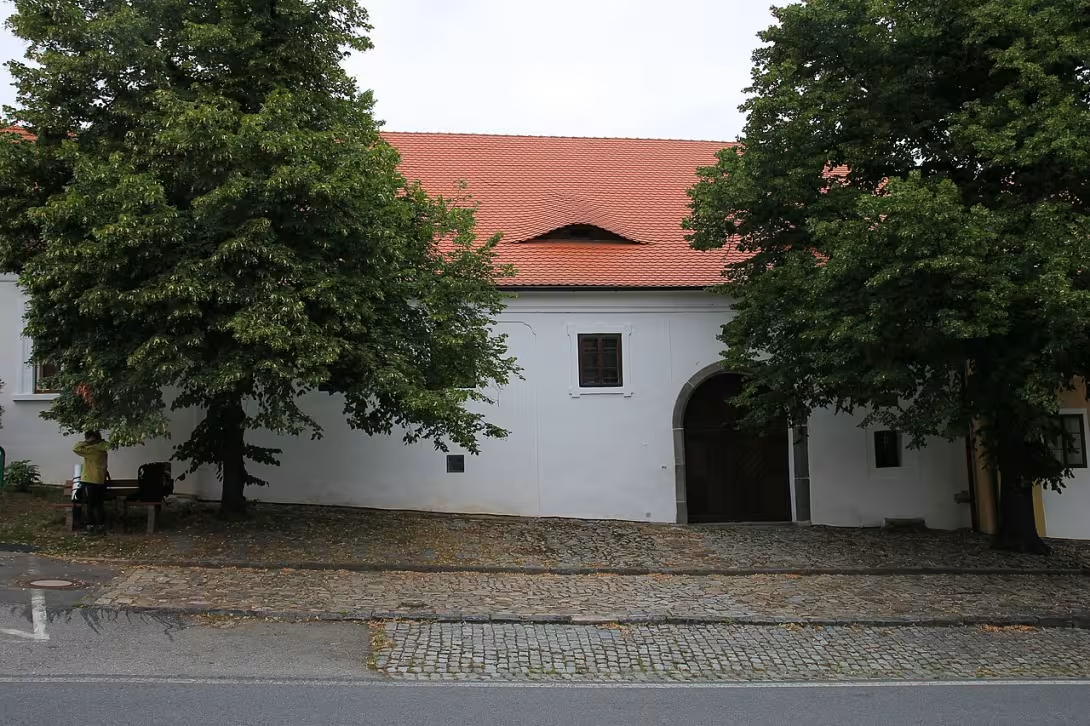

The historical appearance on the left is an AI-generated visualisation and serves as inspiration only.
Historical milestones
- 1616
- Renaissance reconstruction of the original Gothic house.
- 1633
- The first written mention of the house in the letter of Archdeacon Gregory of Klebat.
- 1963
- Registration of the house together with the house No. 37 as cultural monuments.
- 1978
- Declaration of the house for a national cultural monument.
- 2015
- Opening of the reconstructed Centre of Master Jan Hus.
Architectural development
The house is based on a Gothic core that was rebuilt in the Renaissance style around 1616. After the fires in 1654, 1691 and 1859 he underwent further modifications. The original Gothic elements are visible only in the core of the construction. Today, both houses (No.36 and 37) are preserved with a newly built operating building from reconstruction 2014- 2015.
Historical events
- 1633
- The first written mention of the house in the letter of Krumlov's Archdeacon Gregory of Klebat, where the inhabitants show the house as Hus' hometown.
- 1869
- The discovery of Husova's relief of sculptor Bohuslav Schnirch on the front of the house during the 500th anniversary of Jan Husa's birth.
- 1952
- The foundation of Master Jan Hus Memorial in the house after nationalization of the building.
- 2015
- Opening of the reconstructed Centre of Master Jan Hus after the
Owners
1634 – Zikmund Nana (tailor); 1691-1740 – relatives of Zikmund Nany; 1740-1831 – Josef Jileček (baker) and his sons Vojtěch and Ondřej; 1831-1880 – Ondřej Jileček (soap); 1880- 1883 – Augustine Jilecek (son of Ondřej); 1883-1916 – The Association of Svatobor (front of the house) and the Physical Unity of Sokol; 1916- 1922 – The City of Husinec (gift from Sokol); 1922- 1952 – Spolek Svatobor / Ttyl.
Points of interest
- The house was originally Gothic, but its current Renaissance form dates back to around 1616.
In 1633, the letter mentions that local residents were cutting splinters out of the house as a remedy for toothache.
- In the 19th century, the house was owned by Vojtěch Jileček, who produced liquor here, which disgusted the poet František Turinský.
- In 1869, Husova's relief of sculptor Bohuslav Schnirch was revealed on the facade at the 500th anniversary of his birth.
- In the years 2014- 2015 the house underwent a complex reconstruction and became the Centre of Master Jan Hus, which includes Hus' saint and prayer house.
Guide
This guide is narrated by a synthetic voice generated by artificial intelligence.
Show guide text
This text was created by artificial intelligence and has not been editorially reviewed. It may contain inaccuracies.
In Husince in South Bohemia, there is a burgher's house number thirty-six, where according to tradition the priest and preacher Jan Hus was born. However, this is not certain. Sometimes Husinec near Prague is also mentioned as Hus's birthplace.
The house has a Gothic core, but its present appearance is probably Renaissance, dating from around sixteen sixteen. After fires, it was rebuilt several times. Together with the neighboring house number thirty-seven, it has been a cultural monument since nineteen sixty-three and a national cultural monument since nineteen seventy-eight.
The house is first mentioned in writing in sixteen thirty-three. Krumlov archdeacon Řehoř of Klebatu then informed Prague archbishop Arnošt of Harrah that the inhabitants of Husince show Hus's birthplace and cut splinters from it to ease toothaches.
The first known owner was tailor Zikmund Nána, mentioned in sixteen thirty-four. The house burned down in sixteen fifty-four and again in sixteen ninety-one. In seventeen forty, it was bought by baker Josef Jileček. His son Vojtěch distilled spirits there, which displeased poet František Turinský. He visited the house in eighteen twenty-five and wrote a poem about it. Vojtěch's son Ondřej then ran a soap-making business and a small shop there. After another fire in eighteen fifty-nine, he asked the Museum of the Czech Kingdom for help with renovating Hus's study, but the museum had no funds. Later, local Catholic priest Adolf Rodler wanted to buy the house, intending to demolish it and build an orphanage in its place.
In eighteen sixty-nine, for the five hundredth anniversary of Hus's birth, a relief of Hus by sculptor Bohuslav Schnirch was unveiled above the entrance. The house was visited by writers, among them Jan Neruda, Alois Jirásek, and Jaroslav Vrchlický. In eighteen eighty-three, the Svatobor association purchased the front part of the house from collection proceeds and handed it over to Prague Sokol. In nineteen eleven, two linden trees were planted in front of the house.
After the Second World War, the building was nationalized, and in nineteen fifty-two the Memorial of Master Jan Hus was established there. In nineteen ninety-one, the exhibition was freed from ideological distortions and supplemented with a gallery of painter Josef Krejzy, a native of Husince. Since two thousand ten, the site has been managed by the Czechoslovak Hussite Church. In twenty fourteen and twenty fifteen, it was completely renovated and supplemented with a new operational building. The Center of Master Jan Hus was thus created with Hus's study room, a prayer room, and a memorial corner. It also serves for exhibitions, concerts, and courses. It was solemnly opened on May thirtieth, twenty fifteen.
Tips for visitors
The best time to visit is from April to October, when the weather is mild and you can see the surroundings.
We recommend taking a book map or a guide with you so that visitors can be better oriented around.
Photography is allowed, the best places for photos are before and behind the house. The light is best from 10:00 to 2:00.
In the surroundings you can visit the local church of St. Nicholas, which is only 15 minutes walking from the House of Master Jan Hus.
Frequently asked questions
Can the monument be visited?
Some buildings of this kind are open for guided tours, others serve another purpose or are privately owned. We have not verified whether and when this monument is open – please ask the operator.
What are the opening hours and admission?
We have not verified the opening hours or admission. Current information is published by the operator.
Where is the monument?
Location: Husova 36, Husinec, Jihočeský kraj. The map on this page shows the exact spot.
Why is the monument protected?
It is listed in the Central List of Cultural Monuments of the Czech Republic as a national cultural monument (register no. 143).
For kids
Imagine going back 410 years to a small village called Husinec, where Master Jan Hus lived. Rodný dům Mistra Jana Husa is here, in the centre of the village, and today it is a cultural monument of the Czech Republic.
It's like the door to your past opened, and let's see what it looked like! The house stood in the middle of the village, on a square, where people gathered to talk about agricultural crops or the last market. The family of Master Jan Hus was bourgeois, so the house was spacious, with a large courtyard and several rooms.
Businesses nearby
Do you run a restaurant, accommodation, shop, museum, rental, wellness or other visitor service near this monument? Show yourself directly to the people heading to it — this is how they will see you in the app and on the web:
Accommodation nearby
Themed route
Thematic cruise route to the home of Master Jan Hus in Husinci
1.Rodný dům Mistra Jana Husa The historical building here, which stands at the place where Hus was born, is the most important destination of the route. It is protected as a cultural monument and represents a symbol of the Czech Reformation. In the interior there are authentic items from the 15th century and information about the life of Husova.
2. Husinec Museum It is located in Husinci, just a few hundred meters from the home. The exhibition here brings the history of the region, especially the period of the Hussite Revolution, and shows how life around it reflected on the personalities of Jan Hus. Local items and documents are also interesting.
3. Church of St. Jacob the Greater The Baroque church from the 18th century with rich sculpture decoration stands in the heart of Husinka. Its architecture and artistic decoration reflect local cultural traditions and religious importance. In the vicinity of the church there is also a beautiful square with historic houses.
End of route After visiting the sights in Husinci it is recommended to get acquainted with the surroundings and its nature. In the surrounding area there are HusinecKé forests that offer quiet walks and the possibility to observe local flora and fauna. The forests here are ideal for family trips and rest after visiting historical monuments.
Seasonal recommendations
Spring Spring in Husinci brings a gentle revival of nature, when the surroundings of Master Jan Hus' home are awakened after winter. The sun's rays illuminate the ancient walls of the building that are projected into the greenening park and fields around it. The atmosphere is calm, but full of hope - the air smells of wet ground and flowering spring flowers such as a convaline or a spring dandelion. In this period the monument is surrounded by young leaves of trees that shade the sun and create a pleasant shadow. It is convenient to visit it in sunny weather, when the details of the facade and the surrounding garden are well looked at. I recommend arriving early in the morning when there are still few visitors, and wearing light, but protective clothing - spring weather can be variable, with fast transitions between the sun and rain.
Summer Husinec in the main summer season offers warm, sunny days when Master Jan Husa's home house shines in the sun and its stone walls reflect heat. The atmosphere is lively, but also calm - families with children, tourists and students who are interested in history are mixed among visitors. The surrounding area of the monument is green, full of flowers and the noise of leaves, which create a pleasant contrast to historical architecture. The best time to visit is early morning or after lunch when there are fewer crowds. I recommend wearing light but comfortable clothes, perhaps with a hat or sunglasses, and taking enough water. In the summer months the monument is opened longer, but in the main season (July-August) it is often sold out for the morning.
Autumn Autumn Husinec is magical - golden leaves of trees in the park around the home of Master Jan Hus turns into a colored mosaic that is reflected in the windows of the historic building. The atmosphere is calm, almost mysterious, when the sun hides behind the sky and the shadows extend. The air smells of burnt leaves and freshly chopped grass, and even if it's cold, there's something cozy, like time slowly standing. Autumn visit is ideal for those who prefer smaller crowds - there are far fewer people in November than in the summer months. I recommend wearing warmer clothes, perhaps with a windcoat, and visiting a monument in sunny weather, when the details are still well looked at. The opening time may be limited in the Advent time (end of November), so it is good to get up-to-date information.
Winter Winter Husinec is covered with a thin layer of snow, which covers the grass and shade the stone wall of Master Jan Hus' home house. The atmosphere is quiet, almost silent, when the sun hardly rises through the sky and the shadows of the monument are long and mysterious. The air is clean and cold, and while nature sleeps, there is something beautiful in the white blanket of the landscape. Winter visit is suitable for those who want to experience the memory in peace, without crowds. I recommend wearing warm but comfortable clothes - it is often cold and windy in December. The best time to visit is early afternoon, when the light is still sufficient, but the crowds are less than in the morning.
Visualizations and artistic views


The visualisations are generated by artificial intelligence and serve as inspiration.
Photos from the area
Real photos taken near the monument


Zdroj a licence jsou uvedeny u každého snímku.
Atmosphere of the place
This atmospheric visualisation of the place and period was generated by artificial intelligence. It is not real footage of the location.
Tips from visitors
No tips yet. Be the first!
Log in and add your tip.
Sources and literature
Photos: Draceane / CC BY-SA 4.0 — Wikimedia Commons. The author and licence also appear when you hover over the image.
Faktickým podkladem tohoto textu byl článek na Wikipedii, jehož autory jsou přispěvatelé Wikipedie. Článek je dostupný pod licencí CC BY-SA 4.0.
Location on the map





Příběhy a pověsti
Legendy, pověsti a příběhy spjaté s touto památkou
Fotografie návštěvníků
Zatím žádné fotografie. Buďte první, kdo přidá fotografii z návštěvy!
Log in a přidejte svou fotografii nebo hodnoťte.
Za ověřenou návštěvu v aplikaci získáte víc bodů — poznáme podle GPS, že jste na místě.
Reviews and comments