



Rozdělovské věžáky Building complex
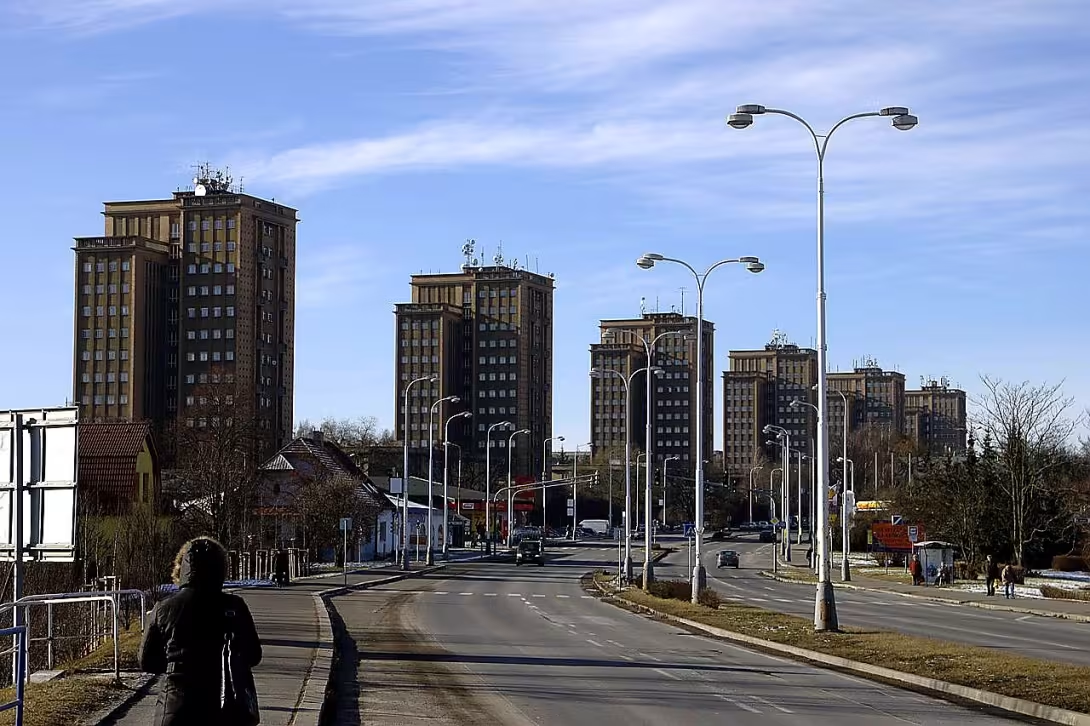
Rozdělovské věžáky consists of a set of six high-rise residential houses in the Kladen part of Rozdilov, built between 1953 and 1957. This cultural monument represents a unique example of postwar perretism in the Czech environment. At the same time, this is an important example of the period's efforts to ensure representative housing for workers in the industrial centre.
The construction of the housing area of which the towers are part was politically conditional on the development of heavy industry after the February coup in 1948. The Kladno as a coal mining centre and the Poldi smelting site required the rapid construction of new housing capacities. The site of the Victory February was designed by architects Josef Havlíček, Karel Filsak and Karel Bubeníček in the still unbuilt area between Divorce and the city centre.
The architectural design is based on the newclassicist legacy of French architect August Perret. Objects consisting of three interconnected units in the shape of the letter T use a steel concrete skeleton with a filling brick wall. The facades combine the birzolite plaster with the cabbages. There are twelve ceramic home signs from Czech sculptors, including Marta Jirásková, Břetislav Benda, Mary Durasová, Martin Reiner, Bedřich Stefan and Hana Wichterlová. A unique technical element is the Crittal heating system, which distributes heat directly in columns, cross-sections of carrier skeleton and floors.
The structure of each house includes ground floor, elevated ground floor, thirteen above ground floors and two basements. In the second basement, anti-atomic shelters were built, while on the roofs of the first and sixth houses, civil defence monitors were built. The layout of the apartments varies on individual floors; There are also rooms for shops in northern corners.
The houses are currently the property of the city and have undergone extensive reconstruction. This included repairs of balconies, electricity distribution, waste, windows and elevators. In 2017, ceramic home signs were restored under the guidance of academic sculptor Jiří Kaifosz and these works are now protected by plexiskles. Thanks to their architecture, the objects became popular film exteriors. For example, they were used to shoot Child Number 44 or Legends and Under One Sky.
The first tower house was opened at the beginning of 2020, which is the first of its kind dedicated to residential architecture in the Czech Republic. The exhibition includes an entrance hall returned to its original form, an exemplary furnished apartment, a civil protection cover and a roof terrace.
Rozdělovské věžáky presents unique testimonies of ambitious post-war architecture and urban planning. Visiting this place offers an opportunity to see the history of living and technical solutions that were not similar in the Czech environment at the time of its creation.
Historical milestones
- 1953
- Opening of major construction works on tower houses.
- 1957
- Finishing the construction of all six tower houses.
- 2017
- Restoring ceramic home signs by academic sculptor Jiří Kaifosz.
Architectural development
The construction consists of a steel concrete skeleton with a filling brick masonry and facade combining a birzolite plaster with cabbages. Architectural houses are based on the neo-classical legacy of August Perret. In the basement, anti-atomic shelters were built and civil defence observation facilities were built on the roofs of the first and sixth houses.
Historical events
1953: Opening of main construction works. 1957: Completion of tower building. 2017: Restaurant work on home signs.
Points of interest
- A set of six tall houses is a rare example of postwar style based on the legacy of French architect Augustus Perret. - A unique technical heating system distributes heat directly in columns, carrier parts and floors. - In the second basement of the houses were built anti-atomic shelters and on the roofs of some buildings were created civil defence observers. - The facades of houses are decorated with twelve ceramic home signs created by Czech sculptors and protected by plexiskles since two thousand seventeen. - The first tower house opened a museum which is the first of its kind in the Czech Republic focused on residential architecture.
Guide
Show guide text
This text was created by artificial intelligence and has not been editorially reviewed. It may contain inaccuracies.
Welcome to the site, which is both historical and architectural treasure of Kladna - Divestrian towers. You are facing an impressive group of six tall houses whose vertical lines emerge from the surrounding urban environment as a symbol of modernity and innovation. These buildings are not only a visual centre, but also witnessed rich historical stories.
Let's dive into the past. Between 1953 and 1957, this high-rise settlement was built as part of a project known as the Resident of the Victory of February. Architects Josef Havlíček, Karel Filsak and Karel Bubeníček brought to Czech countries a unique style of postwar perretism, inspired by the work of French architect August Perret. This project was not only a construction, but also a significant manifestation of new ideas and technologies in the post-World War II period.
Look up at these impressive structures. Note their unique iron concrete skeleton, which is combined with a brick filling. This proposal not only provides stability and robustness, but also reflects an innovative approach to postwar construction. The most interesting is the Crittal heating system, which distributes heat through the supporting structure and floors - a technology that was a real innovation for its time.
This is where personal stories took place. Marta Jirásková, Břetislav Benda or Mary Durasová are just some of the historical characters associated with this settlement. Their lives and contributions to the development of Kladno and its architecture are an essential part of this place.
Now pay attention to an interesting mystery. In the second basement of these houses, anti-atomic boxes were built, a reminder of global tensions during the Cold War and the desire for security at that time.
When walking around these buildings, take time to relax and observe. Notice how architecture harmoniously integrates with the local landscape and how it became part of the everyday life of the people.
Thank you for your visit to the Division Towers. I hope you felt at home here and found a lot to explore. If you want to know more about the Kladno and its history, feel free to see other interesting places around. When you return to us, there will be many new stories waiting to be discovered. Goodbye!
Tips for visitors
To visit the towers, choose a sunny day in the morning when the sun lights up the facades from the east and highlights their architectural details. The location is freely accessible in the residential area, so move with respect to the local population. Take the wide-angle lens camera with you because the buildings are high and they are badly captured at close range. The best pictures can be taken from the space between the houses where their symmetric arrangement stands out. In the vicinity we recommend visiting the Siren department store, exploring the centre of Kladna or exploring industrial sites associated with the history of coal mining and the Poldi Mound, which illustrate the nature of the city. For families with children the location is suitable for walking between houses, where there is plenty of green and quieter environment outside the main transport arteries.
Frequently asked questions
Can the monument be visited?
Some buildings of this kind are open for guided tours, others serve another purpose or are privately owned. We have not verified whether and when this monument is open – please ask the operator.
What are the opening hours and admission?
We have not verified the opening hours or admission. Current information is published by the operator.
Where is the monument?
Location: Kladno. The map on this page shows the exact spot.
Why is the monument protected?
It is listed in the Central List of Cultural Monuments of the Czech Republic as a cultural monument (register no. 1000152361).
Businesses nearby
Do you run a restaurant, accommodation, shop, museum, rental, wellness or other visitor service near this monument? Show yourself directly to the people heading to it — this is how they will see you in the app and on the web:
Nearby
Obchodní dům Siréna, centrum města Kladna, průmyslové areály spojené s historií těžby uhlí a hutě Poldi.
Accommodation nearby
Trips and activities nearby
Guided tours, tickets and activities nearby from GetYourGuide
Affiliate link: if you buy from the partner, we may receive a commission. The price for you does not change.
Search tours and activities →Themed route
Thematic cruise route from Kladno
1.Rozdělovské věžáky (others) Type: Historical monument Why is worth a visit: Rozdělovské věžáky is a key element of the history of coal mining and the Poldi Mound. These structures are indicative of an important period of industrial revolution in the region where coal was transported on the tracks.
2. Siren Business House Type: Historical business object Why is it worth a visit: This historic building is a reminder of the rich industrial heritage of Kladna. Its architecture and location in the heart of the city provide insight into the past business activities connected with the metallurgical industry.
3. Center of Kladna Type: City historical centre Why is worth a visit: The city centre offers a view of architecturally interesting buildings that reflect the industrial past of Kladno. It is a place full of history and culture, where cultural events take place today.
4. Industrial sites associated with coal mining Type: Historical industrial complex Why is it worth visiting: These sites are witnessing the former importance of Kladno as coal mining centres. Visiting them means exploring the historical place where the economy of the region was built.
5. Huta Poldi Type: Historical metallurgical complex Why it is worth a visit: Huta Poldi was one of the largest in Europe and played a key role in the development of industrial Kladno. It's a place where you can explore the history of metallurgy and its impact on local society.
This route offers a view of the rich industrial past of the municipality Kladno and its importance in the development of the regional economy.
Seasonal recommendations
Spring: During the spring season, Rozdělovské věžáky appears in a special atmosphere, where the new foliage is illuminated by historical architecture. Sun rays passing through the fog give the memory a unique touch. Flowers and trees are starting to bloom, which adds color to the surroundings. It is recommended to visit early spring times when crowds are still mild. Clothes should be suitable for changing weather - bring a warm jacket and a short coat.
Summer: During the summer period the monument offers the best conditions for visiting. Sunshine days are suitable for long walks around towers and sightseeing routes. The atmosphere is full of life, but that also means higher attendance - remember to come earlier to avoid long fronts. Clothes should be light and light, with sun protection and always with a drinking bottle on your back.
Autumn: In autumn, Rozdělovské věžáky is transformed into a coloured carpet. Leaves of trees gain living shades, which is ideal for photography and relaxation on outdoor platforms. The weather can change rapidly, so it is advisable to prepare for warm and colder conditions. Visit the memory in the early afternoon, when the weather is usually quieter and the crowds are smaller.
Winter: Winter visit to the Divestrian Towers offers mild weather and beautiful light effects when the historical complex is illuminated. Snow sheets add magic to the landscape, although the attendance may be limited by the short working hours of the monument. Hot clothes and suitable shoes are recommended - maybe even shoes with scars if snow is on the way. Visit in times when the weather is most peaceful to enjoy peace and comfort.
Visualizations and artistic views

The visualisations are generated by artificial intelligence and serve as inspiration.
Photos from the area
Real photos taken near the monument


Zdroj a licence jsou uvedeny u každého snímku.
Tips from visitors
No tips yet. Be the first!
Log in and add your tip.
Sources and literature
Photos: I would appreciate being notified if you use my work outside Wikimedia. More of my work can be found in my personal gall / CC BY 3.0 — Wikimedia Commons. The author and licence also appear when you hover over the image.
Faktickým podkladem tohoto textu byl článek na Wikipedii, jehož autory jsou přispěvatelé Wikipedie. Článek je dostupný pod licencí CC BY-SA 4.0.
Location on the map

Příběhy a pověsti
Legendy, pověsti a příběhy spjaté s touto památkou
Fotografie návštěvníků
Zatím žádné fotografie. Buďte první, kdo přidá fotografii z návštěvy!
Log in a přidejte svou fotografii nebo hodnoťte.
Za ověřenou návštěvu v aplikaci získáte víc bodů — poznáme podle GPS, že jste na místě.
Reviews and comments