



Sloup Nejsvětější Trojice (Nová Bystřice) Holy trinity column
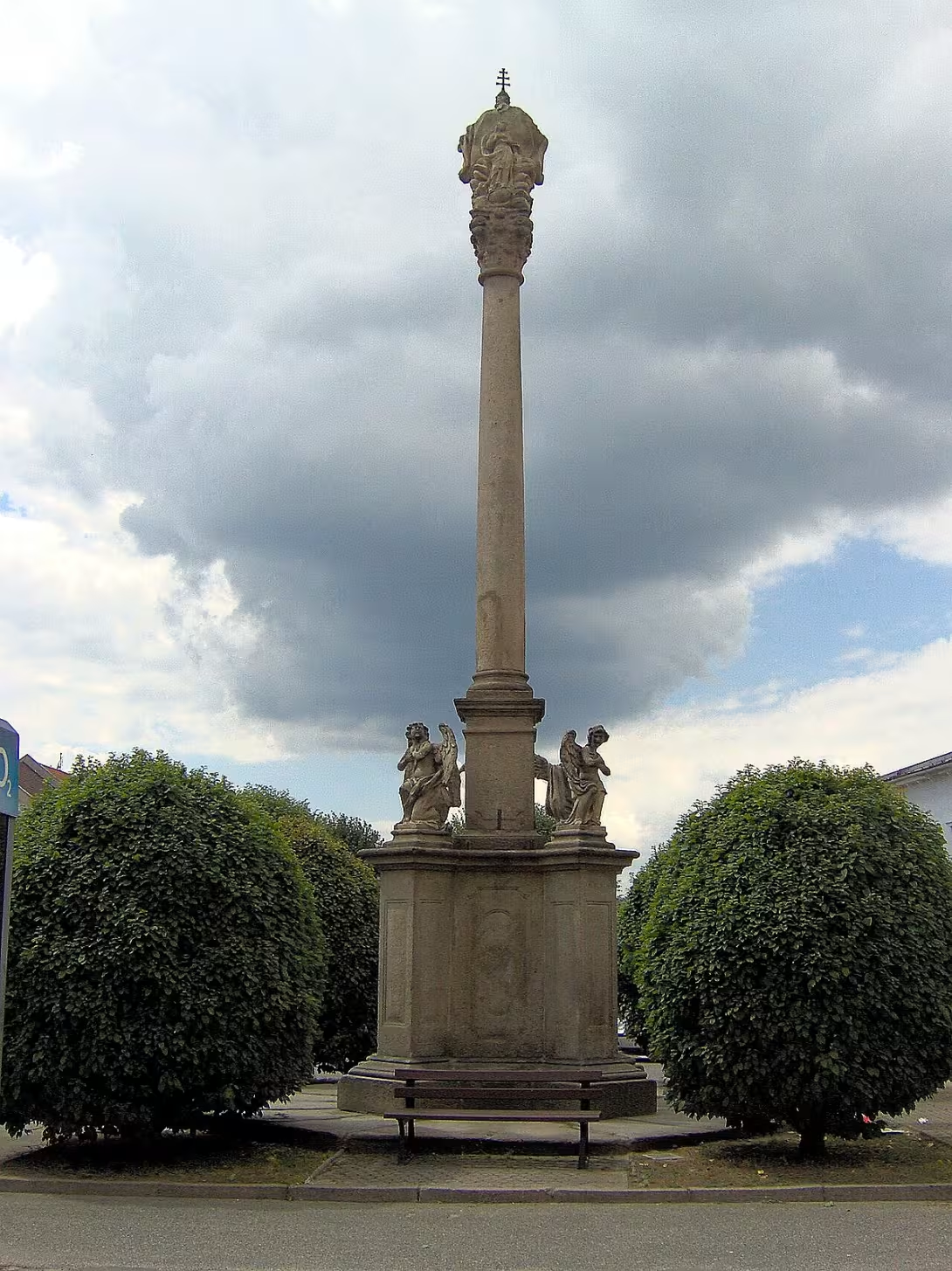
The Column of the Holy Trinity on the Peace Square in Nové Bystřice is an important Baroque monument from 1724, one of the key examples of the Trinity columns in Bohemia. This religious object also has a Marian character and is located in the eastern part of the square.
The history of the monument is the subject of expert discussions. Older data suggest that the column was built in 1679 to thank for the end of the plague epidemic, which would make it the oldest column in the Czech Republic. The sculptor Zikmund Lichtenberg, who worked at the Monastery near Nová Bystřice, is listed as a possible author. According to these figures, the column was damaged in 1691 in a city fire and subsequently restored in 1724. But more recent literature assumes that the present sculpture was built only in 1724. This date corresponds to both the artistic design and the presence of the Earl of Fünfkirchen on the pedestal which he owned from 1693.
The architectural monument stands on a granite pedestal whose four corner pillars are decorated with statues of angels. In the centre of the pedestal there is a cylindrical column with a Corinthian head. On it lies the group of the Holy Trinity known as the Throne of Grace. On the clouds is the figure of God the Father dressed in papal clothing with a tiara on his head that holds the cross with Jesus Christ. At the feet of the crucified, the Holy Spirit is displayed in the form of a dove. An important element is the relief of the Virgin Mary Immaculata, which is carved on the back of the figure of the Father God.
The fate of the monuments was linked to the ownership of the village, which since 1693 was owned by hrabě z Fünfkirchenu. In 1837 there was a restaurant of the monument for the price of 100 gold pieces. Since 1958, the object has been protected as a monument. Another technical repair of the sculpture was carried out in 1994 by Jiří Genzer together with academic sculptors Josef Novotný and Petr Novotný.
Among the attractions are the fact that the original sculpture of the Trinity is today stored in the parish church of St. Peter and Paul. In addition, in the village Nová Bystřice there are two other, smaller trillion columns, one in the park on Husova Square and the other at the dean's church.
This Baroque monument represents an important aspect of the religious faith and history of the region. It is a suitable destination for visitors who are interested in Baroque sculpture and historical monuments.
Historical milestones
- 1679
- Maybe building a pole to thank for the end of the plague.
- 1691
- Damage to the pillar in the city fire.
- 1724
- Restoring or rebuilding the present sculpture.
- 1837
- A pillar's restaurant.
- 1958
- An entry into the memorial service.
- 1994
- The technical repair of the sculpture.
Architectural development
The column was probably built in Baroque style on a granite pedestal. After the fire in 1691 it was subsequently restored in 1724. The current form corresponds to baroque artistic design.
Historical events
1679: Possible pole construction. 1691: Damage to the pillar in the city fire. 1724: Reconstruction or new construction of contemporary sculpture. 1837: Restaurant of the column for the price of 100 gold.
Owners
The Earl of Fünfkirchen since 1693.
Points of interest
- Column of the Holy One The Trinity is built in 1724 and is a key example of the Trinity Columns in Bohemia. - There are discussions about history because older data suggest that it was originally built in 1679 to thank you for ending the plague epidemic. - According to some sources, the sculptor Zikmund Lichtenberg could have been the author of a column that worked at the Monastery at Nová Bystřice between 1678 and 1680. - The contemporary art design of the monument corresponds to 1724, which is confirmed by the presence of the Earl of Fünfkirchen on the pedestal. - Original sculpture The Trinity is today stored in the parish church of St. Peter and Paul.
Guide
Show guide text
This text was created by artificial intelligence and has not been editorially reviewed. It may contain inaccuracies.
Welcome to New Bystrica. You're standing in the Peace Square at the heart of this place where history meets the present. In front of your eyes is the monumental Baroque column of the Holy Trinity, which immediately attracts the attention of anyone who stops here with its nobility and complexity. Feel the atmosphere of calm and the depth of time that spreads around you. This object is not just a stone piece, it is a silent witness to many events that have shaped the lives of people in this city for centuries. Look at him as a whole, a symbol of faith, endurance and recovery.
In order to fully understand the importance of this place, we must go back deep into the past together. The history of this column is linked to the difficult times that people had to overcome. There are important clues suggesting that the first column could have been created already in 16 hundred and seventy-nine. At that time, a plague epidemic spread throughout Europe, bringing death and fear. This monument could have been an expression of deep faith and a thank you for the end of the test that people had to survive. Unfortunately, fate was cruel and the history of the city was full of obstacles. In the year sixteen hundred ninety-one city struck a devastating fire that damaged even this sacred symbol. What you're seeing today is the result of a renewal and a new construction in 17 hundred and twenty-four. This year is crucial to us because that is when the present sculpture was created, which we now admire as an excellent example of baroque art.
Now, please pay attention to the details you have right in front of you. Let's take a visual route from earth to heaven together. This whole monument stands on a solid granite pedestal. Note how this foundation gives the whole piece a sense of unwavering and stability. On this pedestal, on the pillars, four angels rest. These statues provide a whole lightness and act as spiritual guardians of this place. Feel their shapes and how they move in space. Above them is the main part of the work - a high cylindrical column. If you look at the top of it, you'll see the Corinthian warhead. It is a typical element that emphasizes the grandeur of the whole building with its rich decoration and fine shapes. In the very center of the column is a group known as the Throne of Grace. It is the heart of the whole sculpture, the point where all the spiritual power of this work is concentrated. And notice another important element that gives the work a Marian character. It is the relief of the Virgin Mary Immaculata, who carries deep meaning and beauty. Every cut into stone, every line of these statues tells the story of an attempt to link the earthly world to the celestial one.
When you look at these art shapes, you can ask who was behind them and who was taking care of them. The names of artists and personalities associated with this place have been intertwined over the years with the history of the city. There is talk of an architect named Zikmund Lichtenberg whose hand was formed by the work. There are also names such as Jiří Genzer or Josef Novotný and Petr Novotný in the history of this place. Let us not forget the noble families that influenced the city, such as hrabě z Fünfkirchenu. These people, either as creators or as protectors, helped keep this heritage alive for all of us. Even after centuries, the pillar was taken care of, whether at the restaurant in the year one thousand eight hundred thirty-seven, or at the technical repair of the sculpture in the year one thousand nine hundred ninety-four. In the year one thousand nine hundred fifty-eight, the column was also entered into the monument protection, confirming its immense value.
Even though we seem to know a lot about the column, there's still a mystery in it that might interest you. The main question that historians are still interested in is precisely the original time of origin. Is it really the work of seventeen hundred twenty-four, as most records say, or is it the hidden soul of the older monument of sixteen hundred seventy-nine? This discussion about whether it is a completely new building or the restoration of the old thanks for the end of the plague gives it special tension. Who was the real creator? Some sources suggest that the sculptor could have been Zikmund Lichtenberg, but the certainty in these historical sources is not complete. This uncertainty is part of the spell this column radiates.
I hope this short journey over time has helped you better understand this important monument. Column Biggest The Trinity is not just a stone, it is a reminder of human faith, perseverance, and ability to rise again after a storm like fire or plague. But I will not stop you now. Continue your walk around the Peace Square, see the next corner of New Bystřice and get carried away by the atmosphere of this place. Thank you for your attention and have a nice visit.
Tips for visitors
The best time to visit the Trinity Column in Nová Bystřice is an early afternoon, when light dazzles Baroque sculpture and base with angels. This time period offers ideal conditions for understanding the details of the monument and its location in Peace Square.
We recommend using both private vehicle and public transport for arrival. Public transport offers a comfortable way to get to the centre of New Bystřice.
When visiting take a high-quality camera or mobile phone with you to photograph the sights. Thanks to its location on the Peace Square, the column offers excellent possibilities for photography from different angles, especially when lit with natural light.
For families with children, a visit to the Trinity Column along with the parish church of St. Peter and Paul is ideal in Husová Square. These historical monuments offer the opportunity to introduce children to local architecture and history, which can be an interesting experience for them.
Frequently asked questions
Can the monument be visited?
This is a structure in a public space that can usually be seen from outside free of charge. We have not verified that this particular one is freely accessible.
Where is the monument?
Location: Nová Bystřice. The map on this page shows the exact spot.
Why is the monument protected?
It is listed in the Central List of Cultural Monuments of the Czech Republic as a cultural monument (register no. 1000125293).
Businesses nearby
Do you run a restaurant, accommodation, shop, museum, rental, wellness or other visitor service near this monument? Show yourself directly to the people heading to it — this is how they will see you in the app and on the web:
Nearby
Mírové náměstí, farní kostel svatého Petra a Pavla, Husovo náměstí.
Accommodation nearby
Themed route
1. Husovo Square (square): Suitable starting point for dating the village. 2. Peace Square (square): Central area where you can feel the local atmosphere. 3. Column of the Holy Trinity (memorial): The main monument of the trip, which represents the top point of the route. 4. parish church of St. Peter and Paul (church): An important building that ends up walking with its nobility.
Seasonal recommendations
Spring: In the spring season, the Column of the Holy Trinity in Nové Bystřice appears in the glow of the sun, which illuminates the trees and lawns around. Flowers begin to bloom, which adds a colour palette to the panorama of the monument. The atmosphere is full of new life and renewal, when nature awakens from winter sleep. It is recommended to visit in the morning or in the evening to be used in sunny moments without excessive heat. Since this period may be popular between tourists and locals, it is advisable to avoid Wednesday week for a calmer experience.
Summer: Summer brings long sunny days and warm night atmosphere around the Column of the Holy Trinity. Nature is in full bloom, with dense trees providing shade for afternoon relaxation. The atmosphere is charged with heat and light, which increases the beauty of the monument. The best time for a tour is in the early morning or late afternoon to avoid the hardest sun season. The important thing is to carry short clothes and protective sunglasses.
Autumn: In autumn, the Column of the Holy Trinity appears in the golden and red shade of leaves that fall around the monument. The atmosphere is calm and quiet, with cold wounds and warm meridians. This makes autumn an ideal period for a relaxed tour without excessive heat stress. Visitors should be reminded of lighter clothes and perhaps an umbrella, because autumn weather can suddenly be variable.
Winter: Winter brings cold days with a often snow blanket around the Column of the Holy Trinity. The atmosphere is calm and quiet, which allows a peaceful tour without large crowds. The light of the winter sun can create breathtaking silhouettes of monuments on the pale background of snow. Visitors should have warm clothes, protective shoes and perhaps a knife shank if a snow blanket is available. The best time for a tour is at noon, when the sun lights the scene best.
Visualizations and artistic views

The visualisations are generated by artificial intelligence and serve as inspiration.
Photos from the area
Real photos taken near the monument

Zdroj a licence jsou uvedeny u každého snímku.
Tips from visitors
No tips yet. Be the first!
Log in and add your tip.
Sources and literature
Photos: Harold / CC BY-SA 3.0 — Wikimedia Commons. The author and licence also appear when you hover over the image.
Faktickým podkladem tohoto textu byl článek na Wikipedii, jehož autory jsou přispěvatelé Wikipedie. Článek je dostupný pod licencí CC BY-SA 4.0.
Location on the map



Příběhy a pověsti
Legendy, pověsti a příběhy spjaté s touto památkou

Fotografie návštěvníků
Zatím žádné fotografie. Buďte první, kdo přidá fotografii z návštěvy!
Log in a přidejte svou fotografii nebo hodnoťte.
Za ověřenou návštěvu v aplikaci získáte víc bodů — poznáme podle GPS, že jste na místě.
Reviews and comments