






Socha bohyně Ceres Statue
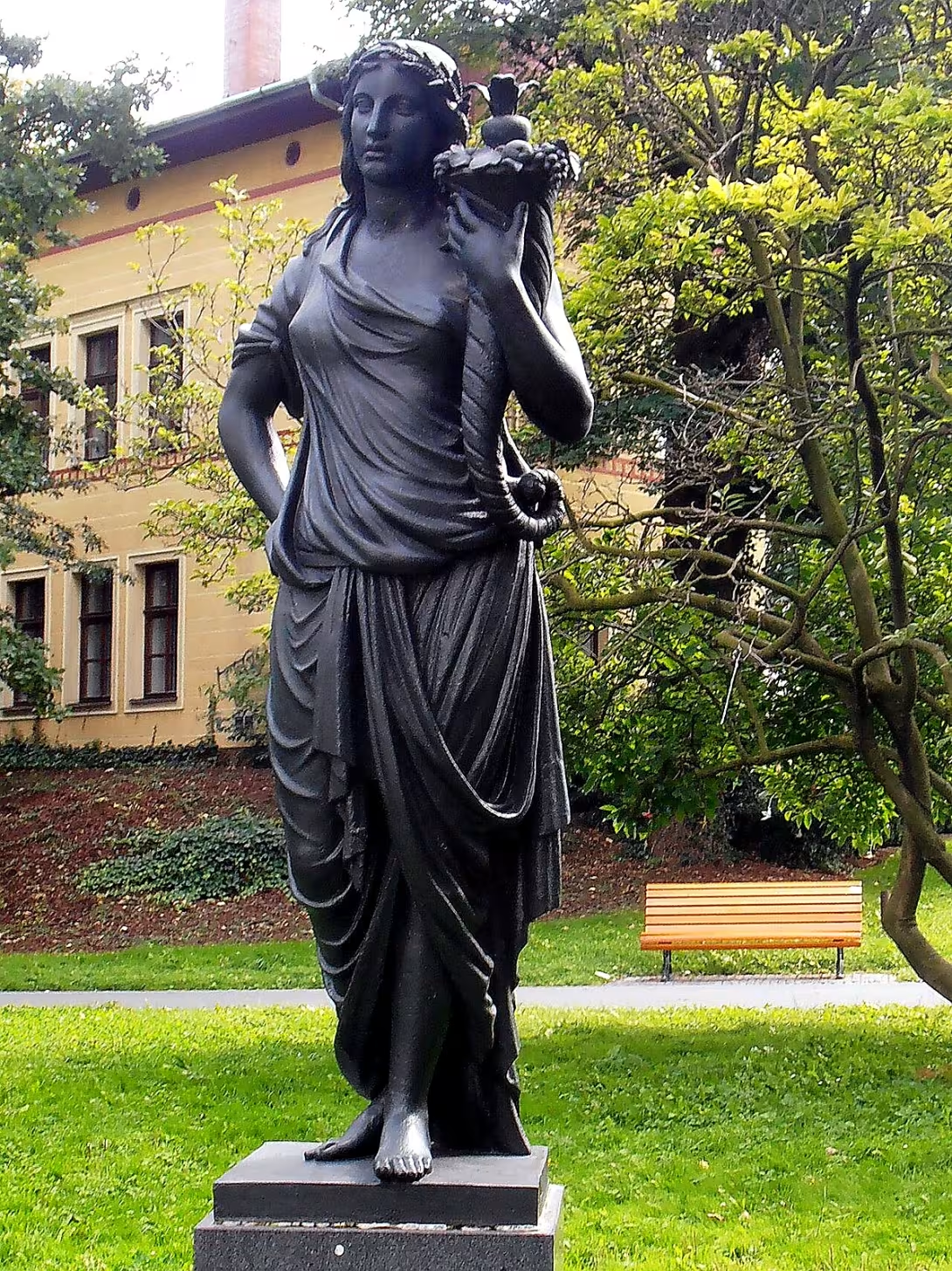
Socha bohyně Ceres is a cast iron sculpture from 1862, located in the sets of Liberty in the village district of Opava. The work was created by the Viennese sculptor Theodor Friedl; serves as an example of historism inspired by ancient aesthetics. It represents an important example of the Czech-Austrian cooperation at the time.
Plastika was created at the expense of local townsman Karl Deml. Her author, Austrian sculptor Theodor Friedl (1842-1900), formed at a time when it was common in the art of Austria-Hungary to return to ancient patterns.
It is the superlife figure of the Roman goddess Ceres represented in contrast. The goddess is lightly dressed in Roman clothing, standing barefoot and her head decorated with a laurel wreath. In the left hand at the shoulder, the horn of abundance is filled with fruit, while the right hand is held on the side. The whole building was cast in Salmovic ironworks in Blansko, which in the 19th century specialized in artistic cast iron with inspiration from antiques.
The fate of the statue has been variable over the years. It was originally part of the fountain in Lower Square, where it stood on a stone three-piece plinth with a profiled ledge. In 1876 it was moved to the City Orchards. It subsequently passed through restaurants in 1977 and 2004, after which it was placed in the Liberty orchards. At the last repair in 2004, the original stone base was replaced by a simpler block.
The building is protected as a real cultural monument since 3 May 1958. The interesting thing is that similar work can also be found in Rosice in the South Moravian Region. The statue is located in the location of Opava hill in Upper Silesia.
Today, the sculpture is available to the public in the Liberty orchards. It represents a valuable historical element of urban space and an example of 19th century industrial art. Thanks to its history and execution, it is worth visiting every person interested in the Opava monuments.
Historical milestones
- 1862
- Creating a statue by Theodore Friedlem
- 1876
- Transfer of the statue to the City Orchards
- 1958
- Registration of cultural monuments
- 2004
- Restaurant and location in Liberty orchards with new plinth
Architectural development
Originally, the statue was placed on a stone three-piece plinth by the fountain. After the restaurant in 2004, the old plinth was replaced with a simpler block. The sculpture is made of artistic cast iron from the Blansky hardware factory.
Historical events
1862: Creation of a statue; 1876: Transfers to City Orchards; 2004: Restaurant and placement in Liberty orchards.
Points of interest
- A cast iron sculpture from 1862 was created by Viennese sculptor Theodore Friedle. - The work was made at the expense of local townsman Karl Deml and was cast in Salm ironworks in Blansko. The superhuman figure of the goddess Ceres holds in his left hand a horn of abundance filled with fruit. - The statue was originally part of the fountain in Lower Square before it was moved to the City Orchards in 1876. - A similar work can also be found in Rosice in the South Moravian Region.
Guide
Show guide text
This text was created by artificial intelligence and has not been editorially reviewed. It may contain inaccuracies.
Welcome to this impressive figure who has been watching over the city of Opava for many decades. You are standing in front of the statue of Roman goddess Ceres and perhaps at first glance you realize how strong her presence in this space is. Its supremacy and strength of the material from which it was created give it the seriousness and majesty of its ancient roots. Before we take a deeper look at her history, let you just enjoy it. Feel the harmony with which the power of cast iron is intertwined with the fineness of the female body and the wealth of nature that this goddess represents.
The view of the statue immediately transmits you to a time when art and industry began to intersect in a new, fascinating rhythm. Notice how the character stands. Her attitude is not rigid, but she acts naturally and alive. This technique, which artists call a classic attitude with weight transfer to one leg, gives the body movement and elegance, even if it is a static object made of metal. Now pay attention to her left hand. Do you see the horn of abundance that holds tight? It is filled with fruit, which is a direct symbol of fertility, prosperity and the gifts of the earth. The whole aesthetics of the work is deeply inspired by ancient beauty, which was in the middle of the nineteenth century a very popular way of expressing nobility and association with ancient ideals.
Now let's go deeper into time and figure out how this unique object was created. The entire history of this statue begins in 1862. It was not a random process, but the result of the connection between two very important personalities and two different worlds. The first was the Viennese sculptor Theodor Friedl, who breathed life into cast iron and shaped her artistic expression. The second key character was Karel Deml, a local townsman who decided to do this important act and made the statue in his own name. It is in this work that the Czech-Austrian cooperation is beautifully mirrored. On the one hand we have artistic talent from the capital of the empire and on the other side a local patron who wanted to enrich his surroundings with a piece of high art.
However, this process of production was much more complex than might appear at first sight. Although the statue bears the features of the ancient world, its body was created by the progress of the industry at the time. The statue was cast in Salm ironworks in Blansko. Imagine the journey from the art design in the Vienna workshop to the hot ovens of the Moravian ironworks where this superlife figure formed from liquid metal. It's a fascinating combination of high art and technical prowess back then.
If you look at the statue up close, you realize that its journey over time wasn't always linear and easy. The statue has passed through several important stages that have determined its place today. After its inception in 1862, the statue had a different charming role than it does today. It was only in 1876 that it was moved to the City Orchards where it became part of the urban landscape. Its historical value was so obvious that already in 1958 it was officially entered into the register of cultural monuments, thereby ensuring that its legacy will be preserved for future generations.
Some monuments are lost in time, but Ceres was able to cope with the challenges of modern times. A few years ago, namely in 2004, the statue went through a fundamental transformation. There was a very thorough restaurant with the aim of preserving its detailed form and resistance. As part of this renewal, it was also placed in the current sets of Liberty, where it is now standing on a new, dignified plinth. This modern installation allows it to excel in a new environment while maintaining its historical integrity.
But now I want to invite you to think about the one interesting thing that lies in this figure. Think about how much this statue is a symbol of stability. At a time when the world was changing around, when industry was developing and political order was changing, Ceres stood here as a reminder of the eternal cycles of nature and abundance. It is fascinating that material, which in the nineteenth century was a symbol of modern progress and technical force - that is, cast iron - was used to capture something as old and timeless as an ancient goddess. It's like the Industrial Revolution bowed to myth and tradition.
Looking at the details you are now seeing, try to reconstruct in spirit the moment when it was first discovered in 1862. Imagine the expectations of people who saw this piece of art for the first time. They saw not only a beautiful woman, but also proof of the prosperity of their city and the ability to connect artists from Vienna to Moravian technology.
I hope that this brief view of the history of the goddess Ceres has brought you new insight and that you are now looking at it with a slightly different understanding. It's more than just a piece of metal; It's a witness to history, a link between the ancient past and modern Opava. Before you go on your next trip, stop quietly for a moment and feel the atmosphere of this place. The city offers you many other hidden treasures and stories worth exploring. I wish you a pleasant walk and many other interesting discoveries in our city. I'll say good-bye and have a lovely day.
Tips for visitors
For the best visual experience we recommend a visit in the morning or at sunset. Soft light in these times best highlights details of cast iron work and the beauty of the figure in contrast.
The place is well accessible in Opposa. You can arrive here by car and public transport; please check the current connection and parking options in the search engine or official website.
During the tour we recommend to bring a drink and comfortable shoes. For photography, the position is ideal right in front of the statue to capture its life-expectancy, or from a distance to capture the overall effect of the work.
Families with children can take advantage of the proximity of spaces such as Freedom Sets. The whole area, which consists of Opava hill and Upper Silesia, offers a pleasant environment for outdoor activities and relaxation.
Businesses nearby
Do you run a restaurant, accommodation, shop, museum, rental, wellness or other visitor service near this monument? Show yourself directly to the people heading to it — this is how they will see you in the app and on the web:
Events nearby
Zdroj akcí: otevřená data měst a obcí ČR (Národní katalog otevřených dat) a kalendář akcí Národního památkového ústavu.
Nearby
Liberty orchards, Opava hill, Upper Silesia.
Accommodation nearby
Themed route
1. Set of Liberty (park) - A quiet green area that offers a pleasant introduction to the walks. 2.Socha bohyně Ceres (statue) - The main destination of the trip, which represents the artistic image of the goddess of the crop. 3. Opava hill tower (natural area) - A place for hiking in hilly landscape with beautiful views. 4. Upper Silesia (historical region) - A wider space for understanding the identity and character of the entire region.
Seasonal recommendations
Spring brings around the statue Ceres awakening nature and fine, scattered light that beautifully highlights the shape of the monument. The atmosphere is fresh and full of expectations, accompanied by the first green leaves in the urban environment. For a visit it is advisable to choose layered clothes so that the morning cold does not surprise you, while the afternoon may be already warmer. The best time for a tour is in the morning when the air is the cleanest and the movement of people in the area is still mild.
In the summer months, the statue is heated by intense sun and the surroundings glow in full colour. The days are long, but the morning heat can be very strong at noon. In order to do your best, we recommend you arrive early in the morning, avoiding the biggest crowds and unpleasant temperatures. Dress lightly and do not forget to protect yourself from direct sunlight.
Autumn turns the atmosphere into calmer and melancholic, when golden rays of the sun form deep shadows on the stone surface of the statue. Nature around the town is colored orange and creates an amazing setting for observing the sights. Due to variable weather and wind impacts, it is recommended to wear a waterproof and windproof jacket. Ideal is a visit in the afternoon when the light is the hottest.
Winter gives the monument a raw and monumental look, especially if the statue is covered with frost or snow. The light is weak in this period and the days are very short, creating a quiet and remote atmosphere. Due to low temperatures it is necessary to wear very warm and high quality winter clothes. The best time to visit is around noon, when daylight is the most distinctive, and you can enjoy peace without any crowds.
Visualizations and artistic views

The visualisations are generated by artificial intelligence and serve as inspiration.
Photos from the area
Real photos taken near the monument


Zdroj a licence jsou uvedeny u každého snímku.
Tips from visitors
No tips yet. Be the first!
Log in and add your tip.
Sources and literature
Fotografie: Richard Zoban / CC BY-SA 3.0 — Wikimedia Commons. The author and licence also appear when you hover over the image.
Faktickým podkladem tohoto textu byl článek na Wikipedii, jehož autory jsou přispěvatelé Wikipedie. Článek je dostupný pod licencí CC BY-SA 4.0.
Location on the map

Příběhy a pověsti
Legendy, pověsti a příběhy spjaté s touto památkou

Fotografie návštěvníků
Zatím žádné fotografie. Buďte první, kdo přidá fotografii z návštěvy!
Přihlaste se a přidejte svou fotografii nebo hodnoťte.
Za ověřenou návštěvu v aplikaci získáte víc bodů — poznáme podle GPS, že jste na místě.
Reviews and comments