



Socha svatého Jana Nepomuckého (Fryštát) Statue
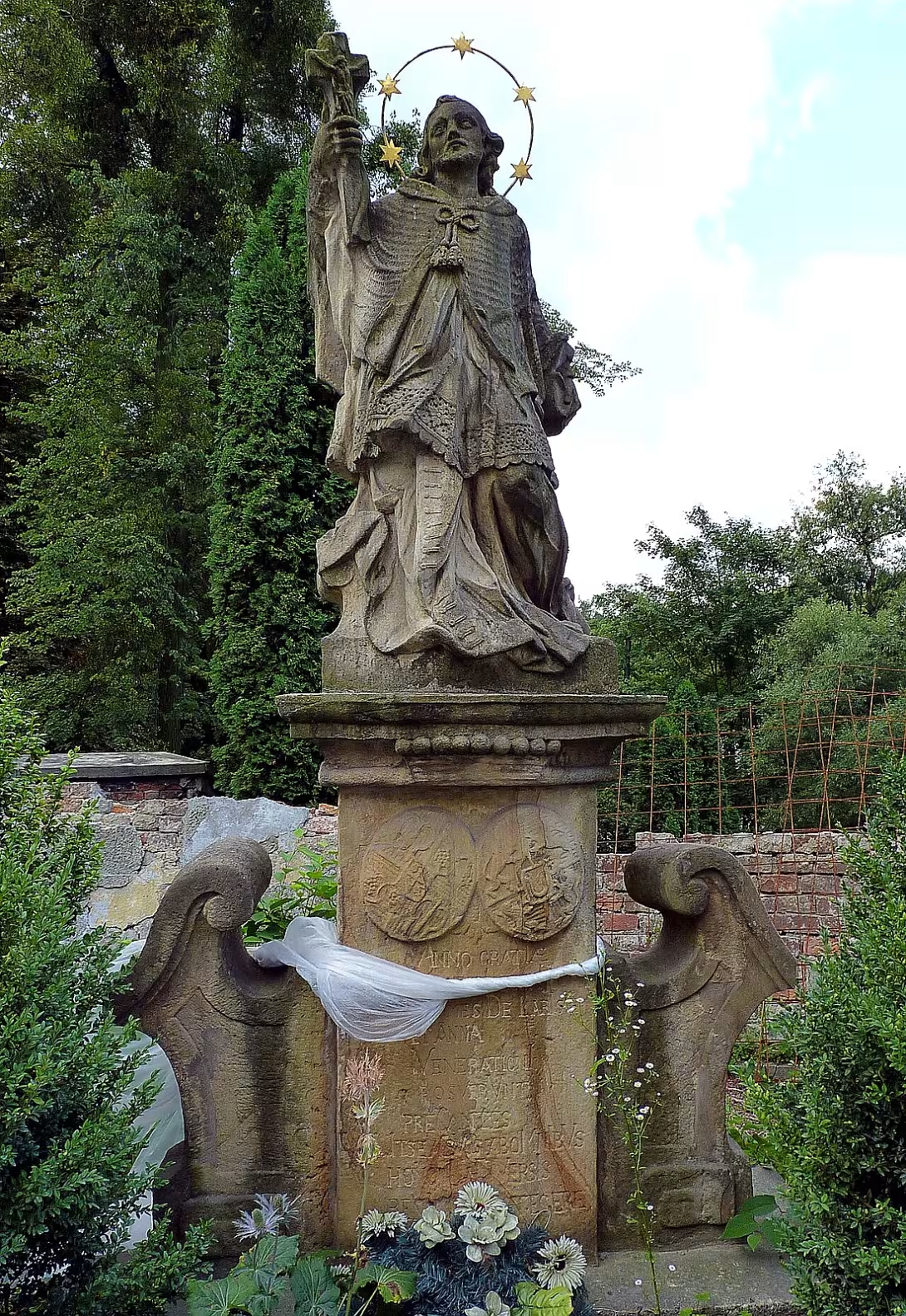
The statue of St. John Nepomucký in Fryštát is a cultural monument of the Czech Republic, which received attention thanks to historical importance and artistic skill. It is located near the Church of the Elevation of the Holy Cross in the cadastral territory of Karvina- town, specifically in Fryštát. This late Baroque sandstone monument is not only an important part of local culture, but also a testament to the historical changes and influence of the Larisch-Mönnich family on the region.
The statue was created in 1774- 1775 by Jan Josef Erdmann Larischam-Mönnich, who became the owner of Karviná Fideicomony Manor after the death of his older brother. It was originally placed in front of a public granary in Karviné-mines at the crossroads, which underlines its importance as an orientation point and symbol of family power. The men's granary was demolished in 1967 for submining the area, and the statue was moved to the parish garden of the Church of the Elevation of the Holy Cross in Fryštát in 1970. This step was necessary because of the reconstruction of the road I / 59 Karviná - Ostrava.
Architecturally, the statue is characteristic of the late Baroque style, which is reflected in its detailed processing. It represents St. John Nepomuk with carefully made draperia, which holds the cross in his right hand and in his left biret with palm branch. The statue stands on a pedestal decorated with volute wings and two heraldic characters of the genus Larisch-Mönnich, highlighting their ownership and patronage over this work. On the pedestal is also preserved Latin inscription dedicated to St. Jan Nepomuk, who expresses respect and gratitude.
The history of the statue is closely linked to the family Larisch-Mönnich, who influenced the region at the time of the late Baroque. Jan Josef Erdmann Larisch-Mönnich was a key person who made the statue as a monument and symbol of his family. The transfer of the statue to Fryštát in 1970 represents an important milestone in changing its location, which was motivated by infrastructure needs.
Today, the statue of St. John Nepomuk stands as an important cultural monument and attracts visitors not only with its historical value but also with artistic processing. Its current location at the Church of the Holy Cross in Fryštát makes it accessible and interesting for those who want to know more about regional history and art. If you have visited this memory, you can appreciate its importance as a testament to the past and as a reminder of Larisch-Mönnich's family heritage.
The statue of St. John Nepomuk in Fryštát is not only an artistic pearl but also a living document of history. Its presence in the region is reminiscent of the importance of historical care and protection of cultural heritage. If you have visited this memory, you can appreciate its historical value and artistic expression that goes beyond time.
Then and now
Drag the slider to compare how the landmark may have looked when it was built with the view today.
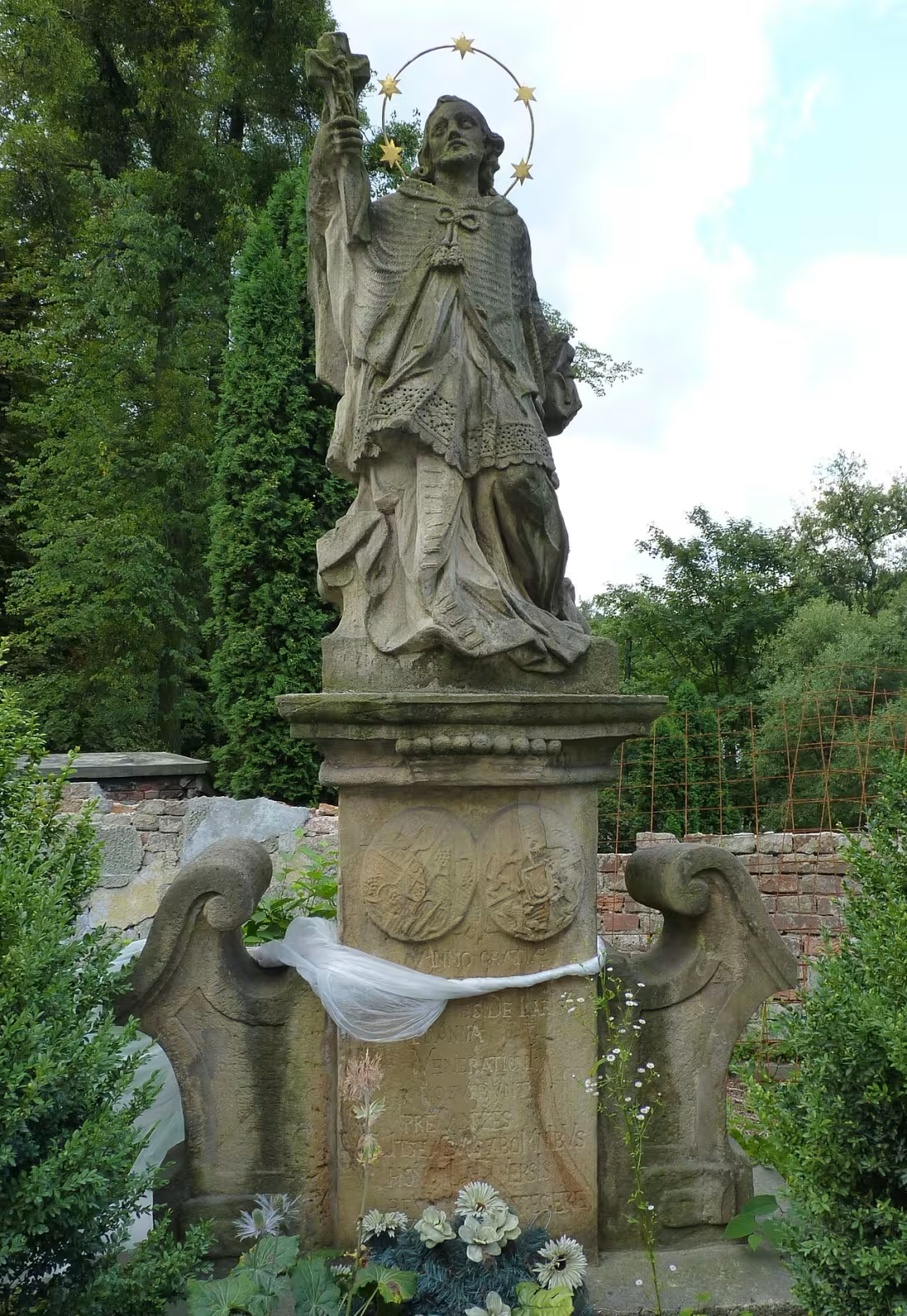

The historical appearance on the left is an AI-generated visualisation and serves as inspiration only.
Historical milestones
- 1774- 1775
- Creation of statue by Jan Josef Erdmann Larischam-Mönnich
- 1967
- Demolition of the men's granary in Karviné-mines for submining the area
- 1970
- Moving the statue to the church garden in Fryštát
Architectural development
The statue is made of sandstone in late Baroque style with emphasis on detailed drapery. The original location of the granary was destroyed as a result of demolition of the construction and submining of the area.
Historical events
- 1774- 1775
- Creation of a statue for Jan Josef Erdmann Larische- Mönnich.
- 1970
- Moving the statue to the parish garden of the Holy Cross Church for road reconstruction.
Owners
Jan Josef Erdmann Larisch-Mönnich (1775)
Points of interest
- The statue of St. John Nepomucký in Fryštát is a cultural monument of the Czech Republic. - Located near the Church of the Holy Cross Elevation in the cadastral territory of the Karvina- town, specifically in Fryštát. - The statue was created in 1774- 1775 by Jan Josef Erdmann Larische-Mönnich. - Originally it was located in front of a public granary in Karviné-mines at the crossroads, which underlines its importance as an orientation point and a symbol of family power. - The men's granary was demolished in 1967 for submining the area, and the statue was moved to the parish garden of the Church of the Holy Cross in Fryštát in 1970.
Guide
Show guide text
This text was created by artificial intelligence and has not been editorially reviewed. It may contain inaccuracies.
Welcome to Fryštát. You just stopped in front of one of the most important pieces of art this place has to offer. You're standing right in front of St. John Nepomuk's sandstone statue. Before we go into deeper exploration, let yourself just for a moment see the atmosphere of this place. In front of your eyes is a figure that is almost life size, and its presence in this space is very strong and dignified. The sandstone from which the statue is carved has its specific texture and color, which carries the glare of light and shadow, which gives the whole character incredible depth. Feel the calm but dynamic energy that this statue emits.
Let us now return to the time when this work was created. This statue is the masterpiece of the late Baroque period. In this style, artists tried to move, emotions and make the hard stone seem alive and flexible. The statue was created in the seventies of the eighteenth years of the eighteenth century, precisely in the years one thousand seven hundred seventy-four to one thousand seven hundred seventy-five. Its creator was Jan Josef Erdmann Larisch-Mönnich. This is very interesting, because the statue was not just a random piece, but it was connected directly to the important family that worked in the region. The creation of such a work at that time required not only enormous artistic skills, but also considerable means and desire to take care of the spiritual and aesthetic side of its surroundings.
Now, please, pay attention to the detail itself and take a closer look at the statue. Notice how an artist worked with the clothes of a saint. The draperies, the complicated folds of the dress, are elaborate to the last detail. It might seem that the substance is actually falling over the body of a saint and that it could move at every breath of wind. This movement is typical of Baroque style. Now look at the hands of the saint. In his right hand he holds a cross that is a symbol of his faith and sacrifice. In his left hand, he carries a biret, which is the specific hat that the clergymen wore, and a palm branch is added to it. This branch is not only an ornament, but in Christian art it represents victory over death and the symbol of the Martyrium.
If you look below, you'll see the base on which the statue stands. It's not just a simple support, it's a separate work of art. It is decorated with beautiful volute wings, which are the typical spiral shapes that match the overall dynamics of the statue. On the pedestal are also preserved two heraldic signs, i.e. the characters of the genus Larisch-Mönnich. These marks remind us of who was the patron saint of this work and how strong the family had ties to the surrounding landscape. In addition, you can see a preserved Latin inscription on the pedestal. Although Latin may be a little distant for us today, this inscription serves as a dedicated saint and as a link to the past, which has something to tell us.
Looking at this statue, we cannot ignore the character behind its creation. Jan Josef Erdmann Larisch-Mönnich was not only a common nobleman, but a man who shaped the face of the place during this period. His decision to make this work points to his deep religious faith and his appetite for high art. The statue thus serves as a permanent reflection of his personality and his influence on this territory.
Perhaps now you might wonder if this statue has always stood right here where you see it right now. And that's where the interesting thing is. The history of this monument is not entirely linear. The statue has passed over the years a path that has been affected by changes in the surroundings. In the year one thousand nine hundred seventy there was an important event when the statue was moved to this parish garden by the church. This transfer ensured that the statue could be preserved in a peaceful environment and protected from constant movement in urban space. It's fascinating how such minor changes in location can change the perception of the whole place. Today this statue is recognized as a cultural monument of the Czech Republic, which underlines its immense value for our common heritage.
You stand here before something that has survived centuries, survived changes in political regimes and the city itself. This statue is a silent witness to history that allows us to look into the minds of the 18th century people. Feel the continuity this sandstone saint represents.
I hope that this brief view of the statue of St. John Nepomuk enriched you and helped you better understand the beauty and depth of this place. Please continue the search. Fryštát has many other secrets and beauty waiting for you. Maybe you'll stop by the nearby Holy Cross Church or walk through the garden looking for more clues of history. We wish you a pleasant rest of your walk and enjoy every moment you spend in this beautiful environment. Goodbye.
Tips for visitors
For the best visual experience we recommend a visit in spring or autumn months. At these times the light is softer, which allows better observation of fine details of sandstone material and baroque carvings on the garment of the saint.
When shooting, focus on the detailed processing of the draperia and the cross the character holds. The best results are obtained during the morning hours or shortly before sunset, when the shadows are not too sharp and highlight the texture of the stone better.
We recommend you take a telescope or camera with you with a good zoom. The statue is almost life-size and thanks to its rich Baroque form offers many small details that you can better see from a larger distance.
During the visit you can also see the Church of the Holy Cross in Fryštát. This combination of historical sculpture and sacral architecture creates an interesting whole for all interested in history.
Children can observe a statue which, thanks to its size, is very impressive and try to find interesting shapes in its details.
Frequently asked questions
Can the monument be visited?
This is a structure in a public space that can usually be seen from outside free of charge. We have not verified that this particular one is freely accessible.
Where is the monument?
Location: Fryštát. The map on this page shows the exact spot.
Why is the monument protected?
It is listed in the Central List of Cultural Monuments of the Czech Republic as a cultural monument (register no. 1000144805).
Businesses nearby
Do you run a restaurant, accommodation, shop, museum, rental, wellness or other visitor service near this monument? Show yourself directly to the people heading to it — this is how they will see you in the app and on the web:
Nearby
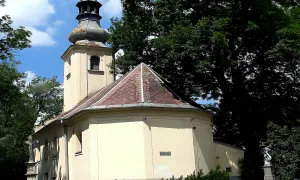
Kostel Povýšení svatého Kříže ve Fryštátě.
Accommodation nearby
Themed route
Statue of St. John Nepomuk Type: Memorial object This statue represents the main objective of your visit. It stands as an important cultural and spiritual symbol in the village Fryštát and offers a view of the traditional sculpture art region.
Church of the Holy Cross in Fryštát Type: Sacral construction This church is located in the immediate vicinity of the statue and forms a logical architectural complex with it. Its history and inner spaces complement the story of local spiritual events and provide a quiet place for reflection.
Tanks and surrounding church Type: Public space The space between the statue and the church allows to connect both points of the route to one smooth whole. It is an ideal place for a short pause, photo photography and admiration of the interconnections of sacral architecture and sculpture.
The inner spaces of the Church of the Elevation of the Holy Cross Type: Exposition / Interior If the church is accessible, there is an opportunity to see its interior. Here you can appreciate the details of the interior decoration and atmosphere that contrasts with the outdoor manifestation of the statue of St. John Nepomuk.
The surrounding streets of the municipality Fryštát Type: Urban development The final walk on the nearest streets allows you to better understand the context in which this monument stands. It offers a view of the daily life of the village and shows how historical elements are integrated into the current environment.
This route is designed to be maximum compact and focused only on specified locations. It starts at the statue, continues to the church and its surroundings and ends with a short walk in the immediate surroundings. The distances between the points are minimal, which allows the entire route to be managed during a short walk without the need for long travel. The emphasis is on connecting historical elements and atmosphere of the place, not on remote trips.
Seasonal recommendations
Spring - In March and April, the first green shoots and flowers bloom around the statue, the light is soft and scattered, highlighting the details of the bronze figure. At this time there are fewer visitors around, so you can choose the late morning when the sun is no longer too sharp, and put on a light jacket or sweater that protects against a colder breeze.
Summer - In the summer months, the sun is high and bright, which illuminates the statue in contrast and underlines its shiny surface; The surrounding trees provide shade and make the atmosphere more comfortable. The most suitable is the early morning or late afternoon when the crowds disperse and the temperature is not excessively high; Light T-shirt, shorts and sun screen will protect you from sunlight.
Autumn - In September and October, the leaves of the trees turn into golden and red shades, light is warmer and long shadows give the statues a nostalgic touch. It is recommended to arrive in the late afternoon when the sun boils to the horizon and the crowds are smaller; layered clothes, warmer sweater and light jacket will warm you up during the colder autumn wind.
Winter - In December and January, the surrounding area is covered with snow, which surrounds the statue with a quiet white background and reflects light on ice crystals, creating an almost mystical atmosphere. You can visit it best during noon when the sun provides enough light and snow is not too snowy; warm coat, hats, gloves and tight shoes are necessary for comfortable stay in cold weather.
Visualizations and artistic views


The visualisations are generated by artificial intelligence and serve as inspiration.
Photos from the area
Real photos taken near the monument


Zdroj a licence jsou uvedeny u každého snímku.
Tips from visitors
No tips yet. Be the first!
Log in and add your tip.
Sources and literature
Photos: Michal Klajban / CC BY-SA 3.0 — Wikimedia Commons. The author and licence also appear when you hover over the image.
Faktickým podkladem tohoto textu byl článek na Wikipedii, jehož autory jsou přispěvatelé Wikipedie. Článek je dostupný pod licencí CC BY-SA 4.0.
Location on the map
Příběhy a pověsti
Legendy, pověsti a příběhy spjaté s touto památkou
Fotografie návštěvníků
Zatím žádné fotografie. Buďte první, kdo přidá fotografii z návštěvy!
Log in a přidejte svou fotografii nebo hodnoťte.
Za ověřenou návštěvu v aplikaci získáte víc bodů — poznáme podle GPS, že jste na místě.
Reviews and comments