






Sochorova hrobka Tomb
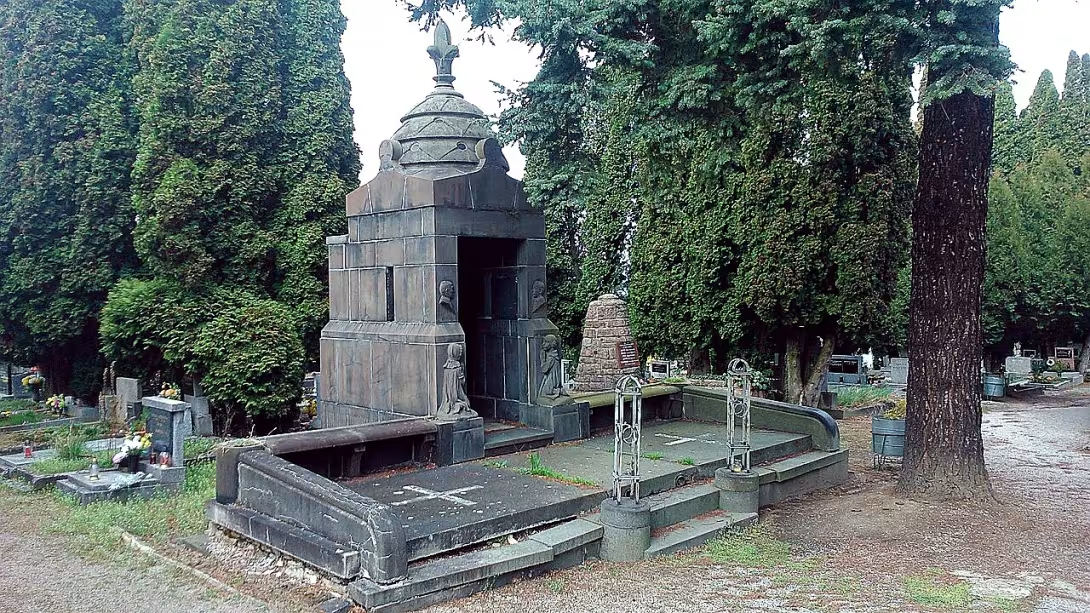
Sochorova hrobka is a Art Nouveau monument in the village Řevnice in Praha- west district, which dominates the local cemetery. The building was designed by the architect Eduard Sochor for himself and his family; since 2009 is protected as a cultural monument of the Czech Republic.
The tomb project was created in 1913, but the construction was only carried out in 1924. The Greek stonemason Karel Havlíček, who worked for Sochor, took the responsibility for the implementation. Originally the tomb stood at the old cemetery near the church, but after World War II it was moved to its present place.
The building has a square plan resembling a chapel and is lined with a worked stone. The entire object ends with a dome with a stylized lily. The sculpture was created by Josef Kalvoda. The entrance opening of the tomb is framed by figure reliefs of architect's children: in the lower part there are characters of two kneeling girls with their hands attached and in the upper part there are bust of two boys. The inside of the chapel is lit by two vertical rectangular windows. On the front wall there are relief of the head of Christ and two inscriptions: "Have respect for the dead" and "Talk about them only nicely." In front of the chapel is a space with stone panelling, where Latin crosses of white marble are inserted on the side of the cover. At the entrance there are two stone sockets of a circular plan, supplemented by metal decorative grids. Originally, the tomb was supplemented by a two-wing glazed entrance door.
The owner of the tomb was Eduard Sochor throughout his life. In 2007, the city of Řevnice received it from the last owner by a free transfer. Several losses occurred in the history of the building; For example, in the 1990s, bronze chains surrounding the tomb were stolen. The last funeral at this place took place in 1982 when Sochor's son-in-law was buried here.
Currently, the tomb is managed by the city of Řevnice. After its takeover in 2007, the city organised a public collection to ensure the most necessary repairs to the decrepit building. The work was done by Tomas Vanya and his associates. In 2016, the city applied for the building to be included in the Ministry of Culture's Emergency Programme on the basis of a restoration plan, which Tomáš Váňa prepared for the city free of charge.
This monument offers a view of the architecture of the late Art Nouveau as well as the personal story of the architect's family. It is an important witness to the history of the village Řevnice and deserves attention when visiting the local cemetery.
Historical milestones
- 1913
- The creation of the tomb project.
- 1924
- The completion of the tomb.
- 1982
- The last burial in the tomb.
- 2007
- The city of Řevnice has acquired the tomb.
- 2009
- The tomb was declared a cultural monument of the Czech Republic.
Architectural development
The tomb has a square plan and is lined with a treated stone. It ends with a dome with stylized lilies and the entrance hole frames figural reliefs. Part of it is the space in front of the chapel with stone panelling and inserted the Latin crosses of white marble. Originally, she was standing in an old cemetery near the church, where she was moved after World War II.
Historical events
In 1913 a tomb project was created. In 1924, the tomb was built by the Greek stonemason Karl Havlíček. After World War II, the tomb was moved to its current location. In 2007, the City of Řevnice acquired the tomb.
Owners
Eduard Sochor (until death), city Řevnice (since 2007)
Points of interest
- The tomb is an Art Nouveau monument designed by architect Eduard Sochor for himself and his family. - The construction was carried out in 1924 and the stonemason Karel Havlíček took part in its implementation. - Originally, the tomb stood at the old cemetery near the church, but after World War II it was moved. - The entrance opening of the tomb is framed by figure relief of children architect: two girls kneeling and two boys. - In the 1990s, bronze chains were stolen from the tomb.
Guide
Show guide text
This text was created by artificial intelligence and has not been editorially reviewed. It may contain inaccuracies.
Welcome. You are standing in front of one of the most important and beautiful points in this place. In front of your eyes is Sochorova hrobka, which, by its own presence, determines the whole atmosphere of this cemetery in Rivnik. It's a building that doesn't just act as a resting place, but as a real architecture that dominates the whole area. Feel now the calm, noble atmosphere that surrounds you. Look at the fort and the certainty this worked stone radiates. This building is not only part of the cemetery architecture, it is a separate work of art that invites you to reflect on the history and the art that was written in it.
To understand why this tomb is so special, we need to go back in time and look at the man behind its creation. It wasn't just a random construction project, it was a deeply personal vision. The tomb project was developed by architect Eduard Sochor himself. Imagine his intention - he designed this place for himself and his own family. This adds a completely different dimension to the construction, not just an anonymous monument, but an expression of family identity and eternity. The first sketches and projects appeared in 1913, when the world and art were on the threshold of great changes. The completion of the construction itself took several years and was completed in 1924. This time variance shows us how important every detail was to the creator and how much he appreciated the resulting work to serve generations.
Now pay attention to the very form of construction that is surrounding you right now. Sochorova hrobka is the peak of late Art Nouveau. If you look at its overall structure, you'll notice it has a square plan. This geometric purity gives her the appearance of the chapel, which gives the building a sacred and noble character. The whole body structure of the tomb is covered with a treated stone, whose surface and proper working indicates the immense skill of the craftsmen at the time. Your eyes should now slide upwards. Above the square base there is a dome which ends with a very specific and beautiful element - stylized lily. This lillie is not just an ornament, it is a typical Art Nouveau style element that carries the symbolism of purity and elegance.
When you look at the entrance of the tomb, notice how it is framed. The entrance is not a simple hole in the wall, but is decorated with figural reliefs. These sculpting elements add human dimension and depth to the construction. And if you have the opportunity to enter, the inner space will surprise you again with its wealth. Inside it lies the relief of the head of Christ, which brings spiritual dimension into the space, and is supplemented by various inscriptions that bear memory and word. This whole space is a harmonious connection between stone, art and faith.
But not only is the architect's imagination behind this masterpiece, but also the tireless work of hands. The architect Eduard Sochor designed the work, but in order to make his vision a reality, he needed a stonemason championship. The stonemason Karel Havlíček took over for the actual implementation. It was his work with the treated stone that allowed Art Nouveau shapes and lines to become a real part of this monumental building. It is a fascinating combination of intellectual design of architect and physical strength and precision of craftsman.
But you may think that this tomb has always stood here, that it has been a fixed point of this cemetery since the beginning of time. But the reality is much more interesting and a little more mysterious. This building has passed through an unusual path. Originally, the tomb stood in the old cemetery, which was at the local church. But there has been a fundamental change in times of major changes and after World War II. The tomb was moved from the original place to where you see it now. Imagine the difficulty and effort that had to be made to move such a massive stone structure, with its dome and fine relief, without losing its beauty and integrity. It's proof of how much people have appreciated this work in the past and how much they wanted to preserve its existence for future generations.
The history of this building does not end in the last century. Even in the modern era, the tomb retains its seriousness. The last burial in the tomb took place in 1982 when Sochor's son-in-law was buried here. Since then, the tomb has become primarily a cultural heritage. In 2007 it was taken over by the city of Řevnice and was officially declared a cultural monument of the Czech Republic in 2009. This is the highest recognition that it is not just a stone structure, but an immortal piece of our history and art.
Now that you know the story, the people and the details that make up this structure, I suggest you walk around it slowly. Look at it from different angles, see how light changes on its worked stone and how the Art Nouveau style lines are drawn against the sky. Let the silence of this place and the memories that Sochorova hrobka bears carry you. Thank you for spending this moment with us when exploring the beauty of the Rivers. We wish you a pleasant rest of your walk.
Tips for visitors
For the best experience we recommend a visit in the morning or late afternoon. In these times, light is ideal for watching details of Art Nouveau architecture and avoiding the greatest heat.
You can reach the location by car or via public transport. The current connection and parking possibilities in the village Řevnice please check the search engine before travelling.
When photographing, focus on the rich decorating of the tomb, which is typical of the late Art Nouveau style. The best results can be achieved with diffuse light, which better highlight the shape and structure of the building.
In the vicinity you can walk through the local cemetery where the tomb is located and look at the area near the church where the tomb was originally located. For families with children it is advisable to choose a slow walk in a quiet atmosphere of the village.
With us we recommend to take comfortable shoes suitable for cemetery terrain and possibly pocket handkerchief or water for convenience during the tour.
Businesses nearby
Do you run a restaurant, accommodation, shop, museum, rental, wellness or other visitor service near this monument? Show yourself directly to the people heading to it — this is how they will see you in the app and on the web:
Events nearby


Zdroj akcí: otevřená data měst a obcí ČR (Národní katalog otevřených dat) a kalendář akcí Národního památkového ústavu.
Nearby
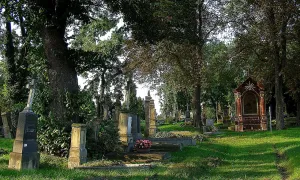
The tomb is located in the cemetery in the village Řevnice in the Praha- west district. She was originally standing in an old cemetery by the church.
Accommodation nearby
Trips and activities nearby
Guided tours, tickets and activities nearby from GetYourGuide
Affiliate link: if you buy from the partner, we may receive a commission. The price for you does not change.
Search tours and activities →Themed route
1. Old cemetery by the church Type: Historical site Why to visit: Here was originally the place where the tomb was moved. Provides historical context for understanding the origin of the monument.
2. Cemetery in the village Řevnice Type: Funeral area Why to visit: The current area where the main destination of the tour is located. It offers a peaceful atmosphere for walking.
3.Sochorova hrobka Type: Architectural memorial Why to visit: The main destination of the route, which will preserve its artistic value and detailed processing.
Seasonal recommendations
Spring: In spring nature awakens around the tomb and soft sunlight highlights the details of stony architecture. The atmosphere is fresh, but due to spring rains and terrain disruption, the road to the memory can be muddy. We recommend that you wear waterproof shoes and clothes in several layers to easily adapt to changing temperatures. The best place to visit is in the morning, when the light is most stable.
Summer: In the summer months the area of the tomb is densely green and intense sun creates dramatic shadows on the stone. There are more people here in the main summer season, which is why it is advisable to come right after the opening to enjoy your peace and avoid the greatest heat. Do not forget the sun protection and plenty of drinking water, because in the open area it can be very hot during the day.
Autumn: Autumn brings a melancholy mood that fits perfectly with a place like this tomb. Morning fog and falling leaves create a mysterious atmosphere that underlines the ageing and neglect of the monument. It is necessary to prepare for colder and wetter weather, so choose a fixed jacket. The ideal time to visit is in the afternoon, when the colors of surrounding vegetation most excel in low light.
Winter: The winter season is characterized by raw and quiet, when bare branches of trees reveal the whole structure of the monument. The light is gray and blurred at this time, which deepens the sense of loneliness. Due to low temperatures it is necessary to wear very warm clothes and high quality shoes. The opening time is shorter in winter, so check it before travelling and plan a visit around noon when the most light is.
Visualizations and artistic views

The visualisations are generated by artificial intelligence and serve as inspiration.
Photos from the area
Real photos taken near the monument


Zdroj a licence jsou uvedeny u každého snímku.
Tips from visitors
No tips yet. Be the first!
Log in and add your tip.
Sources and literature
Photos: Jakub Safranek / CC BY-SA 3.0 — Wikimedia Commons. The author and licence also appear when you hover over the image.
Faktickým podkladem tohoto textu byl článek na Wikipedii, jehož autory jsou přispěvatelé Wikipedie. Článek je dostupný pod licencí CC BY-SA 4.0.
Location on the map
Příběhy a pověsti
Legendy, pověsti a příběhy spjaté s touto památkou
Fotografie návštěvníků
Zatím žádné fotografie. Buďte první, kdo přidá fotografii z návštěvy!
Přihlaste se a přidejte svou fotografii nebo hodnoťte.
Za ověřenou návštěvu v aplikaci získáte víc bodů — poznáme podle GPS, že jste na místě.
Reviews and comments