



Terschův dům Tenement house
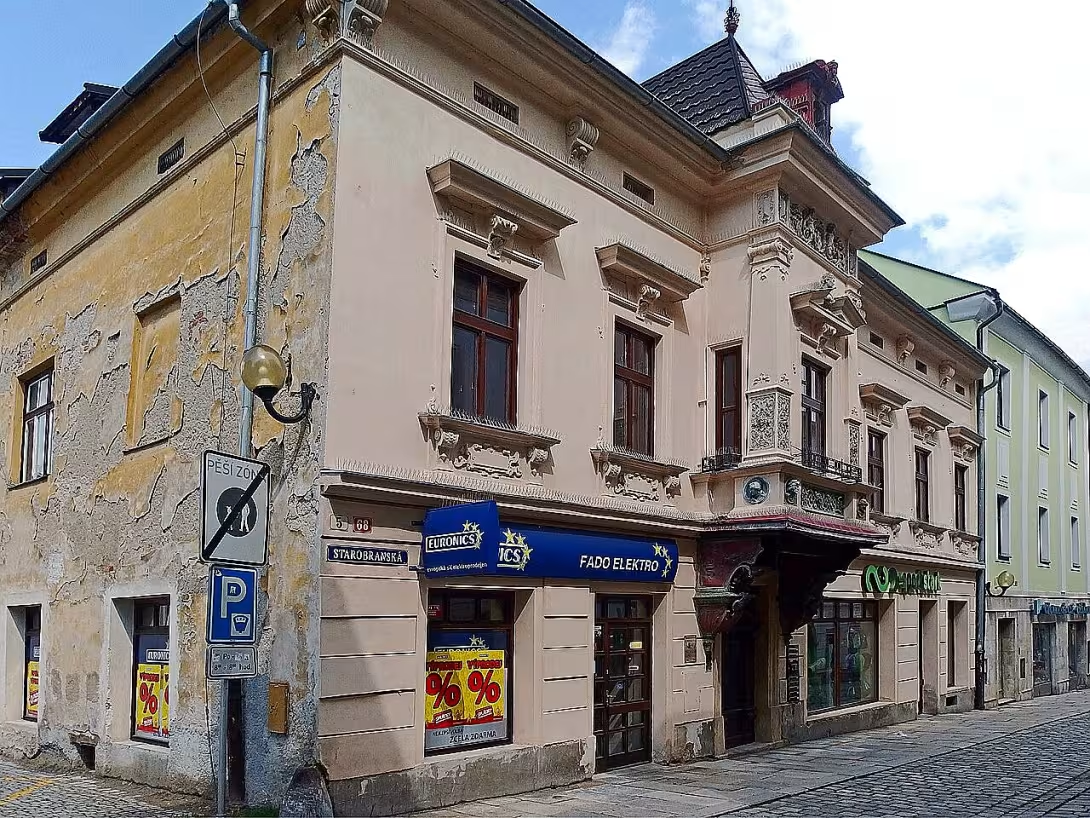
Terschův dům is a historic building in the centre of Šumperk at Starobranská 68 / 5. It excels at the Neo-Renaissance appearance and rich stucco decoration. It stands on medieval foundations and is important in its connection with the Tersch family and the history of the first private post in Austria-Hungary. Since 1994 it has been registered as a real-estate cultural monument.
The building was created by connecting two originally separate medieval houses, which occurred between 1761 and 1800. In the left part of the building in the past lived Purkmaster Johann Dominik Beck, who since 1679 worked at the Inquisition Tribunal. The right part belonged to T. Wendtland; Here in 1669 his wife and daughter died during the devastating fire of the city.
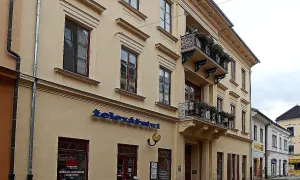
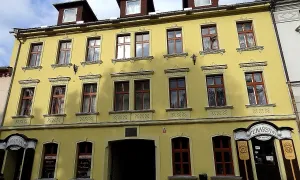
The current form of the house is the result of a reconstruction from 1886 initiated by the owner Fridrich von Tersch, the later mayor of Šumperk. The building is single-storey, triple-winged, walled and finished with valbic roofs. The dominant of the seven-axis street facade in the historic style is the Neo-Renaissance bay in the third axis. It is carried by decorative acorns and its fronton has a woman's bust. The stucco decoration of the bay depicts two winged virgins with laurel wreaths whose bodies go volute.
The facade horizontally divides the cordon ledge and lays, while the crown ledge is carried by volute consoles. The sandstone entrance portal ends with a trapezoidal jewel with a mascaron. The door is supplemented by a grid with volute motifs and an edicula with Ionian warheads. The windows on the floor are decorated with free wings, mantelpiece and St. James shell motif. The side facade facing the street Na Hradby is smooth.
Despite later modifications, the interior has preserved valuable elements. Baroque arched spaces are preserved in the courtyard wings. The former passage is glazed with flaps for massive passports. On the ground floor there are also rolled vaults with liaison lunettes or segment vaults into steel beams. An important element is a three-arm staircase with stone levels and cast iron railing, which decorate motifs of lilies, volutes, bows and heartfelt leaves with palmeta. On the first floor, there's an arcade corridor encircled with passports.
The house was long owned by the Tersch family, which got rich in textile and tobacco trade and also owned locks in Chubabana and Tremeška. In 1841, Franz Xaver Tersch mladší established the first private post office and a switching station in Austria-Hungary. The post office was based here until 1884 when it was nationalized after the founder's death. Financial exhaustion from real estate investments forced the family to sell in 1861 to the farm yard. In honor of Fridrich von Tersch, the street in which the house stands was the name of Terschova in the early 20th century.
Currently, the ground floor of the house is used for commercial purposes, namely as a shop for electrical appliances and equipment for sport and leisure. According to the National Heritage Institute, however, the use of premises as large-scale shops exerts pressure on the destruction of cultural values of the building. The monument value of the house consists primarily of representative facade, arcade corridor and basement and ground vaults.
Terschův dům represents a unique urban element of the Starobranska street and connects the architecture of historism with deeper layers of urban history. It's a place where the business history of the city clashes with the personal destinies of its inhabitants. The visit to this building offers a view of the top craftsmanship in the facade details and in the preserved inner vaults.
Historical milestones
- 1841
- Establishment of the first private post office and switching station in Austria-Hungary
- 1886
- Rebuilding the house into today's Neo-Renaissance form
- 1994
- Writing to the Central List of Cultural Monuments of the Czech Republic
Architectural development
The building was built on the foundations of two separate medieval houses which were connected in the 18th century. In 1886, a major reconstruction was carried out in the style of the neo-Renaissance with historical elements. The dominant feature of the facade is a richly decorated bay with a female bust in front of the front and sandstone entrance portal.
Historical events
1669: The devastating fire of the city, in which members of the Wendtland family died in the right part of the house. 1841: Establishment of the first private post office and switching station in Austria-Hungary. 1884: The nationalisation of the postal institution after the death of Franz Xaver Tersch.
Owners
Tersch family (bought both houses between 1761 and 1800), Fridrich von Tersch (owner in 1886)
Points of interest
- The building is built on medieval foundations and created by the combination of two previously separate houses. - In the left-hand side, there was a Purkmaster Johann Dominik Beck who worked in the tribunal against witches. - In 1841 Franz Xaver Tersch mladší established here the first private post office and the switching station in Austria-Hungary. - The Tersch family, who long owned the house, got rich in textiles and tobacco. - The front of the house is decorated with a Neo-Renaissance bay with a bust of women and figures of winged women.
Guide
Show guide text
This text was created by artificial intelligence and has not been editorially reviewed. It may contain inaccuracies.
Welcome to the historical heart of Šumperk. You're standing in front of a building that tells the story of ambition, trade, and city changes in its appearance and history. In front of you is Terschův dům, a building that with its face represents the wealth and importance this place had in the past. If you look at her now, you'll see a building that dominantly fills space and attracts the attention of anyone who passes through the center of the city. It's a place where different layers of time meet, from the deep Middle Ages to the end of the nineteenth century.
Let's come together to see how this house was built and why Šumperk is so important. Even if you see a united entity today, there is a secret in the foundations. This building was created by connecting two previously separate houses. What you see today as one big building was once two different walls, two different homes. It is fascinating to think that under your feet, deep in the earth, there are still medieval foundations. This means that people have lived and worked here since Šumperk was a completely different city, full of narrow streets and clay roads.
Now pay attention to the very aspect of the house. What you see in front of you is the result of a major reconstruction in 1886. At that time, the building turned into what we now call a neo-Renaissance. Look carefully at the facade and observe the rich stucco decorations. These decorative elements that decorate the facade were supposed to express the status and wealth of the owners at that time. It was a period when the city flourished and the houses were to be not only functional, but, above all, representative. Although we do not know the names of the particular architects who designed this project, their work is clear in the precision of detail and in the harmony of the whole appearance.
If you had the opportunity to look inside, you would find that the house keeps valuable clues from much older periods. In the interior are preserved Baroque arched spaces and arcade corridor, which form a beautiful contrast to the later Neo-Renaissance appearance from the outside. It's like a journey in time where one room belongs to one century and another to another. It is this combination of elements from various era that makes Tersch's house a unique monument, which since 1994 has been officially protected as a real cultural monument of the Czech Republic.
Let us now move on to the people who lived and worked in these walls because it was they who breathed life into the house. Close to the building, the Tersch Knights family is connected. A particularly important figure was Fridrich von Tersch. But the house also carries other, much darker stories. Notice the left side of the building. It was here in the past that the magistrate Johann Dominik Beck lived. Who was this man? He wasn't just the town manager. Beck worked in a tribunal that tried people accused of witchcraft. Imagine the atmosphere of fear and tension that must have existed in these premises at that time, when it was the fate of the people in the process against the witches. It's a frosty contrast to a later bloom of the house.
However, Terschův dům is not only about court proceedings, but above all about innovation and progress. Let's transfer to 1841. It was this year that Franz Xaver Tersch mladší founded something that was completely groundbreaking at the time. He established the first private post office and a switching station throughout Austria-Hungary. Try to imagine it when there were no phones or Internet. The mail was the only thread that connected people over long distances. The loading station then meant that one horse's journey ended here and the journey of other fresh animals began so that the transport of goods and letters could continue at full speed. So this house was basically the logistics center of its time, a place of constant movement, rush and transmission of messages from all over the world.
It's fascinating how the functions of one building changed over the centuries. From the medieval foundations, to the seat of the purkmaster involved in witch hunting, to the modern private post office and subsequent magnificent neo-Renaissance reconstruction. Each of these layers is giving us different feelings. From mystery and fear, to feeling progress and business success, to admiration for the aesthetic beauty of the late nineteenth century.
Now if you look at the building as a whole again, you probably don't just see it as a beautiful house in the center of the city. You see in it a monument to Shumper history. You see in it where the history of communication was written in our region and where the various social layers clashed. Terschův dům is a silent witness to everything that happened in Šumperk, and its walls would probably be able to tell thousands of stories about people coming here over the centuries.
I suggest you stay at the building for a while and try to imagine the noise of the horses in the switching station or the quiet whispering in the arcade corridor. Feel the atmosphere of this place, which so firmly stands in the heart of the city and reminds us that history is not only in the books but is present in the stone and stucco around us.
This concludes a short tour of Tersch's house. I hope that this information has enriched you and that you are now seeing this memory in a new light. Šumperk has many other hidden treasures in the centre waiting for your discovery. I invite you to another walk through the city and explore other historical clues that lead us from the past to the present. Thank you for your attention and I wish you a pleasant rest of the day in our beautiful city. Goodbye.
Tips for visitors
The best time to visit is late afternoon, when the sun hits the Neo-Renaissance facade and highlights its details. The building is located in the centre of the city, where you can transport by car or public connections; Check the current transport possibilities in the maps.
We recommend taking shoes suitable for walking through the historical centre. As it is a residential building, focus on observing architecture from public spaces.
For the best photos we recommend the angle from the opposite side of the street, which captures the entire height of the house. Most details of the facade stand out in bright daylight.
Families with children can use a visit to search for historical characters on the local walls, which will make the city centre visit a small discovery trip.
Frequently asked questions
Can the monument be visited?
This is a residential or farm building, not a museum with opening hours. Please view it from public space and respect the owners' privacy. We have no information about access to the interior.
Where is the monument?
Location: Šumperk. The map on this page shows the exact spot.
Why is the monument protected?
It is listed in the Central List of Cultural Monuments of the Czech Republic as a cultural monument (register no. 1000119973).
Businesses nearby
Do you run a restaurant, accommodation, shop, museum, rental, wellness or other visitor service near this monument? Show yourself directly to the people heading to it — this is how they will see you in the app and on the web:
Events nearby


Zdroj akcí: otevřená data měst a obcí ČR (Národní katalog otevřených dat) a kalendář akcí Národního památkového ústavu.
Nearby
🏰 Historic sites (62)
- Morový mariánský sloup 0.1 km
- sv. Marek Evangelista 0.2 km
- sv. Matouš Evangelista 0.2 km
- sv. Lukáš Evangelista 0.2 km
- Elsa a Emil Bodanští 0.3 km
- Malvína a Emanuel Kantorovi 0.3 km
- Elsa Guttmannová 0.4 km
- Oskar Guttmann 0.4 km
- Vlastivědné muzeum v Šumperku 0.5 km
- Tomáš Garrigue Masaryk 0.6 km
- rodina Schildová 0.8 km
- Muzeum silnic 2.0 km
- Zámek Třemešek 3.0 km
- sv. Rozálie 3.1 km
- Jubilejní kámen knížete Johanna II. z Lichtenštejnu 3.4 km
- Bludov 4.2 km
- Pomník Adolfa Kašpara 4.2 km
- Pomník obětem 2. světové války 5.0 km web
- Pomník obětem 1. světové války 5.1 km web
- Pomník Josefa Kutschery 6.7 km
🍽️ Restaurants and dining (128)
- Cakir's Burger 0.0 km náměstí Míru 23 +420 775100935 web
- Úzká 2 0.0 km
- Minigolf 0.1 km
- Na Lok 0.1 km Starobranská 14 +420 777 441 876
- Pikola 0.1 km Polská 80/3 web
- Bar & Bar 0.1 km Radniční 2
- Kafe Tuli 0.1 km Radniční 19 web
- Bistro J&J 0.1 km Gen. Svobody 244/9
- Mr.india 0.1 km Bulharská 214/2 web
- Restaurant Schiller 0.2 km
- Hotel Hansa 0.2 km
- Fabulous Shisha Lounge 0.2 km Gen. Svobody 55
- U Slovanu 0.3 km
- Restaurace Koruna 0.3 km
- Taverna Salonica 0.3 km
- Pod Komínem 0.3 km
- Pizzeria Istria 0.3 km web
- Pekárnička a café císaře Josefa II. 0.3 km
- Pizzeria Istria 0.3 km
- Opera 0.4 km
🏨 Accommodation (71)
- Hansa 0.2 km
- Černý havran 0.2 km web
- Hotel Koruna 0.3 km web
- Korzo 0.4 km
- Hotel ELEGANCE 0.4 km
- Rotunda 0.5 km web
- Apartmány Elektra 0.5 km web
- Pension Villa Ancora 0.6 km
- Penzion G 0.6 km Fialova 3
- Perk 0.6 km 17. listopadu 413 +420 581 580 000;+420 733 538 082 web
- Moravan 0.8 km web
- Penzionek 0.9 km web
- Sport 1.3 km
- Pod Hájem 1.8 km
- Penzion D 2.0 km
- Penzion JIRSÁK 2.2 km web
- penzion Na Domkách 2.3 km
- Penzion Trámky 3.6 km web
- Na nové 3.9 km
- Autokemping Krásné 4.4 km
🚲 Rentals and sport (27)
- Dama Sport 0.1 km
- Globe sport 0.3 km
- Polách a syn 0.3 km Žerotínova 1/561
- Sport Centrum Kotelna 0.7 km
- Myší díra 0.8 km
- ČD Bike 0.9 km
- HAS bike 1.0 km
- Sportisimo 1.1 km
- Aquacentrum Šumperk 1.5 km
- baseballové hřiště Šumperk 1.6 km
- Střelnice 1.7 km
- fotbalové hřiště Nový Malín 5.2 km
- Koupaliště Ruda nad Moravou 6.7 km
- skiareal Hraběšice 7.9 km web
- TJ Postřelmov 8.1 km web
- Nava sport 8.8 km
- Therme Losiny 9.1 km web
- Školní tělocvična 10.2 km
- DENALI SPORT 11.5 km Československé armády 651/9
- Sportisimo 11.6 km
🥾 Hiking and nature (188)
- Radniční věž 0.1 km
- Čarodějnické procesy 0.1 km
- Jiráskovy sady 0.4 km
- Smetanovy sady 0.4 km
- Sady 1. Máje 0.6 km
- Park Bohuslava Martinů 0.8 km
- Discgolf Šumperk 1.4 km
- U kapličky 1.9 km
- Holubí vrch 2.0 km
- Chocholík 2.4 km
- Háj u Šumperka 2.7 km
- Háj 2.7 km
- Kokeš 2.9 km
- Korea 2.9 km
- Anděl 2 3.5 km
- Ostředek 3.8 km
- Malínský vrch 3.9 km
- Kostelní vrch 4.0 km
- Kokrháč 4.0 km
- Baba 4.1 km
Accommodation nearby
Themed route
Terschův dům
1. Terschův dům (building) - The main destination of the trip, where one can admire the unique architecture and historical details of this city house. 2. Interiors and exposures (indoor spaces) - A tour of rooms and exhibitions that represent life in the mine and its importance to the surroundings. 3. Tanks (areal) - A quiet place to relax and look at the facade details up close.
Seasonal recommendations
In spring nature wakes up around the house and the colors are getting more lively. The light is soft and does not shine. I recommend you take several layers of clothing because the wounds are cold and the afternoon can be warm. The best time to observe the facade is in the morning when the sun lights up the walls.
In the summer months the area is full of thick green and the days are very long. The sun shines strongly and creates sharp shadows on the walls of the building. It is advisable to wear light fabrics and not forget the protection from the sun such as a hat. It is best to visit a place in the late afternoon when the air is more pleasant.
Autumn brings to Šumperka golden shades and morning fog that provide the house with a mysterious atmosphere. Leaves change color and it feels very calm. It is necessary to prepare for moisture and cold, so select a waterproof jacket. The ideal time is around sunset, when the colors most excel.
The winter can be covered with snow and it is very quiet and static. The day is short and the light is weak, often gray. It is necessary to wear very warm clothes, hat and gloves so that it does not freeze. The best is to come around noon when the lights are the most.
Visualizations and artistic views

The visualisations are generated by artificial intelligence and serve as inspiration.
Photos from the area
Real photos taken near the monument


Zdroj a licence jsou uvedeny u každého snímku.
Tips from visitors
No tips yet. Be the first!
Log in and add your tip.
Sources and literature
Photos: Palickap / CC BY-SA 4.0 — Wikimedia Commons. The author and licence also appear when you hover over the image.
Faktickým podkladem tohoto textu byl článek na Wikipedii, jehož autory jsou přispěvatelé Wikipedie. Článek je dostupný pod licencí CC BY-SA 4.0.
Location on the map

Příběhy a pověsti
Legendy, pověsti a příběhy spjaté s touto památkou
Fotografie návštěvníků
Zatím žádné fotografie. Buďte první, kdo přidá fotografii z návštěvy!
Log in a přidejte svou fotografii nebo hodnoťte.
Za ověřenou návštěvu v aplikaci získáte víc bodů — poznáme podle GPS, že jste na místě.
Reviews and comments