






Těšnovský tunel Street
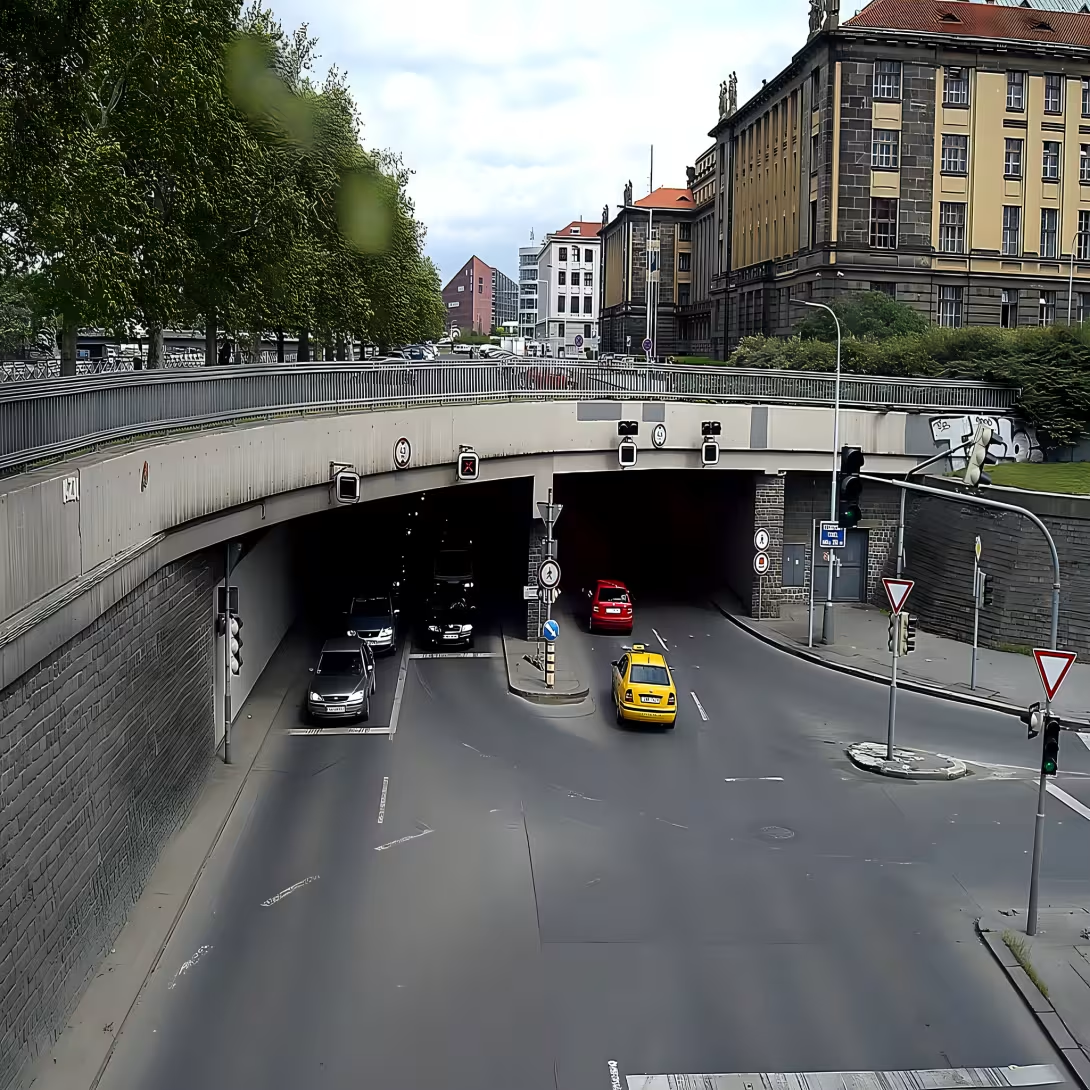
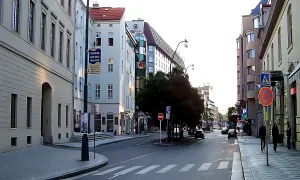
Těšnovský tunel is a shallow, deep road tunnel, which is one of the characteristic elements of Prague's transport infrastructure Vltava. He bears his name according to Těšnov, the area he crosses. The tunnel connects Louis Svoboda's waterfront in New Town in Prague 1 with the Rohan waterfront in Karlín, Prague 8, where its eastern outcome is located. It transfers underground transport in these places, which makes it one of the important transport structures connecting the banks of the river and the city district.
The tunnel is located in the immediate vicinity of major state institutions - near its northern entrance the buildings of the Ministry of Transport and ČD are situated near the Ministry of Agriculture. It was because of its location near the former headquarters of the Communist Party of Czechoslovakia and the context of its construction in the 1980s that the tunnel received the nickname "Husák's silence" - a name linking political history to its insignificant architecture.
The tunnel was completed and operational on 1 October 1980. The tunnel is 360 metres long and has two double-striped tubes, allowing it to transport in both directions. It is part of a larger transport structure - the cross-level crossing of coastal pull with the North South Magistrate. As part of this solution, the tunnel undergoes the Hlavkova Bridge, which represents an elegant engineering solution of dense urban space.
The traffic environment of the tunnel is controlled by two light-controlled junctions. At the west end of the tunnel there is a level crossing with Holb Street, at the east end there is a junction with Ke Štvanici Street. Both junctions perform a key function - connect coastal communication to the various directions of the North-South Magistrate, thereby ensuring safe operation in this intensely loaded location.
The tunnel with its relatively shallow depth proved vulnerable to natural phenomena. In the floods in 2002, the tunnel was completely flooded, indicating the risks associated with its location near the river. However, it remains an essential part of the transport network of Prague, which makes it easier to drive millions of cars every day between New Town and Karlin without the need to hinder surface communication.
Historical milestones
- Around 1975
- The start of preparatory work on tunnel construction within the North South Magistrate.
- 1980
- Completion and commissioning of the Těšnovský Tunnel connecting Nové Město to Karlin.
- 2002
- The tunnel was completely flooded during the flood, which revealed its vulnerability.
Architectural development
It is a deep tunnel with concrete construction, built within the transport infrastructure of the 1970s. It was formed as part of the North-South Magistrate and is part of an off-level crossing with coastal thrust.
Historical events
- 2002
- The tunnel was completely flooded during the flood.
Points of interest
- The tunnel connects Louis Liberty's waterfront in New Town with the Rohan waterfront in Karlin, connecting two parts of Prague.
- Due to its location near the former headquarters of the KSČ and construction in the 1980s, he was nicknamed * "Goose's Silence" *.
- The tunnel is 360 meters long and has two separate tubes for transport in both directions.
- During the 2002 flood, the tunnel was completely flooded, which showed the risks of its location by the river.
Guide
This guide is narrated by a synthetic voice generated by artificial intelligence.
Show guide text
This text was created by artificial intelligence and has not been editorially reviewed. It may contain inaccuracies.
Welcome to one of those Prague sites, which, at first glance, may seem improper, but on closer examination, there are fascinating layers of history, politics and human destiny. You are standing right outside the Těšnov Tunnel, which is where practical transport meets silent witnesses of the past era. Look around you and perceive the atmosphere of this space. It is a place that brings together two important parts of our city, Nové Město and Karlín, while at the same time serving as evidence of how the city has been changing over the past decades. In front of you is the entrance to a deep road tunnel, which basically functions as a modern artery, allowing thousands of vehicles daily to continuously overcome obstacles to the terrain and urban buildings.
Let us now return together in time to understand why this tunnel is here and how it came to be. It all started in the mid-1970s, around 1975. At that time, Praha was in a period of intensive planning of its transport network. There was a vision of the so-called North South Magistrate, which was an ambitious project to solve growing traffic problems in the city centre. Těšnovský tunel was a key part of this whole, namely a cross-border coastal move with just mentioned magistrate. So imagine the time, the noise of construction machines, and the effort of the then regime to imprint the city with a new, functional form that fits the requirements of efficiency and speed. After several years of hard work, the tunnel was completed and operational in 1980. From that moment on, he began to perform his basic role, which he is also shooting today, which is to connect Louis Liberty's waterfront in New Town to the Rohan waterfront in Karlin.
Now pay attention to the structure itself and to what you see before you. Although it may seem to be just a concrete pipe in the ground, its dimensions and arrangements tell their own story. The tunnel is exactly 300 feet long. If you want to imagine it in space, it's four city blocks in a line. Note that the tunnel is not one large space, but consists of two separate two-lane tubes. This means that traffic in both directions is completely separated, which increases the safety and fluidity of the journey. Look at the entrance to the tunnel and see how acoustics and light change. It is a transition from open urban space to a closed, technical environment that has been designed to handle a huge flow of vehicles. The architects who proposed this project remained anonymous, which is quite common in the case of such functional buildings from that time. The aim here was not to create an aesthetic monument, but above all a reliable transport node.
But when we stop at the very place where the tunnel lies, we come across one of the most interesting layers of Prague's storytelling. Těšnovský tunel is located in the immediate vicinity of the place where the Communist Party of Czechoslovakia used to stand. This position gave the tunnel a very specific, popular name, which many know in Prague. It's called Goose's Silence. It's a fascinating nickname that carries a deep ironic undertone. The name refers to Gustav Husák, the country's longtime leader at the time of normalization. Why silence? It's a paradox because the tunnel is a place of constant engine noise and tyre noise. But silence here does not mean the absence of sound, but rather the atmosphere of the time, the atmosphere of silence, caution and political pressure that radiated the neighbourhood with the headquarters of power. Thus, the tunnel is not only a transport structure in Prague's collective memory, but a symbol of a particular era, where thousands of people's destinies were decided in the vicinity, while everyday traffic flowed over their heads or under their feet.
In addition to political shadows, the tunnel also experienced dramatic clashes with nature, which reminded us that even the strongest concrete structures have their limits. Let's move on to 2002. Do you remember, or did you hear about the catastrophic flood that was happening in Prague? Těšnovský tunel was at that time one of the most affected infrastructures. Because of its position in the lowland and near the Vltava, the tunnel was completely flooded. The water filled both tubes up to the ceiling, which basically made it a huge underground tank. This event was both a shock and a valuable lesson for the city. It revealed the vulnerability of modern transport to the natural elements. The cleaning of the mud tunnel and the subsequent repair of technology were a colossal operation that lasted a long time and showed how critically dependent we are in the modern city on these underground connections.
The interesting thing you may not see at first sight is the unique way the tunnel connects two different parts of the city. Nové Město with its dense installation and Karlín, who was reborn after the flood of 2002 and became one of the most modern and desirable places in Prague. So the tunnel is basically a bridge, even if it's underground. It connects the old with the new, administrative center with the dynamic neighborhood, where modern architecture and cafés today rule. It's an invisible stitch that holds these two parts together and allows them to function as one organism.
Now, if you look again at the entrance to the tunnel, try to see it not only as part of the road, but as a layered archive. You see 1975 and the hope of a new construction, 1980 and the completion of the project, the shadows of the Hussakov regime and the silence that persists in the name, and finally 2002, when the water from the Vltava wave. Těšnovský tunel is a reminder that even in the least romantic elements of our city, such as road tubes, with the backgrounds of history.
Now invited to further explore the surroundings. I recommend to walk towards the waterfront and perceive the contrast between the noise of traffic in the tunnel and the calm of the river. Watch how the city's face changes when you go from New Town to Karlin. Těšnovský tunel helped you in this transition, but now you can continue at your own pace and discover other hidden corners of the Prague center. Thank you for stopping by this unusual place. I wish you a pleasant continuation of your trip to Prague and many other fascinating discoveries. Goodbye.
Tips for visitors
{'paragraph': 'Best time to visit the Těšnov tunnel is early in the morning or late in the afternoon. In these times the tunnel is least disturbed by transport and you can better see its architecture and surrounding environment without disturbing noise. In addition, in sunny weather it is advisable to go out in the early morning hours when light falls favourably and creates interesting shadows on the stone walls of the tunnel.'}
{'paragraph': 'You can use both public transport and a passenger car to transport to the Těšnov Tunnel. The location is well accessible from the centre of Prague. If you are arriving by car, find the nearest parking lot near the seafront of Louis Liberty or the Rohan waterfront. It is recommended to use public transport, which is very dense in this part of town and allows easy access directly to the tunnel.'}
{'paragraph': 'When visiting the tunnel, take comfortable shoes and suitable clothes because walking through the tunnel and its surroundings can be quite difficult to move. Next, prepare a mobile phone with a map so that you can easily navigate around and visit other interesting places. If you are planning to take pictures, do not forget the quality camera or at least the smartphone with a good camera.'}
{'paragraph': 'Photography in Těšnov Tunnel is very interesting, especially in terms of architecture and light effect. The best places for photography are tunnel entrances on both sides, where natural light is combined with artificial lighting. It is recommended to photograph at sunset when light creates contrast effects and highlights tunnel structure. The entrances to the waterfront of Ludwig Svoboda and the Rohan waterfront also offer interesting compositions with surrounding buildings.'}
{'paragraph': 'There are several interesting places around the tunnel worth visiting during your trip. Approximately 200 metres south of the tunnel is located the Hlavkov Bridge, which is an ideal place for walking along the Vltava and observing the surrounding environment. At the west end of the tunnel, in the direct neighbourhood, there is a building of the Ministry of Transport, which is architecturally interesting and offers the possibility of a short stop. Also look around the tunnel, where there are other historic buildings and parks.'}
{'paragraph': 'For families with children, visiting the Těšnov Tunnel is an interesting activity which can be associated with a short walk and discovery. Children can see the interesting structure of the tunnel and see how the tunnel is embedded in the field. There are also small parks and green areas around the tunnel where children can play and relax. It is also recommended to visit the Hlavkov Bridge where children can track ships in Vltava and observe the surrounding nature.'}
Frequently asked questions
Is Těšnovský tunel open to the public?
Yes, Těšnovský tunel is publicly available. Visitors may enter the tunnel during normal working hours.
How do I get to the place by car / public transport?
By car you can reach the tunnel through the Rohan waterfront or the Těšnovská street. The public transport line No 9, 15 and 26 can be reached at the stop 'Tešnovská'.
How much is the entrance fee and is it paid on the spot?
Admission is free, visitors can visit the tunnel free of charge.
Is the tour suitable for children and seniors?
Yes, Těšnovský tunel is suitable for all age groups. Visitors can combine the tour with other activities in the area.
How long does the tour take?
The tour of the Těšnov tunnel takes approximately 15-30 minutes, depending on the speed of the visitors.
What are the opening times and booking is required?
The tunnel is available during normal working hours (8: 00 - 16: 00), reservation is not required.
What's interesting in the immediate vicinity?
In the immediate surroundings there are Nové Město, Karlín and other historical monuments of Prague. Visitors can visit, for example, the Old Town Square or Karlin Town Hall.
For kids
Imagine going back to when Praha was a small town. You should live here, see what happened. And today, I want to tell you about the Těšnov Tunnel, which is like a hidden treasure in the heart of our capital.
It was as if a tunnel had appeared centuries ago when Praha was still a city of fortification. You should see how people lived in New Town and Carolina, how traders and craftsmen gathered in the streets and squares. And that's when a new, faster connection between these two parts of the city began to be built. It was Těšnovský tunel!
Businesses nearby
Events nearby

Zdroj akcí: otevřená data měst a obcí ČR (Národní katalog otevřených dat) a kalendář akcí Národního památkového ústavu.
Nearby
{'memories': [{\ 'nazen': 'Názkov bridge', 'distance': 'direct neighbourhood at the west end of the tunnel', 'description': 'building on the waterfront of Louis Liberty'. '}, {' nazen ':' Ministry of Agriculture '(No 1222)', 'distance': 'direct neighbourhood at the west end of the tunnel', 'description': 'building on the waterfront of Louis Liberty'. ',' prikrady ': [{' nazny '(no. 65)': 'distance', 'direct neighbourhood': ';' description ':' building at the waterfront of Louis Liberty '.'], 'prikrazy': [: 'nazny'
Accommodation nearby
Trips and activities nearby
Guided tours, tickets and activities nearby from GetYourGuide
Affiliate link: if you buy from the partner, we may receive a commission. The price for you does not change.
Search tours and activities →Themed route
Thematic cruise route: Těšnovský tunel and its surroundings
1. Těšnovský tunel (bridge) A unique reinforced concrete bridge from 1905, which connects Nové Město with the Little Party. Its architecture and historical importance as the first tunnel bridge in Prague make it a necessary stop for lovers of technical monuments.
2. Head bridge It is located just about 200 metres south of the tunnel and is one of the most famous Prague bridges. Its Gothic and Baroque features and picturesque views of the Vltava and Petřín offer a short but attractive turn.
3. Ministry of Transport (No 1222) The building on Louis Liberty's waterfront is right next to the west end of the tunnel. Its historical core is the former Kinsky Palace, which gives the surroundings a noble atmosphere.
4. Ministry of Agriculture (No. 65) Another historical building in the immediate vicinity of the tunnel, originally the seat of the noble House of Trauttmansdorff. Their representative facades and park design complement the architectural value of the route.
The route is short, but offers a combination of technical heritage, historic palaces and picturesque bridges in the centre of Prague.
Seasonal recommendations
Spring In the spring months, Těšnovský tunel will turn into a picturesque promenade where its arches are reflected in the calm waters of the Vltava and surrounding trees are beginning to bloom. The light of the sun, which penetrates the glass roof, creates a game of shadows and colours, while the bridge has pleasant but not suffocating humidity. Specific is also the awakening noise of water and the sounds of birds, which complement the atmosphere of peace and rest. It is recommended to visit it early in the morning or in the afternoon when there are fewer tourists, and to wear light but wind-resistant clothes - spring weather can be variable. The ideal time is between April and May, when nature is gaining strength, but temperatures are not yet too high.
Summer In the summer months Těšnovský tunel becomes a popular place for walking, when its glass roof releases intense sunlight and creates a pleasant, but not too hot environment in the interior. The surrounding gardens and trees are full of greenery, while there is a lively atmosphere on the bridge - people often relax, take pictures or enjoy walking along the waterfront. However, in the main summer season (July and August) there may be a lot of crowds, so it is advisable to come early in the morning or late in the afternoon to avoid a cluster of tourists. Light, breathable clothes and comfortable shoes are recommended because the corridor is paved and can become quite busy on hot days.
Autumn Autumn brings a unique atmosphere to the Těšnov Tunnel where the sun's rays intersect between the golden leaves of the trees and reflect on the damp stone. The air is fresh but already with elements of cold, and the bridge gains a more mysterious, almost romantic touch, especially in the hours of twilight when artificial lighting is switched on. Nature grows around the tunnel on colours - June, yellow and brown create contrast with glass roof, which emphasizes even more light effects. It is recommended to visit it in September or October when there are fewer people, and to put on layered clothes - temperatures can change quickly. The best time is the afternoon, when light becomes softer and the bridge is the most beautiful.
Winter The winter visit to the Těšnov Tunnel is unique thanks to its light design, where artificial lighting creates a game of color reflections on water and stones. Due to the lower number of tourists, there is a quiet, almost meditative atmosphere, complemented by the noise of freezing air and distant sounds of the city. The surrounding trees are without leaves, which allows a better view of the bridge and its architecture. However, shorter opening times and possible technical constraints should be envisaged in the winter months (November to February). It is recommended to warm but comfortable clothes because the corridor is protected from the wind, but outside can be cold. The best time is this afternoon when evening lighting is switched on and the bridge is gaining on magic.
Visualizations and artistic views


The visualisations are generated by artificial intelligence and serve as inspiration.
Photos from the area
Real photos taken near the monument


Zdroj a licence jsou uvedeny u každého snímku.
Atmosphere of the place
This atmospheric visualisation of the place and period was generated by artificial intelligence. It is not real footage of the location.
Tips from visitors
No tips yet. Be the first!
Log in and add your tip.
Sources and literature
Fotografie: Chmee2 / CC BY-SA 3.0, rozlišení zvýšeno umělou inteligencí — Wikimedia Commons. The author and licence also appear when you hover over the image.
Faktickým podkladem tohoto textu byl článek na Wikipedii, jehož autory jsou přispěvatelé Wikipedie. Článek je dostupný pod licencí CC BY-SA 4.0.
Location on the map
More monuments – Nové Město
Show all in the municipality


Příběhy a pověsti
Legendy, pověsti a příběhy spjaté s touto památkou
Fotografie návštěvníků
Zatím žádné fotografie. Buďte první, kdo přidá fotografii z návštěvy!
Přihlaste se a přidejte svou fotografii nebo hodnoťte.
Za ověřenou návštěvu v aplikaci získáte víc bodů — poznáme podle GPS, že jste na místě.
Reviews and comments