



Truhlářský mlýn Water mill
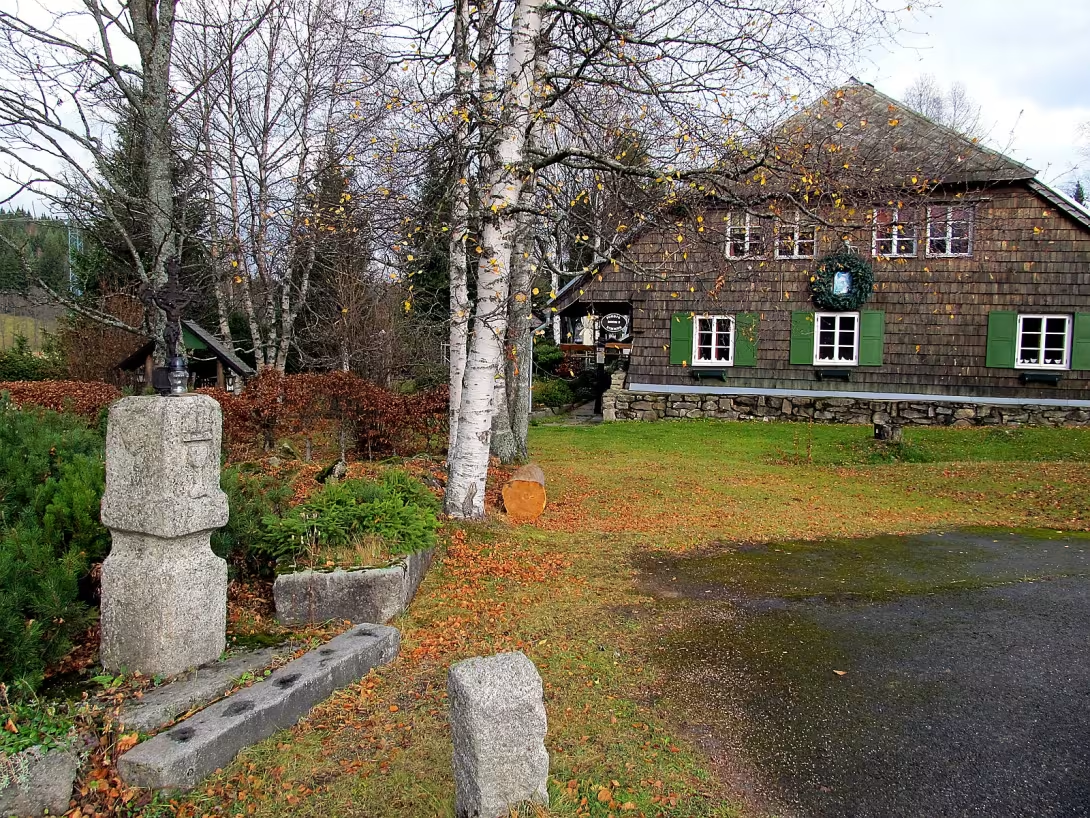
Truhlářský mlýn in the village Srní (Klatovy district) was a former water mill on Hradec creek. In the past it was part of a complex involving a bakery and a shingles factory. The building is historically significant due to its documented existence since the 18th century and its connection with the writer Karl Klostermann.
The first historical records of the building came from the 1st military mapping of 1764- 1768. He stood on the left bank of the Hradec creek and belonged to Sedlo. Apart from the mill itself, there was also a bakery, shingles workshop and a small shop in the area at that time.
Architecturally he had an object grafted floor and half-floor with attached cathode. The mill tract was walled across and equipped with a saddle roof with a two-band shield divided by three pilasters. For operation was used a drive whose wall is still visible in the field from road to mill. In 1930, the facility was equipped with two wheels for the upper water with a drop of 4.3 metres and a power of 3.5 HP.
The mill was owned by the Häusler family until 1934. In 1935 a saw was built, which together with the whole operation ended in 1949. The building was protected as a real cultural monument of the Czech Republic in the years 1958-1980.
In the 1970s, a writer Karel Klostermann visited the mill, who visited his cousin Cecily Häusler. For his work, including novels and short stories, he drew on the story of her husband Václav Häusler.
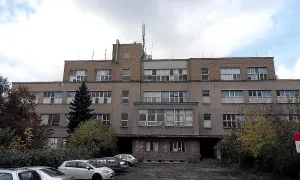
Currently the whole complex is completely rebuilt. The location of Lower Hrádek on the Hradec creek between the municipalities of Srní and Blue is a place where you can still find traces of earlier economic use of this area. This historical trail in the landscape is worth a tour while walking around.
Historical milestones
- 1764
- recording mill on 1st military mapping
- 1935
- sawing
- 1949
- closure of mill and saw operation
- 1958
- starting protection as a real-estate cultural monument
- 1980
- termination of protection as a real-estate cultural monument
Architectural development
The mill had a grafted floor and half-floor with attached cathode. The mill tract was walled with a saddle roof and a shield divided by three pilasters. In the field, there is still a clear wall of drive leading to the water wheel.
Historical events
1935: mill building; 1949: closure of mill and saw operation; 1958-1980: protection as a real estate cultural monument.
Owners
Häusler House (until 1934)
Points of interest
- In the past it was part of a complex involving a bakery and a shingles factory. The first historical records of the building dates back to 1764- 1768. - Architecturally he had an object grafted floor and a half-floor with attached cathode. - In the years 1958-1980 the building was protected as a real-estate cultural monument of the Czech Republic. - In the 1970s, a writer Karel Klostermann visited the mill.
Guide
Show guide text
This text was created by artificial intelligence and has not been editorially reviewed. It may contain inaccuracies.
Welcome to the beautiful landscape around the village Srní. You've just stopped at one of the places that carries a deep trace of the ancient past. You're standing right in front of the carpenter's mill. Before we go into his fascinating history, let yourself stand for a moment and listen. Feel the noise of the Hradec River that flows just below you. For centuries, this water has been the heart of this place and the main engine of everything that has happened here. The atmosphere of this valley, the joining of nourishing water and dense forests, will now guide you back in time, until life here was much more rhythmic and stronger bound to the movement of water and the work of human hands.
To understand how important this place is, we need to look deep in history. Its roots go much further than it might seem. If we want to look at the oldest records available, we will encounter the first military mapping that took place between 1764 and 1768. Even then, this building, this mill, was recorded as a solid part of the local landscape. Imagine what this area looked like over 200 years ago. It wasn't just the mill itself, as you might perceive today. It was an entire living organism, a small industrial complex that formed a fundamental pillar for living around it. The whole complex included a bakery, shingles workshop and a small shop. It was a place where people met, where pastries were made for the whole village, where building materials were prepared for houses nearby and where they were traded. It was a small world in a small world where everything revolved around the needs of the local population.
Now try to look at the construction itself and perceive its architecture. Although the entire complex has been completely rebuilt over the years, the historical nature and manner in which it was built in the region are still present in its form. Note how specific the architecture of this object was in the past. It had a grafted floor and a semi-floor, which was typical of this area and allowed the construction to withstand local climatic conditions. There was also a lock attached to the building, which is an important detail that tells us about technical maturity and that it was not just a bullet, but also wood. If you could go back to 1930, you would see two wheels on top water. This wheel had a power output of three and a half horsepower. Imagine the incredible power the water was developing to power the machines inside the building. The movement, the rhythm, and the sound of water were the constant accompaniment of everyday life. In 1935, the saw was also involved, which extended the complex even further by the additional dimension of the raw wood work.
Places like this aren't just rocks, wooden beams and water wheels. These are the spaces experienced by particular people whose names have been carved into the history of this region. In connection with this area and its atmosphere, the name Karl Klostermann often appears in people's memory. This important writer was closely associated with the region of Šumava and his works often mirror the life that took place in these streams and in these forests. Even though it is not known exactly what role this mill played in its creation, the spirit of the place he so masterfully described is still there to smell. We must not forget the Häusler family, namely Václav Häusler and Cecily Häusler. Their names are closely linked to this place and the surrounding area, probably like the people who lived here, worked or cared for this place at different times. It's the faces that left their mark in this space.
The interesting thing that can make you think is the special fate that has passed the protection of this object. In 1958 his importance was recognised and his protection began as a real-estate cultural monument. This means that the state recognized at that time how important this mill plays for our common history and identity. However, this protection only lasted until 1980 when it was terminated. There's a certain mystery that can only be speculated on. Why was protection terminated after several decades? What changed the perception of this place in that period? Perhaps the intense reconstruction we see today was the result of finding a new way to revive and integrate this place into the modern world without losing its soul.
Now that you have a fundamental view of what is in front of you and have understood how deep the roots of this place have, I suggest you continue your walk around the Hradec creek. Feel the calm that is now in existence, and remember how busy and lively this place was at the time of its greatest glory. Truhlářský mlýn is just one of the many clues that history has left us in this beautiful Shumaan landscape. Thank you for stopping by and paying attention to this history. We wish you a beautiful and inspiring further journey along the surrounding paths.
Tips for visitors
The best time to visit the Woodwork Mill is spring or autumn, when the surrounding nature is the most beautiful on the Hradec River and temperatures are mild. In summer the valley can be humid, while in winter access to the water stream can be heavy on snow and ice. Since this is a historical location in nature, we recommend to check the current state of the access routes in advance.
Transportation to the monument is the most practical personal car, since the mill is located south of the village Srní near Hradec creek. If you decide to come by public transport, check the current connection to the village Srní and follow the walking route to the stream.
Don't forget to wear fixed shoes suitable for walking on uneven ground and near water. Even if the mill is a historical monument, the surrounding landscape may be muddy or grassy. We recommend to wear even a light layer of clothing, because in watercourses it can be windy and humid, no matter what time of year.
The morning or late afternoon light is ideal for photography, which will illuminate the wooden construction of the mill and surrounding vegetation. The best shots can be obtained from the bank of the Hradec creek, where you can capture the mill in the context of nature. Watch out for wet surfaces and do not leave the routes to avoid harming the natural environment.
The locality of Dolní Hrádky and the nearby municipalities of Srní and Modrava are located in the vicinity of the Woodwork Mill. These places are ideal for short walks around (within 30 minutes walk), where you can enjoy a quiet atmosphere and natural beauty. If you have children, alert them to safe water flow behaviour and make sure they are not too close to shore without adult supervision.
Frequently asked questions
Can the monument be visited?
This is a technical monument. Some are open as exhibitions, others are out of use or on private land. We have not verified whether this one is accessible.
What are the opening hours and admission?
We have not verified the opening hours or admission. Current information is published by the operator.
Where is the monument?
Location: Srní, Plzeňský kraj. The map on this page shows the exact spot.
Why is the monument protected?
It is listed in the Central List of Cultural Monuments of the Czech Republic as a cultural monument (register no. 1000145122).
Businesses nearby
Do you run a restaurant, accommodation, shop, museum, rental, wellness or other visitor service near this monument? Show yourself directly to the people heading to it — this is how they will see you in the app and on the web:
Nearby
Hrádecký potok, lokalita Dolní Hrádky, obec Srní a Modrava.
Accommodation nearby
Themed route
1. Modrava, village: Great place to start the trip. 2. Srní, municipality: This village forms an important part of the route. 3. Hradec stream , Water flow: The path leads along this stream. 4. Dolní Hrady, locality: This area leads directly to the main monument. 5. Truhlářský mlýn, mill: The main destination worth visiting.
Seasonal recommendations
The spring visit brings with it the awakening Šumava nature and the freshness of the blooming edges of the forest. The light is delicate in this period and highlights the details of the wooden structures of the mill beautifully. We recommend to prepare layered clothes because the morning cold can quickly take turns with heat during the day. The best is to arrive early in the morning, when the air is the cleanest and visitors are not yet so active.
The summer season offers full, rich green vegetation and warm sun rays that reflect off the water level. The atmosphere is alive and full of life, which makes the mill a popular resting place. Due to the main summer season we recommend a visit in the early morning to avoid the biggest crowds. Don't forget light summer clothes, headgear and insect-proof devices.
The autumn around the mill is magical thanks to golden and red shades of leaves and morning fog, which are lazily rolling over the water. The atmosphere is quiet and slightly melancholic, which is ideal for lovers of silence. Due to variable weather and wet terrain, it is necessary to have waterproof shoes on your feet. The best time for a tour is a clear morning when the sun can penetrate the mist.
Winter time turns the mill into a fairy tale scene covered with snow and freezing silence. The landscape is white and calm, which creates a completely unique environment. Due to low temperatures and shorter daylight, it is necessary to choose very warm clothes and quality winter shoes with good grip. We recommend planning a visit on clear days when daylight is longest.
Visualizations and artistic views


The visualisations are generated by artificial intelligence and serve as inspiration.
Photos from the area
Real photos taken near the monument


Zdroj a licence jsou uvedeny u každého snímku.
Tips from visitors
No tips yet. Be the first!
Log in and add your tip.
Sources and literature
Photos: Jitka Radimska / CC BY-SA 3.0 — Wikimedia Commons. The author and licence also appear when you hover over the image.
Faktickým podkladem tohoto textu byl článek na Wikipedii, jehož autory jsou přispěvatelé Wikipedie. Článek je dostupný pod licencí CC BY-SA 4.0.
Location on the map

Příběhy a pověsti
Legendy, pověsti a příběhy spjaté s touto památkou
Fotografie návštěvníků
Zatím žádné fotografie. Buďte první, kdo přidá fotografii z návštěvy!
Log in a přidejte svou fotografii nebo hodnoťte.
Za ověřenou návštěvu v aplikaci získáte víc bodů — poznáme podle GPS, že jste na místě.
Reviews and comments