






Kostel Nejsvětější Trojice (Srní) Church
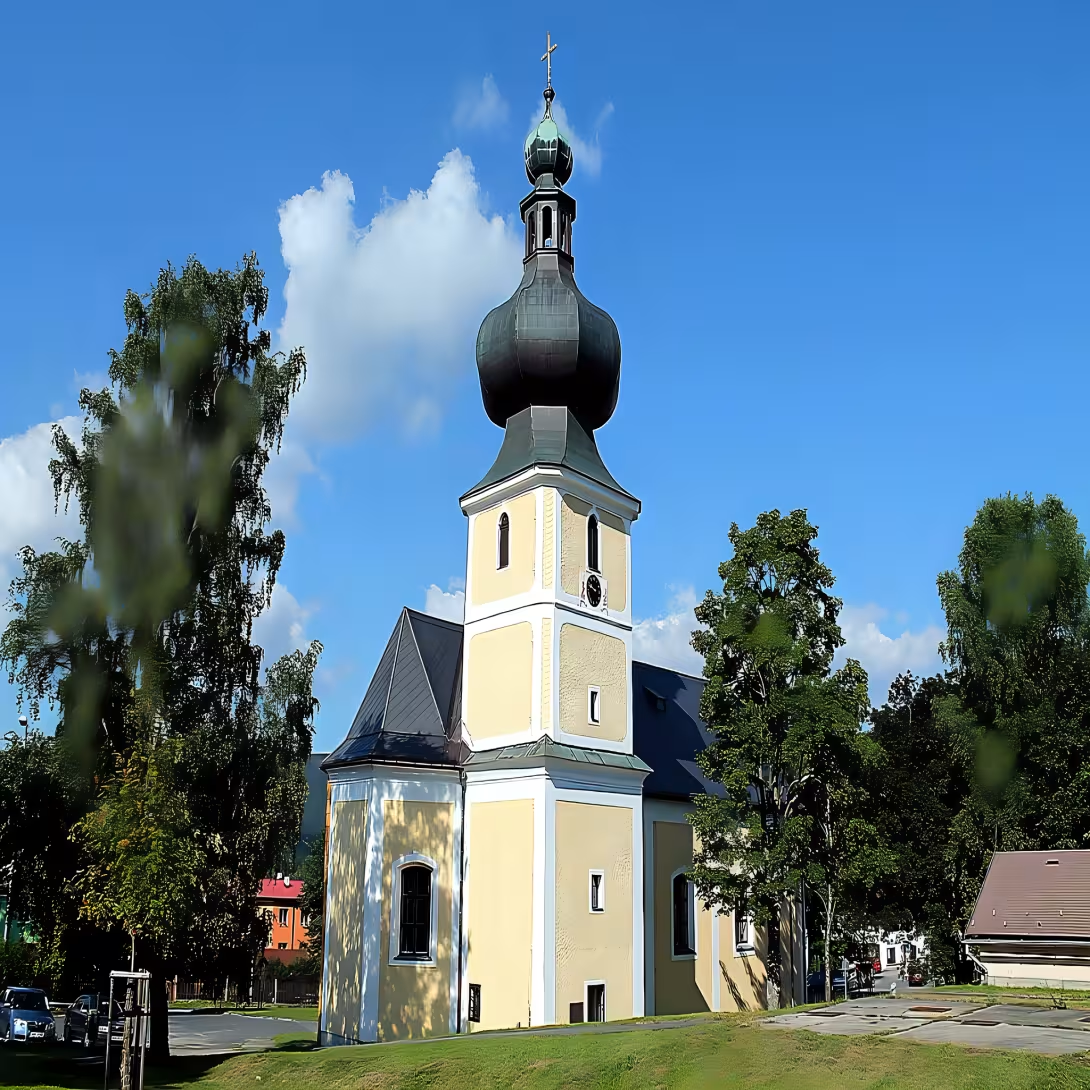
The Church of Nejsvětější Trojice in Srní is a remarkable historical monument within Šumava National Park. It reflects architectural evolution and community significance from the late 18th century to today. Originally constructed as a wooden church in 1788 under Emperor Joseph II's reforms, it was replaced by a brick structure funded partly by Emperor František I., consecrated in 1806. This transformation marked an architectural shift and established the church as a central hub for the local community, surrounded by homes, schools, and an inn.
The monument's origins are deeply rooted in the religious and social changes sweeping Bohemia during the late 18th century. The initial wooden church was built with permission from Emperor Joseph II, reflecting his broader ecclesiastical reforms aimed at modernizing the region's religious infrastructure. This early structure, consecrated by děkan Prokop Haur in 1789, quickly deteriorated, prompting its replacement with a more durable brick edifice. The new church, funded in part by Emperor František I., was consecrated by biskup Jan Prokop Schaaffgotsche in 1806, symbolizing both religious continuity and architectural advancement.
Architecturally, the Church of Nejsvětější Trojice is characterized by its single-nave design with a distinctive bell tower positioned off-center. The presbytery features a three-sided vaulted ceiling, while the tower boasts a bulbous roof, all elements contributing to its unique aesthetic within the region's ecclesiastical architecture. Over time, the church has undergone several renovations, including significant repairs in 1970 and a new roof installation in 2008, ensuring its preservation as both a historical and functional site.
Throughout its history, the church has witnessed various notable events and changes. During World War I, two large bells were removed from the tower for military purposes, only to be replaced by new ones cast by Rudolf Perner in 1922. The post-war period saw further transformations, including the removal of a symbol of Austrian monarchy from the bell tower, replaced with an iron cross. Additionally, the church's surrounding cemetery was closed in 1984 and transformed into a Memorial Park, adding another layer to its historical narrative.
Today, the Church of Nejsvětější Trojice remains an active site for monthly religious services and hosts annual pilgrimages in honor of Panna Marie Hauswaldská. Its rich history and architectural significance make it a compelling destination for visitors interested in exploring the cultural heritage of Šumava National Park. The church not only serves as a testament to the region's historical evolution but also continues to be a vibrant center for community life, inviting all who wish to experience its enduring legacy.
Then and now
Drag the slider to compare how the landmark may have looked when it was built with the view today.
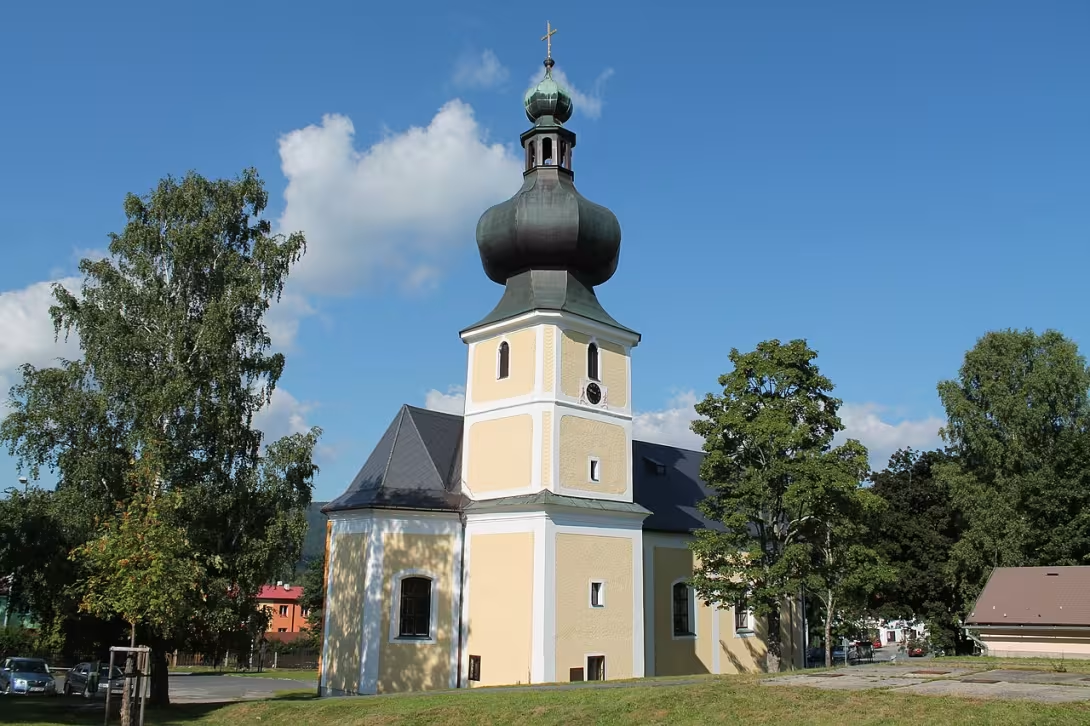

The historical appearance on the left is an AI-generated visualisation and serves as inspiration only.
Historical milestones
- 1788
- Construction of the original wooden church under Emperor Joseph II's reforms.
- 1789
- Consecration of the initial wooden church by děkan Prokop Haur.
- 1806
- Consecration of the new brick church funded partly by Emperor František I., by biskup Jan Prokop Schaaffgotsche.
- 1922
- Replacement of two large bells removed during WWI, cast by Rudolf Perner.
- 1970
- Significant repairs conducted on the church.
- 2008
- Installation of a new roof to ensure preservation.
Architectural development
The original wooden church built in 1788 deteriorated quickly and was replaced by a brick structure funded partly by Emperor František I. The new church, consecrated in 1806, became a community center with nearby homes, schools, and an inn. Over the years, it underwent several renovations, including major repairs in 1970 and roof replacement in 2008.
Historical events
- 1789
- The original wooden church was consecrated by děkan Prokop Haur.
- 1806
- The new brick church was consecrated by biskup Jan Prokop Schaaffgotsche.
- 1916
- Two large bells were removed from the church tower for military purposes during World War I.
- 1922
- New bells, cast by Rudolf Perner, were installed in the church tower.
Points of interest
- The initial wooden church built in 1788 was part of Emperor Joseph II's ecclesiastical reforms aimed at modernizing Bohemia’s religious infrastructure, reflecting broader Enlightenment ideals of rationalization and efficiency. - During World War I, the removal of two large bells from the Church of Nejsvětější Trojice for military purposes is a poignant reminder of how even sacred spaces were not exempt from the demands of war.
- The replacement of an Austrian monarchy symbol with an iron cross on the bell tower after World War I highlights the shifting political landscape in Bohemia and the church’s role as a witness to these changes.
- In 1922, new bells cast by Rudolf Perner replaced those taken during World War I, signifying not only restoration but also the resilience of local traditions and craftsmanship amidst global upheaval.
- The transformation of the surrounding cemetery into a Memorial Park in 1984 reflects changing attitudes towards heritage preservation and memory, adding a layer of historical narrative to the church’s surroundings.
Guide
This guide is narrated by a synthetic voice generated by artificial intelligence.
Show guide text
This text was created by artificial intelligence and has not been editorially reviewed. It may contain inaccuracies.
The Church of the Most Holy Trinity stands in the middle of the village of Srní in Šumava National Park. It used to be a parish church and the parish was established in 1803. After it was dissolved at the end of 2019, the church belongs to the parish of Kašperské Hory.
Originally, there was a wooden church here. Emperor Joseph the Second allowed it to be built in 1788 and the expenses were borne by the villages of Sedlo and Srní. The consecration in August 1789 was attended by up to 800 people. However, the wooden structure soon began to deteriorate, so it was replaced by a brick church. Emperor Francis the First also contributed to it with a sum of 5443 gold coins and 39 kreutzers. The new church was consecrated on August 15, 1806 by the Czech Budějovice bishop Jan Prokop Schaaffgotsche. Houses of settlers were then built around it and together with the rectory, school and inn, it became the center of the new village. The original timber-working settlement below it still bears the name Staré Srní.
In December 1916, two large bells were removed from the tower for military purposes. New ones were installed on the tower in 1922. Three years later, an eagle more than two meters high, the symbol of the Austrian monarchy, disappeared from the tower and was replaced by an iron cross of roughly the same height. After the Second World War, the church fell into disrepair and faced demolition. It was saved by a general restoration in 1970.
It is a single-nave building with no distinctive architectural style. A pyramidal tower with an onion-shaped roof stands outside the axis of the nave. The southern, windward side is protected by shingles.
Inside is a Baroque altar and Rococo candlesticks from the time of the church's construction. The main altar is decorated with beads from the glassworks in the settlement of Antýgl. On the side altar stands a wooden statue of Our Lady of Lourdes from the Hauswald Chapel, which was destroyed by gunfire in 1957. The organ dates from 1811.
The local cemetery was closed in 1984 and today a Remembrance Park with the Table of Reconciliation stands in its place. Some relatives of Karl Klostermann and figures from his books were supposed to be buried there. A cannon ball from the Napoleonic Wars, which was brought by the priest Wenzel Prinz from the battlefield near Teplice, is walled into the gate of the former rectory.
Since 2013, a pilgrimage to Our Lady of Hauswald has been held here again. The procession comes to the church from the Hauswald Chapel.
Frequently asked questions
Can the monument be visited?
Religious buildings are usually open mainly during services; at other times a visit is normally arranged with the parish or the operator. We have not verified specific times.
Where is the monument?
Location: Srní, Plzeňský kraj. The map on this page shows the exact spot.
Why is the monument protected?
It is listed in the Central List of Cultural Monuments of the Czech Republic as a cultural monument (register no. 16728/4-3294).
Businesses nearby
Do you run a restaurant, accommodation, shop, museum, rental, wellness or other visitor service near this monument? Show yourself directly to the people heading to it — this is how they will see you in the app and on the web:
Nearby
The church is located within Šumava National Park, surrounded by natural beauty and other historical sites such as Hauswaldská kaple Panny Marie Lurdské.
Accommodation nearby
Themed route
Tematická výletní trasa: Kostel Nejsvětější Trojice a okolí
1. Kostel Nejsvětější Trojice (Srní)
Typ: Historická památka
Proč stojí za návštěvu: Tento barokní kostel, postavený v 18. století, je nejen duchovním centrem obce Srní, ale také architektonickou perli Plzeňského kraje. Jeho bohatá historie a umělecká hodnota činí z něj nezbytný první cíl na této trase.
2. Hauswaldská kaple Panny Marie Lurdské
Typ: Kaple
Proč stojí za návštěvu: Tato malebná kaple je umístěna v přírodním prostředí Šumavy a slouží jako místo klidu a útulku pro návštěvníky. Je známá svým historickým významem a krásnými výhledy na okolní krajinu, což ji činí ideálním druhým cílem.
3. Šumava National Park
Typ: Národní park
Proč stojí za návštěvu: Okolo kostela a kaple se rozprostírá Šumavský národní park, který nabízí nejen pohledy na divokou přírodu, ale také možnost prozkoumat místní flóru a faunu. Procházka zde je ideálním způsobem, jak si užít klid a krásu tohoto jedinečného území.
Tato trasa nabízí kombinaci historických i přírodních atrakcí v rámci Šumavy, což z ní činí ideální den pro ty, kteří hledají jak kulturní, tak přírodní zážitky.
Seasonal recommendations
Spring: Visiting the Church of the Holy Trinity in Srní during spring offers a unique experience as nature begins to awaken around this historic landmark. The surrounding landscape is adorned with vibrant wildflowers and fresh greenery, creating an idyllic setting that enhances the church's serene atmosphere. As daylight extends into the evening, visitors can enjoy the soft natural light filtering through the stained glass windows, casting colorful patterns inside the church. This season sees moderate visitor numbers, allowing for a peaceful exploration of the site. It is advisable to wear comfortable walking shoes and layers that can be adjusted with fluctuating temperatures typical of spring weather.
Summer: The summer months bring heightened activity around the Church of the Holy Trinity in Srní, as it becomes part of the vibrant tapestry of local cultural events. The lush greenery surrounding the church provides a picturesque backdrop for visitors who often come to enjoy outdoor concerts or festivals held nearby. With longer daylight hours, early arrival is recommended to avoid larger crowds and fully appreciate both the natural beauty and architectural details of the church. Light, breathable clothing is ideal for exploring during this warm season, and carrying water is advisable due to increased temperatures.
Autumn: Autumn at the Church of the Holy Trinity in Srní offers a rich tapestry of colors as the surrounding foliage transforms into shades of red, orange, and gold. This seasonal change creates a stunning visual contrast with the church's historic architecture, making it an ideal time for photography enthusiasts. The cooler temperatures and shorter days mean fewer visitors, allowing for a more intimate experience. It is recommended to wear layers that can be adjusted as temperatures drop throughout the day, and comfortable shoes for walking on potentially uneven paths covered in fallen leaves.
Winter: Winter transforms the Church of the Holy Trinity in Srní into a serene and almost mystical site, with snow often blanketing the landscape, enhancing its historic charm. The shorter days mean limited daylight hours for visiting, so arriving early is advisable to make the most of the natural lighting. The church may have reduced opening times during this season, so checking ahead is recommended. Visitors should dress warmly in layers and wear sturdy footwear suitable for potentially icy conditions. Despite fewer visitors due to the cold weather, the quiet atmosphere provides a peaceful opportunity to reflect on the church's historical significance.
Visualizations and artistic views


The visualisations are generated by artificial intelligence and serve as inspiration.
Photos from the area
Real photos taken near the monument


Zdroj a licence jsou uvedeny u každého snímku.
Atmosphere of the place
This atmospheric visualisation of the place and period was generated by artificial intelligence. It is not real footage of the location.
Tips from visitors
No tips yet. Be the first!
Log in and add your tip.
Sources and literature
Photos: Harold / CC BY-SA 3.0, rozlišení zvýšeno umělou inteligencí — Wikimedia Commons. The author and licence also appear when you hover over the image.
Faktickým podkladem tohoto textu byl článek na Wikipedii, jehož autory jsou přispěvatelé Wikipedie. Článek je dostupný pod licencí CC BY-SA 4.0.
Location on the map

Příběhy a pověsti
Legendy, pověsti a příběhy spjaté s touto památkou
Fotografie návštěvníků
Zatím žádné fotografie. Buďte první, kdo přidá fotografii z návštěvy!
Log in a přidejte svou fotografii nebo hodnoťte.
Za ověřenou návštěvu v aplikaci získáte víc bodů — poznáme podle GPS, že jste na místě.
Reviews and comments