



hradlový most v Modravě Wooden bridge
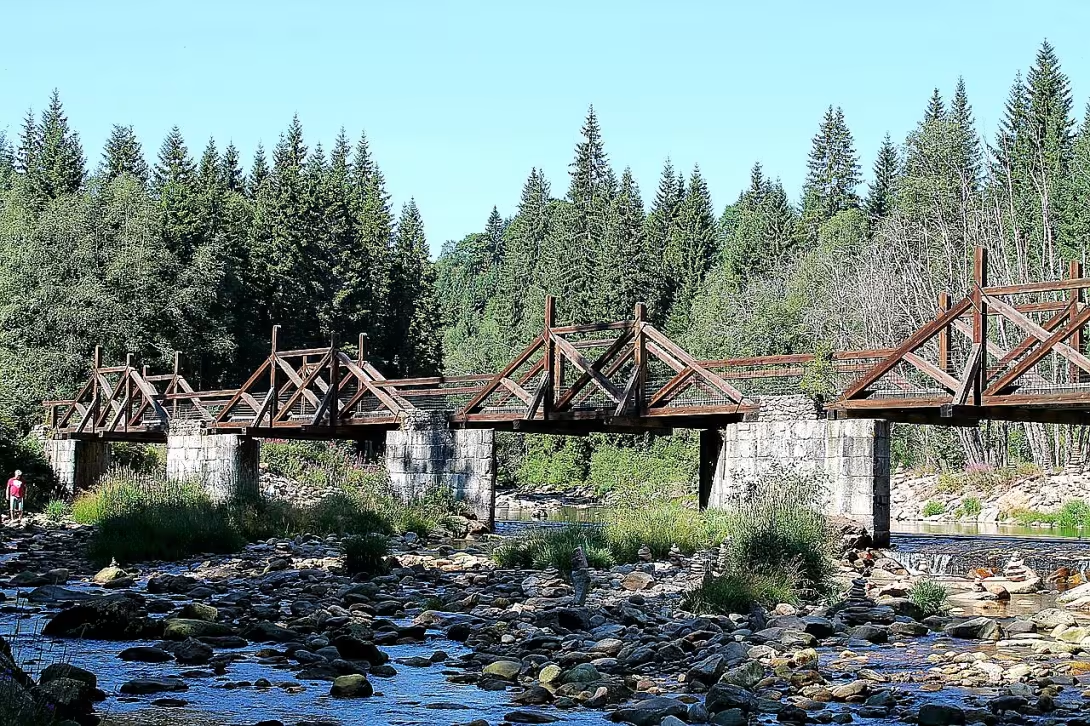
The castle bridge or the rechle at Blue is a classic water work. It's made up of a wooden bridge, and it's eaten by the floodgates. It is located at an altitude of 940 metres in the protected landscape area of Šumava about half the way between Blue and Antégle. This work provided for the diverting part of the water from the river Vydry to the Vchynico-tett canal. It was used to capture and channel floating timber and is today a protected cultural monument to industrial heritage.
The Modrava Castle Bridge represents a unique historical waterworks. It is located on the left bank of the river Vydra and forms the beginning of the Vchynicko-Tattoo Canal. If the water flow is not enlarged by Vydrou, the balvanized stream under the wall bridge remains almost empty. The Koryto partially fills only small tributaries and Hamer stream. In the early nineteenth century, the Czech Kingdom experienced the development of industrial and transport structures within the Habsburg monarchy. The increased need for firewood for growing Prague required the construction of sophisticated water works and sewers for navigating to that time of inaccessible Šumava flows.
The construction of the canal and the castle bridge took place between 1799 and 1801. Its purpose was to transport wood from Šumava to Prague, because the natural flow of the river Vydra was not suitable for this purpose. The designer and builder of this work was engineer Josef Rosenauer. The entire navigation channel flows through ten stone arched bridges. It measures 14.4 kilometers, its width varies from 1 to 5 meters and has an average gradient of about 3 promile.
The construction is wooden with granite pillars and trapezoidal ornaments of two meters height. The bridge has a length of 72 metres, a width of 3.5 metres and stands tilted towards the river Vydra. Wooden walls, called rafts, jaws or reeds, were planted in the binding beams placed between the pillars of the bridge. It was used to capture floating wood. After pulling out the strong beams inserted perpendicular to the road which held the logs, there was sudden release of the accumulated material and its next path through the navigation channel.
In 1958, the sailing channel, along with the bridge and the ride, was declared a cultural monument. Until 1959, some of the sources reported in 1953, led over the bridge of the road connecting Blue to Srním, respectively the road from Rokyta to Blue. After the new bridge under Antégle and the new road was exposed, the water works began to disintegrate. Eventually, the castle bridge was even removed. On the costs of the administration of the national park, the protected landscape area of Šumava and the then Western Bohemian energy Plzeň, this water work was completely restored between 1999 and 2000. The construction of bridges Prague became the contractor of his replica. A fish transition has also been part of the water work since 1999. This allows the fish to overcome the food and get further up against the river Vydra.
Today, a restored water work serves as an important historical monument. It reminds of sophisticated technical constructions of the past, while allowing visitors to Šumava to see the history of wood transport. Visit this unique place and get to know the historic water construction championship in the impressive nature of the national park.
Then and now
Drag the slider to compare how the landmark may have looked when it was built with the view today.
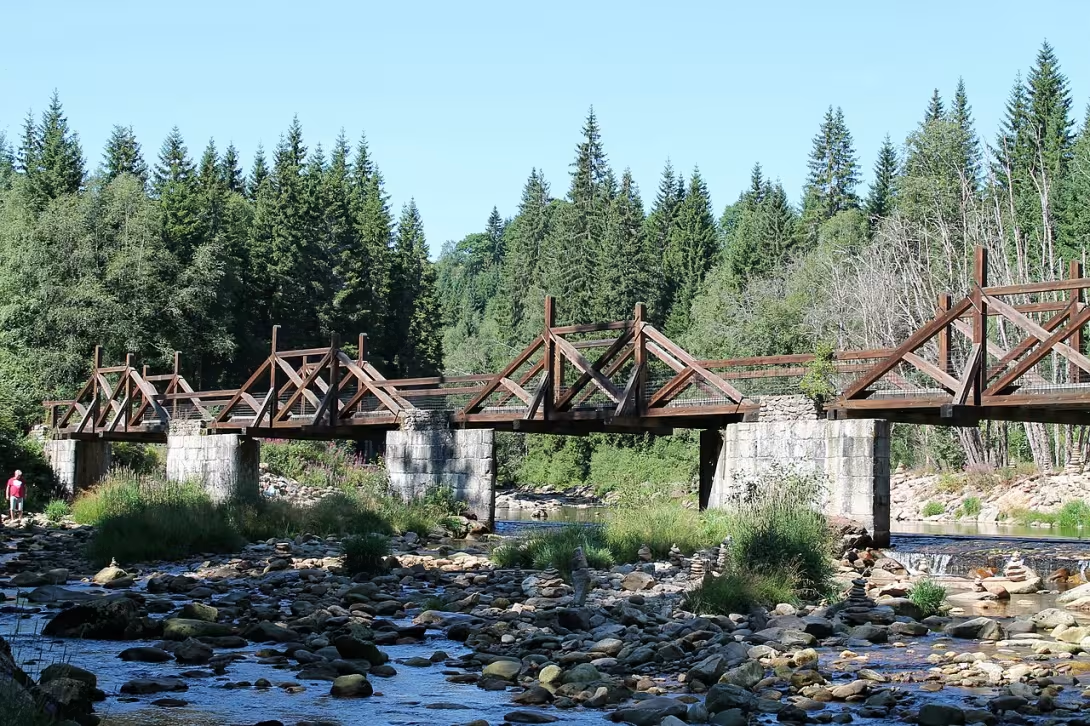
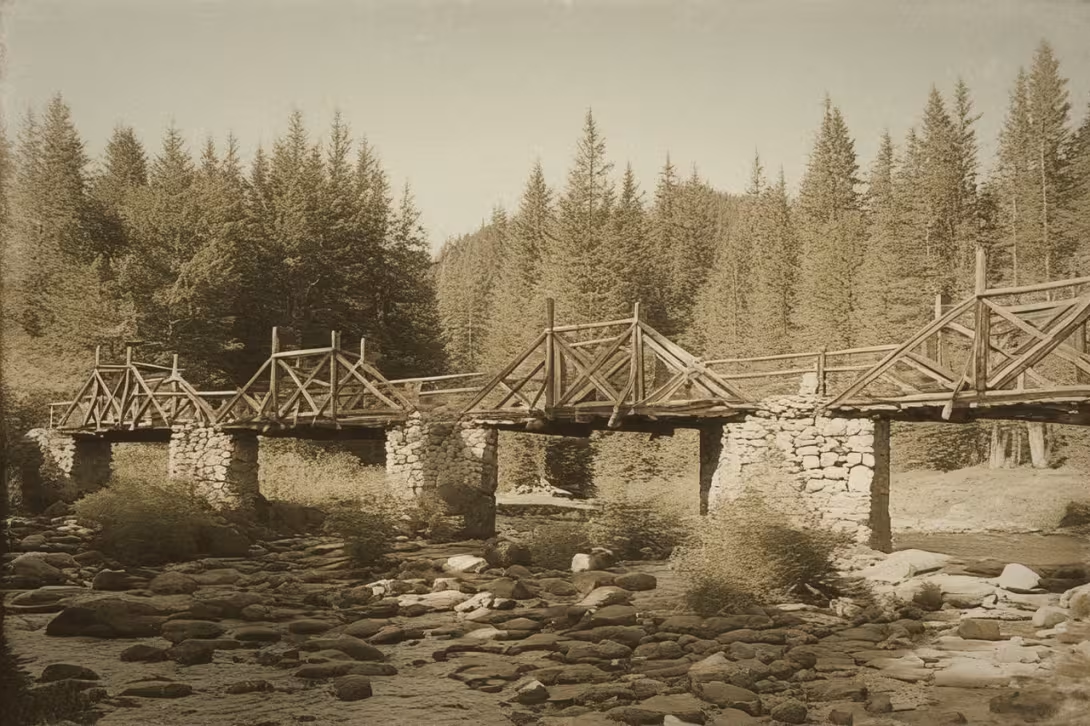
The historical appearance on the left is an AI-generated visualisation and serves as inspiration only.
Historical milestones
- 1801
- Completion of the construction of the canal and the castle bridge.
- 1958
- Declaration of the bridge and the sailing channel for a cultural monument.
- 2000
- Completion of reconstruction of historical water works.
Architectural development
The wooden bridge with a length of 72 metres and a width of 3.5 metres is built on granite pillars with two-metre trapezoidal ornaments. Wooden walls used to capture and channel floating timber were inserted into the binding beams between the pillars. The original building was decayed and even removed after 1959, but at the turn of the millennium a faithful replica was created by the Prague Bridge Construction Company.
Historical events
The construction of the navigation channel took place between 1799 and 1801. In 1958, the ride bridge was declared a cultural monument. Between 1999 and 2000, the water works were fully restored by the management of the national park and energy.
Points of interest
- The castle bridge or the rechle near Blue is a classic waterworks that make up a wooden bridge and eat the stalls. - The construction took place between 1799 and 1801 and its designer was engineer Josef Rosenauer. - The bridge is seventy-two metres long, three and a half meters wide and stands at a slope towards the river Vydra. - In 1958, the sailing channel, along with the bridge and the ride, was declared a cultural monument. - From 1999 to 2000, this water work was completely restored and since 1999, the fish transition has also been part of it.
Guide
Show guide text
This text was created by artificial intelligence and has not been editorially reviewed. It may contain inaccuracies.
Welcome to the heart of the Shimaan countryside. You just stopped by one of the most interesting places in this valley. You're standing right in front of the castle bridge, which people here also call a relic. If you look up now and look ahead, you will see a fascinating combination of human art and the power of nature. In front of your eyes is a large water work that forms a wooden bridge and a calm level of the lake above which the floodgates watch. Feel the atmosphere, feel the smell of wet wood and listen to the roar of water that has been flowing here for centuries. You are at an altitude of nine hundred forty meters, where the river Vydra determines the rhythm of the entire area.
Let us now return together to the time when everything began to be built here. Imagine the end of the 18th century. Shumava was then an impenetrable and rich forest, but it offered something very valuable - a huge amount of wood. In order for this forest gold to reach far from Prague, it was necessary to find a way to transport it. That's why this building was born. In the years one thousand seven hundred ninety-nine to one thousand eight set one was carried out a project to change the face of this valley. The goal was to create the beginning of the Vchynic- aunt's sailing channel. This channel was not just an ordinary path for water, it was a pillar of life for the transportation of wood, which connected deep forests with cities.
Now pay attention to the construction itself, which now surrounds you. Look at this precise wooden structure. Although it may not seem like it was the work of craftsmen, it was a very sophisticated engineering plan. This entire bridge is seventy-two meters long and its width is three and a half meters. But notice one very important thing that you can observe right now. The bridge isn't built right across the water stream, as if it's trying to defend itself. On the contrary, it is erect towards the river flow. This clever idea allowed water and floating wood to flow better through the whole building. This whole classic water unit, formed by the bridge and the ride, is proof of how people were able to work with natural elements at the time.
The name of an extraordinary person is behind all this success. Engineer Josef Rosenauer was the man who designed this magnificent plan and led it to reality. He was a visionary who saw in these wild mountains the possibility of creating a functional and beautiful water work. His work was not just about spreading stones or cutting trees, it was about understanding the movement of water and creating a path for human progress. Rosenauer's project was so good that even after centuries, which had elapsed since the completion of construction in one thousand eight sets one, this building is still holding and awakening astonishment.
You might find one interesting thing that gives this place special weight. Although this building seems to be part of the wild, it is a protected treasure. Already in the year one thousand nine hundred fifty-eight this place, the castle bridge and the entire navigation channel, was declared a cultural monument. This means that its value for our history is immense. Although time and water constantly mencobalize their power, this work resisted. Even in our modern age, namely around the year two thousand, the whole building was thoroughly restored to serve as a witness to its times and a reminder of human ingenuity for future generations.
Imagine that scene over 200 years ago. You see these huge tree tribes slowly moving through the water, leaning on the wooden structures, reflecting the sun in them. This whole system of slugs that you see now was used to keep the lake level right where it needed to be possible and safe. It was a constant struggle with the current, the surface and the mass of the wood.
Now that you know the story of this place, I suggest you continue your walk. Take a closer look at the wooden connections, see the stability of this structure and try to imagine the work that people in these mountains had to do. The blue team and its surroundings have much to tell you. Thank you for stopping by and paying attention to this historic water work. We wish you a beautiful and peaceful journey along the paths of the Šumava forests. We say goodbye and wish you many more experiences in discovering the beauty of our country.
Tips for visitors
The best time to visit the castle bridge near Blue is early in the morning or late in the afternoon, when there are the least visitors and you can feel the noise of the river Vydra in peace. Take with you fixed shoes for walking along the surrounding forest paths, clothes for changing mountain weather and a bottle of drinking water. For photography, it offers the best shots of the wooden bridge and the early or late evening lake light, which picturesively depicts the details of the historical building on the water stream. In the wider area, this water work is located on the river Vydré in the middle of the road between the villages of Blue and Antégl in the protected landscape area of Šumava. For families with children, the trip is suitable thanks to a low-cost route, but it is necessary to take care constantly to be careful in the vicinity of running water and historical buildings.
Frequently asked questions
Can the monument be visited?
This is a structure in a public space that can usually be seen from outside free of charge. We have not verified that this particular one is freely accessible.
Where is the monument?
Location: Srní, Plzeňský kraj. The map on this page shows the exact spot.
Why is the monument protected?
It is listed in the Central List of Cultural Monuments of the Czech Republic as a cultural monument (register no. 1000138018_0002). It is protected as part of a larger listed ensemble.
Businesses nearby
Do you run a restaurant, accommodation, shop, museum, rental, wellness or other visitor service near this monument? Show yourself directly to the people heading to it — this is how they will see you in the app and on the web:
Nearby
Vodní dílo se nachází na řece Vydře zhruba na polovině cesty mezi obcemi Modra a Antýgl v chráněné krajinné oblasti Šumava.
Accommodation nearby
Themed route
Srní Place: Municipality Why is it worth a visit: The starting point for a trip to the protected landscape area of Šumava. It offers accommodation and facilities for tourists to the river Vydra.
Antégle Place: Osada Why is it worth a visit: A historic place located approximately halfway from the main destination. It's an ideal stop when traveling along the river Vydra.
Castle bridge in Blue Place: Water work Why is it worth a visit: Unique technical monument on the river Vydra in the protected landscape area of Šumava. It is located approximately halfway between the municipalities of Blue and Antégle.
Blue Place: Municipality Why is worth a visit: A picturesque place in close proximity to the water works. It closes the route along the river Vydra.
Seasonal recommendations
Spring on Blue brings the surrounding nature to life, which in historical water works creates a unique spectacle of melting snow and rising level of the stream, while the rays of the sun reflecting from flowing water offer wonderful natural lighting for lovers of photography. During this period you will not encounter large crowds of tourists, so you will enjoy the silence interrupted only by the scourge of the current, but you must count on the muddy terrain in the surrounding forests; Therefore, for your trip, take firm waterproof shoes and warmer layered clothes, because mountain air is still very cold, and the best time to visit is in the morning, when morning fog is often held over the valley.
Summer brings lush green vegetation and sunny days, when the beam structure of the bridge contrasts beautifully with the deep forests of Šumava and clear water, whose level shines under direct sunlight at a clear noon. In the high season, the largest number of visitors are heading here, so if you want a quiet atmosphere without people, go to the water part early in the morning or late in the evening, when the sun is slowly falling behind the horizon and the landscape is getting a golden touch. Pack light breathable clothes, sun-proof headgear and plenty of drinking water on the way, as you will not find much shade at the open stream.
Autumn turns the whole area into a colorful palette of yellow, red and brown colors, which are mirrored on the water surface and create a melancholy, yet extremely impressive atmosphere supported by frequent morning herpes and low sun. Tourists are decreasing markedly at this time, making autumn an ideal period for peaceful contemplation and perception of the genius loci of this technical monument. The practical council is in charge of wearing a warm windbreaker, scarf and firm shoes in fallen and often wet leaves, the best time for visiting is around noon, when the temperature reaches its daily maximum and the fog usually dissolves.
Winter covers the whole area in deep snow, giving the old wooden bridge a fairy tale, which stands out especially at dusk, when the snow cover blue reflects light from the sky and the surrounding forests are deeply quiet. In the winter months, few people visit, so you will enjoy complete solitude, but you must pay attention to the state of the roads and the bridge itself, which can be frozen and slippery. For this visit, quality winter clothes, hats, gloves and tight shoes with anti-slip soles are absolutely essential, and the best time is early afternoon before it gets dark and the temperature drops significantly.
Visualizations and artistic views


The visualisations are generated by artificial intelligence and serve as inspiration.
Photos from the area
Real photos taken near the monument


Zdroj a licence jsou uvedeny u každého snímku.
Tips from visitors
No tips yet. Be the first!
Log in and add your tip.
Sources and literature
Photos: Harold / CC BY-SA 3.0 — Wikimedia Commons. The author and licence also appear when you hover over the image.
Faktickým podkladem tohoto textu byl článek na Wikipedii, jehož autory jsou přispěvatelé Wikipedie. Článek je dostupný pod licencí CC BY-SA 4.0.
Location on the map


Příběhy a pověsti
Legendy, pověsti a příběhy spjaté s touto památkou

Fotografie návštěvníků
Zatím žádné fotografie. Buďte první, kdo přidá fotografii z návštěvy!
Log in a přidejte svou fotografii nebo hodnoťte.
Za ověřenou návštěvu v aplikaci získáte víc bodů — poznáme podle GPS, že jste na místě.
Reviews and comments