



U Zlatého úlu House
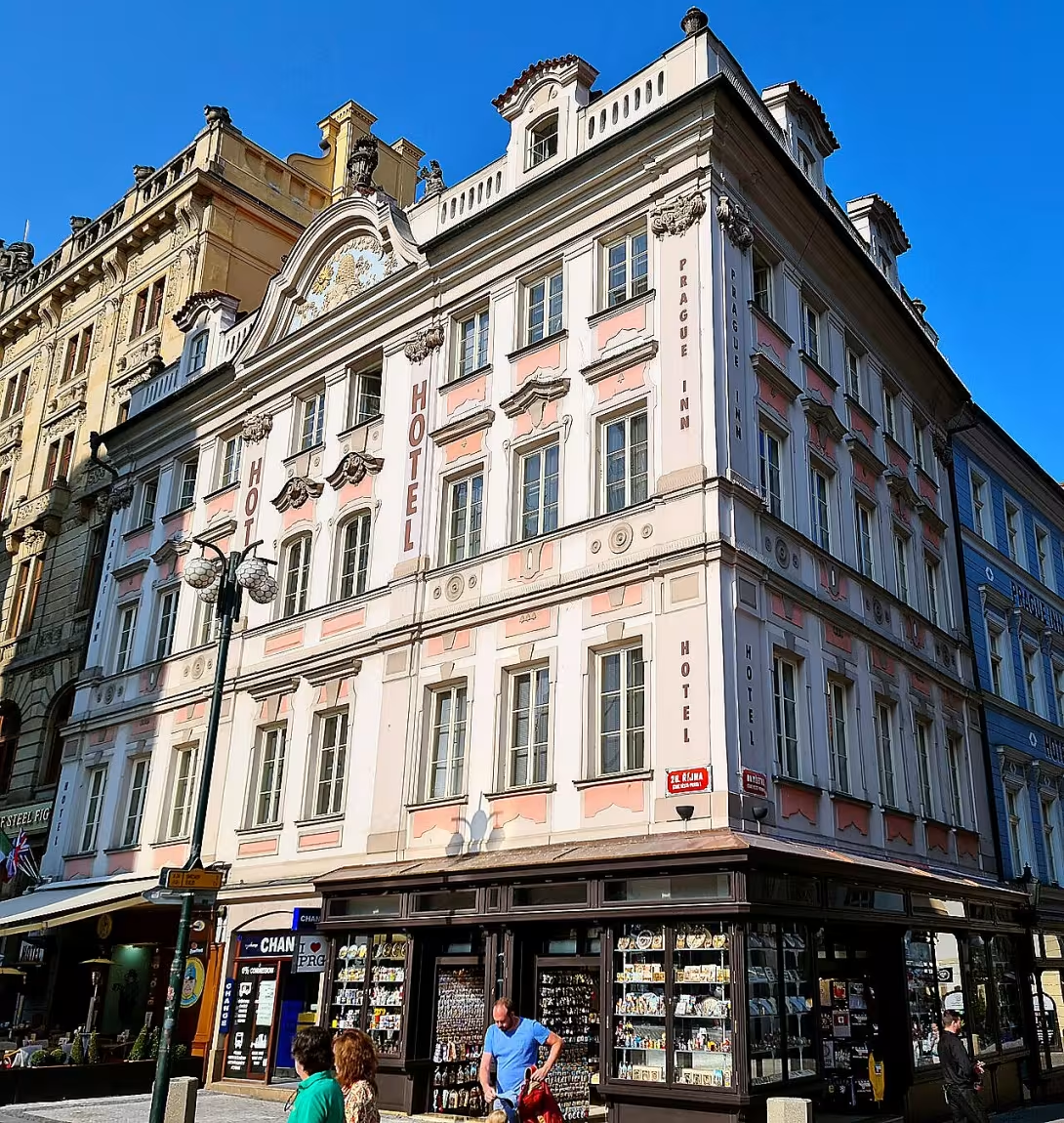
House U Zlatého úlu is a city palace in Prague 1 in Old Town. Together with the opposite house on the Bridge it closes the north side of Wenceslas Square. The building in the present Baroque classical form dates back to 1789. It's probably the oldest object in the entire square.
There were originally two Gothic buildings at the site of the present palace. These houses were connected in the 1970s and subsequently renegotiated. The present appearance is the result of the reconstruction of 1789- 1790, which took place according to the plans of architect Zacharias Fiegert. The ground floor was modified after 1930.
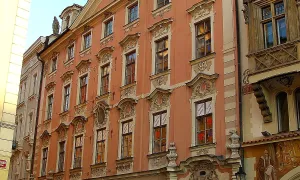
The palace is three storey with a rectangular plan. The facade headed for Wenceslas Square is eight-axis with a shallow two-axis central risalite. Above the crown ledge there is a Mansard roof with an aticia and a skylight ending in the segment. The five-axis side facade to the street Na Most is dealt with similarly, but without risality. There is a strong profile above the ledge on the ground floor.
The building features a shield attachment above the risalite. There is a relief of a large gold decorated beehive. It is accompanied by statues of putti, a vase on top of the shield and a unique depiction of the sun and moon. The interior has preserved elements from various periods: on the first floor there is a Renaissance cross vault, on the ground floor some vaults from the late Baroque and staircase. In the oldest parts, specifically in the cellars, gothic portals of original houses are preserved.
The object is known under several names. In addition to U Zlatého úlu, it was referred to as the Wettenglov House, the Great Christopher, the Great Hive, the Holy Hive or simply the Hive. Since 1964, the house has been protected as a cultural monument. After 1989 it was privatized, subsequently reconstructed and adapted to the hotel.
The U Zlatého úlu Building represents a valuable architectural layered record from goth to classicism in one of Prague's most frequent places. The visit allows you to observe rare details of the historical facade in the city centre.
Historical milestones
- around 1400
- The creation of original Gothic houses
- 1570
- Connection of buildings and renaissance arrangements
- 1789
- Rebuilding to the Baroque Classicist
- 1930
- Ground floor adjustment of the building
- 1964
- Announcement of a cultural monument
- 1989
- Privatization and subsequent change to hotel
Architectural development
Originally, there were two Gothic houses which were connected and renegotiated in the 1970s. In 1789- 1790 a baroque classical reconstruction took place according to the plans of Zacharias Fiegert. After 1930, part of the ground floor was modified.
Historical events
1964: a cultural monument; after 1989: privatization and adaptation to the hotel.
Points of interest
- It's probably the oldest object in Wenceslas Square. - On the facade is placed a relief large gold decorated beehive with unique depiction of the sun and moon. - In interiors are preserved elements from various periods, such as the Renaissance Cross Vault on the first floor. - In the oldest parts in the cellars are preserved gothic portals of original houses. - The building was known in the past under several names, such as the Great Christopher or the Great Hive.
Guide
Show guide text
This text was created by artificial intelligence and has not been editorially reviewed. It may contain inaccuracies.
Welcome to the heart of Prague, the place where the history of the old town meets the dynamics of the modern centre. You're standing in front of a building called U Zlatého úlu. When you look at it now, you see a noble palace-type city house, which together with the house opposite it on the Bridge forms the northern border of Wenceslas Square. It is a building that, by its presence in space, seems calm and at the same time very dignified, as if the memory of many centuries were stored there.
Stop for a moment and feel the atmosphere of this place. It may interest you to know that even though you are on one of the most famous squares in the whole city, this building contains secrets that go much deeper into the past than you thought at first sight. Let's take a look together at how this house has evolved and what it's been through.
When we return in time very far, until around the year thousands of four hundred, there were original Gothic houses. So imagine that in the place where you are now standing there were once more modest but solid structures from the Middle Ages. The world was completely different then, the square was not this large and the buildings had a different purpose. But time passed, and people's needs changed. Around the year a thousand and five hundred and seventy made a significant change. The owners then decided to connect the original buildings into one whole and made Renaissance modifications. This was the moment when one larger and more representative palace began to form from several smaller houses.
Now that you know about it, pay attention to the very form of the building you see before you. What you're seeing today is the result of later interventions. The end of the eighteenth century, namely the year of the thousand seven hundred and eighty-nine, brought a great reconstruction. It is at this time that the building has acquired its present form, which combines elements of late Baroque and Classicism. The architectural changes from this period gave the house elegance and order, which is typical of the time. The builder Zachariáš Fiegert was responsible for these modifications.
Now look carefully up on the front of the house. Notice the detail that gives the building her name. There is a relief of a large, gold-decorated beehive. It's a fascinating element that, when people couldn't read, served as a sign of the house. But look even closer. This relief is not just an ordinary depiction of the hive. It contains a unique depiction of the sun and moon. It is a small but very rare detail that gives the facade depth and mystery. Try to imagine how many thousands of people have passed this golden hive in the last two years.
When we think about the history of the entire Wenceslas Square, we find one very interesting thing. It is assumed that this very object is the oldest building in the entire square. It is a fascinating idea that while the surrounding buildings have been torn down many times over the years and rebuilt, this house is still here and is indicative of the beginnings of this site. He's a quiet observer of history who's seen changes in regimes, wars, and blooming seasons.
Even if you're standing outside now, we can briefly mention what's inside. In the interiors are preserved elements from different periods that intersect here. If you had a chance to look at the first floor, you would have encountered a Renaissance vault, which is living proof of the early form of a house from the sixteenth century. It's a beautiful contrast to later facade modifications.
The building has undergone other changes in more recent history. In the year of the thousand and nine hundred thirty, the ground floor section was modified to better meet the commercial needs of the city. Given its high historical value, it was declared a cultural monument in a thousand and nine hundred and sixty-four, which means that it is under state protection and its values must be preserved for future generations.
An interesting break was the year one thousand nine hundred and eighty-nine. At that time the building was privatized and the house turned into a hotel. The building returned to the function of providing accommodation for travelers, which is very natural in the centre of Prague. Today, it serves as a resting place for people from all over the world who can sense a cavity of time in its walls.
Stop now for a moment and look again at the golden hive with the moon and the sun. It's a symbol of stability and continuity. This building has survived for centuries, adapted to new styles and today stands as a monument to Prague architecture. It is fascinating how one building can combine Gothic, Renaissance, Baroque and Classicism and yet remain harmonious in total.
I hope this short trip to history has helped you to better perceive the beauty and meaning of the U Zlatého úlu house. It is a place that teaches us that history is not only in books, but is present in every stone and in every detail around us. You can now calmly continue your journey around Old Town and discover other hidden corners of our beautiful Prague. I wish you a pleasant walk and many other discoveries. Goodbye.
Tips for visitors
The best time to visit is the morning sloping sun, which beautifully highlights the details of the facade of this oldest house in the square. As it is a residential building, the tour takes place only from the outside, which allows a quick stop during a walk through the centre.
You can easily reach the place by public transport or by car; Check the specific connection and stop options in the current search engines. We recommend comfortable shoes because the surroundings are paved streets.
For the best photos we recommend the angle from the upper part of Wenceslas Square, where the building is seen in its whole size. Watch the game of light on historical walls that changes during the day.
During a short walk in the surrounding area you can visit Wenceslas Square, Na Mostku street or the street on 28 October. All these places are located close to the palace.
We recommend to families with children a game to find old characters and ornaments on the facade of the house, which the children will entertain at a short stop in front of the building.
Frequently asked questions
Can the monument be visited?
This is a residential or farm building, not a museum with opening hours. Please view it from public space and respect the owners' privacy. We have no information about access to the interior.
Where is the monument?
Location: Praha 1. The map on this page shows the exact spot.
Why is the monument protected?
It is listed in the Central List of Cultural Monuments of the Czech Republic as a cultural monument (register no. 1000150436).
Businesses nearby
Do you run a restaurant, accommodation, shop, museum, rental, wellness or other visitor service near this monument? Show yourself directly to the people heading to it — this is how they will see you in the app and on the web:
Events nearby

Zdroj akcí: otevřená data měst a obcí ČR (Národní katalog otevřených dat) a kalendář akcí Národního památkového ústavu.
Nearby
Václavské náměstí, ulice Na Můstku, ulice 28. října.
Accommodation nearby
Trips and activities nearby
Guided tours, tickets and activities nearby from GetYourGuide
Affiliate link: if you buy from the partner, we may receive a commission. The price for you does not change.
Search tours and activities →Themed route
Here is the design of the cruise route:
1. Wenceslas Square (open space) - The centre of the city where you can observe the excitement and urban architecture. 2. Street On the Bridge (street) - Walk through the trading zone, which will guide you towards the center. 3. October 28th (street) - Road leading to the main destination. 4. U Zlatého úlu (Palace) - A visit to the historical building, which is the main point of the whole trip.
Seasonal recommendations
In spring nature wakes up and the city gets a fresh look. The buildings in the centre of Prague are enlightened in this period by fine morning light, which excels beautifully on the facade of the palace. We recommend visiting the place in the morning when the coast is clear. Due to the variable weather, it is advisable to choose layered clothes and comfortable shoes to walk through the streets.
Summer brings intense sun and hot air that creates contrast to the cold stone walls. The atmosphere is full of energy and the streets have the most people. The best time for outside observation is time shortly before sunset, when the colors are the most saturated. It is necessary to wear light, breathable substances and not forget the sun protection.
In the autumn, the surroundings are painted in gold and brown tones, which matches the name of this house. The light is softer and creates a nostalgic mood that is ideal for silent observation of architecture. There are fewer visitors in this period than in the summer season. We recommend you bring a waterproof jacket and a warm neck scarf.
Zimą looks very noble, especially if the facade is covered with snow or freeze. In Advent Time, the surroundings are lit up and the air smells like winter goods. Walk is the best in a time when street lamps are lit. It is necessary to wear warm winter clothes, gloves and high quality footwear to keep the feet dry.
Visualizations and artistic views

The visualisations are generated by artificial intelligence and serve as inspiration.
Photos from the area
Real photos taken near the monument

Zdroj a licence jsou uvedeny u každého snímku.
Tips from visitors
No tips yet. Be the first!
Log in and add your tip.
Sources and literature
Photos: Ricardalovesmonuments / CC BY-SA 4.0 — Wikimedia Commons. The author and licence also appear when you hover over the image.
Faktickým podkladem tohoto textu byl článek na Wikipedii, jehož autory jsou přispěvatelé Wikipedie. Článek je dostupný pod licencí CC BY-SA 4.0.
Location on the map
Příběhy a pověsti
Legendy, pověsti a příběhy spjaté s touto památkou
Fotografie návštěvníků
Zatím žádné fotografie. Buďte první, kdo přidá fotografii z návštěvy!
Log in a přidejte svou fotografii nebo hodnoťte.
Za ověřenou návštěvu v aplikaci získáte víc bodů — poznáme podle GPS, že jste na místě.
Reviews and comments