



Vila Rusalka Villa
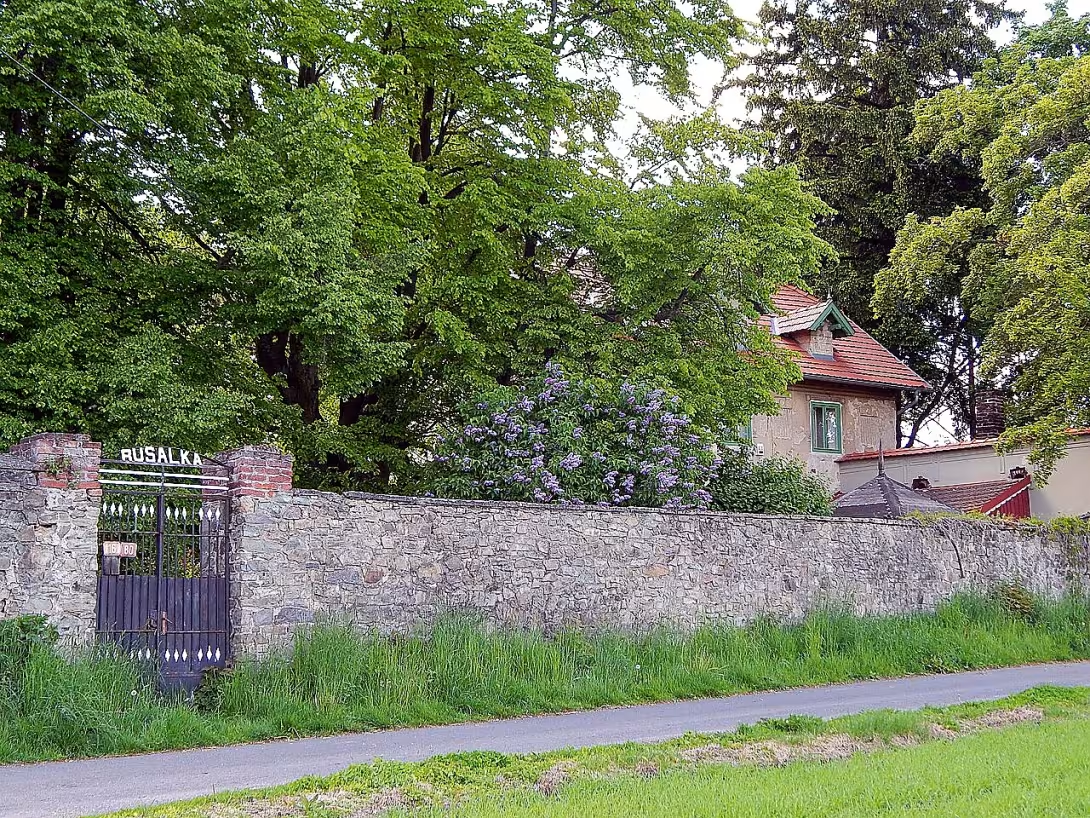
Vila Rusalka in the village Vysoká u Příbramě in the Central Bohemian Region served as a summer residence of composer Antonín Dvořák. The building is protected as a cultural monument. A number of world-famous musical works were created here.
Antonín Dvořák visited the castle area in Vysoká near Pribrama since 1880. Thanks to his brother-in-law, Count Václav Robert from Kounice, he stayed here in a house called the Court. In 1884 he purchased from him for 2000 gold coins an abandoned shouchar and a sheepskin with an surrounding plot on the northwest edge of the village. There was a major reconstruction on the house. The construction was managed by Jan Hertan and August Bohdanecký, Director of Schwarzenberg Manor in Rakovice near Čimelice. The composer supervised the house and garden reconstruction personally. The family stayed here for the first time from May to September 1885.
Dvořák's study was located on the first floor. It had a view of the surrounding forests, meadows, fields, the village of Trebsko and, in good visibility, the Šumava Boubín. The rest of the house was inhabited by a family in three rooms. Later, thanks to the extension with the kitchen, it expanded them by two more. Instead of the original sheep house with a barn, a house was built for the manager Jan Hodík. In the absence of owners, he took care of the premises and twenty pairs of Dvořák pigeons. The garden was divided into a productive and decorative part with precious trees and wooden gazebo with oak table and three benches. The whole area is bounded by a stone, partially wired wall with two gates with pillars. Around 1908, the villa was sectored. From 2010 to 2016, the facade was repaired from benefits from the benefit concerts.
Every year, the family remained here for five months from spring to autumn. The exception was 1893 when Dvořák stayed in America and spent the summer in Spillville. The composer's daily regime started around 4:00 a.m. by walking or Mass in Treb, where he sometimes played the organ. In the morning and in the afternoon he dedicated composing. He alternated with walks with children, taking care of pigeons or visits to the Kounics. He spent his evenings in a local pub among miners by beer and cards, where he told about his travels. In the garden gazebo he liked to create and receive music visits.
There were a number of flagship works in the villa. These include Symphony Nos 7 and 8, Requiem, the second row of Slavic dances, Piano Quintet A major, Piano Quartet Es major and the opera Rusalka, Dimitri, Jacobin, Cert and Kacha or unfinished Armida. Dvořák also played the organ in Bohtěn and Třebsk. In 1894 he gave the church a new instrument, which however destroyed the fire in 1953.
The memorial plate was placed on the house by composer Josef Suk, son-in-law of Antonín Dvořák. In the 1950s, a bust was added from the sculptor Henry Ríha. The name of the Rusalka building was given to the descendants in whose property the complex remained. The villa is not normally accessible; entry is only possible exceptionally. Until 2017, visitors were linked by the grandson of the composer, Antonín Dvořák III. In some years, the villa was opened to participants in the long-distance march Za Dvořák to Vysoká, which takes place on 1 May each year.
Vila Rusalka remains a silent witness to the creative process of one of the most important Czech composers. Her visit resembles a deep bond between Dvořák's music and the Czech landscape.
Historical milestones
- 1884
- The purchase of the building and the launch of extensive reconstruction on the residential house.
- 1885
- The first summer stay of the Dvořák family in the villa.
- 1908
- Art Nouveau.
- 2010
- The beginning of the house facade repair.
Architectural development
In 1884, originally the shouchar and the sheepfold were converted into a residential house under the direction of John Hertan and Augustus Bohdanecký. Around 1908 the building went through Art Nouveau modifications. The facade was repaired between 2010 and 2016.
Historical events
In 1884, a reconstruction of the hoarder to the residential house took place. In 1885 the Dvořák family first stayed here. Around 1908, the villa was sectored.
Owners
Václav Robert z Kounic (owner of the estate), Antonín Dvořák (since 1884).
Points of interest
- Vila Rusalka served as the summer residence of composer Antonín Dvořák. - A number of world-important musical works were created here, among them Symphony Nos 7 and 8, Requiem, the second series of Slavic dances, Piano Quintet A major, Piano Quartet Es major and opera Rusalka, Dimitri, Jakobin, Black and Kacha or unfinished Armida. - Dvořák bought the abandoned shouchar and sheep house in 1884 for 2000 gold pieces and followed by extensive reconstruction on the residential house. - The memorial plate was placed on the house by composer Josef Suk, son-in-law of Antonín Dvořák; In the 1950s, a bust was added from the sculptor Henry Růha. - The name of the Rusalka building was given to the descendants in whose property the complex remained.
Guide
Show guide text
This text was created by artificial intelligence and has not been editorially reviewed. It may contain inaccuracies.
Welcome to Vile Rusalka, a unique place full of history and music. You're standing in front of an elegant residential house with an ornamental garden that invites you to explore its beautiful atmosphere. In 1884, this house, originally a simple hoarder and sheepdog, was rebuilt to the summer residence of composer Antonín Dvořák.
Let's look at the history of this place. Vila Rusalka belongs to the era of the late nineteenth century when it was purchased and rebuilt by Antonín Dvořák to create peace and inspiration. This reconstruction was completed in 1885, allowing the Dvořák family the first summer stay in the villa. In the following years, the house underwent the seceseenian treatment and became a place where the composer created his most famous musical works.
Look up at the front of the house. Note its elegant design and observe how architects Jan Hertan and August Bohdanecký have combined functionality with aesthetics. The house is surrounded by an ornamental garden and a wooden gazebo, which supply the place with more poetry.
This place was not only the home of Antonín Dvořák, but also connected with other important personalities. Among them Václav Robert z Kounic and Josef Suk, who contributed to the cultural wealth of this site.
The interesting thing is that a number of world-famous works have been created here. Symphony number seven and eight, Requiem, the second series of Slavic dances, Piano Quintet A major and many others were inspired by the peace and beauty of this place. The operas of Rusalka, Dimitri or Krit and Kacha were also created here.
Now let's look at some details. Note how the house maintains its historical value despite repairs made in 2010. The entire building is protected as a cultural monument and represents an invaluable heritage.
Let's move closer to the garden where you can feel the atmosphere that inspired Dvořák. Notice the peace and beauty this space offers.
Let me give you an invitation to explore this fascinating place. See the ornamental gardens and wooden gazebo that deliver Vile Rusalka's unique atmosphere.
Thank you for your visit. I hope you enjoyed exploring this historical monument and retaining memories of the beauty of Vile Rusalka.
Tips for visitors
The best time to visit the villa Rusalka is during the summer months when the weather is most favourable and the surrounding nature offers the most beautiful views. This time also allows you to explore the castle area in Vysoká near Pribrama, where the villa is located, and surrounding forests overlooking Boubin.
It is possible to use both passenger cars and public transport to access the villa Rusalka.
When visiting, wear a suitable suit because the local weather can be variable. It is also good to have water and sun cream to protect against the sun. Photography of Villa Rusalka offers the best possibilities from green areas around, where there is also a lighter light.
In the vicinity of the villa Rusalka you can visit the village Třebsko, which offers quiet rooms and beautiful views. It is advisable for families with children to plan a visit to the castle grounds where children can play and enjoy the natural environment.
Frequently asked questions
Can the monument be visited?
This is a residential or farm building, not a museum with opening hours. Please view it from public space and respect the owners' privacy. We have no information about access to the interior.
Where is the monument?
Location: Vysoká u Příbramě, Středočeský kraj. The map on this page shows the exact spot.
Why is the monument protected?
It is listed in the Central List of Cultural Monuments of the Czech Republic as a cultural monument (register no. 1000141807).
Businesses nearby
Do you run a restaurant, accommodation, shop, museum, rental, wellness or other visitor service near this monument? Show yourself directly to the people heading to it — this is how they will see you in the app and on the web:
Events nearby
Zdroj akcí: otevřená data měst a obcí ČR (Národní katalog otevřených dat) a kalendář akcí Národního památkového ústavu.
Nearby
Zámecký areál ve Vysoké u Příbramě, vesnice Třebsko a lesy s výhledem na Boubín.
Accommodation nearby
Themed route
Travel Route: Municipality of Vysoká u Příbramě
1.Vila Rusalka
Type: Architectural monument
Why is worth a visit: This villa is an example of a modern work of architecture that boasts unique design and history. It's the perfect place for those who like unusual architecture.
2. Castle area in Vysoká near Pribrama
Type: Historical and cultural object
Why is worth a visit: The castle is famous for its beautiful architecture and history. Its area offers views of the surrounding countryside, making it an ideal place to relax and explore.
3. The village of Treb
Type: Historical village
Why is it worth a visit: This picturesque village is known for its authenticity and beautiful gardens. It's a place where you can feel calm and relax while walking through her travels.
4. Forests overlooking Boubin
Type: Natural space
Why is worth a visit: Walking through these forests offer not only peace and opportunity to relax, but also beautiful views of Boubin. It's an ideal place for nature lovers and photographers.
This route combines history, architecture and nature, making it perfect for a day trip.
Seasonal recommendations
Spring: Vila Rusalka in the spring season offers visitors an unforgettable experience where nature comes to life and everything blooms around them. The sun illuminates the architecture of the villa with fine rays, which decorate the roofs and windows with coloured stripes. The green of the park is fresh and beautiful, which adds peace and harmony to the atmosphere. We recommend visiting when the trees start to green, but they are not yet dense enough to cover up the view of the beautiful architectural complex. Dress up suitable for mild weather and come in the early hours to avoid possible crowds.
Summer: In summer, Vila Rusalka is the best base for relaxing in the shade of old trees and near a quiet pond located in the park. Long summer days offer a chance for a long walk along flowering plants. The sun rays illuminate architectural details of the villa, making them even more attractive to explore. This season the opening of visitors' halls and gardens can be adapted to longer hours, but we recommend that you come early to avoid large crowds. Don't forget the sun protection and plenty of drinking water.
Autumn: In autumn Vila Rusalka offers visitors a different but equally attractive atmosphere. Green leaves turn into gold and red, giving the park a unique character. The sunny days are pleasant for walking around the villa and its surroundings, while cooler evenings can be the time to relax by the fireplace. The architectural elements of the villa are decorated with shade and natural colour accents of leaves. We recommend visiting the moment when the weather is quietest, usually at the end of autumn, with clothes suitable for mild cold days and evenings.
Winter: In winter months, Vila Rusalka offers visitors a calm and quiet atmosphere where everything is decorated with snow. The architecture of the villa is illuminated by light from inside and outside, which gives the place a magical character. The parks can be covered with a light coating of snow, which adds romance and calm to the view. We recommend warm clothes with protective elements against cold and humidity to enjoy a visit without worry.
Visualizations and artistic views


The visualisations are generated by artificial intelligence and serve as inspiration.
Photos from the area
Real photos taken near the monument

Zdroj a licence jsou uvedeny u každého snímku.
Tips from visitors
No tips yet. Be the first!
Log in and add your tip.
Sources and literature
Photos: Tr.ma / CC BY-SA 3.0 — Wikimedia Commons. The author and licence also appear when you hover over the image.
Faktickým podkladem tohoto textu byl článek na Wikipedii, jehož autory jsou přispěvatelé Wikipedie. Článek je dostupný pod licencí CC BY-SA 4.0.
Location on the map
More monuments – Vysoká u Příbramě
Show all in the municipality




Příběhy a pověsti
Legendy, pověsti a příběhy spjaté s touto památkou
Fotografie návštěvníků
Zatím žádné fotografie. Buďte první, kdo přidá fotografii z návštěvy!
Log in a přidejte svou fotografii nebo hodnoťte.
Za ověřenou návštěvu v aplikaci získáte víc bodů — poznáme podle GPS, že jste na místě.
Reviews and comments