



Vodní mlýn čp. 10 Water mill
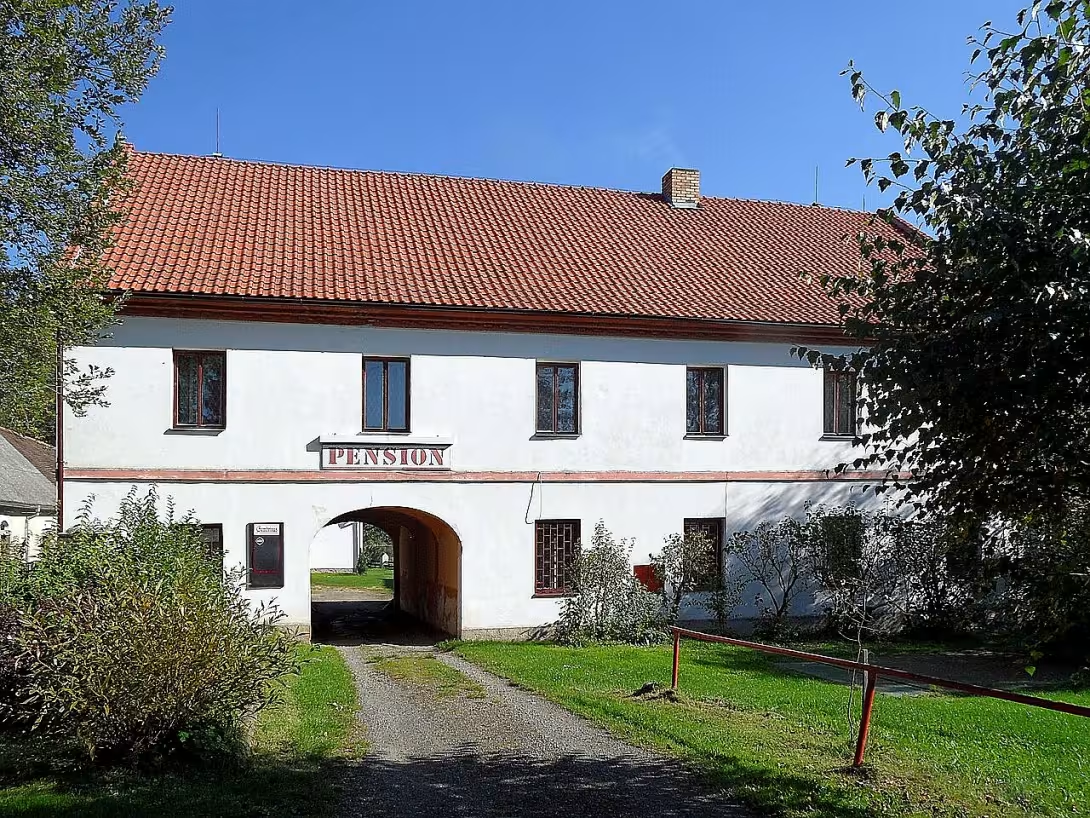
Vodní mlýn čp. 10, known as Mlýn Buda, is located in Horce nad Sazavou in Kutna Hora district. This classicist object from the first quarter of the 19th century stands on the river Sazava near the Horka Jez, approximately 108.6 km. Monumental protected area with closed rectangular structure includes residential building, mill, mill apartment and economic building. Today it serves as a guesthouse and restaurant.
The mill comes from the development of industrial enterprises in Czech countries, when rural construction gradually began to modernize. Water for propulsion flowed over the food with the miller as the manager of his door. By 1900 the mill had three water wheels, which were replaced by a Francis turbine in 1930.
The area has a rectangular available and lies close to the road, about 40 metres south of the train station. The residential house is storey with a saddlebag roof and six window axes. The passage has an unsymmetrical glass vault, while the mill on a rectangular plan has segmental windows. The cottages have a saddle roof and stone translations at the door openings. On the northeast corner there is a perpendicular to the arcade carried by the pillar, beside which is the miller's apartment.
After 1948 the mill was nationalized and integrated into the Central Bohemian mills. In 1950, grain milling ended while the saw continued to operate until 1954. The area was then taken over by the Local National Committee of Horka nad Sázavou. In 1980, a tourist autocamp opened.
Key events include modernization of the mill in 1887 and installation of the Francis turbine in 1931, which replaced the original wheels. In 1950, the grinding of grain was finally over. Today it is protected as a cultural monument of the Czech Republic and serves for recreation.
This mill is an important proof of the development of rural architecture and milling techniques in Sázava, offering visitors a view of the history of industrial heritage.
Historical milestones
- 1887
- The mill has undergone modernization.
- 1931
- A Francis turbine was installed to replace the original water wheels.
- 1950
- The mill stopped grinding and only the saw remained in operation.
- 1980
- A tourist autocamp was set up at the mill.
Architectural development
The area has a closed rectangle available surrounded by residential, mill and economic buildings. The storey residential house is covered by a saddlebag roof and has six window axes. Part of the complex is also a perpendicular with an open two-parlour and the following shorter stone apartment of the miller.
Historical events
The mill was modernised in 1887. A new turbine was installed in 1931. After 1948 the mill was nationalized and in 1950 the milling was stopped.
Owners
Central Bohemian mills, Local National Committee Horka nad Sazavou
Points of interest
- Mill No. 10 is a classicist object from the first quarter of the 19th century. - The area has historical protection and serves as a guesthouse and restaurant. In 1930, the original water wheels were replaced by Francis' turbine. - After 1948 the mill was nationalized and integrated under Central Bohemian mills, which ended the milling of grain in 1950. - The mill is an important example of the development of rural architecture and milling techniques in Sázava.
Guide
Show guide text
This text was created by artificial intelligence and has not been editorially reviewed. It may contain inaccuracies.
Welcome to the water mill with descriptive number ten, which is called Buda. You are standing in front of this historic landmark on the banks of the Sazava River in the village of Horka in the district of Kutna Hora and have just put on headphones to hear the story of this remarkable place. Look around you and see the atmosphere this building radiates. In front of you, there is an entire complex with a closed, rectangular layout that carries traces of many years of human work and transformation. If you look at what's right in front of your eyes, you see a complex that includes a residential building, a mill itself, an apartment once designed for miller workers and the necessary economic buildings. This whole form a harmonious picture of folk construction, which is firmly connected to the water flow.
Let's move forward in time and see how this mill was formed and what its historical context was. The whole object dates back to the first quarter of the nineteenth century and carries in it the essays of Classicism. It was created at a time when the river Sazava was an important artery for grinding grain and when the milling craft was of great weight in the region. People lived here in close contact with nature and water-powered mill wheels were the main source of livelihood. The building stood by the road and near the river, which made it easier to transport the grain to grinding and to transport the flour to the customers. Over the years, this mill has undergone a number of necessary adjustments that correspond to technical progress and the needs of the time.
Now pay attention to the architecture itself and the details that you can see at the construction site before you. Take a look at the facade and overall layout of the complex, which is enclosed in a rectangular form. Stop by to see the individual parts, such as the residential building or the mill. Although the building underwent modernization over the years, it retained its historical character as a classical building from the first quarter of the nineteenth century. When you look at developments over the centuries, you will find that the mill underwent significant modernization already in the 1980s. Another big milestone in technical equipment came in the year one thousand nine hundred thirty-one, when the modern Francis turbine was installed. It then replaced the original water wheels and moved the mill to a new level of efficiency.
The history of this place is interwoven with many stories about people who worked and lived here. The names of specific builders or historical figures do not indicate the sources, but the fates of the miller and their families are written in invisible letters in the walls. The grinding of the grain was a heavy kernel that depended on the power of water and the whims of weather. The break in the life of the mill came after nineteen hundred forty-eight, when the object was nationalized. It was then incorporated under the Central Bohemian mills, which meant a great deal of interference in the traditional way of operation. In the year one thousand nine hundred and fifty, the milling of the crop finally stopped and only the saw, which was used to process the wood, remained in operation.
The interesting thing that will attract your attention here is its transformation in modern times. The mill No. 10 is protected as a real cultural monument, which underlines its historical value. While people used to grind the grain and later cut the wood, there was another turn in the 1980s. At the mill, a tourist autocamp was set up, which brought new life to the quiet valley of Sazava. Today you will no longer hear the click of the millstones or the hum of the saw, because the object has undergone sensitive modernization and serves as a guesthouse and restaurant.
In conclusion, we'd like to invite you to explore this beautiful place again. You can enter, sit in the restaurant, enjoy a pleasant atmosphere or walk near the Sazava River and perceive the genius loci of this classic mill. Thank you for listening to our audio guide, and we wish you a wonderful experience in the next discovery of history in Horce nad Sázavou. Goodbye.
Tips for visitors
The best time to visit the water mill is early in spring or late in autumn when the mild weather and light along the river is the most pleasant; There are also fewer visitors in these periods, so you can soak up the atmosphere of the historical area in peace.
Check the current connection in the public transport search engine.
What to bring: comfortable shoes suitable for uneven terrain, umbrella or raincoat, water bottle and possibly light lunch or snack, because there is no permanent refreshment service on the premises. We also recommend a paper map or an application with an offline map so that you don't just get a cell signal.
Photography looks best from the bank of the river Sazava, where you can capture the mill in the reflection of water; The ideal light is the morning after sunrise or late afternoon when the sun shines at an angle and creates interesting shadows. For stable images, use the tripod and make sure that modern traffic signs do not appear in the background.
What to visit nearby: just at the mill lies Lake Horka, ideal for a short walk or rest by the water; along the river leads a natural trail suitable for family trips; nearby is also the historical centre Horka II, where you can soak up the local atmosphere and taste regional specialities.
Frequently asked questions
Can the monument be visited?
This is a technical monument. Some are open as exhibitions, others are out of use or on private land. We have not verified whether this one is accessible.
What are the opening hours and admission?
We have not verified the opening hours or admission. Current information is published by the operator.
Where is the monument?
Location: Horka II, Středočeský kraj. The map on this page shows the exact spot.
Why is the monument protected?
It is listed in the Central List of Cultural Monuments of the Czech Republic as a cultural monument (register no. 1000138885).
Businesses nearby
Do you run a restaurant, accommodation, shop, museum, rental, wellness or other visitor service near this monument? Show yourself directly to the people heading to it — this is how they will see you in the app and on the web:
Nearby
Mlýn leží na řece Sázavě v těsné blízkosti jezu Horka a přibližně čtyřicet metrů jižně od místní vlakové stanice.
Accommodation nearby
Trips and activities nearby
Guided tours, tickets and activities nearby from GetYourGuide
Affiliate link: if you buy from the partner, we may receive a commission. The price for you does not change.
Search tours and activities →Themed route
1.Vodní mlýn čp. 10 Type: Historical technical monument Why is it worth a visit: This mill is located on the river Sazava in the village Horka II. It offers a unique view of the historical building associated with water construction.
2. Eat Hot Type: Water construction Why is worth a visit: Located close to the mill on the river Sazava. The place offers an interesting spectacle of flowing water and surrounding shores.
3. Local Train Station Type: Transport construction Why is it worth a visit: It lies approximately 40 meters north of the mill. It serves as a starting point or end point for travellers arriving on tracks.
Seasonal recommendations
Spring at the historic water mill in the village of Horka II brings about the awakening of nature, when the surrounding trees and grass acquire bright greenery and the banks of the water stream come alive by singing birds. The sun rays in this period penetrate low above the horizon and create fine shadows on old grafted walls, which gives the whole place a calm and romantic mood. From the point of view of practical advice, it is advisable to start in the morning, when the area is almost empty and visitors can easily see the outdoor areas in very good condition. Clothes should consist of solid shoes suitable for wet spring soil and light jackets, because it is colder with water.
Summer in this monument offers lush vegetation, which partly surrounds the building and creates a pleasant shade under the crowns of grown trees. The daylight is sharp and long, which increases the beauty of wooden details and water levels in the surroundings. Since this is the main tourist season, it is recommended to come either early in the morning after opening or late in the afternoon to avoid larger groups of people. As clothing, breathable summer things are sufficient, but due to the proximity of the water stream, it is worth having an insect repellent and not forgetting the headgear for direct sun protection.
Autumn moons turn the surroundings of the mill into a colour palette of shades of yellow, red and brown, which perfectly contradict a well-maintained historical building. Low sun creates warm and soft light ideal for lovers of photography of old buildings and natural scenery. In this period it is usually calmer than in summer, so the visit in the afternoon guarantees an undisturbed atmosphere. Practical recommendations include a warmer sweater, long pants and waterproof shoes, as fallen leaves and autumn showers can make roads around the water slippery.
Winter gives the water mill a quiet and fairy-tale atmosphere, especially when the landscape is covered by a layer of snow and thin ice crust forms on the water surface. The light day is very short, the sun soon sets, and it soon shines, which gives the whole area a mysterious touch. Visitors should count on limited operating hours and head out for a tour around noon, when the best chance of daylight is out. The necessary equipment is a quality winter coat, hats, gloves and solid winter shoes, because movement around the frozen water stream requires increased caution.
Visualizations and artistic views


The visualisations are generated by artificial intelligence and serve as inspiration.
Photos from the area
Real photos taken near the monument


Zdroj a licence jsou uvedeny u každého snímku.
Tips from visitors
No tips yet. Be the first!
Log in and add your tip.
Sources and literature
Photos: Stribrohorak / CC BY-SA 3.0 — Wikimedia Commons. The author and licence also appear when you hover over the image.
Faktickým podkladem tohoto textu byl článek na Wikipedii, jehož autory jsou přispěvatelé Wikipedie. Článek je dostupný pod licencí CC BY-SA 4.0.
Location on the map





Příběhy a pověsti
Legendy, pověsti a příběhy spjaté s touto památkou

Fotografie návštěvníků
Zatím žádné fotografie. Buďte první, kdo přidá fotografii z návštěvy!
Log in a přidejte svou fotografii nebo hodnoťte.
Za ověřenou návštěvu v aplikaci získáte víc bodů — poznáme podle GPS, že jste na místě.
Reviews and comments