



Vodní mlýn čp. 19 (Vepřek) Water mill
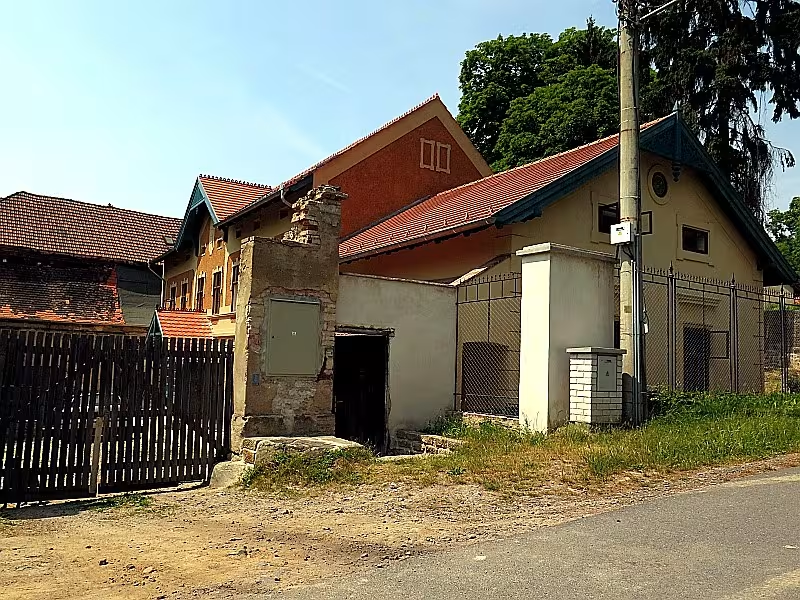
Satran Mill in Veprak near Nové The village of Mělnicka is a historic water mill on the left bank of the Bajov creek. The object, the oldest parts of which are probably from the 14th century, represents an important document of technical heritage. Since 2011 it has been protected as a real-estate cultural monument of the Czech Republic and boasts preserved historical technologies.
The mill was created at the time of the blooming of Czech countries during the reign of Luxembourg and was owned by the Prague chapter in the early days. Since few reports of the oldest history have been preserved, we derive the age of the building from preserved late Gothic stonework articles and secondary Renaissance bars. During the 30-year war, the mill was damaged, after which the foundation of the new mill was laid.
The area consists of four buildings closing an irregular courtyard, which encircles a walled wall with a gate. On the north side there is a residential building with a port on which the mill with machine room is perpendicular. The east side of the court occupies the granary, the south side occupies the economic buildings. Architectural development includes a major reconstruction around 1816, followed by eclectic modifications of the residential building between 1904 and 1907. In the 1920s, a turbine engine room was added to the mill.
Property history is mainly linked to the Satranová family, after which the mill bears its name. The construction of the State Northwest Railway line in the 1950s, which physically separated the mill from the municipality, was a significant interference in the operation of the complex. Technical equipment has undergone modernization at the beginning of the 20th century; In 1930, three Francis turbines operated with different performance and momentum.
After World War II, the mill stopped serving its purpose. In the second half of the 20th century, he faded, leading to the collapse of most roofs. The turnover took place only after 2010, when the new owners started the overall reconstruction of the site including the restoration of historical technologies.
Today, Satan's mill is open to the public as a complete technical monument. Visiting this place offers the opportunity to familiarize yourself with the development of miller and construction history in an authentic environment that has been saved from extinction.
Historical milestones
- 1816
- Rebuilding the mill in the preserved range.
- 1904-1907
- The eclectic reconstruction of the residential building and the modernisation of technical equipment.
- 2011
- Declaration of the area of the mill for the cultural monument of the Czech Republic.
Architectural development
The original medieval core with late Gothic elements was supplemented by a new mill after 30 years of war. There was a major reconstruction around 1816, followed by eclectic modifications of the residential building in 1904- 1907. In the 1920s, a turbine engine room was added.
Historical events
Damage to the mill during the 30-year war, construction of the State Northwest Railway line in the 1950s, declaration for cultural monument in 2011.
Owners
Prague chapter (Middle Ages), the family of Satranova (later period), new owners (after 2010).
Points of interest
- The oldest parts of the mill are probably from the 14th century and was owned by the Prague chapter in the early days. - The area consists of four buildings closing an irregular courtyard, which encircles a walled wall with a gate. - The construction of the line of the State Northwest Railway in the 1950s separated the mill physically from the village. - In 1930, three Francis turbines were operating with different power and momentum. - After World War II, the mill stopped serving its purpose and lost its purpose in the second half of the 20th century, leading to the collapse of most roofs.
Guide
Show guide text
This text was created by artificial intelligence and has not been editorially reviewed. It may contain inaccuracies.
Welcome to the water mill number 19 in Pork. You've just stopped at a place that's much more than a set of old walls and roofs. You're standing in front of a living witness to the flow of time reflected in the surface of the Bakovsky creek. Before you go any further, I suggest you close your eyes for a moment and listen. Feel the noise of water that has been around here for hundreds of years, and imagine how this noise accompanies anyone who has been in these areas from the Middle Ages to this day. Before your eyes, a complex complex is now spreading out, which, with its informal but firm structure, acts as a closed world in which time has stopped.
Let's look together at what you see before you. The whole area consists of four main buildings which are not built in strict geometry but surround an irregular courtyard. This irregularity is not accidental; It is the result of organic growth, where every new building had to adapt to what had already been here and to how it was allowed by the terrain and water flow. Note how the area with its buildings creates a sense of security and privacy, which was a vital element for the life of the mill. In addition, this whole area is enclosed by a wall of the wall wall, which is supplemented by a gate. This wall is not just a building element, it is the border between the world of outside chaos and the order that rules in this mill's economy.
If we try to look deeper into the past, we'll find that the history of this place is incredibly long. Although buildings may seem to you from different periods, their roots go back to the 14th century. Imagine the era when the landscape around you looked completely different, and when we talked about this place, it belonged to important assets. In the early days, this mill was not just an ordinary economy, but belonged directly to the Prague capital. This gives this place some nobility and historical weight. The mill was not just about grinding grain, it was part of the wider economic and religious order of the then society.
Over the centuries, the mill had to change constantly to keep working. If you look more closely at the residential building now, you can see in its details the traces of a large reconstruction that took place at the beginning of the twentieth century, namely between 1904 and 1907. At that time, architecture was a style called eclectism. This means that architects did not hesitate to combine various historical elements to create a harmonious and representative whole. It is this modernization that breathed the living parts of the mill into a new, then very modern look and increased its comfort.
Now pay attention to the technical heart of this place. The mill was not only home, it was mainly a machine. Over the years, technical equipment has been continuously improved. One of the most important steps was to install a turbine engine room. The transition from older water wheels to modern turbines was a huge leap in efficiency and was proof that this historical object was able to adapt to the technological advances of its time. This transformation was part of a wider process of modernization, which culminated in the mill at the turn of the century.
If we talk about the people who left their trail here, we can't forget the name of Vojtěv Satran. The character of this man is closely linked to the history of this mill. Although the history of the mill is constantly being rewritten, the House of Satrans and their activities here are an important bond that connects us to the human dimension of this place. The miller was not just a worker, he was a man who had to understand water, mechanics, and the human needs of the entire community. Life in the mill was a rhythm of water and seasons, and characters like Vojtěch Satran were the ones who determined that rhythm.
But now I want to invite you to think about one interesting thing that may seem a little unusual. Notice how this area is situated in the landscape. In the 1950s, there was an event that physically changed the surroundings of the mill forever. The line of the State Northwest Railroad was built. This railway structure has become an invisible but relentless border that has physically separated the mill from the rest of the landscape. It's fascinating to imagine the contrast between the slow, rhythmic movement of water in the stream and the quick, noisy passage of steam locomotives that started passing by the mill. This railway brought a new world of speed and industry into the area, while the mill remained loyal to its water source.
This contrast between old and new, between water and rail, is what makes this place so special. The mill survived the period of decaying, the changes in political regimes and technological revolutions. And, despite the fact that in the times of the greatest decline it seemed that it could disappear, thanks to its value it was officially declared a real-estate cultural monument of the Czech Republic in 2011. This is proof that its value is not only in the material, but in the story it tells.
Now that you know the foundations of its existence, its architecture and the most important moments that have shaped it, I urge you to further explore. Walk around the wall, perceive the atmosphere of this enclosed courtyard and try to imagine in your mind what sounds were heard here hundreds of years ago. Every stone and building here has their own voice. Thank you for spending this moment with us at the Water Mill in Pork. I wish you a beautiful and inspiring rest of your trip.
Tips for visitors
A tour of the mill is recommended to plan for the morning hours during the working week when the resort is quieter and offers better conditions for observing historical architecture without a large number of visitors.
When visiting the premises we recommend fixed shoes suitable for moving around the historical yard and around the Bakovský creek. Don't forget to pack your camera because the broken layout of four buildings offers interesting compositions.
Best lighting conditions for capturing the details of the mill and its links to the Bakovsky stream are usually in soft afternoon light. Focus on the irregular courtyard, which forms the heart of the whole complex.
For families with children, the location is interesting thanks to the proximity of the water stream and the possibility of observing historical buildings in the authentic environment of the village Veprak and Nová Ves. Children will appreciate the area of a closed yard where they can safely explore the corners of the mill.
Frequently asked questions
Can the monument be visited?
This is a technical monument. Some are open as exhibitions, others are out of use or on private land. We have not verified whether this one is accessible.
What are the opening hours and admission?
We have not verified the opening hours or admission. Current information is published by the operator.
Where is the monument?
Location: Středočeský kraj. The map on this page shows the exact spot.
Why is the monument protected?
It is listed in the Central List of Cultural Monuments of the Czech Republic as a cultural monument (register no. 1000122418).
Businesses nearby
Do you run a restaurant, accommodation, shop, museum, rental, wellness or other visitor service near this monument? Show yourself directly to the people heading to it — this is how they will see you in the app and on the web:
Events nearby
Zdroj akcí: otevřená data měst a obcí ČR (Národní katalog otevřených dat) a kalendář akcí Národního památkového ústavu.
Nearby
Bakovský potok, village Veprak, village Nová Ves, railway line State Northwest Railways.
Accommodation nearby
Trips and activities nearby
Guided tours, tickets and activities nearby from GetYourGuide
Affiliate link: if you buy from the partner, we may receive a commission. The price for you does not change.
Search tours and activities →Themed route
1. Municipality of Nová Ves (municipality) - The entry point of the trip, which serves as an ideal starting point for walking through the countryside. 2. Railway line State Northwest Railways (Railways) - Historical transport element that resembles the development of regional infrastructure. 3. Vodní mlýn čp. 19 (Vepřek) (mill) - The main destination of the journey, which represents a valuable technical monument to water management. 4. Bakovský stream (stream) - The natural flow that drove the mill and offers a relaxing journey along the water. 5. Municipality of Veprak (municipality) - The local municipality where the mill is located and which forms the natural conclusion of the route.
Seasonal recommendations
Spring: In spring, the mill wakes up with nature. The first leaves start to green around the water and the morning sun gently illuminates the historical wood and stone parts of the building. The atmosphere is fresh and full of new energy. We recommend taking layered clothes because morning cold can be overlooked, and prepare for sudden changes in weather. The best is to come early in the morning when everything is freshest and quieter.
Summer: In the summer months the mill is surrounded by dense greenery and warm sun. The reflection of the light on the water surface creates a pleasant and light environment for visiting. In the main summer season there are more people around the monument, so it is advisable to arrive early in the morning to enjoy peace without crowds. Dress lightly and don't forget to protect yourself from the sun, especially if you move in the open area near the flow.
Autumn: Autumn brings the mill nostalgic beauty thanks to the golden and brown shades of surrounding vegetation. The morning mist above the water gives the place mystery and a calm, melancholy atmosphere. It is an ideal time to observe nature, especially in the afternoon when light is softer. For a comfortable walk we recommend firm shoes that can handle moist soil and falling leaves, as well as a warmer layer of clothing.
Winter: Winter turns the mill into a quiet and freezing landscape. If frost comes, the surrounding terrain can be covered with snow and the sound of running water in the ice environment is very moving. At this time, traffic is the lowest, which guarantees maximum privacy. The need is very warm clothes and quality shoes in case of ice. It is appropriate to verify in advance, where appropriate, the shorter opening times during that period.
Visualizations and artistic views


The visualisations are generated by artificial intelligence and serve as inspiration.
Photos from the area
Real photos taken near the monument


Zdroj a licence jsou uvedeny u každého snímku.
Tips from visitors
No tips yet. Be the first!
Log in and add your tip.
Sources and literature
Photos: Sovicka169 / CC BY-SA 4.0 — Wikimedia Commons. The author and licence also appear when you hover over the image.
Faktickým podkladem tohoto textu byl článek na Wikipedii, jehož autory jsou přispěvatelé Wikipedie. Článek je dostupný pod licencí CC BY-SA 4.0.
Location on the map





Příběhy a pověsti
Legendy, pověsti a příběhy spjaté s touto památkou
Fotografie návštěvníků
Zatím žádné fotografie. Buďte první, kdo přidá fotografii z návštěvy!
Log in a přidejte svou fotografii nebo hodnoťte.
Za ověřenou návštěvu v aplikaci získáte víc bodů — poznáme podle GPS, že jste na místě.
Reviews and comments