



vodní mlýn v Doksanech Water mill
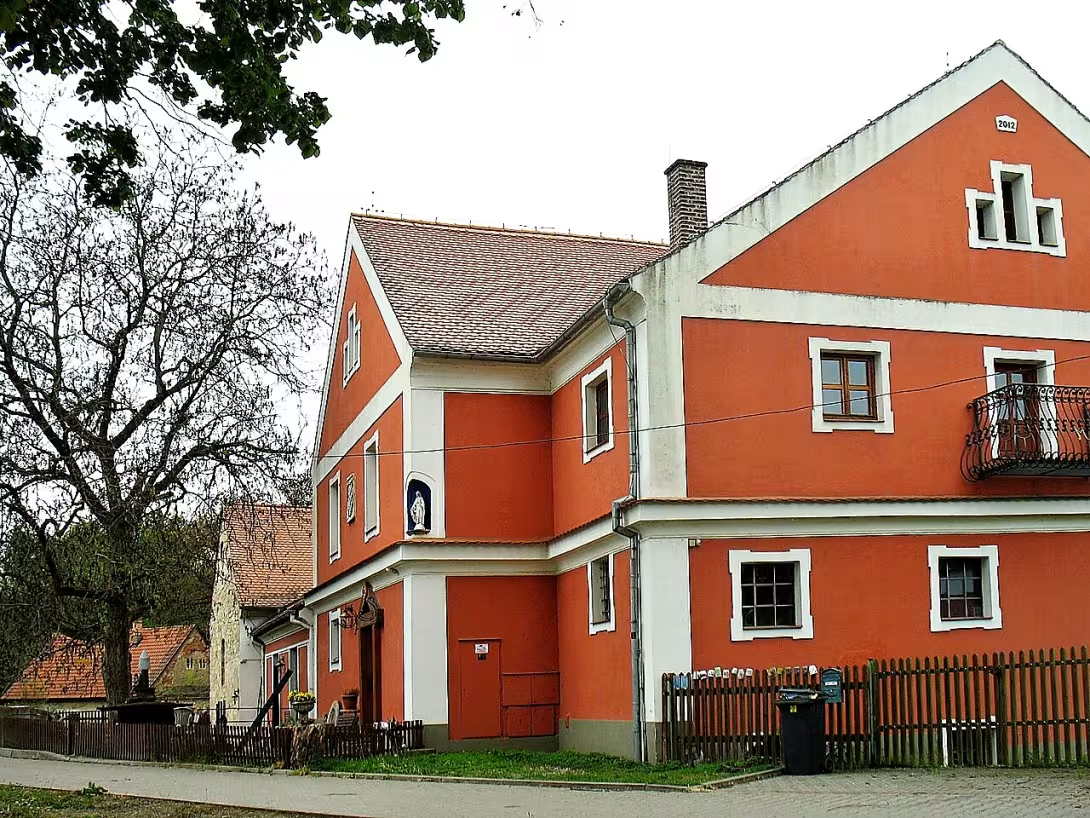
The Doksan Mill in the district of Litoměřice stands on the river Ohře and comes from the middle of the 12th century. It is protected as a real cultural monument of the Czech Republic and is closely related to the history of the monastery of premonstraty.
The construction was created at the same time as the establishment of the Premonstrate monastery. In the time of King Přemysl Otakar II, the object was the subject of an 80-year lawsuit between the municipality of Brozany and the monastery Doksany for a claim to water. Further mention of the mill dates back to the beginning of the 15th century.
The current form is based on the early Baroque mill from 1558 and subsequent reconstruction from 1678- 1679. As a cultural monument, the mill building itself, the economic object on the left bank of the drive, the operational part of the small hydropower plant, the bridge before its eastern front and the part of the drive with reinforced supporting walls are protected.
In the 14th century, the mill equipment was supplemented with a bag for grain dosing. The mill equipment remained unchanged until the end of the 18th century. Originally, the mill was powered by six water wheels with a diameter of six metres, into which the water was driven by a drive through the food and a fork. In 1926, large water destroyed the wooden engine room; It was replaced by a Francis turbine in a concrete storage. By 1930, it had a drop of 2.25 meters and 60 horsepower. The Kaplan turbine with a drop of 3.2 metres and a model Hydrohrom 1000 with a power output of 110 kW was preserved in the building.
In 1882 Jan owned a free master from Aehrenthal, owner of Doksan, and in 1939 Jan Aehrenthal. In 1951 the building was nationalized and shut down together with the power plant working at 120 V voltage. In 1982, the entire facility was demolished. Only two cylindrical and two stone mills remained, a pocket elevator, a snail conveyor, a flour sieve and part of the transmissions.
Since 1997, the mill has been gradually repaired. A small hydroelectric power plant was reconstructed, where the original equipment was replaced by a recessed Kaplan turbine and the output of the generator was connected to the state network.
The Doksan Mill represents an important technical and historical unit documenting the development of water management in the region. It is an attractive goal for anyone interested in the industrial architecture and history of this site.
Historical milestones
- 1951
- The mill was nationalized and shut down
- 1982
- The demolition of the whole facility, only some parts remained
Architectural development
The original mill equipment included two cylindrical and two stone mills. In 1926, the wooden engine room was replaced by a Francis turbine in concrete storage, which was later replaced by a Kaplan turbine.
Historical events
- half of the 12th century
- The establishment of the monastery of premonstratas and the creation of the first mill
- 1233-1278
- Court proceedings between the municipality of Brozany and the monastery Doksany on entitlement to water
- 1951
- The mill was nationalized and shut down together with the power plant
Owners
- 1558
- 1939
Points of interest
- The Doksan Mill stands on the Ohra River and dates back to the middle of the 12th century. - The mill was part of an 80-year lawsuit for a claim for water in the time of King Přemysl Otakar II. - The current form of the mill dates from the early Baroque period, namely from 1558 and reconstruction from 1678- 1679. - In 1926, the wooden machinery room was replaced by a Francis turbine in a concrete storage. - Since 1997 there has been a gradual repair of the mill, which includes the reconstruction of a small hydropower plant with a Kaplan turbine receptacle.
Guide
Show guide text
This text was created by artificial intelligence and has not been editorially reviewed. It may contain inaccuracies.
Welcome to the Doksans. Stop for a moment and take a deep breath into the air at the Ohre River. You are standing in a place that once beat the heart of the local economy and industry. In front of you, there is a space that once stood a significant water mill. You may not see at first sight today the monumental structure you're used to knowing from fairy tales, but that's where the strange atmosphere of this place lies. Feel the current of the river surrounding you. This water has been a source of energy, wealth and also a source of great conflict for centuries. Take a look around you and try to imagine how in this silence a water wheel used to rumble, how dust from ground grain floated through the air and how cars from nearby villages flowed in.
To understand why this place is so important, we need to go back deep into the past, all the way to the Middle Ages. The first mention of the mill in Doksany leads us to the mid-twelfth century. Imagine the period of knights and the first Czech cities, when the mill was more than just a grain-grinding building. It was the technological peak of its time. This mill was not founded randomly, but was closely linked to the historical monastery of premonstratas. Monasteries at that time were not only centres of faith, but also centres of education and modern agriculture. It was thanks to the influence of the premonstrats that the industry was developing here, which served the whole area. The mill was a key link in the survival chain of the locals, because without it, there would be no place to make flour for bread, which was the cornerstone of life back then.
Now, if you think about the sights, we have to be honest. What you see today is merely remnants and traces of ancient glory. Over time, the original medieval building gave way to new needs and changes in architecture. If you could see the mill at its most beautiful time, you would see the construction from the early Baroque period. The main form of the mill came from a thousand and fifty-fifty-eight. Later, in the years of a thousand six hundred seventy-eight to a thousand six hundred seventy-nine, he went through another major reconstruction. The Baroque style brought to this industrial building some elegance and robustness, which made it dominant at the shore of the Ohře. Notice the surrounding terrain and the ripening of the shore. This is where the current of water was broken, which was powered by the mill mechanism. Although the main parts of the building are now gone, the landscape itself still bears the impression of how the water was controlled and used for human needs in this place.
But the history of this place is not only about stones and wood, but above all about people and their passions. Let's move on to the time of King Rehysl Otakar's second. Imagine the tension that existed in this area at the time. The mill and the right to water at the time was a question of power and money. There was an incredibly long legal conflict that lasted for 80 years. The object of the dispute was the claim for water, which the inhabitants of Brozany and the monastery in Doksany disputed. It is fascinating to think that two generations of people have argued over the same stream of water that flows before you today. This feud was so significant that it got to the monarch himself, King Prehnuz Otakar the other, who had to seek a solution in the trial. This story shows us that water was not only a natural element, but a precious resource that had been fought for decades.
Now pay attention to the sadder part of the chronology of this place. Every monument has its peak and its decline. For the Doksan Mill came a break in the year one thousand nine hundred fifty-one. At that time, there was a nationalisation process, which meant that the mill was no longer privately owned and was under state control. But with the new system came the end of its functionality. The mill was shut down, the wheels stopped turning, and the building slowly started to decay. The peak of tragedy occurred in the year one thousand nine hundred and eighty-two. This year, the entire facility was trashed. Imagine the moment when the baroque walls that have survived centuries have been levelled. There are only some parts left that may be silent today to witness what was once there. It is a reminder of how fragile human creation is and how easily it can be forgotten if it is not taken care of.
Now you might wonder why we're here today and what might interest us in a place where basically nothing costs anymore. The secret of this place lies in its invisible layer. If you're standing by the river, try to imagine the contrast. On the one hand a quiet monastery of premonstratas, where the monks prayed and sought inner peace, and on the other hand a noisy, working mill, where a decision was made about profit and loss, where the interests of the village of Brozana and the monastery collided. This conflict of the spiritual and material world has been defined by Doksany for many centuries. It is a place where faith met hard work, and the law of the king faced the daily needs of the villagers.
This space teaches us humility. They teach us that even the strongest buildings can disappear, but the stories that took place in them remain in the memory of the landscape. The Doksan Mill was not just a building, it was a symbol of the union of man and nature. The water from the Ohra, which still flows in the same direction, was the largest constant. Everything else has changed. From the Middle Ages to the Baroque blossom to the painful demolition of the 1980s.
Now I invite you to move on slowly. Walk along the river bank and feel its rhythm. Try to replenish the missing walls in your mind and hear echoes of ancient water disputes. If you continue to explore Doksan, I suggest you think about how much this region has influenced the premonstratry monastery and how the life of monks and the life of artisans has been blended here.
Thank you for spending time with us at this forgotten but still important place. We hope that you have felt the spirit of history that still persists here, even if you can no longer see the walls. We wish you a pleasant further journey and many new discoveries in the beautiful Doksan. Goodbye.
Tips for visitors
The best time to visit is early morning or late afternoon, when soft light hits the river Ohře beautifully and highlights the details of the historical facade.
With us we recommend to take comfortable shoes suitable for walking near water and camera to capture architecture.
For the best photos, look for angles along the river bank where you can catch the reflection of the mill in the surface of the Ohře, which creates very atmospheric images.
In the area we recommend visiting the monastery of premonstraty. Families with children will appreciate a walk along the river and watching the water mill, which is currently in reconstruction.
Frequently asked questions
Can the monument be visited?
This is a technical monument. Some are open as exhibitions, others are out of use or on private land. We have not verified whether this one is accessible. According to the heritage register restoration is under way, so access may be restricted.
What are the opening hours and admission?
We have not verified the opening hours or admission. Current information is published by the operator.
Where is the monument?
Location: Doksany, Ústecký kraj. The map on this page shows the exact spot.
Why is the monument protected?
It is listed in the Central List of Cultural Monuments of the Czech Republic as a cultural monument (register no. 1000133200).
Businesses nearby
Do you run a restaurant, accommodation, shop, museum, rental, wellness or other visitor service near this monument? Show yourself directly to the people heading to it — this is how they will see you in the app and on the web:
Events nearby




Zdroj akcí: otevřená data měst a obcí ČR (Národní katalog otevřených dat) a kalendář akcí Národního památkového ústavu.
Nearby
Klášter premonstrátek
Řeka Ohře
Accommodation nearby
Trips and activities nearby
Guided tours, tickets and activities nearby from GetYourGuide
Affiliate link: if you buy from the partner, we may receive a commission. The price for you does not change.
Search tours and activities →Themed route
Thematic cruise route from Doksan
1. Water Mill in Doksany (Mill) This historic water mill is our main destination. It represents an interesting technology of the past and its location at the Ohra River adds to visiting a quiet atmosphere. The mill is ideal for those who want to understand the historical ways of using hydroenergy.
2. Premonstratek monastery (monastery complex) The monastery is not far from the mill and offers a view of the architectural beauty of the Middle Ages. It is a place of peaceful walking between historic buildings that attract their rich history and location in a picturesque environment. The monastery is ideal for those who are interested in spiritual and cultural aspects of the past.
3. River Ohře (River) A walk along the Ohre River offers an opportunity to relax and relax. This natural element is not only a source for the water mill, but also provides beautiful views of the surrounding landscape. It's an ideal place for a picnic or just sit for a while and enjoy the peace.
This route offers a combination of historical, cultural and natural experiences around Doksan.
Seasonal recommendations
Spring: In the spring season, a wonderful flower rosary appears in Doksan, which paints the surrounding landscape and gives the mill its attraction. Sunny days with mild temperatures are ideal for walking around the water stream where you can relax and enjoy the green surroundings. At this time it is recommended to visit the memory in the morning or later in the afternoon to avoid the middle hours when there may be more visitors. Due to the changed weather, it is advisable to carry clothes for all options and consider an umbrella.
Summer: Summer brings full sun days in Doksan that light the mill with their golden light. The water is calm and clean, providing ideal conditions for relaxing or visiting natural surroundings. Due to the high number of tourists during the summer season, it is advisable to visit the memory of the previous afternoon to minimise the meeting with the crowd. Don't forget the sun protection - bath clothes and parasol are essential equipment for this time of year.
Autumn: Autumn in Doksan offers a wonderful view of the colors of the forest that turn into pink and yellow shades. The atmosphere is calm and quiet, which makes this time ideal for visiting the mill without many people. Sunshine days are still present, but temperatures are falling, so it is advisable to carry warmer clothes and perhaps even an umbrella, because autumn weather may be irregular. The best time to visit is an early afternoon when nature still shines in the last rays of the sun.
Winter: In winter the atmosphere around the mill in Doksany is calm and peaceful. Ice trees and snow bring bright beauty that spreads across the landscape. Hot clothes with protection against cold and snow are essential - consider warm shoes, shirt and hat. Despite the cold, a visit at this time can be comfortable thanks to a lower number of tourists.
Visualizations and artistic views


The visualisations are generated by artificial intelligence and serve as inspiration.
Photos from the area
Real photos taken near the monument

Zdroj a licence jsou uvedeny u každého snímku.
Tips from visitors
No tips yet. Be the first!
Log in and add your tip.
Sources and literature
Photos: Marie Čcheidzeová / CC BY-SA 4.0 — Wikimedia Commons. The author and licence also appear when you hover over the image.
Faktickým podkladem tohoto textu byl článek na Wikipedii, jehož autory jsou přispěvatelé Wikipedie. Článek je dostupný pod licencí CC BY-SA 4.0.
Location on the map

Příběhy a pověsti
Legendy, pověsti a příběhy spjaté s touto památkou

Fotografie návštěvníků
Zatím žádné fotografie. Buďte první, kdo přidá fotografii z návštěvy!
Log in a přidejte svou fotografii nebo hodnoťte.
Za ověřenou návštěvu v aplikaci získáte víc bodů — poznáme podle GPS, že jste na místě.
Reviews and comments