



Vyšehradské sady Park
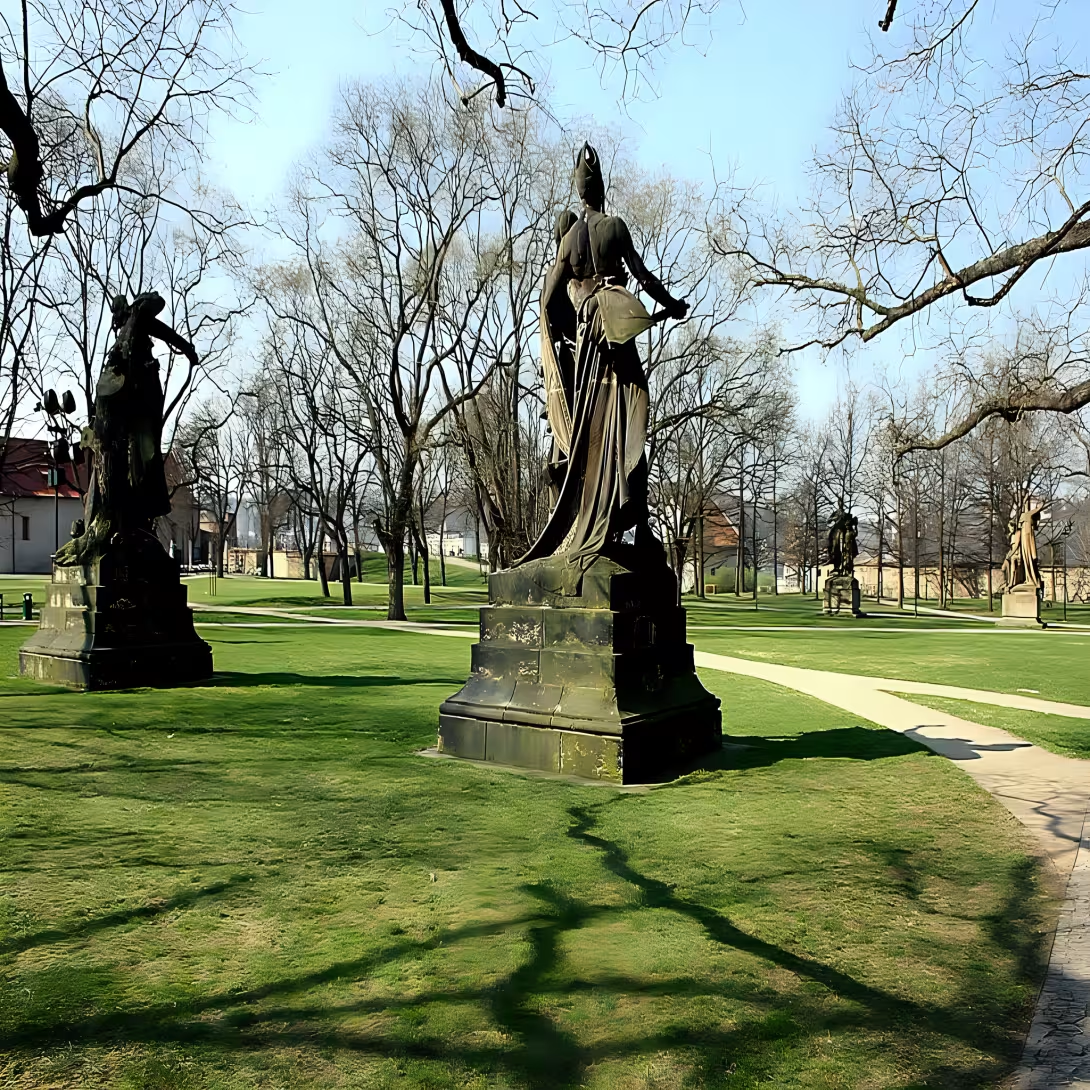
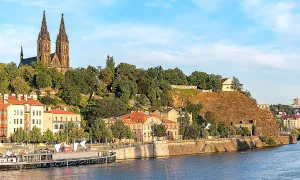
Vyšehradské sady represents the central element of the castle and serves as a public park with an interesting history. While vineyards were here in the 15th century, the park won its own form in the 19th century. The border architecture of the complex are various buildings - the old purcrabism, the old deanery and the basilica of St. Peter and Paul - and especially the walls, of which the beautiful views of Prague, especially the western part, are opened.
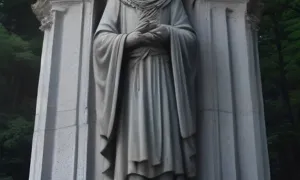
The four great sculptures of Josef Václav Mysbek are the most famous elements of the orchards. Their journey here was unusual. Mysk won the competition to decorate the nearby Palacký Bridge in 1881 and in the following years he worked on the sculpture. From 1887 to 1897 it was gradually mounted on four bridge boxes, located at both ends of the bridge. During the bombing of Prague in 1945 the bridge was badly damaged, so the statues of 1947 were moved to Vyšehrad, where it is still today. The boxes were removed when the bridge was expanded.
Each of these superlife sculptures represents a pair of figures from Czech mythology and historical memory. Libuše and Přemysl (1890) show mythical Czech rulers originally based on Vyšehrad; The princess is captured in the gesture of the oracle. This sculpture was most badly damaged by the bombing and is now visible as a carved copy. Ctirad and Šárka (1895) capture the heroes' rumours of a girl's war, when after the death of Libuše women built Castle Devin against Vyšehrad; Ctirad is displayed with a horn at the moment of a love flare before its death. Lumír and Píseň (1888) draws from the royal manuscript, which is considered to be a forgery from the beginning of the 19th century. Lumír was supposed to be a mythical singer who refused to sing a song to men after the girls' wars and instead sang about the glory of Vyšehrad; his character contrasts with the allegory of the song - a young, naked girl with a varnish. The last sculpture, Záboj and Slavoj (1892), depicts the leader of the uprising of the Czechs against the German troops mentioned in the same old letter.
Vyšehradské sady is not the only park space on Vyšehrad. In the same fortress there are also Karlach sets with Certová's column and Stulka sets with Baroque equestrian statue of St. Wenceslas. Visiting the orchards is appreciated by those looking for a combination of Czech legends, historical atmosphere and city views.
Then and now
Drag the slider to compare how the landmark may have looked when it was built with the view today.
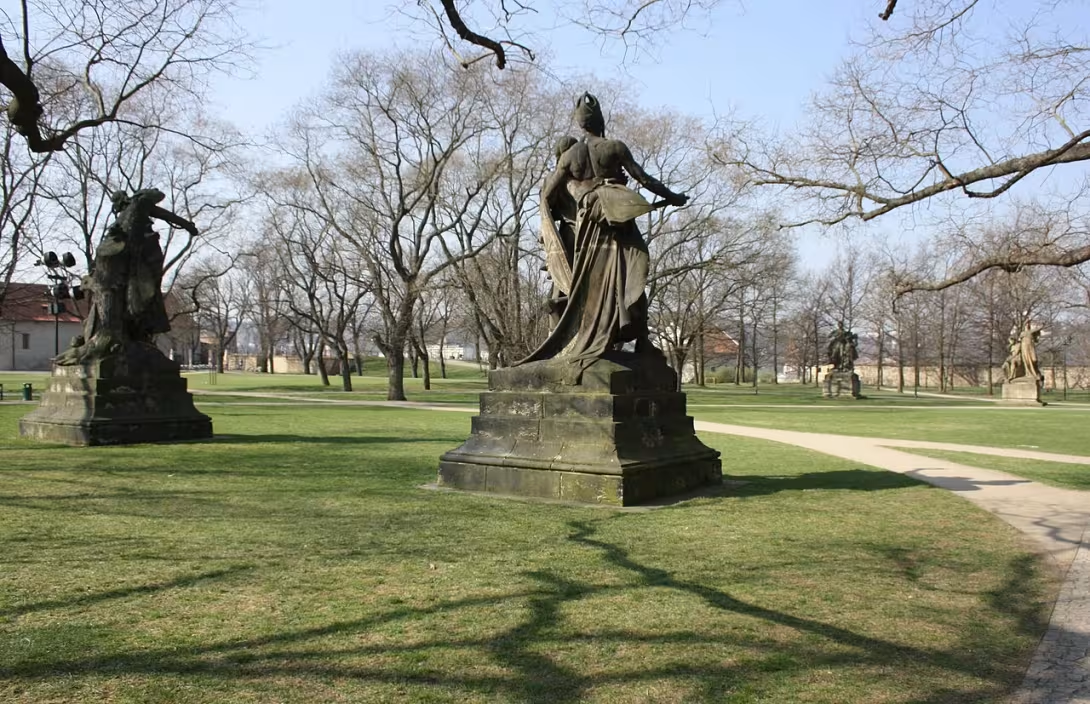

The historical appearance on the left is an AI-generated visualisation and serves as inspiration only.
Historical milestones
- 15th Century
- Setting up vineyards in today's orchard.
- 1881
- Win Josef Václav Mybek in the competition for decoration of the Palacky Bridge.
- 1887-1897
- Gradually planting sculptures on the Palacky Bridge.
- 1945
- Damage to the Palacky Bridge during bombing and subsequent transfer of statues to Vyšehrad orchards.
Architectural development
The park was based on the plans of Josef Mocker in the 19th century when the vineyards were transformed into green areas. The dominance is the statues of Josef Václav Mysbek, which were originally placed on the Palacký bridge and later carried here. The sculpture is made of bronze and stone, with a distinctive historical style consistent with contemporary artistic expression.
Historical events
- 15th Century
- There were vineyards in the park, which were part of the Vysehrad estate.
- 1881
- Josef Václav Myslbek won a competition to decorate the Palacky Bridge by four people.
- 1945
- The Palacký Bridge was damaged during the bombing of Prague, which led to the transfer of statues to Vyšehrad orchards.
Points of interest
- The statue of Josef Václav Mysbek was originally used as a decoration for the bridge selection on the Palacky Bridge before it was transferred to Vyšehrad after its damage during the bombing.
- The most damaged sculpture Libuše and Přemysl is today seen as a carved copy because the original statue suffered during the bombing.
- The figure Ctirad and Šárka depicts the moment of love flare Ctirad before his death, as described in the legend of a girl's war.
- The figure Lumír and Píseň is drawn from the Manuscript of the Royal Court, which is described in the text as false.
- Vyšehradské sady are part of the Fortress of Vysehrad and originally there were vineyards that turned into a park in the 19th century.
Guide
This guide is narrated by a synthetic voice generated by artificial intelligence.
Show guide text
This text was created by artificial intelligence and has not been editorially reviewed. It may contain inaccuracies.
Vyšehrad Gardens is a public park in the southern part of Prague's Vyšehrad. In the 15th century, there were vineyards here, but the place acquired its present appearance only in the 19th century. The park is bounded by buildings, including the old burgrave's office, the old deanery, and the Basilica of Saints Peter and Paul. However, the largest part of the park is lined by fortification walls, from which there is a view over Prague, especially its western part.
The Vyšehrad fortress also has two other gardens: Karlachovy Gardens with the Devil's Column and Štulcovy Gardens with a Baroque equestrian statue of Saint Wenceslas.
In Vyšehrad Gardens there are several sculptures, mostly depicting personalities from Czech history. Among them are four sculptural groups by Josef Václav Myslbek, which originally adorned Palackého Bridge not far below Vyšehrad. Myslbek won the competition for the bridge's decoration in 1881 and then worked on the sculptural groups for several more years. Between 1887 and 1897, they were gradually installed on four booths, in which tolls were collected at both ends of the bridge. During the bombing of Prague in 1945, the bridge was severely damaged. Therefore, in 1947 the sculptures were moved to Vyšehrad and the booths were removed during the bridge's expansion.
Each sculptural group is larger than life-size and depicts a pair of figures from the legendary Czech ancient past. Two of them are based on classical Czech legends, and two are based on compositions from the Rukopis královédvorský, which is considered to be a forgery from the beginning of the 19th century.
The sculptural group of Libuše and Přemysl from 1890 depicts the legendary rulers who resided on Vyšehrad. The princess in a prophetic gesture recalls the conclusion of Smetana's opera Libuše. This sculptural group suffered the most damage in the air raid, and therefore today a hewn copy stands in its place.
Ctirad and Šárka from 1895 are heroes of the legend about the maiden war. According to it, after Libuše's death, women built the fortress Děvín, which lies opposite Vyšehrad. Ctirad with his horn is captured in a moment of passionate love before his death.
The sculptural group of Lumír and Píseň from 1888 is based on the poem about Záboj from the Rukopis královédvorský. In it, Lumír appears as a legendary singer who, after the end of the maiden wars, refused to sing a celebratory song to the victorious men and instead sang about the glorious Vyšehrad. Beside him stands an allegory of song, a young naked girl with a varyta, a stringed instrument.
The last sculptural group, Záboj and Slavoj from 1892, depicts leaders of a rebellion of Czechs against the German troops of Luděk, as told in another poem of the Rukopis královédvorský.
Frequently asked questions
Can the monument be visited?
Parks and gardens are often open to the public, but some have opening hours or are part of a closed site. We have not verified the entry conditions.
What are the opening hours and admission?
We have not verified the opening hours or admission. Current information is published by the operator.
Where is the monument?
Location: Vyšehrad, Hlavní město Praha. The map on this page shows the exact spot.
For kids
Imagine going back to the past in the Middle Ages. How would you feel? It would be a great adventure! And this is what life in Prague looked like centuries ago. But today I'm going to tell you a story about one of the most beautiful places in our metropolis - Vyšehrad orchards.
What you see today is just a small piece of what was once here. The castle Vyšehrad stood in this place already in 870 and was protected from enemies as a fortress. Who lived here? Nobility, priests, soldiers... They all took care of the castle and its defenses.
Businesses nearby
Do you run a restaurant, accommodation, shop, museum, rental, wellness or other visitor service near this monument? Show yourself directly to the people heading to it — this is how they will see you in the app and on the web:
Events nearby


Zdroj akcí: otevřená data měst a obcí ČR (Národní katalog otevřených dat) a kalendář akcí Národního památkového ústavu.
Accommodation nearby
Trips and activities nearby
Guided tours, tickets and activities nearby from GetYourGuide
Affiliate link: if you buy from the partner, we may receive a commission. The price for you does not change.
Search tours and activities →Themed route
1.Vyšehradské sady * Park with historical core and picturesque views of Vltava. * It's a quiet place with rich vegetation, where nature and monuments mix. Ideal for walking, picnics or relaxing on benches near water surfaces.
2. St. Peter and Paul's Basilica * Roman Basilica from the 12th century, one of the oldest sacral buildings in Prague. * The inner frescoes and calm atmosphere attract thought. It is part of the Vyšehrad orchards, so the visit is a natural continuation.
3. Vyšehrad Castle * A strategic fortress from the 10th century with a rich history. * Its remains and views of the city offer a view of the past. It is located only about 300 metres from Vyšehrad orchards, so it is easily accessible.
4. Charles sets * 19th century English park inside the castle complex. * Offers romantic trails, gazebo and quiet corners. It is part of the Vyšehrad fortress and perfectly complements the walk through the historical centre.
* (The route leads logically from the park through the basilica to the castle and its gardens without leaving the designated locations.) *
Seasonal recommendations
Spring Vyšehradské sady offers a unique atmosphere of awakening nature in spring months, when the park turns into a mosaic of pastel shades. Blossoming trees, especially magnolia and Japanese sakurs, create colorful clouds over the sun's path, while morning fog above the Vltava gives the place mysterious poetry. A soft light is also specific, which in the morning softens the contours of historical monuments and statues. It is practically best to visit the park early in the morning or in the afternoon when you avoid the main flows of tourists heading towards the Vyšehrad cemetery. Comfortable shoes and light layers of clothing are recommended - the weather can change rapidly between sunny and rainy moments. The ideal time for a tour is April and May, when nature reaches its peak, but there is still no summer heat.
Summer In summer, Vyšehradské sady will turn into a popular place of rest for Prague and visitors, where green areas and shady alleys offer an escape from the city's heat. The specific element is evening lighting, which in the summer months creates a calm atmosphere for romantic walks or seating at Vltava. The park is alive this season but also often overcrowded, especially in the main summer time from June to August. It is recommended to arrive early in the morning to avoid crowds, and to equip yourself with water, sunglasses and light coats for possible showers. The best time to visit is in the afternoon when the sun is not too hot and the park offers pleasant shading.
Autumn Autumn Vyšehradské sady enchantments golden and red colours of deciduous leaves that create natural carpets on the roads and meadows. The colder air and quieter atmosphere bring a sense of escape from the summer rush, while the morning dew on the grass and the foggy features of historical monuments give the place a nostalgic touch. The changing light is also specific, which in September and October creates dramatic shadows and coloring. This season, the park is much calmer, but it is recommended to have warmer clothes, especially in November, when evenings can be cold. The best time to visit is in the afternoon when the sun still shines enough, but the crowds are minimal. In Advent time the park becomes even more picturesque thanks to the lighting windows of the Vyšehrad Church and Christmas decorations.
Winter Winter Vyšehradské sady offers a unique atmosphere of peace and quiet, when the snow cover turns the park into a fabulous landscape. Freezing air and silent trees create contrast with historical monuments that look like from another century. A short daylight is also specific, which shortens the possibilities of the tour in December and January, but also gives the place a magical touch, especially at sunset. In winter the park is almost deserted, but it is recommended to warm, layered clothes and comfortable shoes to avoid slipping on frozen roads. The best time to visit is the afternoon when the light is still sufficient and should avoid late nights when the park can be almost invisible.
Visualizations and artistic views


The visualisations are generated by artificial intelligence and serve as inspiration.
Photos from the area
Real photos taken near the monument

Zdroj a licence jsou uvedeny u každého snímku.
View from the area
This animation was generated by artificial intelligence from a real photograph of the surroundings. The motion and details are not real footage of the location.
Atmosphere of the place
This atmospheric visualisation of the place and period was generated by artificial intelligence. It is not real footage of the location.
Tips from visitors
No tips yet. Be the first!
Log in and add your tip.
Sources and literature
Photos: Андрей Бобровский / CC BY 3.0, rozlišení zvýšeno umělou inteligencí — Wikimedia Commons. The author and licence also appear when you hover over the image.
Faktickým podkladem tohoto textu byl článek na Wikipedii, jehož autory jsou přispěvatelé Wikipedie. Článek je dostupný pod licencí CC BY-SA 4.0.
Location on the map
Příběhy a pověsti
Legendy, pověsti a příběhy spjaté s touto památkou
Fotografie návštěvníků
Zatím žádné fotografie. Buďte první, kdo přidá fotografii z návštěvy!
Log in a přidejte svou fotografii nebo hodnoťte.
Za ověřenou návštěvu v aplikaci získáte víc bodů — poznáme podle GPS, že jste na místě.
Reviews and comments