



Wiehlův dům (Praha) House
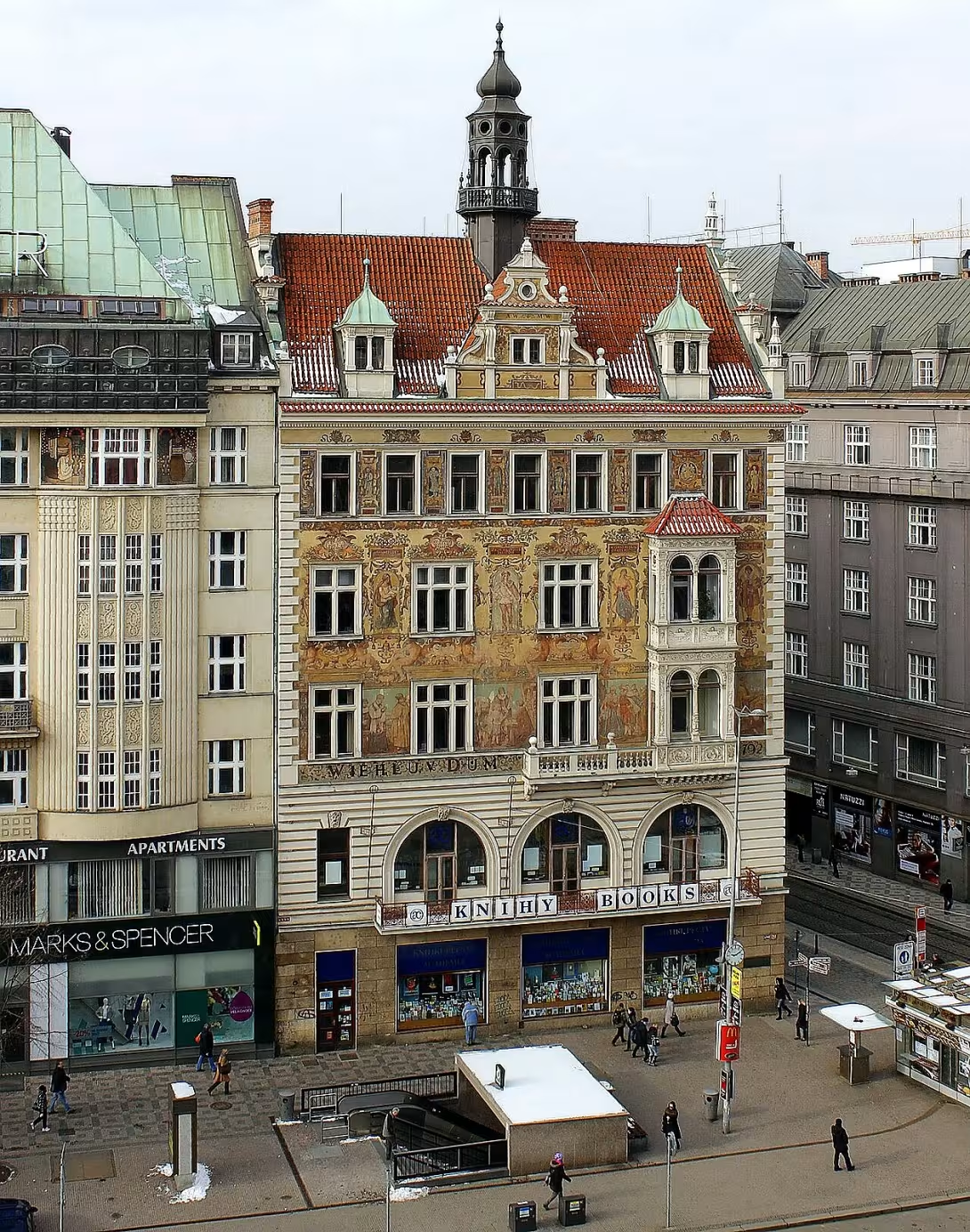
Wiehl's house is a Neo-Renaissance building located on the corner of Wenceslas Square and Vodičkova Street in Prague 1. The project was designed by an important architect Antonín Wiehl who built it in 1894-1896. The object is remarkable with rich painting decoration and using the concept of so-called talking architecture.
The house was built on a property that Wiehl purchased in 1894, and on it he had the original building demolished. The building was completed in 1896 and served the architect for housing and work. In the interior he kept extensive art collections, library and antiques. In the last years of his life he spent here sorting his collections and working on the documents for the Commission for the inventory of building, art and historical monuments of the royal capital of Prague.
It is a corner four-story house with 4 × 11 window axis spacing. The roof is saddled, decorated with shields, windscreens and a lid with a gallery on the ridge. The front of Vodičkov Street is equipped with a portal. The facade combines plaster, stucco and sandstone; in the outer axis of the second and fourth floors there is a bay connected to the balcony. The original layout included business premises on the ground floor, coffee shop on the first floor and other floors of apartments and offices.
The painting decoration of the facade is unique in Prague from the end of the 19th century with its scope. Whose theme and composition Wiehl himself designed. The ornamental part was realized by Josef Fanta and figure Mikolas Ales; The paintings themselves were performed by Láda Novák and A. Hofbauer with the assistance of František Urban and Wilhelm Trsek. The decoration uses motifs of the Czech Renaissance, including ornaments, cartouche, masks, herms, floral decoration, fruit festons and ribbons in Czech national colours. The upper parts show nude figures in the michelangelic postures and children with musical instruments.
In the decoration, Wiehl used a collection of short stories which he perceived as a bearer of humor, wisdom and morality. On the facade to Wenceslas Square, the allegory of virtue is displayed on the last floor, while in the shield on Vodickov Street we find amors, symbols of Day and Night and under the crown ledge masks War and Peace.
The central motive is two cycles from the life of a townsman, depicted as a buyer, scholar and defender of his city. The whole cycle is accompanied by the motto Life - pilgrimage to God. On the facade of Wenceslas Square are shown from left to right: a judge with a child over the scene of baptism, a student with a teacher, a half-naked girl with an apple over the picture of the fiancé and a townsman over the trader with accounts. The facade to Vodičkov Street is decorated by a knight above the scene of knighthood and an old man in a family circle with the character of Morana. The paintings are accompanied by folk sayings, such as the Tree, as it grows and stands or there is no root against the Sea.
Antonín Wiehl died in the house and was referred in his will by the Czech Academy of Sciences and Arts. Since then the house belongs to this institution and its legal successors, the current Academy of Sciences of the Czech Republic. The building was declared a cultural monument on 3 May 1958 and is registered in the Central List of Cultural Monuments of the Czech Republic.
During the May uprising in 1945, the house was damaged by the German bombing of Wenceslas Square, which required repairs in the 1950s. The ground floor was modified during the construction of the underpass in Wenceslas Square in 1967- 1968. This created an arch in Vodickova Street and the house connected with the metro station Mostek. The original rustic ground floor replaced the tiles of polished stone. In 2016 there was extensive repair of facade, roof and interior.
Today, the house houses the Academia publishing house, which runs a representative bookstore of specialized literature on the ground floor and the first floor. The building is an important tourist destination, there is an information board on its front at Wenceslas Square.
Wiehl's house is one of the most exemplary examples of neo-Renaissance in Prague and represents a unique combination of architecture and painting. It's where the history of urban life meets the artistic visionaries of Antonín Wiehl. Visitors are advised to carefully study the details of the facade and its talking symbolism.
Then and now
Drag the slider to compare how the landmark may have looked when it was built with the view today.
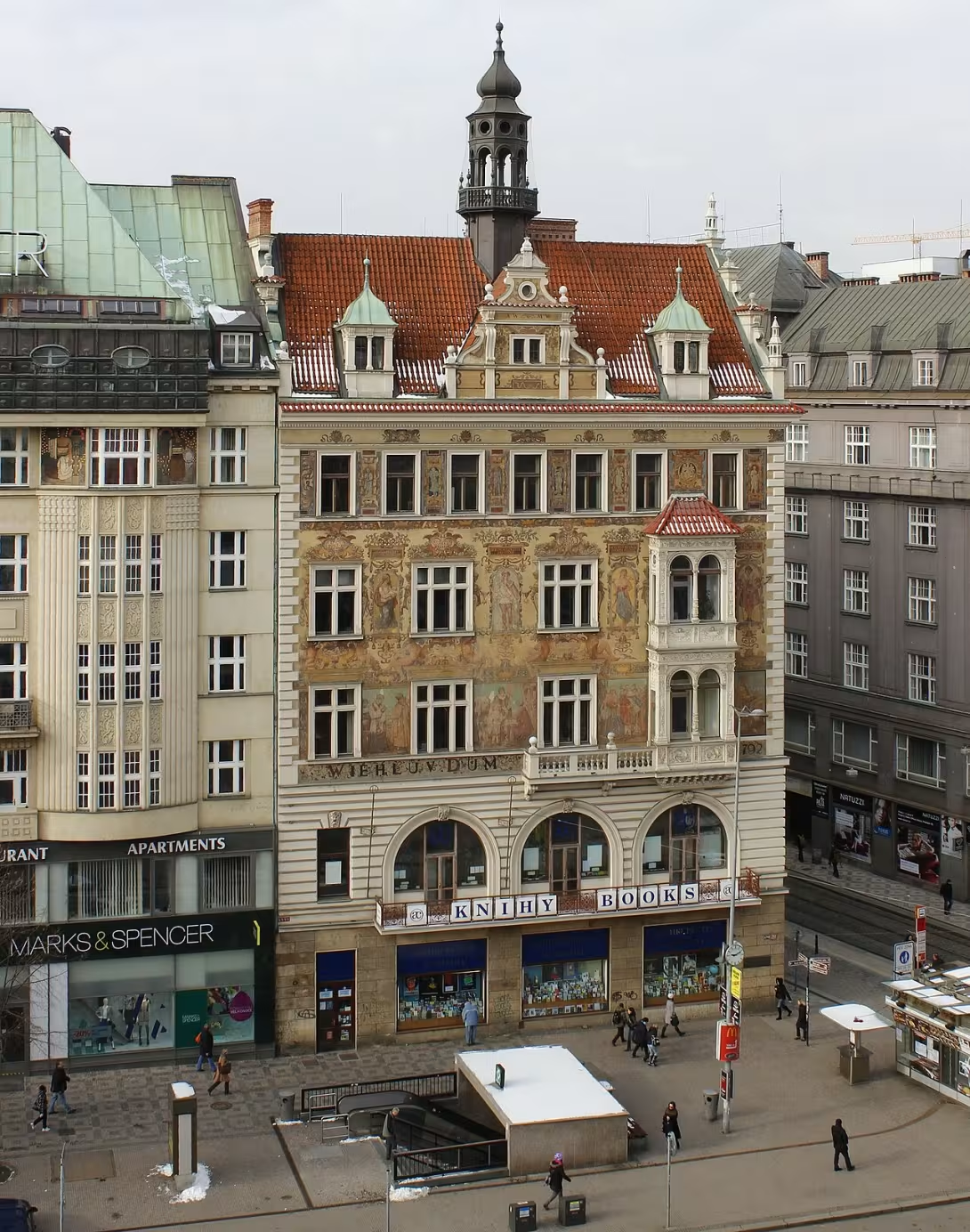

The historical appearance on the left is an AI-generated visualisation and serves as inspiration only.
Historical milestones
- 1896
- The construction of Wiehl's house.
Architectural development
Wiehl's house was built on the property after demolition of the original building. Architect Antonín Wiehl designed a neo-Renaissance building with rich painting decoration, which includes short stories and allegory.
Historical events
- 1894-96
- The position of Wiehl's house according to the Antonín Wiehl project.
- after Wiehl's death
- House dedicated to the Czech Academy of Sciences and Arts.
Owners
- 1894
- after Wiehl's death
Points of interest
- Wiehl's house is a Neo-Renaissance building designed by architect Antonín Wiehl. - The building has a rich painting decoration and uses the concept of talking architecture. - The painting decoration of the facade is unique in its scope, with motifs of the Czech Renaissance and tall tales. - The decoration was designed by Wiehl himself, which was realized by Josef Fanta, Mikolas Ales, Láda Novák and A. Hofbauer. - The house was bequeathed to the Czech Academy of Sciences and Arts after the death of Wiehl and is declared a cultural monument.
Guide
Show guide text
This text was created by artificial intelligence and has not been editorially reviewed. It may contain inaccuracies.
Welcome to Wenceslas Square in the heart of Prague, where it stands before one of the most famous architectural works of the city - Wiehl House. This Neo-Renaissance shield is proud to turn off on the corner with the Vodice Street, drawing attention to its four floors and rich painting decoration. As you've probably already noticed, it's a place full of history and art.
The house was completed in 1896 according to the design of Antonín Wiehl, one of the most important architects of his time. Wiehl's house is the result of an attempt to restore and reinterpret the Renaissance style with a modern approach, which was common in the 19th century when more and more people turned to the cultural heritage of the past.
Look up and notice the details on the facade. Wiehl's house is known for its rich painting decoration that revives walls. This decoration is not only decorative - it uses the concept of talking architecture, which means that each element has its meaning and story. The motives of the Czech Renaissance, together with the talkers, give the building a personality and character.
Now pay attention to some of the specific details you see before you. Wiehl's house is unique in its extensive painting decoration, which is really rare in Wenceslas Square. This decoration was not only an artwork, but also a personal manifestation of Wiehl himself, who designed and implemented it.
As we look at the history of this place, we find no specific stories or personalities here, but its significance is evident. Wiehl's house was built in the peak period of Czech modernism and still reflects the dynamics and ambitions of that time.
The interesting thing about this place is that although Wiehl's house is not as well known as some other sights in Prague, it is worth its uniqueness and architectural ambition. It is a reminder of the time when Czech artists and architects tried to combine tradition with a sense of innovation.
Now, what do you notice next? Think about how the house was designed to be harmonically related to the surrounding buildings, and yet differ from some by its richness. It's like a musical solo in a symphony that stands for attention.
Thank you for the tour of Wiehl's house. I hope you enjoyed this visit and are thinking about the historical and artistic importance of this place. If you are interested in further exploring Prague, do not forget to visit other cultural monuments that await discovery. When we meet again, perhaps in another corner of this beautiful city.
Tips for visitors
For the best experience we recommend a visit in the morning or late afternoon, when natural light best highlights the facade details. We recommend taking a photo machine and comfortable shoes to walk around. During the photo shoot, focus on the corner of the building at Vodičkov Street and the rich painting decoration that is dominant here. Within a short walk within 30 minutes visit Wenceslas Square and St. Wenceslas Church. Families with children are recommended to observe the architectural details on the facade together, which may be an interesting game to find various decorative elements.
Frequently asked questions
Can the monument be visited?
This is a residential or farm building, not a museum with opening hours. Please view it from public space and respect the owners' privacy. We have no information about access to the interior.
Where is the monument?
Location: Praha 1, Hlavní město Praha. The map on this page shows the exact spot.
Why is the monument protected?
It is listed in the Central List of Cultural Monuments of the Czech Republic as a cultural monument (register no. 1000152013).
Businesses nearby
Do you run a restaurant, accommodation, shop, museum, rental, wellness or other visitor service near this monument? Show yourself directly to the people heading to it — this is how they will see you in the app and on the web:
Events nearby
Zdroj akcí: otevřená data měst a obcí ČR (Národní katalog otevřených dat) a kalendář akcí Národního památkového ústavu.
Nearby
V okolí se nachází Václavské náměstí, jedno z nejznámějších míst v Praze.
Další historické památky v blízkosti zahrnují kostel sv. Václava a další budovy s bohatou architektonickou historií.
Accommodation nearby
Trips and activities nearby
Guided tours, tickets and activities nearby from GetYourGuide
Affiliate link: if you buy from the partner, we may receive a commission. The price for you does not change.
Search tours and activities →Seasonal recommendations
In the spring, the surroundings of the house are awakening to life and the city is coloring into the world. The light is delicate and golden at this time, which beautifully highlights all the features of the historical facade. It is advisable to wear a light jacket because the wounds may still be cold. The best time for a tour is in the morning when the coast is clear and tourists are still not moving on the streets.
During the summer months it is very hot in the centre of Prague and the sun is the strongest. The mood is busy and the streets are full of people enjoying the summer air. I suggest you come as soon as possible in the morning to avoid the biggest crowds and heat. Clothes should be light and breathable, and don't forget the drinking regime, because the concrete streets of Prague are rapidly draining heat.
Autumn brings a quieter mood to the neighborhood and leaf colors give the neighborhood a wonderful look. The morning mist can create a mysterious and nostalgic feeling around the house. You need to prepare for cooler wind days, so bring your coat or scarf. It is ideal to visit the memory in the afternoon when light turns into softer shades.
In winter time it is often gray in the city centre and the days are very short. If the snow comes, the house looks very charming and clean. Because of low temperatures, you have to wear layers and wear a warm jacket and a hat. In Advent time there are more people around, but overall there are fewer visitors in this period than in summer, which allows for more peaceful observation of architecture.
Visualizations and artistic views


The visualisations are generated by artificial intelligence and serve as inspiration.
Photos from the area
Real photos taken near the monument

Zdroj a licence jsou uvedeny u každého snímku.
Tips from visitors
No tips yet. Be the first!
Log in and add your tip.
Sources and literature
Photos: Gampe / CC BY-SA 3.0 — Wikimedia Commons. The author and licence also appear when you hover over the image.
Faktickým podkladem tohoto textu byl článek na Wikipedii, jehož autory jsou přispěvatelé Wikipedie. Článek je dostupný pod licencí CC BY-SA 4.0.
Location on the map
More monuments – Praha 1
Show all in the municipality

Příběhy a pověsti
Legendy, pověsti a příběhy spjaté s touto památkou
Fotografie návštěvníků
Zatím žádné fotografie. Buďte první, kdo přidá fotografii z návštěvy!
Log in a přidejte svou fotografii nebo hodnoťte.
Za ověřenou návštěvu v aplikaci získáte víc bodů — poznáme podle GPS, že jste na místě.
Reviews and comments