






Zahrádka (zámek) Chateau
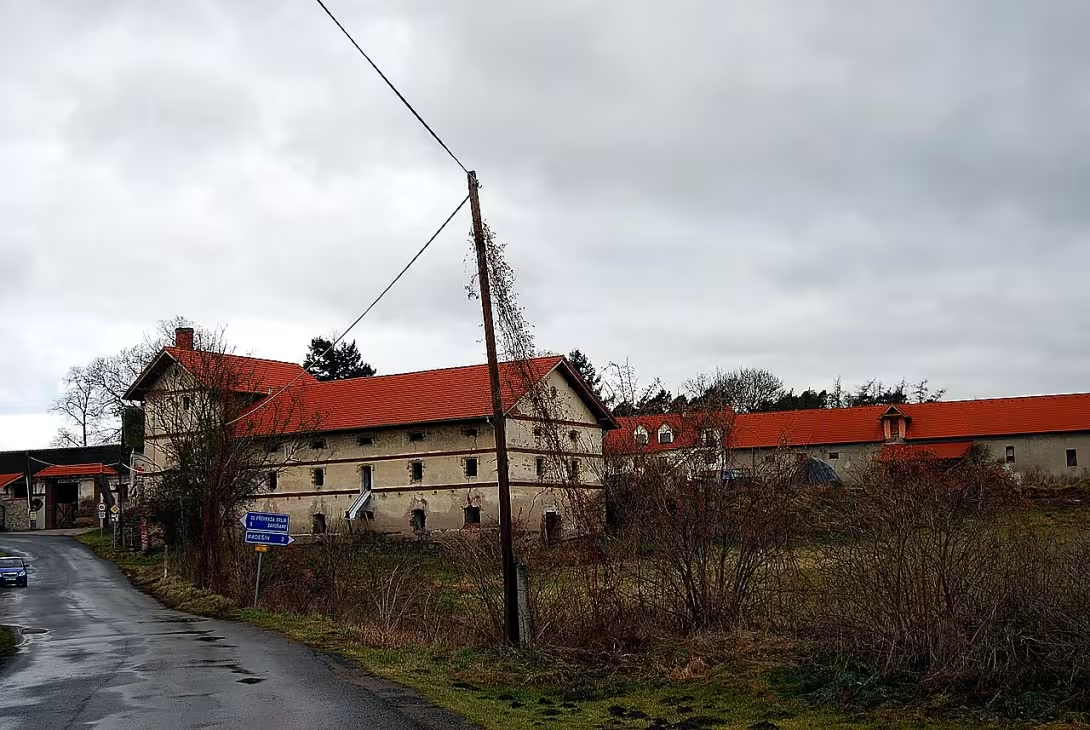
Zahrádka is a extinct Baroque chateau located in a village of the same name near Petrovic in Příbram district, Central Bohemia region. Originally it was a Renaissance fortress which Jan Erazim Cukr z Tamfeldu converted into a representative mansion in the mid-eighteenth century. Only a devastated park remains from the building today.
The oldest history of the place is little known, the first written mention of the fort dates back to 1365, when the brothers Vojslav and Diviš ze Zahrádky lived there. When lower nobility was established in the Czech Republic, the owners often had different holders. In 1497 it was purchased by Jan of Orlov and Jan Hruška of Strkov. After the death of John the wife of Markéta of Pelhrimov in 1512, the estate was divided between the brothers Karlík of Nežetky and Kateřina of Pelhrimov, which after 1524 gained the second half. In 1538 Václav Halash from Radimovic sold Zahradec to Adam from Zahradec. His successor was Jilji Zahradecký from Wolf Mountain, whose descendants held the farm until 1609.
The building design of the chateau was based on the original Renaissance wall of the fortress, which was incorporated into the Baroque building. It was a one-story building with two rectangular wings and a mansard roof. The main facade had four window axes where segmental and angular frontons, so-called edicules, were alternated. The facades were broken down by the lizen frames and a small lid was coming out of the roof. The north wing was probably among the older parts.
In the middle of the eighteenth century Jan Erazim Cukr z Tamfeldu rebuilt the fortress into a Baroque chateau, which corresponded to the modernization trend at that time. After his death, the chateau was inherited by the widow Margaret, born Malovcova. Other owners were Jan František Linker in 1787 and since 1841 Vojtěch Mladota from Solopisk. In the second half of the twentieth century the chateau served the needs of the state farm, but it gradually faded because of the failure to maintain it.
In 2007, the whole building collapsed. Only the former park's torso at the west and north side of the former economic court remained from the original conservation area. This ruin represents a trace of the diseased Baroque residence. Visit this place and explore the remains of history around the village Petrovice.
Historical milestones
- 1365
- First written mention of the chateau in Zahradec.
- 1497
- I'll buy a farm with Jan from Orlov and Jan from Strkov.
- 1538
- Sale of Zahrádek to Adam Zahrádeski from Zahrádka.
- 2007
- The collapse of the chateau building.
Architectural development
Originally a Renaissance fortress whose masonry was later incorporated into the Baroque chateau. The chateau was single-storey with two rectangles of wings, a mansard roof and a small lid. The facades were broken down by lizene frames and the main facade was carried by segmental and angular frontons.
Historical events
1365: First written mention of the fort; 18th century: rebuilding the fortress into a Baroque chateau; 2007: The collapse of the chateau building.
Owners
Vojlav and Diviš ze Zahrádky (1365), Jan z Orlov and Jan Hruška z Strkov (1497), Kateřina z Pelhrimov (after 1524), Adam Zahradecký z Zahrádka (1538), Jilji Zahradecký z Vlíká Hora (up to 1609), Jan Erazim Cukr z Tamfeldu (half of the 18th century), Jan František Linker (1787), Vojtěty Mladota z Solopisk (1841), state farm (2nd half of the 20th century).
Points of interest
- The chateau is a decayed Baroque chateau located in the same village near Petrovic. - Originally, it was a Renaissance fortress which Jan Erazim Cukr z Tamfeldu converted into a representative mansion in the mid-eighteenth century. - The oldest written mention of the fort dates back to 1365, when the Vojlav brothers and Diviš ze Zahrádky lived there. - In 1538 Zahrádka sold Václav Halash from Radimovic Adam Zahradec from Zahrádka. - The building design of the chateau was based on the original Renaissance wall of the fortress, which was incorporated into the Baroque building.
Guide
Show guide text
This text was created by artificial intelligence and has not been editorially reviewed. It may contain inaccuracies.
Welcome to Petrovice, a place where history meets silence and oblivion. You stand before what once was a proud residence, today a sad reminder of the past we know as Zahrádek. Now, if you look around you, you may experience some contrast between the calm of the surrounding landscape and the emptiness of this particular place. In front of you, there are no strong towers or decorated gates, but the remains of a building that has been the center of local life and power for centuries. Feel the atmosphere of this place and try to imagine that the walls that are missing today have stood here and told stories about generations of people who lived here, worked and dreamed.
To understand what we have lost in this place, we must return very far in our minds to the past until this landscape was completely different. The first written mention of this place dates back to 1365. At that time there was no representative chateau, but a Renaissance fortress. The fortress was at that time an essential element of defense and management of the countryside, serving as a safe port and symbol of the power of the local nobleman. In these early times, there were brothers who, at this strategic point at Petrovic, established the foundations of the future residence. So imagine a place where you see a ruin today, like a fortified space with high walls to protect its people from the enemy while controlling the surrounding property.
The history of Zahrádky is like a book whose pages were printed by different families and personalities. In 1497 the owner changed when Jan of Orlov and Jan Hruška of Strkov bought the farm. It was a period of great changes in architecture and society, when the medieval world slowly began to turn into a modern world. A little later, in 1538, Zahrádek got into the hands of Adam Zahradecký from Zahrádka, who probably got his whole place today's name. In these times, the fortress was still dominated by the village, a place where the fate of the surrounding fields and the people were decided.
Let us now move forward in time, to the second half of the eighteenth century, when the most important transformation of this place took place. It is at this time that the fort has turned into what many of us now imagine as a chateau. Jan Erazim Cukr z Tamfeldu decided that the old fortified fortress no longer meets the requirements of the time. He wanted a representative residence that would radiate elegance, wealth and taste of the baroque era. So he converted the building into a one-story lock.
Now, if you look at the space in front of you, try to reconstruct the shape of it from that time. The chateau had two wings that encapsulated space and created a harmonious whole. The most significant element was the Mansard roof, which at that time was a symbol of modern architecture and gave the building a noble look. Imagine the tall windows that had the light in the spacious halls and the one-story layout that allowed easy movement between the rooms. Everything was designed to impress guests and give the owner maximum comfort.
Other personalities like Vojslav ze Zahrádky or Diviš ze Zahrádky are associated with this place, who have left their mark in the history of the farm at different times. Each of them added a chapter to the history of Zahrada, whether it was an economic boom, a family feud or a local community building. The chateau was not just a home, it was the center of administration, culture and social intercourse in the district of Příbram.
But now comes the sadder part of the story, which explains why you are not standing in front of a beautiful Baroque building today, but in front of its remains. Time and human inattention are sometimes more cruel than any enemy. In modern times, the chateau lost its original position of noble residence. The building was used for the needs of the state farm, which meant that it was still in operation, but its aesthetic and historical value was completely neglected. The chateau stopped being a home and became only a practical space for agricultural needs.
Gradually, neglect began to occur. The roof, which once so proudly decorated the sky, began to shed water, the plaster fell off, and the masonry, which lasted centuries, began to subdue moisture and not care. The chateau gradually faded until the representative mansion became a shadow of itself. The highlight of this tragedy was 2007. It was this year that the whole building collapsed. What was left of the baroque dream of Jan Erazim Cukra of Tamfeld was finally subject to the laws of gravity and decay.
There's a deep paradox and a mystery. How could a building that survived for hundreds of years, from a Renaissance fortress to a Baroque chateau to a modern farmhouse, collapse so suddenly at one time? Maybe it's a warning story about what happens if we forget our history and stop caring for the sights that tell us who we were. The garden is no longer a building that can be admired for its details, but it is a monument in a different sense. It is a monument to the permeability of everything material.
Notice now the silence surrounding this place. It's a silence that makes us think. You're standing in a place where there was once a laugh of the guests at the baroque balls, where future generations were planned in the Renaissance chambers, and later the voices of the workers of the state farm. All these layers of time are now compressed into one space that no longer has walls.
Now, if you continue to explore the area, I suggest you slowly go around this place. Feel where one wing probably ended and the other started. Try to imagine what the Mansard roof looked like when the first morning rays of the sun hit it. Even if you see only a ruin, the history of Zahrádka still lives in archives, maps and the memory of local residents.
Thank you for joining me on this short journey in time. I hope this view of Zahrádek helped you see more than just a pile of rocks and rubble. It's a place that teaches us humility before time and reminds us that every building has a soul that we need to protect as long as possible. Now invited to further explore the area of Petrovic and discover other hidden corners of this beautiful landscape. Goodbye and wish you a pleasant rest of the day.
Tips for visitors
The most suitable period for visiting is spring months or autumn, when the surrounding landscape is the most colorful and weather for walking. For best experiences we recommend a visit in the morning when the light for shooting is the cleanest. Transportation to the place is possible by combination of car and public transport; Please check the current connection within normal traffic search engines. Parking in the vicinity of the villages is usually available, but we recommend looking for reserved places to prevent traffic. When visiting the ruins, prepare for uneven terrain, so wear firm and comfortable shoes. Don't forget to bring enough drinking water and possibly even small refreshments, because the site itself may not have service. For lovers of photography are the best positions overlooking the ruins in the background landscape, especially during the golden watch before sunset. The contrast between historical walls and nature offers excellent ideas. In the surroundings you can explore the village Petrovice and surrounding landscape of the Central Bohemian Region, which offers ideal conditions for tourist and natural trips. For families with children, moving in this open landscape is a great way to enjoy an adventure in nature between historical clues.
Businesses nearby
Do you run a restaurant, accommodation, shop, museum, rental, wellness or other visitor service near this monument? Show yourself directly to the people heading to it — this is how they will see you in the app and on the web:
Events nearby
Zdroj akcí: otevřená data měst a obcí ČR (Národní katalog otevřených dat) a kalendář akcí Národního památkového ústavu.
Nearby
The village Petrovice and the surrounding landscape of the Central Bohemian Region.
Accommodation nearby
Themed route
Thematic cruise route of castle Petrovice
1. Garden (ruin) * Type: * Historical landmark Famous with its beauty and history, this ruins of the chateau attracts visitors seeking peace and view of the landscape formations of the Central Bohemia Region. It is an ideal place to understand the history of the region and explore the remains of architecture.
2. Petrovic Forest * Type: * Forest area Located near the chateau, Petrovický forest offers beautiful pavement for walks and circling along its travels. It is a perfect place for relaxation in the society of nature and listening to murmuring leaves.
3. Chapel by the chateau * Type: * Religious monument This picturesque chapel is located near the ruins and served as a place of prayer for residents and visitors. It is a quiet place where you can relax for a while and enjoy the view of the surrounding countryside.
4. Petrovic pond * Type: * Pond The best way to enjoy a quiet moment in Petrovice is to explore Petrovický pond. Its mild water surfaces are ideal for relaxing and observing local fauna.
5. Petrovic Municipality * Type: * Urban area Explore Petrovice where you can enjoy quiet moments in the center of the village. It is a place full of history and traditions that are reflected in the architecture of houses and public buildings.
This route offers visitors the opportunity to explore not only the Petrovice chateau, but also its surrounding natural and cultural attractions.
Seasonal recommendations
In spring, the ruin comes alive thanks to lush green and blooming vegetation, which slowly covers old stones. The atmosphere is full of hope and fine spring light. We recommend moisture-resistant shoes because the terrain can be muddy after melting snow. An ideal visit in the morning is when the air is the cleanest.
The summer season offers thick shade of foliage and rich colors of surrounding nature, which create a strong contrast with the grey stone broken down walls. The air is hot and the room is filled with the sound of insects. For the season and the biggest crowds, come first thing in the morning. Remember light clothes, hat and plenty of fluids.
Autumn brings melancholy mood, morning fog and golden shades of leaves that surround the ruin. The lighting is soft and rich, which gives the place a mysterious touch. Suitable are layered clothes and solid shoes for walking on wet leaves. The best time to visit is the late afternoon before sunset.
In winter, the monument works in a dense and quiet way, especially if it is covered by a layer of snow. The contours of the broken walls are sharp and clean in the freezing air. It is necessary to have warm thermal clothing and waterproof shoes. Count on shorter daylight time and we recommend planning the morning trip.
Visualizations and artistic views

The visualisations are generated by artificial intelligence and serve as inspiration.
Photos from the area
Real photos taken near the monument

Zdroj a licence jsou uvedeny u každého snímku.
Tips from visitors
No tips yet. Be the first!
Log in and add your tip.
Sources and literature
Fotografie: Richenza / CC BY-SA 3.0 — Wikimedia Commons. The author and licence also appear when you hover over the image.
Faktickým podkladem tohoto textu byl článek na Wikipedii, jehož autory jsou přispěvatelé Wikipedie. Článek je dostupný pod licencí CC BY-SA 4.0.
Location on the map
More monuments – Petrovice
Show all in the municipality
Příběhy a pověsti
Legendy, pověsti a příběhy spjaté s touto památkou
Fotografie návštěvníků
Zatím žádné fotografie. Buďte první, kdo přidá fotografii z návštěvy!
Přihlaste se a přidejte svou fotografii nebo hodnoťte.
Za ověřenou návštěvu v aplikaci získáte víc bodů — poznáme podle GPS, že jste na místě.
Reviews and comments